11th House Astrology (Labha Bhava): Gains, Desires & the Power of Allies
Contents
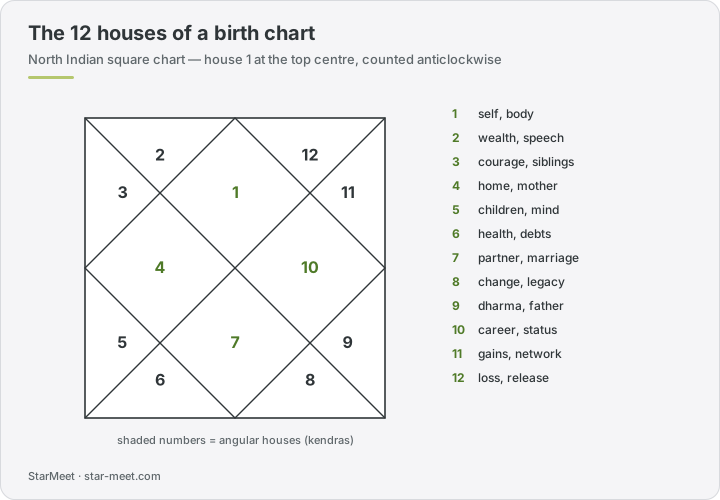
Why do some people attract money and opportunities effortlessly, while others work twice as hard for a fraction of the results? In Eastern Astrology, the answer often lies in the 11th house — Labha Bhava, the house of gains, fulfilled desires, and powerful alliances.
This comprehensive guide covers everything you need to know about 11th house astrology: Sanskrit names and classical significations, the Upachaya mechanism, all 9 planets' effects, the lord of the 11th in each of the 12 houses (from BPHS), Dhana Yogas, divisional charts, and K.N. Rao's triple confirmation method for timing windfall periods. Every analysis is drawn directly from the Brihat Parashara Hora Shastra, the works of K.S. Charak, and the K.N. Rao school of Eastern astrology (also called Vedic astrology, or Jyotish).
Key Takeaways
- Labha Bhava (11th house) = gains, fulfilled desires, and social alliances — three intertwined themes
- It belongs to the Upachaya group (3rd, 6th, 10th, 11th): results improve dramatically with time and competitive effort
- Natural malefics (Saturn, Mars, Rahu, Sun) give the best material results here — they provide unstoppable pursuit energy
- Three income houses serve different functions: 2nd = wealth stored, 10th = work performed, 11th = profits received
- Saturn is the natural karaka (significator) of the 11th house — his transit through the 11th marks golden financial periods
- The lord of the 11th in the 2nd and the lord of the 2nd in the 11th are the most classical Dhana Yoga combinations
- No major financial event manifests without the triple confirmation: natal promise + active Dasha + supportive transit
What Is the 11th House in Eastern Astrology? — Labha Bhava Defined
The 11th house in Eastern Astrology is Labha Bhava — the House of Gains. The Sanskrit word labha literally means profit, advantage, and acquisition. The house is also known as Aya Bhava (aya = income, revenue). Classical texts list additional synonyms: Bhava (manifestation), Aagama (arrival), and Praapti (acquisition of what is sought).
According to the Brihat Parashara Hora Shastra (BPHS) — the foundational classical text — the 11th house signifies:
- Gains and profits of all kinds
- Income, acquisitions, and all manner of earnings
- Fulfillment of desires (icchā/kāma)
- The nature of earning, rewards, and recognition
- Favors from rulers and authorities
- Elder brothers and sisters
- Allies, friends who help achieve goals
- Membership in communities, guilds, and organizations
- The left ear (physical body signification)
BPHS describes the native with a strong 11th house as: "Happy, rich, well-appearing, a leader, widely respected."
The 11th house belongs to the Kama Trikona — the triangle of desire (3rd, 7th, 11th houses). K.N. Rao defines it as the "culmination of desire — getting what was wanted, fulfilled." In the natural zodiac, the 11th sign is Aquarius (Kumbha), ruled by Saturn, carrying the Vayu (Air) element — social networks, broad communities, and collective ambitions. As an odd (masculine) house, it possesses active, outward-reaching energy directed at conquering the material world.
The Three Levels of Income in Eastern Astrology: 2nd, 10th, and 11th House
Eastern Astrology distinguishes three houses of wealth, each playing a distinct role in the financial biography of your life.
| House | Sanskrit Name | What It Represents |
|---|---|---|
| 2nd (Dhana Bhava) | House of Wealth | Accumulated capital, bank balance, stored resources |
| 10th (Karma Bhava) | House of Action | Career, profession, the work you perform |
| 11th (Labha Bhava) | House of Gains | Cash flow, profits received, desires fulfilled |
K.N. Rao explains the distinction precisely: the 10th house is your destiny (action), while the 11th house is the phala (fruit) of that action. A brilliant 10th house brings fame and status; only a strong 11th house converts that effort into cash in hand.
Passive income — rent, dividends, royalties — belongs entirely to the 11th house, because these funds are "received" rather than actively "earned." Salary from employment as a subordinate relates to the 6th house (service). Business income through partnership relates to the 7th house. The 11th house is the universal collector of all profits and returns.
Unexpected or sudden wealth — inheritance, lottery, insurance payouts — belongs to the 8th house (Randhra Bhava), not the 11th. K.S. Charak defines the 8th house as: "legacies, unearned wealth, suddenness." This distinction matters enormously in financial prediction.
Dhana Yogas Involving the 11th House — BPHS Chapter 24
When the lord of the 11th connects with other wealth-related houses, powerful prosperity combinations (Dhana Yogas) form:
| Combination | BPHS Result |
|---|---|
| Lord of 11th in 2nd | "Endowed with all kinds of wealth, generous, religious, and always happy." Profits accumulate as savings. |
| Lord of 2nd in 11th | "Accumulates all kinds of wealth; always diligent and renowned." Gains flow into the wealth base. |
| Lord of 10th in 11th | "Endowed with wealth, happy, virtuous, truthful, and joyful." Career directly monetizes. |
| Lord of 11th in 10th | "Honored by rulers, virtuous, devoted to religion, truthful and wealthy." Status generates profit. |
| Lord of 11th in 11th | "Gains in all endeavors; desires fulfilled; learning and happiness increase daily." |
| Lords 1-2-11 connected | Personal effort generates profit that accumulates permanently — the "money magnet" Yoga |
| Lords 5-9-11 connected | Gains through past-life merit, investments, and divine fortune |
The Bhavat Bhavam principle: The 11th house from the 11th house is the 9th house (Bhagya — Fortune). Long-term capacity to receive gains depends entirely on your dharmic fortune. A powerful 11th with a damaged 9th produces fast money that brings no lasting happiness, disappearing due to the absence of divine protection.
Calculate your birth chart and discover your 11th house →
Upachaya Houses in Eastern Astrology: Why Malefics Excel in the 11th House
The Upachaya houses — 3rd, 6th, 10th, and 11th — are called the houses of growth because their results improve progressively over time with sustained effort.
Unlike Kendra (angular) and Trikona (trine) houses that deliver results from birth-chart promise, Upachaya houses reward struggle, competitive drive, and persistence. They represent the domains where time works in your favor.
| Upachaya House | Core Theme | Growth Mechanism |
|---|---|---|
| 3rd (Sahaja Bhava) | Initiation, courage, communication | First effort, younger siblings |
| 6th (Ari Bhava) | Obstacles, competition, disease | Overcoming opposition |
| 10th (Karma Bhava) | Professional action, public status | Career achievement |
| 11th (Labha Bhava) | Gains, fulfilled desires | Peak of material success |
The 11th is the strongest Upachaya house — the apex where all struggle finally pays off in material rewards.
Why do natural malefics perform best here? P.V.R. Narasimha Rao explains: malefics carry aggressive energy, competitive drive, and raw endurance. In material domains, they provide the relentless force to compete and win. In the 11th house, they enable what the classical texts call "blatant pursuit of one's desires and their fulfillment at any cost." This ruthless ambition is precisely what the house of gains rewards.
Natural benefics (Jupiter, Venus) in the 11th bring pleasant, ethical income — but without the aggressive edge that creates great fortunes.
All 9 Planets in the 11th House — Complete Analysis
Every planet placed in the 11th house produces gains, but the character, source, and method of those gains varies dramatically by planetary nature.
| Planet | Income Source | Allies | Primary Desire | Key Difficulty |
|---|---|---|---|---|
| Sun | Government, authority, politics | Officials, politicians | Recognition, power | Tension with elder siblings |
| Moon | Public, agriculture, liquids | Women, caregivers, masses | Emotional comfort, popularity | Fluctuating income |
| Mars | Real estate, engineering, military | Soldiers, engineers, athletes | Victory, dominance | Conflicts with elder siblings |
| Mercury | IT, trade, writing, accounting | Businessmen, writers, youth | Knowledge, commercial success | Over-diversification |
| Jupiter | Teaching, law, consulting, religion | Scholars, judges, priests | Righteous gains, wisdom | Karako Bhava Nashaya |
| Venus | Arts, luxury, fashion, entertainment | Artists, women, aesthetes | Luxury, romance | Overspending on pleasures |
| Saturn | Industry, land, mining, politics | Workers, industrialists | Disciplined success | Long delays before results |
| Rahu | Foreign companies, tech, aviation | Foreigners, innovators | Unconventional wealth | Unethical sources |
| Ketu | Esoteric work, research, hidden arts | Spiritual seekers | Detachment, liberation | Indifference to material gains |
Sun in the 11th House
The Sun in the 11th house creates a natural leader who attracts income from government, state authority, and elite institutions. BPHS notes the native is wealthy, long-lived, and widely respected. Income flows through father-figures, political connections, and official recognition. The solar energy builds alliances at the highest levels — ministers, executives, and heads of institutions.
Bold quotable fact: Sun in the 11th house natives gain most dramatically during their Sun Mahadasha, especially when transiting Jupiter simultaneously aspects their natal Sun or the 11th house.
Moon in the 11th House
The Moon in the 11th house produces a popular, emotionally intelligent, wealthy person with a broad public following. Income fluctuates like lunar phases but remains continuous — gains arrive through public-facing work, agriculture, food industries, and service sectors centered on care. The person builds a wide but emotionally variable network of supporters and patrons.
Mars in the 11th House (mars 11th house)
As a natural malefic in an Upachaya house, Mars in the 11th house is exceptionally powerful for material wealth accumulation. The native boldly pursues desires and crushes competition. Income arrives through real estate, construction, engineering, surgery, and military-related industries. Mars aspects the 5th house from the 11th — this may create challenges around children or speculative investments.
Mercury in the 11th House (mercury 11th house)
Mercury in the 11th house multiplies income through intelligence, communication, and commerce. This is the placement of successful entrepreneurs, accountants, IT professionals, and writers. Mercury's nature of multiplicity creates several simultaneous income streams. The person gains through business networks, intellectual communities, and educational ecosystems.
Jupiter in the 11th House — The Dharmic Wealth Planet (jupiter 11th house)
Jupiter in the 11th house is one of the most auspicious placements for sustained, meaningful wealth. As natural karaka of both the 2nd (resources) and 9th (fortune), Jupiter in the 11th multiplies gains through righteous means — teaching, law, consulting, and religious service.
The Karako Bhava Nashaya principle applies: when a planet's natural significatorship sits in its own domain, it may paradoxically harm that domain's material expression. Since Jupiter is the karaka of elder brothers, his sole placement in the 11th can indicate difficulty or absence of the elder sibling — despite producing financial abundance.
Jupiter's "destiny dividends": gains through Jupiter in the 11th arrive as though collecting rewards from past lifetimes — income that flows without excessive struggle, as cosmic interest on accumulated punya (merit).
Venus in the 11th House (venus 11th house)
Venus in the 11th house delivers wealth through beauty, art, luxury industries, and partnerships. The native attracts affluent circles and lives with elegance. Income flows through women, fashion, jewelry, automobiles, entertainment, and design. The risk: Venus can generate compulsive spending on pleasures that erodes gains as fast as they arrive.
Saturn in the 11th House — Karaka of Labha Bhava (saturn 11th house)
Saturn is the natural karaka (significator) of the 11th house because he rules Aquarius — the natural 11th sign of the zodiac. Saturn's core themes — destiny, patience, time, and overcoming obstacles — align perfectly with the Upachaya mechanism of the 11th house.
Saturn in the 11th house is one of the most powerful wealth-producing placements in all of Eastern Astrology. As the strongest natural malefic in the strongest Upachaya house, Saturn delivers enormous wealth, vast land holdings, and political influence. The critical condition: results arrive only after decades of disciplined, persistent effort. There are no shortcuts.
The spiritual lesson Saturn teaches through the 11th house: genuine gains arrive only through disciplined service to society — Aquarius's higher purpose of collective welfare rather than individual hoarding.
Rahu in the 11th House (rahu 11th house)
Rahu in the 11th house generates massive, unconventional income through foreign connections, disruptive technology, aviation, and non-traditional industries. As a powerful malefic in an Upachaya house, Rahu delivers exactly what classical texts describe: "blatant pursuit of one's desire and getting it fulfilled at any cost."
This placement produces extreme, restless ambition. Wealth arrives suddenly and in large amounts — often in ways the native never planned. The shadow: Rahu can attract income through deception, manipulation, or ethically questionable schemes. Allies in the network may be duplicitous.
Ketu in the 11th House (ketu 11th house)
Ketu in the 11th house creates the ultimate paradox: the planet of liberation placed in the house of material desire. Classical texts confirm that Ketu here gives wealth and material comforts — yet the native remains strangely detached from them.
The person achieves success but feels no deep satisfaction from it. Income often flows through esoteric fields, psychology, astrology, and research into hidden realms. This placement points toward Nishkama Karma — performing actions without attachment to their fruits. Ketu in the 11th creates the soul's natural pathway from Kama (desire) toward Moksha (liberation).
Iccha and the Kama Trikona: How the 11th House Fulfills Desires
The Kama Trikona (3rd, 7th, 11th houses) forms the triangle of desire in every birth chart. Understanding its progression is the key to understanding what the 11th house ultimately delivers:
- 3rd house: Desire is born. The seed of intention emerges; the native takes first steps toward what they want.
- 7th house: Desire seeks partnership. Fulfillment is pursued through others — business partners, spouses, and negotiations.
- 11th house: Desire reaches culmination. This is the moment of receiving what was wanted — the materialization of intention.
The Moon (mind, emotions) is the bridge between desire and the 11th house. When the Moon connects with the 11th house or its lord, deep emotional desires find material expression. K.N. Rao teaches: analyzing the Moon-11th connection reveals what the native most urgently seeks from life.
Technique for desire fulfillment analysis: Identify the house governing the specific desire (4th for home, 7th for marriage, 5th for children). Check if that house's lord connects to the 11th house or Labhesh. When these connect in an active Dasha, the desire manifests in the outer world.
Elder Siblings, Allies, and Organizations: The 11th House Social Architecture
Elder Siblings in the 11th House
The 11th house governs elder brothers and sisters in Eastern Astrology. The logic is elegant and systematic: the 3rd house (counted forward from the Lagna) represents those born after the native (younger siblings). The 11th house (3rd counted in reverse, representing those born before) covers elder siblings.
Jupiter is the natural karaka of the elder brother. The Karako Bhava Nashaya rule again applies: Jupiter alone in the 11th may indicate absence of or difficulties with the elder sibling.
For deep sibling analysis, the Drekkana (D3) divisional chart is authoritative — the 11th house from the D3 Lagna reveals the elder siblings' character and the quality of the relationship.
Allies, Friends, and Influential Connections
The 11th house describes friends who help you achieve your goals — distinct from the 4th house, which shows friends of the heart. The difference is functional: 11th house allies are strategically useful; 4th house friends are emotionally beloved.
Planetary placements indicate ally types: Sun → powerful officials; Mercury → businessmen and intellectuals; Venus → affluent artists; Saturn → industrialists and workers; Rahu → foreigners and innovators.
The combination of the 11th house with the 10th house signals career built on social capital. K.N. Rao notes: if the lord of the 10th is in the 11th, or vice versa, who you know matters as much as what you know. BPHS lists "recognition and favors from the ruler" as a direct 11th house signification — a powerful 11th with an exalted Sun or Jupiter indicates mighty patrons and institutional sponsors.
Communities, Organizations, and Mass Movements
The 11th house's Aquarian energy governs guilds, professional associations, political parties, and social movements. Saturn and Rahu in the 11th house specifically grant the ability to lead and mobilize mass movements — these natives become leaders of forces capable of transforming societies.
Lord of the 11th House in Each of the 12 Houses (BPHS)
BPHS Chapter 24 gives precise results for the lord of the 11th (Labhesh) placed in each of the 12 houses. K.N. Rao teaches that the Labhesh carries "the energy of fulfilled desires and profits" into whichever house it occupies — read each house as the domain through which gains are channeled.
| Labhesh In | BPHS Result & Interpretation |
|---|---|
| 1st house | Sincere, wealthy, happy, talented in poetry/oratory. Gains flow directly to the native's personality and personal magnetism. |
| 2nd house | Classical Dhana Yoga: all kinds of wealth, generous, religious, always happy. Profits accumulate directly as savings. |
| 3rd house | Skilled in all pursuits, wealthy; happiness through siblings. Income through initiative, courage, and communication. |
| 4th house | Gains from maternal relatives, pilgrimages; owns land and homes. Profits directed toward home comfort and property. |
| 5th house | Happy, educated, religious; children bring happiness. Powerful yoga for earning through intellect, investments, and speculation. |
| 6th house | May suffer illness, be harsh, live abroad, or face problems with enemies. Income through hard labor, medicine, or litigation (gains through struggle). |
| 7th house | Always gains through spouse or partner; generous and widely traveled. Business partnerships consistently bring success. |
| 8th house | May suffer losses in endeavors; lives long but spouse may face difficulties. Income hidden or connected to others' resources — insurance, inheritance, others' money. |
| 9th house | Highly fortunate, rich, truthful, honored by rulers, skillful. Fortune directly and generously produces money. |
| 10th house | Honored by rulers, virtuous, devoted to religion, truthful and wealthy. Direct and natural monetization of every professional effort. |
| 11th house | Gains in all endeavors; "desires fulfilled; learning and happiness increase daily." The most powerful position for the Labhesh. |
| 12th house | Wealth flows into expenses — charitable acts (if benefic) or sensual pleasures (if malefic). Gains from foreigners; income earned abroad. |
Divisional Charts for 11th House Analysis in Eleventh House Eastern Astrology
K.N. Rao insists: never predict major financial events from the Rashi chart alone. Divisional charts provide the confirmation layer that separates genuine wealth from chart promises that never materialize.
D9 (Navamsha): Stability and Durability of Gains
The Navamsha reveals the inner strength and soul-purpose sustainability of wealth. If the lord of the 11th house in D1 is strong in D9 (exalted, in its own sign, in a Kendra or Trikona), the wealth is durable, meaningful, and protected.
The crucial Vargottama rule: if the lord of the 11th occupies the same sign in both D1 and D9, its income-generating ability becomes unshakeable — like a mountain. No Dasha or transit can easily disrupt it. Conversely, even the most spectacular Dhana Yoga in D1 remains unfulfilled without D9 confirmation. K.N. Rao: "D9 is the foundation. Without it, wealth is an illusion."
D10 (Dashamsha): Career and Professional Income
The D10 chart shows professional achievement and the financial rewards it brings. The 11th house in D10 specifically shows the financial fruits of professional activity — bonuses, promotions, workplace alliances, and earnings from professional reputation.
When the lords of the 10th and 11th in D10 are connected (conjunction, mutual aspect, or exchange), career income flows generously. Bill Gates's chart, extensively analyzed by K.N. Rao, shows an exceptionally powerful 11th house influence in D10 — professional destiny converting seamlessly and without limitation into Labha.
D2 (Hora): Liquid Assets
The Hora chart focuses purely on financial status and liquid wealth. The 11th house in D2 shows the inflow of liquid money — cash, bank deposits, and immediately accessible funds. For financial predictions, D2 adds a layer of specificity about actual liquidity versus wealth on paper.
D12 (Dvadashamsha): Elder Siblings and Family Wealth Lineage
The D12 chart governs parents, ancestors, and family roots. The 11th house in D12 indicates relationships with elder siblings and the family wealth transmission from older generations. Financial bequests, inheritance discussions, and support from elder family members can be read through the 11th house in D12.
The Three-Varga Confirmation Rule (K.N. Rao Method)
K.N. Rao's method for predicting major financial gain requires alignment across minimum three charts:
- D1 (Rashi): Identify the static promise — is there a Dhana Yoga involving the 11th house?
- D9 (Navamsha): Confirm that the activating planets are strong in D9 (not debilitated or afflicted).
- D10 (Dashamsha) or D2 (Hora): If career income — check D10; if the question is about liquid money — check D2.
Only when all three confirm positive alignment does a confident prediction of major financial gain follow.
The Arudha System: K.N. Rao also uses the Arudha Lagna (AL) and A11 (Arudha of the 11th house). When transiting Jupiter aspects A11 in a favorable Dasha, large cash arrivals become imminent. This Jaimini layer adds precision to Parashari timing.
Read your complete birth chart including divisional charts →
Timing Your Gains: Dashas, Transits, and K.N. Rao's Triple Confirmation
Wealth timing in Eastern Astrology requires the convergence of three independent signals: natal promise (D1), active Dasha, and triggering transit.
When Do Gains Peak? — Dasha Analysis
Maximum income periods arrive during:
- Mahadasha of the lord of the 11th, 2nd, or 10th houses
- Antardasha of the lord of the 11th within a favorable Mahadasha
- Most powerful combinations: MD of Lagnesh + AD of lord of 11th; MD of 2nd lord + AD of 11th lord; MD of 10th lord + AD of 11th lord
Malefics (Saturn, Mars, Rahu) in the 11th give enormous income during their own Mahadashas. Benefics (Jupiter, Venus) in the 11th give easy, pleasant income during theirs.
Jupiter's Transit Through the 11th House
Jupiter's transit through the 11th house is one of the most auspicious transits in all of Eastern Astrology. K.S. Charak records: it brings "return of lost status, acquisition of wealth, honors from rulers, children's marriages, and attainment of comfort."
From the 11th, transiting Jupiter simultaneously aspects the 3rd (initiative), 5th (investments and children), and 7th (partnerships) — all related wealth domains flourish in unison. This transit acts as a trigger that converts Dasha potential into actual cash flow.
Saturn's Transit Through the 11th House
Saturn's transit through the 11th house marks a golden period of material consolidation and maximum reward for past effort. This transit typically precedes Sade Sati (when Saturn enters the 12th from natal Moon). Classical texts record: "destruction of enemies, growth in professional status, increased income from land and industry."
Because the 11th is Upachaya, Saturn here rewards all the disciplined effort invested over the previous two decades. It is literally the most financially productive transit Saturn makes in its 29-year cycle.
Rahu and Ketu Transits Through the 11th House
Rahu's transit through the 11th house is highly favorable for material gains — it brings sudden ambitions, foreign contracts, digital income streams, and unconventional money-making methods.
Ketu's transit through the 11th house brings a more complex experience: connections are severed, the native becomes disillusioned with friends and professional communities, and income arrives without bringing satisfaction. This is the transit of spiritual detachment from material desire.
The K.N. Rao Triple Confirmation Rule
The most important rule in financial prediction: no event manifests unless confirmed on three levels simultaneously:
- Rashi (D1): Active Dasha connects with the 11th or 2nd house (lord in period, or planet in house in period)
- Navamsha (D9): The Dasha planets are strong in D9 — not debilitated or severely afflicted
- Transit (Gochara): The joint transit of Jupiter and Saturn creates a "double transit" on the 11th house, its lord, or the 2nd house
When all three signals converge, financial prediction becomes reliable and specific.
Dhana Yoga and the 11th House: Key Wealth Combinations
BPHS Chapter 41 ("Yogas for Wealth") gives explicit formulas involving the 11th house.
Parashara states: "When the lord of the 1st is in the 2nd, the lord of the 2nd in the 11th, and the lord of the 11th in the 1st — the native will be very wealthy."
Three major Dhana Yoga clusters:
1-2-11 Connection: Lords of 1st (self), 2nd (savings), and 11th (gains) are connected through conjunction, mutual aspect, or exchange. The native's own efforts generate profit that accumulates permanently. The most self-sustaining wealth Yoga.
5-9-11 Connection: Connects Purva Punya (5th = past-life merit), Bhagya/Lakshmi Sthana (9th = divine fortune), and gains (11th). Wealth arrives effortlessly — through investments, creative work, inheritance, and divine patronage.
10-11 Connection: The greatest career-wealth combination. Every professional action converts directly and generously into financial gain. Natives with this Yoga never work "for the idea" — they are always well compensated.
BPHS principle for wealth: the conjunction of the lord of the 11th with lords of Kendras (4, 7, 10) and Trikonas (5, 9) guarantees the absence of poverty in the native's life — a strong statement that underlines the centrality of the 11th house.
Special Cases: Empty 11th House, Lord in Dusthanas, and Afflicted Labha
Empty 11th House in Astrology
An empty 11th house (no planets present) is not a problem. With no planets, the house operates entirely through its lord (the Labhesh). Analyze: the sign on the 11th house cusp, the lord's placement by house and sign, planets aspecting the 11th, and the lord's strength in D9. An empty 11th house with an exalted lord in the 2nd, 9th, or 11th itself can indicate outstanding income that arrives without struggle.
Lord of 11th in the 6th House
Income arrives through hard labor, service sectors, medical practice, legal disputes, or military service. The native may work in foreign lands or deal with recurring health expenses from gains. BPHS: "May suffer from illness, be harsh, live abroad, or have enemies." K.N. Rao adds: gains come through struggle and conflict (6th house theme), not effortlessly.
Lord of 11th in the 8th House
The most challenging placement for stable income. BPHS: "Natīve may suffer losses; lives long but spouse may have difficulties." Profits are subject to sudden reversals, hidden sources (insurance, others' money), or catastrophic loss. This placement may yield income from research, detective work, occult sciences, or managing other people's money — but requires constant vigilance.
Lord of 11th in the 12th House
Gains immediately flow into expenses. If the planet is a benefic, spending goes toward charitable acts, spiritual pursuits, and foreign investments. If malefic, money is lost to sensory indulgences. Foreign income and residence abroad are strongly indicated. BPHS notes "passion for sensual pleasures."
When Lord of 11th Equals Lord of 12th
This occurs for Pisces Lagna, where Saturn rules both the 11th (Capricorn) and the 12th (Aquarius). K.N. Rao applies the Moolatrikona rule: a planet gives more results of the house where its Moolatrikona falls. Saturn's Moolatrikona is Aquarius (the 12th for Pisces Lagna). Therefore, Saturn tends toward expenses and outflow unless strongly placed in a powerful house — 11th, 2nd, or 9th — where the 11th house signification can override.
Connection Between the 8th and 11th Houses
When the lords of the 8th and 11th house are mutually connected, gains arrive suddenly and unexpectedly through inheritance, insurance, wills, or other people's money. This is distinct from regular Labha — it represents windfalls from transformation (8th house theme) rather than earned profits or strategic income.
The Spiritual Dimension of Labha Bhava
The 11th house stands at the threshold between material fulfillment and spiritual liberation. In the natural zodiac sequence, the 11th house (Aquarius) precedes the 12th house (Pisces — the house of Moksha). This proximity is deeply symbolic in the Eastern framework.
The Kama Trikona reaches its absolute peak at the 11th house — all desires fulfilled, all gains received. But completion leads directly to the 12th house of dissolution, detachment, and ultimate liberation. The universe's design is precise: satisfaction (11th) inevitably flows into renunciation (12th). The soul that fulfills every desire eventually discovers their emptiness and seeks transcendence.
Saturn's Karaka Role — The Spiritual Teaching
Saturn as natural karaka of the 11th house delivers a profound teaching beyond material wealth. True gains arrive only through disciplined service to the collective (Aquarius's highest expression — humanity as community). Gains accumulated selfishly cannot endure. Saturn in the 11th house ultimately teaches that the greatest "profit" is not money but the wisdom accumulated through decades of patient, disciplined service.
Ketu in the 11th House — Nishkama Karma
Ketu in the 11th house embodies the Nishkama Karma principle from the Bhagavad Gita: performing actions without attachment to their fruits. The native achieves material success but remains inwardly untouched by it — income arrives, but no sense of fulfillment. This is the "dividends of destiny" concept in its highest form.
The highest expression of the 11th house — confirmed by K.N. Rao's teachings — is not maximum profit but the wisdom to use accumulated resources for dharmic, humanitarian, and spiritual purposes, freely transitioning toward the 12th house's liberation.
Check Your 11th House in Your Birth Chart
Ready to discover what your own Labha Bhava holds? The strength of your 11th house lord, the planets within it, and the connections it forms with other houses determine your wealth patterns, the character of your allies, and which desires are destined to be fulfilled in this lifetime.
Calculate your complete Eastern birth chart →
Try the free birth chart calculator →
Key Takeaways: The 11th House (Labha Bhava) in Eastern Astrology
The 11th house in Eastern Astrology is far more than a "money house." Labha Bhava is simultaneously the culmination of desire, the reward of disciplined effort, and the map of every meaningful alliance in your life. From K.N. Rao's triple confirmation method to BPHS's Dhana Yogas, from Upachaya dynamics to the spiritual threshold between Kama and Moksha — the 11th house reveals where your destiny converts into tangible reality.
Understanding your Labha Bhava — its lord, the planets within it, and its confirmation across D9 and D10 — gives you the most precise roadmap available for timing financial peaks, cultivating the right alliances, and ultimately understanding what the universe has designated as "gains" for you in this incarnation.
Explore the 10th House in Eastern Astrology →
Frequently Asked Questions
What does the 11th house represent in Eastern astrology?
The 11th house (Labha Bhava) represents gains, income, fulfillment of desires, elder siblings, allies, and social networks. It is the house where effort converts into tangible rewards — money received, wishes granted, and powerful connections formed.
Which planet is best placed in the 11th house?
Natural malefics — Saturn, Mars, Rahu, and the Sun — give the strongest material results in the 11th house because it is an Upachaya (growth) house. They provide relentless drive to pursue and fulfill desires. Saturn as the natural karaka of the 11th house gives enormous but delayed wealth.
What is the difference between the 2nd, 10th, and 11th house in Eastern astrology?
The 2nd house shows accumulated wealth (resources you have), the 10th shows your professional action and life purpose (work you do), and the 11th shows gains and profits (what you receive as a result). These three together form the complete wealth picture in any birth chart.
What does Saturn in the 11th house mean?
Saturn in the 11th house delivers enormous wealth, land, and political power — but only after decades of persistent effort. As the natural karaka (significator) of the 11th house, Saturn here is exceptionally powerful. Results come late but prove lasting and substantial.
What does Rahu in the 11th house indicate?
Rahu in the 11th house gives massive, often unconventional income — from foreign companies, technology, or non-traditional sources. It represents blatant pursuit of desires at any cost. Wealth can arrive suddenly but may come through unethical or unexpected channels.
How do I know if my 11th house is strong?
Your 11th house is strong when its lord is exalted, in its own sign, or placed in a Kendra (1st, 4th, 7th, 10th) or Trikona (1st, 5th, 9th) house. Confirmation in Navamsha (D9) is essential — the lord should also be strong there for durable, lasting wealth.
What does an empty 11th house mean in astrology?
An empty 11th house is not a problem. With no planets, the house operates entirely through its lord. Analyze the lord's sign, house placement, and aspects on the 11th house. An empty 11th with an exalted lord in the 2nd or 9th can indicate exceptional income.
What is an Upachaya house and why is the 11th the strongest one?
Upachaya means gradual growth. Houses 3, 6, 10, and 11 improve with time and competitive effort. The 11th is the strongest Upachaya house — it represents the peak of material achievement after all struggle is complete, making malefics especially powerful here.
About the author
Vadim Arkhipov
Founder of StarMeet. Student of Jyotish since 2013, having completed an advanced course under Dr. K.N. Rao; 30+ years in business. Articles here are written to my brief, drafted with AI assistance and edited by me before publishing.
Profile, expertise and all articles →Related Articles
10th House Eastern Astrology: Karma Bhava, Career & Dharmic Purpose
Complete guide to the 10th house in Eastern Astrology — Karma Bhava: career vs service (6th vs 10th), all 9 planets in 10th house, Dashamesh in 12 houses, D10 chart, Saturn transit, Raja Yogas, and 8-step career analysis algorithm.
Jyotish2nd House in Eastern Astrology (Dhana Bhava): Wealth, Speech & Family
Complete guide to the 2nd house in Eastern Astrology — Dhana Bhava significations, all 9 planets in 2nd house, Dhana Yoga wealth combinations, Maraka effects, and practical remedies from Brihat Parashara Hora Shastra.
JyotishHow to Read a Eastern Birth Chart: Step-by-Step Guide
Learn to read a Eastern Astrology birth chart step by step — Lagna, PAC method, 12 houses, Shodasavarga, Shadbala, Avastha states and chart styles explained.
Jyotish