Ashtakavarga & Gochara: Eastern Planetary Transits
Contents
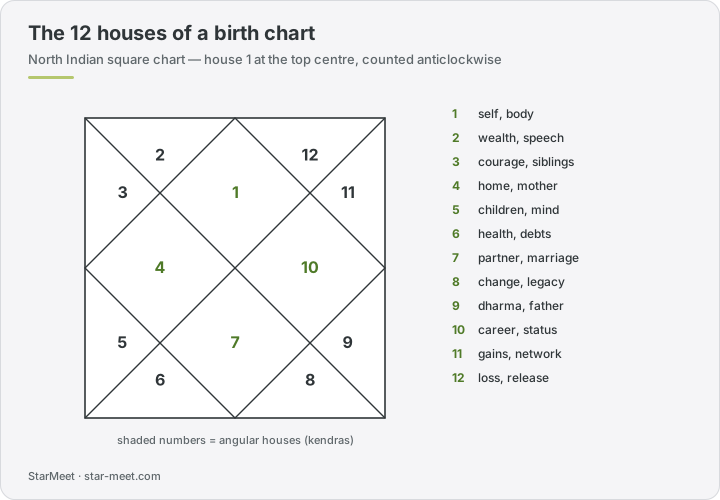
Gochara (planetary transits) in Eastern Astrology tracks how currently moving planets activate or suppress natal chart promises. Unlike Western astrology, Jyotish uses Ashtakavarga — a 337-point mathematical strength grid — to determine whether each transit will manifest its results. Transits are always read from the natal Moon sign (Janma Rashi), not the Sun sign.
When a Eastern astrologer says "Saturn is transiting your Moon sign — expect a difficult period," the precision behind that statement comes not from intuition, but from a 1,500-year-old mathematical system. Gochara (planetary transits in Jyotish) is the mechanism by which heavenly movements activate — or fail to activate — the promises encoded in your natal chart. This guide covers the complete Gochara system: the Ashtakavarga chart, Saturn and Jupiter transits through all 12 houses, Rahu-Ketu effects, the Double Transit technique of K.N. Rao, the Vedha obstruction table, and the 8-step algorithm for precise event timing.
Key Takeaways
- Gochara requires Dasha support: a planetary transit activates an event only when the active Mahadasha or Antardasha aligns with the same theme — transit alone is insufficient.
- Count from the Moon sign (Janma Rashi), not the Sun sign — this is the foundational classical method in all major Jyotish texts including Brihat Parashara Hora Shastra.
- Ashtakavarga gives every transit a numerical score: a house score of ≥5 out of 8 amplifies the transit; ≤4 weakens it — explaining why "the same" Saturn transit brings success to one person and failure to another.
- The Double Transit (Guru-Shani Yoga) narrows a multi-year Dasha window to 1–3 precise months when both Jupiter and Saturn simultaneously aspect the same house.
- Vedha obstruction cancels up to 30% of apparently favorable transits — the Vedha table is essential for accurate prediction.
- The Moon as final trigger: the exact date of a predicted event is determined by the Moon transiting the relevant house — providing 24–48 hour precision.
- Divisional charts (D-9, D-10) must confirm the natal chart transit for a full-scale event to materialize.
What is Gochara? The 3-Condition Rule for Transit Activation
Gochara (Sanskrit: go — movement, chara — going, flowing) is the core transit system of Eastern astrology (also called Vedic astrology, or Jyotish) — it observes how the current sky positions of planets interact with your fixed natal chart positions, particularly your natal Moon sign.
According to K.S. Charak in Essentials of Medical Astrology and Elements of Eastern Astrology, a transit activates its full effect only when three conditions are simultaneously met:
- The planet transits a favorable house from the natal Moon (or aspects a key natal point)
- The active Dasha supports the same life theme (Mahadasha or Antardasha of a planet connected to the event)
- The Ashtakavarga score for that transit is ≥ 5 (out of 8 possible Bhinnashtakavarga points)
Gochara without Dasha support is a door without a lock — transit energy is present but cannot open anything. This explains why Jupiter transiting your 7th house (the classic marriage indicator) may pass uneventfully: if you're in Saturn Mahadasha with no connection to the 7th lord, the transit cannot activate the natal promise of marriage.
The Moon as the Daily Trigger for Events
While Saturn and Jupiter create the large timing windows (years), the Moon creates the final trigger with its rapid 2.25-day-per-sign transit cycle. The Moon transits all 12 signs in 27–28 days, completing a full circuit in under a month.
Practical application: If Jupiter transiting your 7th house creates a 12-month "marriage window," the specific date of the event is determined by the Moon transiting through the same 7th house — or through your natal Venus (the natural significator of marriage).
Case Study #1 — Amita and Siddharth's Marriage: Active Dasha: Saturn Mahadasha / Venus Antardasha (Venus = 7th lord). Jupiter in transit through 7th house from Moon; Saturn aspecting the 7th lord through Double Transit. The wedding date corresponded exactly to the Moon's transit over natal Venus. StarMeet calculated this window in under 30 seconds — check your own event windows.
The Ashtakavarga Chart: Numerically Scoring Every Transit
The Ashtakavarga system is Jyotish's most sophisticated transit evaluation tool, converting qualitative transit assessments into precise numerical scores. Without Ashtakavarga, a "Saturn transiting the 3rd house" prediction has only a binary favorable/unfavorable value. With Ashtakavarga, you know how strongly favorable or unfavorable it actually is for your specific chart.
Bhinnashtakavarga: 0–8 Points per Planet per House
Each of the 8 classical planets (Sun, Moon, Mars, Mercury, Jupiter, Venus, Saturn, and Lagna — counted as a planet for this system) contributes either 1 or 0 points to every house. The sum = Bhinnashtakavarga score for that planet in that house:
| Bhinnashtakavarga Score | Transit Quality |
|---|---|
| 8 | Maximum strength — rare, excellent results |
| 6–7 | Very strong — highly favorable |
| 5 | Favorable — delivers good results |
| 4 | Neutral / Mixed — some results |
| 2–3 | Weak — poor results |
| 0–1 | Very weak — barely any effect |
The key threshold is 5: a transit through a house scoring ≥5 in the planet's own Bhinnashtakavarga is considered favorable. Below 5 — the transit works against the native, even in a "good" house.
Sarvashtakavarga Chart: The Complete Picture
The Sarvashtakavarga (SAV) chart adds up the Bhinnashtakavarga scores of all 8 planets for each house, giving each house a maximum possible score of 56 points, and the entire chart a maximum of 337 points.
| SAV Score per House | Interpretation | Action |
|---|---|---|
| ≥ 30 | Strong house — transits deliver maximum results | Actively initiate events |
| 25–29 | Average house — mixed results | Proceed with moderate expectations |
| 20–24 | Weak house — limited results | Exercise caution |
| < 20 | Very weak — transits produce minimal output | Avoid major launches |
This explains a common puzzle: why does a person with "Jupiter transiting the lucky 11th house" experience financial failure? If their 11th house scores only 18 in Sarvashtakavarga, the house is structurally weak — no transit can overcome its natal limitations.
Calculate your Ashtakavarga chart free →
Saturn Transit in Eastern Astrology: The 2.5-Year Destiny Audit
Saturn transits each sign for approximately 2.5 years, making it the most sustained and structurally significant of all Eastern planetary transits. Saturn does not destroy — it audits. Whatever is built on a weak foundation is dismantled; whatever is genuinely solid is strengthened.
"Saturn's transit acts as an impartial government auditor of your life: it identifies structural weaknesses in your relationships, career, and health, and demands immediate correction." — K.S. Charak, Elements of Eastern Astrology, Vol. II
Complete Table: Saturn Transit Through 12 Houses from Moon
| House from ☽ | Saturn Transit Effect | Core Theme | Duration |
|---|---|---|---|
| 1 | Physical challenges, delays, identity crisis | Self | ~2.5 yrs |
| 2 | Financial restrictions, speech difficulties | Resources | ~2.5 yrs |
| 3 | ✅ Perseverance, success through effort | Communication | ~2.5 yrs |
| 4 | Domestic difficulties, separation from mother | Home | ~2.5 yrs |
| 5 | Stress related to children, mental strain | Creativity | ~2.5 yrs |
| 6 | ✅ Victory over enemies and illness | Health/Service | ~2.5 yrs |
| 7 | Partnership tensions, marital strain | Union | ~2.5 yrs |
| 8 | ⚠️ Ashtama Shani — most difficult; health crises | Transformation | ~2.5 yrs |
| 9 | Spiritual trials, conflict with father/guru | Dharma | ~2.5 yrs |
| 10 | Career restructuring or crisis | Destiny | ~2.5 yrs |
| 11 | ✅ Financial gains, fulfillment of desires | Gains | ~2.5 yrs |
| 12 | Isolation, expenditure, forced retreat | Liberation | ~2.5 yrs |
Note on Sade-Sati: When Saturn transits the 12th, 1st, and 2nd houses from the natal Moon consecutively, it creates the famous 7.5-year period known as Sade-Sati — covered in detail in Block #21.
Case Study #2 — Michael's Career Crisis That Built His Foundation: Saturn transiting the 10th house from the Moon. Unfair dismissal from a senior role. The "Ashtoma Shani" feeling of collapse. Realization: he had been building his career on others' terms. 2 years 3 months later, Saturn entered the 11th — first significant income from his own business. Saturn removed the "borrowed success" and required him to build something real.
Jupiter Transit in Eastern Astrology: The 1-Year Window of Cosmic Grace
Jupiter transits each sign for approximately 12 months. Unlike Saturn, Jupiter expands, multiplies, and opens opportunities wherever it aspects. The annual Guru Peyarchi (Jupiter sign change) is celebrated as an astrological festival across South India, with millions visiting temples to receive blessings for the new Jupiter cycle — underscoring Jupiter's significance as the Planet of Wisdom and Fortune in Jyotish.
Complete Table: Jupiter Transit Through 12 Houses from Moon
| House from ☽ | Jupiter Transit Effect | Strength | Key Theme |
|---|---|---|---|
| 1 | ✅ Personal growth, recognition, fresh opportunities | Good | Self |
| 2 | ✅ Financial improvement, family expansion | Good | Wealth |
| 3 | Journeys, contacts — mixed results | Average | Effort |
| 4 | ⚠️ Domestic disruptions, relocation | Challenging | Home |
| 5 | ✅ Children, knowledge, creative expression | Very Good | Creativity |
| 6 | Victory over enemies but physical strain | Average | Service |
| 7 | ✅✅ Marriage, partnership, business growth | Excellent | Union |
| 8 | ⚠️ Health challenges, unexpected losses | Challenging | Depth |
| 9 | ✅✅ Best position — fortune, pilgrimage, grace | Supreme | Dharma |
| 10 | ✅ Career growth, professional recognition | Good | Career |
| 11 | ✅✅ Profit, fulfillment, social achievement | Excellent | Gains |
| 12 | Expenditure, spiritual practices, foreign travel | Variable | Liberation |
Case Study #3 — Anna: The One-Year Window: Five years without meaningful relationships. Jupiter Mahadasha / Jupiter Antardasha. Jupiter entered the 7th house from the natal Moon. Within eight months, she met her future husband. Wedding date: Double Transit confirmed — Saturn also aspected the 7th through the natal 7th lord. "Before this, Jupiter was in the 6th and 8th — those transits promised nothing," explains K.N. Rao.
The Double Transit Technique: Narrowing to the Month
Double Transit (Guru-Shani Yoga) is K.N. Rao's most celebrated contribution to Jyotish prediction methodology. The principle: a major life event materializes ONLY when both Jupiter and Saturn simultaneously transit through or aspect the same house from the natal Moon.
"It is the mutual operation of transiting Jupiter and Saturn through a specific bhava that determines when soul-purpose themes ripen into physical events." — K.N. Rao, Predicting Through Jaimini's Chara Dasha
Without the Double Transit, a favorable Dasha may produce only internal changes, minor opportunities, or unfulfilled potential. With the Double Transit confirmed, prediction accuracy increases dramatically.
Saturn vs Jupiter Transit: Complete Comparison
| Parameter | Saturn Transit | Jupiter Transit |
|---|---|---|
| Duration per sign | ~2.5 years | ~1 year |
| Quality | Soul-purpose audit | Cosmic grace |
| Favorable houses from ☽ | 3, 6, 11 | 2, 5, 7, 9, 11 |
| Effect type | Structures, restricts | Expands, grants |
| In Saturn Mahadasha | Greatly amplified | Partially neutralizes |
| Key divisional chart | D-10 (career) | D-9 (marriage) |
| Synergy | Double Transit with Jupiter | Double Transit with Saturn |
| Soul-purpose theme | Past debts and dues | Past merits and blessings |
Rahu and Ketu Transit: 18 Months of Soul-purpose Reckoning
Rahu and Ketu move retrograde through one sign for approximately 18 months each. The lunar nodes do not govern physical celestial bodies — they work through the planets and houses they occupy, amplifying or distorting their significations.
Rahu's principle: intensification, amplification, illusion of achievement. Ketu's principle: dissolution, detachment, spiritual deepening.
Rahu Transit Through 12 Houses from Moon
| House | Rahu Transit Effect | Warning |
|---|---|---|
| 1 | Ambition, identity shifts, appearance changes | Unrealistic self-image |
| 2 | Unconventional income, risk in speech/finance | Deception, financial schemes |
| 3 | ✅ Courage, travel, digital success | Sibling conflicts |
| 4 | Domestic instability, relocation | Anxiety, loss of peace |
| 5 | Education, creativity — double-edged | Complications with children |
| 6 | ✅ Victory over enemies | Hidden competitors |
| 7 | Unconventional partnerships | Deception in relationships |
| 8 | Hidden knowledge, inheritance, hidden crises | Danger without warning |
| 9 | Spiritual wandering, challenging traditions | Conflict with father/guru |
| 10 | Rapid but unstable career rise | Fall after peak |
| 11 | ✅ Profit, expanded network | Unreliable allies |
| 12 | Expenditure, isolation, foreign opportunities | Scandals, hidden enemies |
Ketu Transit Through 12 Houses from Moon
| House | Ketu Transit Effect | Spiritual Dimension |
|---|---|---|
| 1 | Detachment, introversion, blurred identity | Self-knowledge without ego |
| 2 | Financial and speech losses | Simplicity |
| 3 | Distance from siblings, introspection | Meditation practice |
| 4 | Separation from home, nostalgia | The inner home |
| 5 | Loss of creative joy | Spiritual creativity |
| 6 | ✅ Liberation from disease and enemies | Humility |
| 7 | Distance in partnership | Equanimity |
| 8 | Mysticism, occult sciences | Deep hidden knowledge |
| 9 | Disillusionment with tradition | Direct experience of truth |
| 10 | Withdrawal from career ambition | New calling |
| 11 | Indifference to profit | Freedom from desire |
| 12 | Moksha, meditation, solitude | Highest spirituality |
Mars Transit (Mangal Gochara): The 45-Day Detonator
Mars transits each sign in approximately 45 days (without retrograde), making it the fastest of the outer planet transits. Mars does not create long-term trends — it detonates accumulated energy in short, intense bursts.
Ashtama Mangal: The Highest Risk Zone
Ashtama Mangal is the transit of Mars through the 8th house from the natal Moon. According to Brihat Parashara Hora Shastra: "Mars in the eighth house from Moon brings danger from weapons, fire, and surgery." Practical precautions during Ashtama Mangal:
- Postpone elective surgeries
- Avoid high-risk travel
- Exercise extreme caution in physical confrontations
- Review insurance and safety protocols
Mars Transit Through 12 Houses from Moon (~45 Days)
| House | Mars Transit Effect | Theme |
|---|---|---|
| 1 | Physical energy surges, irritability | Self / Body |
| 2 | Financial disputes, harsh speech | Wealth |
| 3 | ✅ Courage, competitive success | Initiative |
| 4 | Domestic conflicts, emergency repairs | Home |
| 5 | Mental tension, arguments with children | Creativity |
| 6 | ✅ Victory over enemies, high productivity | Health |
| 7 | Partner conflicts, business friction | Partnership |
| 8 | ⚠️ ASHTAMA MANGAL — maximum risk | Danger |
| 9 | Spiritual conflicts, risky journeys | Dharma |
| 10 | Intense career competition | Career |
| 11 | ✅ Financial wins, social victories | Gains |
| 12 | Expenditure, hospitalization risk | Loss |
Vedha: Why Favorable Transits Fail
Vedha (Sanskrit: "piercing, obstruction") is the principle by which another transiting planet, occupying a specific "blocking" house, completely neutralizes the beneficial effect of an otherwise favorable transit.
"Even when a planet transits a favorable house, the result will not manifest if a Vedha-blocking planet is simultaneously present in the obstructing house." — K.S. Charak, Elements of Eastern Astrology
Complete Vedha Table
| Transit through house | Vedha (blocking house) | Exception |
|---|---|---|
| 1 | 5 | Sun-Moon do not mutually block each other |
| 2 | 12 | — |
| 3 | 9 | — |
| 4 | 3 | — |
| 5 | 1 | — |
| 6 | 12 | — |
| 7 | 2 | — |
| 8 | 5 | — |
| 9 | 3 | — |
| 10 | 4 | — |
| 11 | 8 | — |
| 12 | 6 | — |
Practical example: Jupiter transiting the 7th house promises marriage — excellent transit. But Saturn stands in the 2nd house. According to the table, the 2nd house is the Vedha point for the 7th. Vedha is active — marriage is delayed until Saturn exits the 2nd house.
Transits in Divisional Charts: D-9, D-10, D-4, D-7
A single transit simultaneously projects onto all divisional charts (Vargas), revealing different dimensions of the same event. This explains cases where Saturn's "good transit" through the 10th house (D-1) coincides with a family crisis: D-10 improves (career rises), but D-4 deteriorates (home suffers).
| Divisional Chart | Theme | Application in Gochara |
|---|---|---|
| D-9 (Navamsha) | Marriage, partnership, spirituality | Confirms marriage transit |
| D-10 (Dashamsha) | Career, public success | Confirms career transit |
| D-4 (Chaturthamsha) | Property, luck, peace | Confirms property transit |
| D-7 (Saptamsha) | Children, progeny | Confirms childbirth transit |
Rule of double confirmation: A favorable Jupiter transit through the 7th house in D-1 will bring marriage only if D-9 simultaneously shows Jupiter transiting through the Lagna or the 7th house lord of the Navamsha chart.
The 8-Step Gochara Algorithm of K.N. Rao
According to K.N. Rao, a complete and accurate transit analysis requires eight sequential steps — none of which can be omitted without reducing prediction reliability:
| Step | Action | Tool |
|---|---|---|
| 1 | Identify active Mahadasha and Antardasha | Vimshottari Dasha |
| 2 | Identify the natal "promise" for the relevant life theme | Natal chart D-1 |
| 3 | Establish favorable houses from the Moon for the needed transit | Classical table |
| 4 | Check Bhinnashtakavarga: score ≥5? | Ashtakavarga chart |
| 5 | Verify Double Transit: do Jupiter + Saturn both aspect the needed house? | Gochara calculation |
| 6 | Check Vedha obstruction: is any planet in the blocking house? | Vedha table |
| 7 | Calculate Tarabala: is the Moon's nakshatra favorable? | Nakshatra system |
| 8 | Await the final Moon trigger: Moon transiting the relevant house | Lunar transit |
All eight steps confirmed → prediction is reliable. Any step skipped → prediction is speculative.
"A transit prediction that does not account for all eight factors is merely an approximation. The precision of Jyotish lies in the convergence of multiple confirming signals." — K.N. Rao, Planets and Education
Sun, Venus, Mercury: Fast-Moving Triggers
The fast-moving planets — Sun (~1 month), Venus (~1 month average), and Mercury (~3 weeks) — serve as accelerators of already-active processes rather than independent event creators:
- Sun: amplifies leadership, visibility, themes related to father and government
- Venus: activates marriage, artistic, and financial themes
- Mercury: accelerates communication, documents, commercial decisions
They do not produce major events independently, but frequently serve as "the final spark" — the last trigger when the slower planets have already set the stage.
Conclusion: Gochara as the Calendar of Destiny
Gochara is not a list of "bad periods" and "good years." Gochara is the language through which destiny describes its own schedule. Saturn's transit removes what you have outgrown; Jupiter's transit opens what you have earned; Rahu's transit amplifies ambition until its illusory nature becomes visible.
Understanding Gochara correctly means reading the blueprint of your life with astronomical precision — not the fear of a superstitious mind.
StarMeet automatically calculates all eight Gochara steps — Ashtakavarga scores, Double Transit windows, Vedha obstructions, and Dasha alignment — for your personal chart.
Unlock your complete transit analysis →
For the foundational timing system that activates transits, read our guide to Vimshottari Dasha. To understand Ashtama transit risks, see the 8th House guide. For marriage transit analysis, see the 7th House guide.
Frequently Asked Questions
What is Gochara in Eastern astrology?
Gochara is the system of planetary transits in Jyotish, tracking the current movement of planets relative to your natal Moon sign (Janma Rashi). A transit activates only when three conditions are met simultaneously: the active Dasha supports the theme, the Ashtakavarga score is ≥5, and no Vedha (obstruction) is present. No transit works in isolation without Dasha support.
What is an Ashtakavarga chart and how do I read it?
An Ashtakavarga chart assigns a score of 0–8 points (Bhinnashtakavarga) to each house for each planet. A score of ≥5 indicates a favorable transit of that planet through that house; ≤4 indicates a weak or unfavorable transit. The combined score (Sarvashtakavarga) totals up to 337 points across all 8 planets and all 12 houses, revealing the overall strength of each house.
Should I count Eastern astrology transits from the Moon sign or Sun sign?
Planetary transits in Eastern astrology are counted from the natal Moon sign (Janma Rashi), not the Sun sign. The Moon represents the mind and karmic memory in Jyotish, making it the primary reference point. K.N. Rao and K.S. Charak both establish Moon-sign transits as the standard classical method. Sun-sign transits (Western astrology) have no equivalent validity in Jyotish.
What is the Double Transit (Guru-Shani Yoga) theory of K.N. Rao?
Double Transit is K.N. Rao's most precise timing technique: a major life event (marriage, birth, career breakthrough) occurs ONLY when both Jupiter and Saturn simultaneously aspect the same house from the natal Moon. For example, marriage = both planets transiting through or aspecting the 7th house. This technique narrows a 3-year Dasha window to 1–3 specific months.
What is Ashtama Mangal and why is it dangerous?
Ashtama Mangal is the transit of Mars through the 8th house from the natal Moon sign. Brihat Parashara Hora Shastra states: 'Mars in the 8th from Moon brings danger from weapons, fire, and surgery.' It lasts approximately 45 days and represents the period of highest risk for accidents, surgeries, and physical confrontations. Elective surgeries and risky journeys should be avoided during this period.
What is Vedha in Eastern astrology and how does it block transits?
Vedha (Sanskrit: 'piercing, obstruction') is the principle by which another transiting planet in a specific 'blocking' house cancels the beneficial effects of a favorable transit. For example, Jupiter transiting the 7th house (promising marriage) is blocked if Saturn simultaneously occupies the 2nd house — the Vedha point for the 7th. Vedha explains up to 30% of 'failed' predictions in Jyotish practice.
How does the Sarvashtakavarga chart help predict transits?
The Sarvashtakavarga chart totals the Bhinnashtakavarga scores of all 8 planets for each house, producing a maximum of 337 points across 12 houses. Houses scoring ≥30 are strong — transits through them yield the best results. Houses scoring below 25 are weak — transits produce minimal output. This allows astrologers to identify which houses in your chart deliver the most powerful life events.
How long does each planet's transit last in Eastern astrology?
Saturn transits one sign for approximately 2.5 years. Jupiter transits one sign for approximately 1 year. Rahu and Ketu transit one sign for approximately 18 months (retrograde). Mars transits one sign for approximately 45 days (up to 6 months when retrograde). The Sun, Mercury, and Venus each transit one sign for approximately 1 month on average.
About the author
Vadim Arkhipov
Founder of StarMeet. Student of Jyotish since 2013, having completed an advanced course under Dr. K.N. Rao; 30+ years in business. Articles here are written to my brief, drafted with AI assistance and edited by me before publishing.
Profile, expertise and all articles →Related Articles
Vimshottari Dasha: 120-Year Planetary Periods Guide
Complete guide to Vimshottari Dasha: 9-planet sequence, Janma Nakshatra formula, all Maha Dashas, Antardasha mechanics, double confirmation, D-9/D-10 timing, and the 8-step synthesis algorithm.
Jyotish8th House in Eastern Astrology (Ayu Bhava): Longevity, Transformation & Hidden Gains
Complete guide to the 8th house in Eastern Astrology — Ayu Bhava governs longevity, sudden wealth, occult knowledge, and transformation. All 9 planets in the 8th house explained with Maraka rules and remedies.
JyotishKalatra Bhava: 7th House in Eastern Astrology — Complete Guide
Complete guide to the 7th house in Eastern Astrology — Kalatra Bhava: Dara Karaka, marriage timing, Kuja Dosha, open enemies, Maraka, all 9 planets, Navamsha analysis, and classical remedies.
Jyotish10th House Eastern Astrology: Karma Bhava, Career & Dharmic Purpose
Complete guide to the 10th house in Eastern Astrology — Karma Bhava: career vs service (6th vs 10th), all 9 planets in 10th house, Dashamesh in 12 houses, D10 chart, Saturn transit, Raja Yogas, and 8-step career analysis algorithm.
Jyotish