Nakshatra Finder: 27 Lunar Mansions in Eastern Panchang — Complete Guide
Contents
Nakshatra Finder: 27 Lunar Mansions in Eastern Panchang
Every day, the Moon moves into a new stellar home. This daily rhythm — the transit through 27 Nakshatras — is the beating heart of the Panchang, the Eastern astrology (also called Vedic astrology, or Jyotish) time-keeping system that has been used for thousands of years to answer one deceptively simple question: is today the right moment?
The Eastern zodiac is divided not only into 12 signs but into 27 Nakshatras of exactly 13°20' each. The Nakshatra the Moon occupies today determines the psychological quality of the day more precisely than any other element of the Panchang.
This article decodes the complete system: the mathematics behind the 27 lunar mansions, their seven natures, the personal Tarabala index, the dreaded Gandanta knots, and the practical guide for timing romance, luxury purchases, haircuts, and difficult conversations.
Key Takeaways
- 27 Nakshatras are precise 13°20' arc segments of the ecliptic — the Moon traverses one per day
- The Nakshatra governs not the environment (that's the Rashi/sign) but how the mind feels within that environment (Moon = Manas/Mind)
- 7 Nakshatra natures (Mridu, Laghu, Chara, Sthira, Ugra, Tikshna, Mishra) prescribe appropriate activities for each type of day
- Your personal Tarabala — a 9-step cycle from your birth Nakshatra — predicts your personal danger days and achievement days
- Gandanta zones (Water→Fire sign transitions) mark intense soul-purpose reset periods, not curses
- Soft (Mridu) Nakshatras — Mrigashira, Chitra, Anuradha, Revati — are ideal for romance, beauty, and luxury shopping
- Check your Janma Nakshatra instantly with the free StarMeet calculator
What Is a Nakshatra? The Mathematics of 13°20'
A Nakshatra (Sanskrit: नक्षत्र — "lunar mansion") is one of 27 equal segments dividing the 360-degree zodiacal belt. Each segment spans exactly 13 degrees and 20 minutes of arc — precisely 800 arc minutes — which corresponds to the Moon's average daily movement. This creates a natural cosmic clock: one Nakshatra, one day, one psychological character.
Classical Eastern Astrology relies on the Sidereal (Nirayana) zodiac, anchored to fixed stars — unlike the Western Tropical zodiac that shifts with the vernal equinox. The difference between them (Ayanamsa — approximately 23°51' by Lahiri in 2026) must be applied to all Nakshatra calculations.
The systematization of the 27 Nakshatras, their planetary rulers, and the Vimshottari Dasha system was codified by Maharishi Parashara in the Brihat Parashara Hora Shastra (BPHS) — the foundational authority of classical Jyotish.
27 vs. The Hidden 28th Nakshatra
Classical texts acknowledge a 28th intercalary Nakshatra — Abhijit — inserted at 276°40' to 280°53', overlapping the final quarter of Uttarashadha and the beginning of Sravana. However, for standard Vimshottari Dasha and daily Panchang, the 27-star system is absolute. Abhijit functions as an emergency Muhurta: approximately 48 minutes around solar noon, usable when no other favorable Nakshatra is available.
The Five Limbs of Panchang: Why Nakshatra Is Its Soul
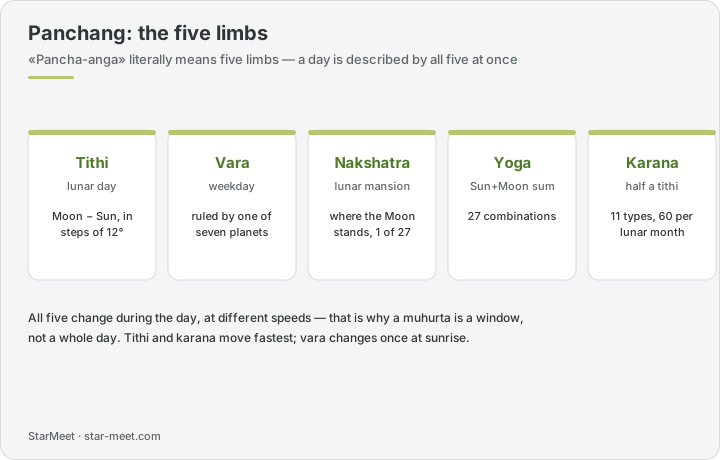
"Panchang" literally means "Five Limbs": Tithi (lunar phase), Vara (weekday), Nakshatra (lunar mansion), Yoga (Sun-Moon angular relationship), and Karana (half-Tithi). Each governs a different element.
If Tithi governs water (emotions) and Vara governs fire (energy), Nakshatra governs air and ether — the direct psychological experience of the day.
Parashara in BPHS defines Chandra (Moon) as Manas (Sanskrit: मनस् — "mind, sensory perception"). This distinction is fundamental:
- The Rashi (zodiac sign) = the environment or circumstances
- The Nakshatra = how the mind feels within that environment
Example: A Moon in Scorpio signals a turbulent environment, but if it sits in Anuradha Nakshatra (ruled by Saturn), the mind expresses devotion, loyalty, and a sense of duty despite external chaos. This is why, in Muhurta electional astrology, Nakshatra quality overrides sign quality — human action is ultimately driven by the mind's emotional state.
The 7 Natures of Nakshatras: What to Do When
B.V. Raman's Muhurtha: The Astrology of Auspicious Time classifies all 27 Nakshatras into seven natures (gana), determining what activities naturally align with each type of stellar energy.
| Nature | Sanskrit | Nakshatras | Best Activities |
|---|---|---|---|
| Sthira (Fixed) | sthira | Rohini, Uttara Phalguni, Uttarashadha, Uttarabhadra | Marriage, foundation-laying, long-term projects, planting |
| Chara (Movable) | cala | Sravana, Dhanishta, Shatabhisha, Punarvasu, Swati | Buying vehicles, travel, new movements |
| Ugra (Dreadful) | ugra | Purva Phalguni, Purvashadha, Purvabhadra, Bharani, Magha | Hostile/destructive actions only |
| Tikshna (Sharp) | tikṣṇa | Mula, Jyeshtha, Ardra, Ashlesha | Forced separations, surgery, aggressive interventions |
| Mridu (Soft) | mṛdu | Chitra, Anuradha, Mrigashira, Revati | Romance, beauty, new clothes, art, reconciliation |
| Laghu (Light/Swift) | laghu | Ashwini, Pushya, Hasta, Abhijit | Jewelry, sports, medicine, short travels |
| Mishra (Mixed) | sādhāraṇa | Krittika, Vishakha | Ordinary, everyday activities |
According to the Brihat Parashara Hora Shastra, the nature (gana) of the Nakshatra determines not only the energy of the day, but the long-term fate of any enterprise initiated under its influence.
The Special Case of Pushya
Among all 27, Pushya (ruled by Jupiter/Brihaspati) holds a singular place. B.V. Raman declares it "the most benefic of all 28 constellations" — its inherent purity can neutralize almost all doshas (flaws) arising from other adverse combinations. A Pushya day is one of the safest times to initiate virtually any important endeavor.
Beauty, Self-Care & Luxury Shopping: Mridu Nakshatras in Practice
If you've ever noticed that a haircut on one day grows beautifully while another day's result disappoints — that's not coincidence. Classical Jyotish explicitly prescribes soft (Mridu) and swift (Laghu) Nakshatras for aesthetic activities:
- Mrigashira (ruled by Moon) — tender, curious, rejuvenating. Ideal for haircuts, beginning beauty regimens, buying new clothing.
- Chitra (ruled by Vishwakarma, the divine architect) — the premier Nakshatra for luxury shopping, custom jewelry, cosmetic procedures, and bespoke design commissions.
- Anuradha (ruled by Mitra, god of friendship) — social harmony. The best time to buy gifts for loved ones or an engagement ring.
- Revati (completion and abundance) — ideal for finalizing high-value luxury purchases or closing real estate deals gently.
- Hasta (mastery of hands) — handcrafted goods, luxury watches, massage, aesthetic contouring procedures.
For double confirmation: combine the Mridu Nakshatra with a supportive Hora (planetary hour). Jewelry shopping reaches peak auspiciousness in Chitra Nakshatra during a Venus Hora.
Gandanta: The Soul-purpose Knots of the Zodiac
Gandanta (Sanskrit: gaṇḍānta — "the knot at the end") marks the highly sensitive junctions where both a zodiac sign and a Nakshatra end simultaneously. This occurs only at Water-to-Fire sign transitions.
The Three Gandanta Zones:
- Revati → Ashwini (Pisces/Aries border)
- Ashlesha → Magha (Cancer/Leo border)
- Jyeshtha → Mula (Scorpio/Sagittarius border)
B.V. Raman issues a precise warning: "The last ghatis of Ashlesha, Jyeshtha, Moola, Revati and Ashwini and the first four ghatis of Magha should be avoided as injurious for good work."
Why These Days Carry Mental Crises
Energetically, Gandanta is the point between the completion of a soul cycle (water = emotional integration) and the explosive, ungrounded beginning of a new one (fire = identity assertion). The mind is caught between worlds, struggling to adapt. In natal astrology, births in Gandanta degrees are associated with profound psychological transformations and the need for soul-purpose "unknotting" through Shanti rituals.
Crucially: Gandanta is not a curse — it's a mandatory soul-purpose reset. People born in these degrees often become powerful agents of change precisely because they are bound to two worlds simultaneously, able to bridge them consciously.
Tarabala: Your Personal Nakshatra Index
Tarabala (Sanskrit: tārabala — "strength of the star") translates the Moon's daily transit into a personalized forecast by measuring it against your birth Nakshatra.
How to Calculate
- Find your Janma Nakshatra (Moon's position at birth) — use the StarMeet calculator
- Count from your birth Nakshatra to today's Moon Nakshatra in the Panchang
- Divide by 9. The remainder (if 0, use 9) = your Tara today
The Nine-Tara Cycle (Navatara Chakra)
| Position | Tara Name | Sanskrit | Nature |
|---|---|---|---|
| 1 | Janma | janma | Mixed — personal, body |
| 2 | Sampat | sampat | ✅ Auspicious — wealth, gains |
| 3 | Vipat | vipat | ❌ Danger |
| 4 | Kshema | kṣema | ✅ Auspicious — well-being |
| 5 | Pratyak | pratyak | ❌ Obstacles |
| 6 | Sadhaka | sādhaka | ✅ Achievement |
| 7 | Vadha/Naidhana | vadha | ❌ Destruction (most severe) |
| 8 | Mitra | mitra | ✅ Friendly support |
| 9 | Parama Mitra | parama mitra | ✅ Greatest friend |
K.N. Rao emphatically taught: never start a new job, sign a contract, or initiate a major journey when the daily Moon forms the 3rd, 5th, or 7th Nakshatra counted from your birth star.
The Unexplained Failure Pattern
Consider this: you've prepared thoroughly for a crucial investor meeting — numbers memorized, slides rehearsed. The laptop crashes mid-presentation. You lose your train of thought. The investors leave unimpressed. Later you discover it was your Vipat Tara day — literally "danger day." This isn't incompetence; it's cosmic friction that statistical preparation cannot overcome. Rescheduling to your Sadhaka (achievement) Tara can transform the outcome.
Three Danger Days Per Month — and What to Do
Since 27 Nakshatras divide into three 9-star cycles, Vipat, Pratyak, and Vadha each recur approximately 3 times per month — roughly 9 caution days total. B.V. Raman provides classical remedial measures: if postponing is impossible, donate jaggery (Vipat), salt (Pratyak), or sesame/gold (Vadha) to pacify the energy.
Nakshatras for Relationships: Dating and Reconciliation
The Panchang is among the most precise tools for matters of the heart. Classical texts (Vivaha Muhurta) prescribe only 10 Nakshatras for romantic initiations and marriage ceremonies.
Auspicious for first dates and marriage: Rohini, Mrigashira, Magha, Uttara Phalguni, Hasta, Swati, Anuradha, Uttarashadha, Uttarabhadrapada, Revati
Forbidden: Jyeshtha, Mula, Ardra, Ashlesha, Shatabhisha — their sharp or fierce nature induces sudden severances or psychological cruelty in romantic contexts.
Nakshatra Compatibility in Synastry
In the Ashtakoota compatibility scoring system, Nakshatras determine three critical parameters:
- Nadi Dosha — 27 Nakshatras divided into three Nadis (Adi, Madhya, Antya) representing fundamental temperamental types. Partners with the same Nadi face irreconcilable temperamental friction — a serious classical incompatibility.
- Yoni (Instinctual Compatibility) — each Nakshatra carries one of 14 animal symbols. Natural enemies in the Yoni system (Mongoose–Serpent, Tiger–Cow, Cat–Rat) create primal, instinctual incompatibility.
- Tara Dosha in Synastry — if Partner B's Moon falls in Partner A's 7th (Vadha) Tara position, Partner B will unconsciously drain Partner A's energy, creating a destructive dynamic.
K.N. Rao adds: the Nakshatra of the 7th house lord in the natal chart is the psychological blueprint of the ideal partner. Meeting someone whose Moon aligns with that Nakshatra creates an immediate, inexplicable sense of recognition.
Timing a Difficult Conversation
Post-conflict, the right Nakshatra matters as much as the right words. A reconciliation attempt in Ardra (ruled by Rudra/Storms) will trigger defensiveness; the same attempt in Mrigashira (ruled by Moon, symbolizing gentle searching) naturally opens the heart.
K.N. Rao advises against reconciliation attempts during Chidra Tithis or Gandanta periods — the mind is inherently unstable during these times and prone to misinterpreting intent.
Nakshatras and the Navamsha: Why Birth Time Accuracy Matters
Each Nakshatra divides into 4 Padas (quarters) of exactly 3°20'. These Padas map perfectly onto the Navamsha (D-9) chart — the division K.N. Rao called "the X-ray of the horoscope," especially for marriage and deep soul analysis.
Mathematics: 27 Nakshatras × 4 Padas = 108 Padas = 108 Navamsha segments. A Pada transition takes just 13–15 real-time minutes.
Practical example: Two people born 20 minutes apart may share the same Ascendant Nakshatra (Ashwini), yet have different Padas:
- Ashwini Pada 1 → Navamsha Lagna in Aries
- Ashwini Pada 2 → Navamsha Lagna in Taurus
K.N. Rao consistently stressed: an error of 15 minutes in the recorded birth time makes the Navamsha Lagna wrong, completely invalidating marriage predictions. Enter your precise birth time in the StarMeet calculator to get the accurate Pada and Navamsha.
Nakshatra Deities and Their Practical Meaning
Every Nakshatra is governed by a celestial deity (Adhipati Devata) that determines the psychological motivation and practical outcome of the day:
| Nakshatra | Deity | Practical Use |
|---|---|---|
| Ashwini | Ashwini Kumaras (celestial physicians) | Ideal for beginning medical treatment |
| Rohini | Brahma (Creator) | Foundation-laying, creative projects |
| Mrigashira | Moon | Romance, beauty, new clothing |
| Ardra | Rudra (Storms) | Strictly for drastic, destructive actions |
| Pushya | Jupiter/Brihaspati | Best for all — neutralizes most flaws |
| Ashlesha | Serpents/Sarpa | Mysticism; avoid for auspicious beginnings |
| Magha | Pitrus (Ancestors) | Ancestral rites; avoid for commercial starts |
| Swati | Vayu (Wind) | Buying vehicles, initiating movements |
| Chitra | Vishwakarma | Jewelry, luxury design, aesthetic purchases |
| Revati | Pushan (Guide) | Completing deals, finalizing decisions |
Practical Panchang Reading: A Step-by-Step Guide
- Find today's Nakshatra in any Panchang app (Drik Panchang, iShubhTime, or StarMeet)
- Identify its nature using the 7-gana table above
- Calculate your Tarabala — count from your Janma Nakshatra to today's Moon
- Check for Gandanta — is the Moon in a Water→Fire transition zone?
- For important dates — choose Mridu/Laghu Nakshatras + a supportive planetary Hora
Abhijit reserve: If no favorable Nakshatra is available today but action is urgent, use the 48-minute Abhijit window around solar noon — it neutralizes most minor daily flaws.
Nakshatra Finder: Find Your Birth Star by Date of Birth
Ready to apply this knowledge to your own chart?
Our free birth chart calculator provides:
- Your Janma Nakshatra with full character profile
- Nakshatra lord and deity significance
- Your Pada (quarter) for precise Navamsha analysis
- Complete natal chart with interpretation
Calculate your Janma Nakshatra for free →
Go Deeper: Related Articles
- 27 Nakshatras: Complete Guide to Eastern Lunar Mansions — all Nakshatras, Padas, and lords
- Ashwini Nakshatra: First Star of the Eastern Zodiac — detailed breakdown
- Darakaraka: The Planet of Your Spouse in Jaimini Astrology — finding a partner through astrology
This article is based on classical Jyotish sources: Brihat Parashara Hora Shastra, B.V. Raman's Muhurtha, and K.N. Rao's foundational teachings. Written for those who wish to use Eastern Astrology as a practical tool for conscious daily planning.
May the stars guide you to the perfect moment. ✨
Frequently Asked Questions
How do I find my birth Nakshatra (Janma Nakshatra)?
Your Janma Nakshatra is determined by the Moon's position at your exact birth time and place. Use the free StarMeet birth chart calculator — enter your birth date, time and city to instantly find your Nakshatra, its ruling deity, planetary lord, and Pada (quarter).
Why are there 27 Nakshatras and not 28?
Classical Eastern astrology uses 27 Nakshatras as the standard for Vimshottari Dasha calculations and daily Panchang. The 28th Nakshatra, Abhijit, exists mathematically but is reserved as an emergency Muhurta (~48 minutes around solar noon). The 27-star system was codified by Parashara in Brihat Parashara Hora Shastra.
What is Tarabala and how does it affect daily decisions?
Tarabala is your Personal Star Strength index. Count from your birth Nakshatra to today's Moon Nakshatra: positions 3 (Vipat/Danger), 5 (Pratyak/Obstacle), and 7 (Vadha/Destruction) are inauspicious for major decisions. These occur roughly 3 times a month — K.N. Rao taught never to sign contracts or start new jobs on these days.
Can a bad Nakshatra ruin a first date?
Sharp Nakshatras (Jyeshtha, Mula, Ardra) create tension and misunderstandings on romantic meetings. Soft (Mridu) Nakshatras — Mrigashira, Chitra, Anuradha, Revati — are classically prescribed for romance. The right Nakshatra doesn't guarantee success, but it creates a naturally supportive emotional environment.
What remedies exist for being born in Gandanta?
Classical texts prescribe Shanti puja (pacification ritual) for births in Gandanta zones (Revati–Ashwini, Ashlesha–Magha, Jyeshtha–Mula). Gandanta is not a curse — it represents a destiny reset. B.V. Raman notes these individuals often become powerful agents of transformation once the life-pattern knot is consciously untied.
Which Nakshatra is best for starting a business?
Rohini (Fixed, ruled by Brahma), Pushya (universally auspicious, neutralizes most flaws), Uttara Phalguni, and Hasta are classically recommended for business launches. Also check your personal Sadhaka Tara — your personal achievement day — for maximum alignment.
Which Nakshatras are best for haircuts and beauty treatments?
Mrigashira (youthful, searching), Chitra (beauty and jewelry), Hasta (skilled handwork), Anuradha (social harmony), and Revati (completion) are the top choices. Mrigashira specifically supports hair rejuvenation, while Chitra governs all aesthetic enhancements.
How often do dangerous Tara days occur each month?
Since there are 27 Nakshatras divided into three 9-star cycles, the dangerous Vipat (3rd), Pratyak (5th), and Vadha (7th) Taras each repeat approximately 3 times per month — roughly 9 caution days total. Classical texts provide specific charitable remedies if actions cannot be postponed.
About the author
Vadim Arkhipov
Founder of StarMeet. Student of Jyotish since 2013, having completed an advanced course under Dr. K.N. Rao; 30+ years in business. Articles here are written to my brief, drafted with AI assistance and edited by me before publishing.
Profile, expertise and all articles →Related Articles
27 Nakshatras: Complete Guide to Eastern Lunar Mansions
Complete guide to 27 nakshatras — astronomical foundation, pada system, Vimshottari Dasha table, Ashtakuta compatibility, 7-fold Muhurtha classification, and all 27 Devata, Symbol, Shakti.
JyotishAshwini Nakshatra: Characteristics, Compatibility & Career Guide
Ashwini Nakshatra is the first of 27 nakshatras, ruled by Ketu and Aries 0°–13°20′. Discover traits, compatibility, career paths, and all 4 padas explained.
JyotishFind Your Darakaraka: Jaimini Astrology's Complete Spouse Blueprint
Darakaraka (DK) is Jaimini's unique spouse indicator — the planet that reveals your soul-purpose partner. Find your darakaraka, discover all 8 archetypes, DK in houses, Navamsha, synastry & timing.
Compatibility