9th House Astrology: Dharma Bhava, Fortune & Higher Purpose in Eastern Astrology
Contents
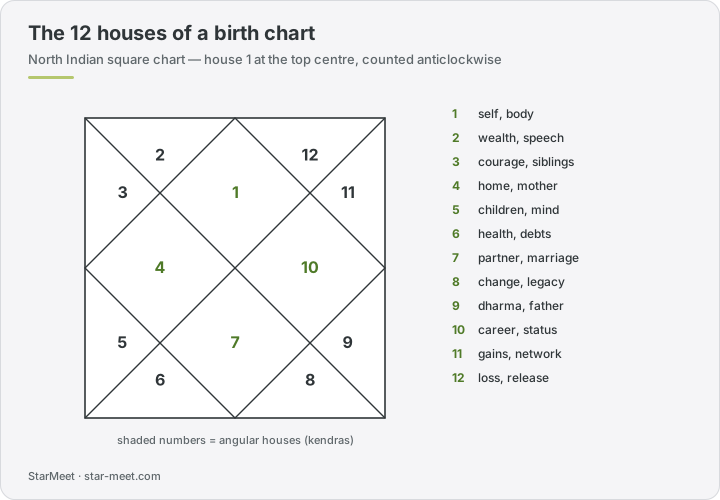
Of all twelve houses in a Eastern horoscope, none generates more philosophical debate — or more profound real-world impact — than the 9th house in astrology. It is simultaneously the house of Dharma (your cosmic duty), Bhagya (your inherited fortune), the Father, the Guru, higher education, long journeys, and the accumulated merit of your past lives.
This is Dharma Bhava — the house of righteousness. Bhagya Sthana — the house of divine luck. Pitri Bhava — the house of your ancestors. And above all, it is the most powerful Trikona house in the entire horoscope, ranked by classical texts above even the 1st and 5th houses in its capacity to bestow grace.
Discover your 9th house placements →
This complete guide draws from Brihat Parashara Hora Shastra (BPHS), K.N. Rao's lecture series, B.V. Raman's How to Judge a Horoscope, P.V.R. Narasimha Rao's Eastern Astrology Lessons, and K.S. Charak's classical texts. Every concept here traces back to classical scripture — not modern speculation.
Key Takeaways
- The 9th house is the strongest Trikona in any horoscope — in the Panchaphala hierarchy: 9th > 5th > 1st
- Bhagya Sthana = effortless luck, distinct from the 11th house (Labha = earned income through effort)
- The 9th governs your father, guru, higher education, long travel, dharma, and Purva Punya (past-life merit)
- Jupiter in the 9th is the highest Purva Punya blessing; Saturn delays but never denies 9th house fortune
- Dharma-Karmadhipati Yoga (lords of 9th + 10th connected) = career aligns with dharmic calling — career fame
- The Bhavat Bhavam principle: 9th from 9th = 5th house — these two houses form an inseparable soul-purpose pair
- A strong 9th house (SAV ≥30, Jupiter Ashtakavarga ≥5) acts as a cosmic shield against life's catastrophes
9th House Astrology: The Nature of Dharma Bhava
The 9th house in Eastern astrology (also called Vedic astrology, or Jyotish) carries more Sanskrit names than almost any other house, each revealing a different dimension of its multifaceted nature.
Dharma Bhava comes from the root dhr — "to sustain, to uphold." Dharma is the cosmic order that sustains the universe. It stands between the 8th house (Tantra, the occult, the boundary of death) and the 12th house (Moksha, final liberation). The 9th house is orthodox religion, the 5th is devotional Bhakti, and the 12th is Moksha — three distinct spiritual registers within the chart.
Bhagya Sthana means "the place of fortune." Here lies a crucial distinction: the 9th house (Bhagya) and the 11th house (Labha) represent fundamentally different types of fortune. The 11th gives income earned through effort, networking, and achievement. The 9th gives luck that arrives without effort — like an inheritance you didn't work for, a lucky coincidence at precisely the right moment, or a teacher who appears in your life when most needed. This is Purva Punya — the dividend of dharmic deeds from previous incarnations.
Lakshmi Sthana — the three Trikona houses (1st, 5th, 9th) are called Lakshmi Sthanams, the abodes of the goddess of fortune. The three Kendra houses (1st, 4th, 7th, 10th) are Vishnu Sthanams. A Rajayoga forms when a Kendra lord and Trikona lord combine — this is the fundamental Raja Yoga principle of Brihat Parashara Hora Shastra.
The 9th house holds the highest rank in the Panchaphala (five-fruit) hierarchy: 9th > 5th > 1st > 4th > 7th > 10th. This means that among all twelve houses, the 9th house has the greatest power to bless, and a powerful 9th lord or planet in the 9th creates the most potent single-house fortune indicator in a horoscope.
The Bhavat Bhavam Principle
The 9th from the 9th house is the 5th house. This is the Bhavat Bhavam principle — a house counted from itself reveals its deeper soul-purpose layer. The 5th house (Buddhi, Mantra, Poorva Punya) is the intrinsic foundation of the 9th house's fortune. This is why strong 5th and 9th houses together create what astrologers call the Maha Bhagya Yoga — the native is simply born into a life trajectory of grace.
Cosmological Dimension: The Solar Ayana
In the Kalapurusha chart (the cosmic person), the 9th house corresponds to the sign of Sagittarius — ruled by Jupiter, the great benefic. The Sun enters Sagittarius at the final stages of Dakshinayana (southward journey) before beginning Uttarayana (northward journey) at Capricorn (the 10th house). This cosmological placement reinforces the 9th house's role as the point of dharmic preparation before worldly action — the place where cosmic wisdom is gathered before the soul enters the world of destiny (10th house).
What Does the 9th House Represent? Complete Significations
The 9th house rules a remarkably interconnected web of life domains, all united by the theme of grace, wisdom, and higher guidance.
Father (Pitri Bhava)
The 9th house is the primary house of the Father in Eastern Astrology — not the 10th house as in Western tradition. The Sun is the Pitrikaraka (significator of the father). This distinction matters enormously: the 10th house shows authority, career, and social status (both yours and your father's public role), while the 9th house reveals the father's dharmic influence, longevity, and his role as your first spiritual guide.
The classical rule of Karako Bhava Nashaya (the karaka destroys the bhava it occupies) applies here: Sun in the 9th house often brings early separation from the father, even when it simultaneously elevates the native's own dharmic status. This is why interpreting the father requires examining both the 9th house and the Sun's placement together.
The Guru and Spiritual Teacher (Acharya)
The 4th house represents your mother and early education (school); the 9th house represents your Guru, Acharya, and initiation (Diksha). Jupiter is the natural Karaka for both the 9th house and the Guru principle. The quality of your relationship with teachers — their caliber, their transformative impact on your life, whether you encounter authentic masters or charlatans — is readable from the 9th house.
When the 9th house is strong and well-aspected, genuine spiritual teachers appear in the native's life at exactly the right moments. When afflicted, the native is prone to false teachers, ideological manipulation, or complete rejection of higher guidance.
Higher Education vs. School
The 4th house governs primary and secondary education (school); the 9th governs higher education — university, graduate studies, philosophy, law, theology, and advanced research. The 9th house determines whether you pursue higher education, the quality of your academic institution, and whether scholarly pursuits become a life path. How to read your complete education story in the birth chart →
Religion, Dharma, and Spirituality
The 9th house governs Dharma as organized religion and righteous living, distinct from the 5th house (Bhakti, personal devotion) and 12th house (Moksha, liberation). It covers religious observance, temple visits, sacred rituals, ethical frameworks, and the code of conduct that guides a person's choices. A afflicted 9th can manifest as religious hypocrisy, fundamentalism, or complete rejection of dharmic principles.
Long Travels and Pilgrimage (Tirtha Yatra)
The 3rd house governs short-distance travel; the 9th governs long-distance, foreign, and sacred travel. Critically, the 9th vs. 12th house distinction: the 9th represents travel with return (you come back home enriched), while the 12th represents permanent relocation or emigration (you leave and stay). Pilgrimage (Tirtha Yatra) is specifically a 9th house phenomenon — the physical journey as spiritual practice, the body moving through space to activate dormant merit.
Fortune, Grace, and Destiny (Bhagya/Punya)
Bhagya in the 9th house represents Purva Punya — the accumulated merit of dharmic actions across past lifetimes. When the 9th house is strong, the native experiences what can only be described as grace: obstacles dissolve mysteriously, the right people appear at the right moment, and life flows with unusual ease. This is not random luck — it is cosmic reciprocity for dharma lived in previous existences.
Calculate your Bhagya indicators →
All 9 Planets in the 9th House: Dharmic Archetypes
| Planet | Effect on 9th House | Key Theme |
|---|---|---|
| Sun | Moderate positive for status; Karako Bhava Nashaya → separation from father | Leadership dharma |
| Moon | Positive (waxing); mother as primary spiritual guide | Intuitive faith |
| Mars | Negative for effortless luck; positive for ambition | Warrior dharma |
| Mercury | Exceptionally positive; philosophical intellect, law, astrology | Scholar dharma |
| Jupiter | Highest blessing (Purva Punya); KBN warning re: guru loss | Brahmin dharma |
| Venus | Highly positive; fortune through beauty, art, post-marriage | Artistic dharma |
| Saturn | Mixed; delays fortune until maturity; ascetic spirituality | Ascetic dharma |
| Rahu | Negative for tradition; Guru Chandala Yoga with Jupiter; foreign lands | Non-conformist dharma |
| Ketu | Spiritual (positive for Moksha); past-life wisdom, cosmic connection | Mystic dharma |
Sun in the 9th House
The Sun in the 9th house elevates the native's own dharmic status, creating natural authority in religious, legal, or educational domains. However, Karako Bhava Nashaya applies here directly: since the Sun is the Pitrikaraka (significator of the father), its placement in the 9th house (the father's house) often manifests as early separation from the father — through death, absence, or estrangement. In exaltation (Sun in Aries/9th = the Sun's most powerful position for Aries ascendant Yogas), a domineering father. In debilitation (Sun in Libra in the 9th), the father's authority is undermined.
Moon in the 9th House
A waxing Moon in the 9th house gives strong, intuitive faith and a mother who functions as the primary spiritual guide. The native's emotional connection to religion is deep and genuine. A waning Moon introduces doubts and fluctuations in belief — faith grows and contracts with lunar cycles. The 9th house Moon individual often feels dharma as an emotional need rather than an intellectual construct.
Mars in the 9th House
Mars in the 9th creates what classical texts call the Kirata type — the warrior-philosopher, the person who fights for dharma rather than simply studying it. This placement is negative for effortless Bhagya (Mars disrupts the quiet grace of the 9th), but excellent for achieving through courage and willpower. The native often has conflicts with teachers and authorities, achieves higher education through struggle, and practices a martial form of dharma. Law enforcement, military chaplaincy, and activist religious movements are 9th house Mars manifestations.
Mercury in the 9th House
Mercury in the 9th is exceptionally positive — one of the finest placements for intellectual dharma. The combination of Mercury's analytical precision with the 9th house's philosophical depth produces brilliant legal minds, astrologers, linguists, and scholars of ancient texts. Mercury in own sign (Gemini or Virgo) in the 9th gives phenomenal memory and the ability to synthesize vast bodies of knowledge. According to K.N. Rao, many of India's most respected astrologers and Eastern scholars have Mercury in the 9th or 3rd house.
Jupiter in the 9th House
Jupiter in the 9th house is considered the signature of highest Purva Punya — the native was a dharmic person in previous lives, and the cosmic dividend arrives in this lifetime. Jupiter here gives genuine spiritual wisdom, inspiring teachers at critical life junctures, protection from adversity, and fortune that seems almost supernatural. The Karako Bhava Nashaya caution applies: because Jupiter is the natural karaka for the 9th house, its placement here can bring eventual disillusionment with formal teachers — the native outgrows their mentors. Jupiter in Sagittarius or Pisces in the 9th is the most powerful configuration for this principle. According to Brihat Parashara Hora Shastra, a strong Jupiter in the 9th shields the native against even severe planetary afflictions elsewhere in the chart.
Venus in the 9th House
Venus in the 9th brings fortune through beauty, art, and the sacred feminine. The native's dharma expresses through aesthetic creation — music, dance, visual arts, or beauty-related commerce. K.N. Rao's analysis shows that Venus in the 9th often produces dramatic fortune after marriage (the 9th = 3rd from the 7th, linking dharma and partnership in a positive way). The native experiences life's highest pleasures as spiritual experiences — beauty as a form of worship.
Saturn in the 9th House
Saturn in the 9th is the most misunderstood placement. It delays fortune but does not destroy it. Saturn here creates what B.V. Raman describes as the "austere dharma" — rigorous, disciplined, severe in its religious expression. The native works for every scrap of luck while peers seem to float forward effortlessly. Yet after Saturn's threshold (typically mid-thirties), the disciplined foundation created by this placement pays extraordinary dividends. Saturn in the 9th produces some of the most accomplished scholars, disciplined spiritual practitioners, and eventually honored elders in any community.
Rahu in the 9th House
Rahu in the 9th disrupts traditional religious frameworks and creates the famous Guru Chandala Yoga when conjunct Jupiter — a combination that can manifest as brilliance-with-unorthodoxy or manipulation-with-spirituality, depending on the chart's strength. Rahu here creates a powerful pull toward foreign lands and non-traditional dharmic paths. The native often finds spiritual inspiration outside their birth religion. Migration abroad is strongly indicated when Rahu (or Ketu) occupies the 9th house with connections to the 12th.
Ketu in the 9th House
Ketu in the 9th is the mystical placement — the native brings ancient spiritual wisdom from past lives and has a direct, unmediated connection to the divine that bypasses formal religious structures. Formal rituals often feel hollow or unnecessary. The native's dharma is received directly from the cosmos, not transmitted through human institutions. This is simultaneously the most spiritually advanced placement and the one most likely to create social friction with religious establishments.
9th House Lord in All 12 Houses
The 9th house lord (Navamesha) carries the fortune energy of the 9th into whichever house it occupies. Its placement reveals where and how your Bhagya manifests in daily life.
| Placement | Effect | Quality |
|---|---|---|
| 1st house (Lagna) | Powerful Raja Yoga; luck follows you everywhere | ⭐⭐⭐⭐⭐ Excellent |
| 2nd house (Dhana) | Righteous wealth; Dhana Yoga; material prosperity | ⭐⭐⭐⭐⭐ Excellent |
| 3rd house (Sahaja) | Luck through personal effort; risk for father | ⭐⭐⭐ Mixed |
| 4th house (Matri) | Home as sacred space; fortune in property; Kendra+Trikona Raja Yoga | ⭐⭐⭐⭐⭐ Excellent |
| 5th house (Putra) | Bhavat Bhavam; Maha Bhagya Yoga; exceptional Purva Punya | ⭐⭐⭐⭐⭐ Exceptional |
| 6th house (Ripu) | Dharma through trials; talent for law/medicine; difficult for luck | ⭐⭐ Difficult |
| 7th house (Kalatra) | Fortune through marriage; Raja Yoga; Dharma through partnership | ⭐⭐⭐⭐ Good |
| 8th house (Randhra) | Traditional religion → occultism; father at risk; difficult for material | ⭐ Challenging |
| 9th house (own) | Vastharupa; unobstructed fortune; father lives long; optimal | ⭐⭐⭐⭐⭐ Optimal |
| 10th house (Destiny) | Dharma-Karmadhipati Yoga; career = dharma; outstanding career fame | ⭐⭐⭐⭐⭐ Exceptional |
| 11th house (Labha) | Righteousness produces material fruits; powerful Dhana Yoga | ⭐⭐⭐⭐⭐ Excellent |
| 12th house (Vyaya) | Dharma → Moksha; fortune abroad; poor for material ambitions | ⭐⭐⭐ Spiritual |
The most powerful single placement: 9th lord in the 5th house. This is the Bhavat Bhavam position — the 5th is the 9th from the 9th, creating a doubled fortune resonance. Classical texts call this Maha Bhagya Yoga when Jupiter aspects this combination. The native is born into a life of unusual grace.
The career-making placement: 9th lord in the 10th house. This creates Dharma-Karmadhipati Yoga — the pinnacle career-fortune combination. During its Dasha activation, the native rises dramatically in professional life. K.N. Rao documents hundreds of charts where this combination activated during Vimshottari Dasha periods to produce notable career achievements.
Powerful Yoga Combinations of the 9th House
1. Dharma-Karmadhipati Yoga
The connection between the 9th lord (dharma) and 10th lord (destiny) is one of the five most important Raja Yogas in Eastern Astrology. This yoga forms through conjunction, mutual reception (exchange), or aspect between these two lords. Its manifestation: the native's career and their dharmic purpose are the same — they earn a living by doing what they were born to do.
Professional domains: law, education, spiritual leadership, philosophy, international business, publishing, and any field where one's values and profession are inseparable. During the Dasha of the 9th or 10th lord when this yoga is activated, dramatic career recognition and public fame are the typical outcomes.
2. Trikona Raja Yoga (1-5-9)
When the lords of the three Trikona houses (1st, 5th, and 9th) are mutually connected — by conjunction, aspect, or exchange — it creates a Trikona Raja Yoga that elevates the native to a life of singular fortune. The three Lakshmi Sthanams harmonize to produce a person whom life seems to favor without obvious struggle. According to Brihat Parashara Hora Shastra, this combination outranks most other Rajayoga formations in its ability to confer effortless prosperity.
3. Kendra-Trikona Raja Yoga (The Fundamental Rajayoga)
Parashara's foundational Raja Yoga rule: any connection between a Kendra lord (1, 4, 7, 10) and a Trikona lord (1, 5, 9) creates a Raja Yoga. The 9th house is the most powerful Trikona, making its lord the most coveted Yoga-forming planet in any chart. Examples:
- Capricorn Ascendant: Venus lords the 5th and 10th (Kendra+Trikona = powerful Rajayoga lord)
- Aries Ascendant: Jupiter lords the 9th and 12th; Moon lords the 4th — Jupiter-Moon connection = Raja Yoga
- Cancer Ascendant: Mars lords the 5th and 10th (Kendra+Trikona for Cancer)
4. Guru Chandala Yoga
When Jupiter conjuncts Rahu or Ketu in the 9th house, it forms the famous Guru Chandala Yoga. This yoga's manifestation depends heavily on chart strength: in a strong chart with benefic support, it can produce a brilliantly unorthodox spiritual teacher who challenges religious establishment and discovers new philosophical territory. In a weak chart, it manifests as religious hypocrisy, manipulation of followers, or the native falling prey to false teachers. K.N. Rao warns that Guru Chandala Yoga in the 9th house requires careful analysis — it is never simply "good" or "bad."
5. Pitri Dosha
Pitri Dosha arises when the 9th house, its lord, and/or the Sun are afflicted by Saturn, Rahu, or Ketu simultaneously. This creates what classical texts call "ancestral debt" — the destiny of unresolved issues with the father or ancestors manifesting as obstacles to fortune, health problems, and family difficulties. The primary remedies for Pitri Dosha are Shraddha rituals (annual ancestor ceremonies), Gaya pilgrimage, and continuous honoring of parents. BPHS devotes an entire chapter to Pitri Dosha, underscoring its importance in traditional Eastern analysis.
Divisional Charts & Techniques for 9th House Analysis
D1 (Rashi Chart): Foundation Analysis
In the D1 chart, the 9th house lord's placement tells the primary fortune story. Navamesha in Kendras or Trikonas = fortune expressed strongly in life. Navamesha in Dusthanas (6th, 8th, 12th) = fortune obstructed or delayed. The fixed significators are Jupiter (Guru/Dharma) and the Sun (father/Pitri).
Ashtakavarga analysis: Count Jupiter's Ashtakavarga points in the natal 9th house. ≥5 points = strong protection and fortune. In the Sarvashtakavarga (SAV), 9th house SAV <25 = minimal Bhagya; 25-29 = average luck; ≥30 = Maha Bhagya (exceptional fortune).
D9 (Navamsha): The Dharma Amplifier
The D9 chart is the most important divisional chart for 9th house analysis. The Navamsha shows the soul's underlying dharmic disposition — what the native truly believes and lives by, beyond surface religious observance.
Key technique: Vargottama — when the 9th lord occupies the same sign in both D1 and D9, it creates unshakeable, lifetime fortune. Even if the 9th house is weakly placed in the D1, a strong D9 position promises that fortune will emerge — typically after tests and trials, or after marriage (since D9 also governs marriage). Pushkara Navamsha and Vaiseshikamsha positions of the 9th lord add further protection even when D1 indicators are weak.
D12 (Dvadasamsha): Ancestral Destiny
The D12 chart reveals the destiny of ancestors — the quality of your parental lineage and what was inherited spiritually and materially. The 9th house in D12 directly shows the father's nature, status, and longevity. Affliction in the 9th of D12 confirms Pitri Dosha. A strong Jupiter in the 9th of D12 indicates a family with genuine spiritual heritage and prosperity flowing across generations.
D20 (Vimshamsha): Spiritual Evolution Path
The D20 chart governs the specific spiritual discipline through which you evolve. The planet occupying the 9th in D20 reveals your dharmic practice:
- Mars in 9th of D20: Hatha Yoga, physical austerity, Shaiva path
- Venus in 9th of D20: Bhakti, Tantric devotion, Shakti worship
- Mercury in 9th of D20: Jnana Yoga, philosophical inquiry, textual study
- Saturn in 9th of D20: Deep austerity (Tapasya), renunciant path
- Ketu in 9th or 12th of D20: Mystical illumination, direct realization
D24 (Siddhamsha): Higher Education
The D24 specifically governs the attainment of higher knowledge — university education, mastery of advanced subjects, and scholarly achievement. A strong 9th house in D24 connected to Mercury or Jupiter predicts deep scholarly attainment, multiple advanced degrees, or mastery of traditional sciences (Ayurveda, Jyotish, Sanskrit, philosophy).
Jaimini Techniques: Karakamsha Analysis
In Jaimini Karakamsha analysis, when the Atmakaraka (the planet with the highest degree in the chart) is placed in the 9th house of the Rashi or Navamsha chart, it indicates a soul whose primary life purpose is teaching, dharmic leadership, or spiritual guidance. A strong Jupiter in the 9th house from the Karakamsha creates what Jaimini calls the sign of a Guru — one who transmits sacred knowledge.
Vimshottari Dasha: Timing the 9th House
The Mahadasha and Antardasha of the 9th lord typically triggers the major dharmic life events: university enrollment, meeting the life-changing guru, first major long-distance travel, significant encounter with religion, or the father's life events. K.N. Rao documents extensively how the Dasha of the 9th lord activates fortune — often dramatically and suddenly — for natives with a powerful 9th house natally.
Dharma as a Cosmic Magnet: Philosophy, Grace & Remedies
The Dharma-Destiny Triad: 1st–5th–9th Houses
The three Trikona houses (1, 5, 9) form the soul-purpose spine of the horoscope. The 1st house = your present-life dharma (Svadharma — your personal duty). The 5th house = Purva Punya (the merit accumulated in past lives). The 9th house = Bhagya, the dividend those past actions pay in this life. The 10th house (Destiny) receives the direct output of the 9th's fortune — your worldly achievements are fueled by your dharmic alignment.
"Dharmo Rakshati Rakshitah" — "Dharma protects those who protect Dharma." This ancient saying from the Manusmriti is the philosophical foundation of the 9th house. When the native lives in alignment with their dharma, the 9th house acts as an Arista Bhanga (dissolution of suffering) — adversities that would destroy others become growth experiences in the dharmic native's life.
Three Types of Dharma
The Eastern tradition recognizes three distinct categories of dharma, each with its own house association:
- Sanatana Dharma (Universal/Eternal) — governed by the 9th house + Jupiter: the eternal cosmic laws that apply to all souls regardless of birth
- Svadharma (Personal Duty) — governed by the 1st house and its lord: your unique individual calling in this lifetime
- Kula Dharma (Ancestral/Family Duty) — governed by the 2nd and 4th houses: your obligations to family lineage and cultural tradition
A natal chart reveals which of these three dharmas is strongest and most karmically relevant for the native's current incarnation.
Guru Kripa: The Grace of the Teacher
"Guru Kripa hi Kevalam" — "Only the Guru's grace is needed." This statement from the Eastern tradition captures the 9th house's most essential teaching. Jupiter's aspect on the Ascendant or Moon (the two primary life indicators) is considered by P.V.R. Narasimha Rao as one of the most powerful "save factors" in any horoscope — it can neutralize even severe afflictions during a difficult Dasha.
Diksha (formal initiation from a teacher) is a specifically 9th house event — it literally changes your soul-purpose code. Astrologers who have analyzed thousands of charts note that Diksha events nearly always occur during the Dasha of the 9th lord or during transits of Jupiter over the 9th house.
Pilgrimage Types by Planet
Different planets ruling or placed in the 9th house indicate different types of sacred journeys that activate dormant dharmic merit:
- Sun and Mars: Mountain temples, fire temples (Agni Tirthas), sacred hills — Tirupati, Kedarnath
- Moon and Venus: Shakti Peethas near water — Vaishno Devi, Kamakhya, coastal temples
- Jupiter: Brahminical seats of learning — Kashi (Varanasi), Mathura, Puri
- Saturn: Remote, difficult-to-reach austerity sites — Kailash Mansarovar, deep forest ashrams
- Mercury: Libraries of sacred texts, pilgrimages to the homes of masters, university cities
- Ketu: Ancient ruins, forgotten sacred sites, places of silence and mystical emptiness
Practical Signs of 9th House Strength vs. Weakness
Strong 9th house (Bhagya Sthana functioning well):
- "Lucky coincidences" occur with unusual frequency
- Outstanding teachers and mentors appear at life's critical junctures
- Deep respect for and harmonious relationship with the father
- Foreign travel or international connections that open doors
- Higher education completed with relative ease and recognition
- Life trajectory bends toward prosperity without brutal struggle
Weak 9th house:
- Chronic "bad luck" — the right thing always happens to the wrong person
- Persistent conflicts with father and authority figures
- Vulnerability to false teachers and ideological manipulation
- Difficulty completing higher education or finding meaningful philosophical framework
- Trips abroad that turn problematic
- Actions that seem righteous but produce unexpected negative results
Remedies for the 9th House
Mantra (Sacred Sound):
- Aditya Hridayam — recited daily for Sun/father destiny healing
- Dakshinamurti Stotra — recited on Thursdays for Jupiter/Guru activation
- Brihaspati Kavacham — for protection of the 9th house significations
Dana (Charitable Giving):
- Thursday donations to temples, educational institutions, and teachers
- Supporting Eastern scholars and classical arts
- Feeding Brahmins or scholars on auspicious days
Ratna (Gemstone Therapy):
- Yellow Sapphire (Pukhraj) — for Jupiter as functional 9th house benefic (must be verified by chart analysis)
- Ruby (Manikya) — for Sun-ruled dharmic activation (Leo Ascendant)
- Note: Gemstone prescription REQUIRES individual chart analysis — never wear without consulting a qualified Jyotishi
Get your personalized 9th house analysis →
FAQ
What is the 9th house in Eastern Astrology? The 9th house is Dharma Bhava and Bhagya Sthana — the house of dharma, fortune, father, guru, higher education, long travel, and past-life merit (Purva Punya). It is the most powerful Trikona house and the single strongest fortune indicator in any Eastern horoscope.
Which planet is best in the 9th house? Jupiter is the ideal planet for the 9th house as its natural karaka. Mercury gives brilliant philosophical intellect. Venus brings fortune through beauty and art. The Sun gives dharmic authority. A strong Jupiter in Sagittarius or Pisces in the 9th is the highest Purva Punya blessing available in a single placement.
How does the 9th house affect marriage? The 9th house itself doesn't directly govern marriage (that's the 7th), but the 9th lord placed in the 7th creates fortune through partnership. Venus in the 9th specifically brings expanded fortune after marriage. The Navamsha (D9) is the primary divisional chart for marriage analysis.
What does Saturn in the 9th house indicate? Saturn delays fortune until the native's mid-thirties but eventually rewards disciplined dharmic living. It creates austere, serious spiritual practitioners who earn lasting respect through perseverance. Saturn transiting the 9th house activates a ~2.5 year period of testing dharmic values before fortune reopens.
What is the 9th house's relationship with the 5th house? The 5th is the 9th from the 9th (Bhavat Bhavam). The two houses are karmically inseparable — 5th shows the Purva Punya foundation, 9th shows how that fortune expresses. The 9th lord in the 5th creates Maha Bhagya Yoga. Strong 5th AND 9th houses together indicate a life of extraordinary grace.
Key Takeaways: The 9th House as Your Chart's Fortune Engine
The 9th house in astrology is the most direct indicator of how grace flows in your life. Where the 10th house (Karma Bhava) shows what you achieve through effort, the 9th house (Dharma Bhava) reveals the cosmic inheritance you were born with — the accumulated dividend of past-life virtue arriving as this life's fortune.
Understanding your 9th house means understanding your relationship with your father and teachers, the direction your higher education takes, the quality of luck that seems to flow effortlessly into your life, and the dharmic purpose that gives your actions cosmic weight.
The ancient teaching is simple and profound: live your dharma fully, and Bhagya follows automatically. Dharmo rakshati rakshitah — protect dharma, and dharma protects you. The 9th house is where that protection lives.
Explore your 9th house and full birth chart →
Sources: Brihat Parashara Hora Shastra (Chapters 7, 9, 11, 24, 43); B.V. Raman, How to Judge a Horoscope Vol. 1; K.N. Rao, Astrology, Destiny and the Wheel of Time; P.V.R. Narasimha Rao, Eastern Astrology Lessons (Series 1-3); K.S. Charak, Elements of Eastern Astrology; Jatakalankara.
Frequently Asked Questions
What is the 9th house in Eastern astrology?
The 9th house in Eastern astrology is called Dharma Bhava (house of righteousness) and Bhagya Sthana (house of fortune). It governs your dharmic path, higher education, long-distance travel, father, spiritual teacher (guru), religion, and the accumulated merit (Purva Punya) of past lives. It is the most powerful Trikona house and the strongest fortune indicator in any horoscope.
What does the 9th house represent in astrology?
The 9th house represents luck and fortune (Bhagya), dharma and righteousness, the father, guru and spiritual teachers, higher education and philosophy, long-distance travel and pilgrimages, religion and temples, and the grace that flows from past-life merit. It also governs law, publishing, and higher knowledge. According to Brihat Parashara Hora Shastra, the 9th is the strongest of all Trikona houses.
Which planet is best in the 9th house in Eastern astrology?
Jupiter is the best planet in the 9th house as it is the natural karaka (significator) of the 9th house. Its placement here gives exceptional spiritual wisdom, fortunate teachers, and protection from adversity — though the Karako Bhava Nashaya rule warns of potential disillusionment with gurus. Mercury in the 9th gives brilliant philosophical intellect. Venus brings fortune through art and love. Jupiter in Sagittarius or Pisces in the 9th is considered the highest Purva Punya blessing.
Is Saturn in the 9th house good or bad?
Saturn in the 9th house is mixed — difficult in youth, positive in maturity. Saturn delays (vilamba) fortune but does not deny it. It creates a serious, austere, ascetic approach to dharma and religion. The native works hard for every bit of luck. After age 35-40, Saturn's discipline begins rewarding the native with steady, lasting fortune. B.V. Raman notes that Saturn in the 9th can produce highly disciplined spiritual practitioners and scholars who earn respect through perseverance.
What does the 9th house lord in the 10th house mean?
The 9th house lord in the 10th house creates the powerful Dharma-Karmadhipati Yoga — one of the most coveted combinations in Eastern astrology. Your career (10th house) becomes your dharma (9th house). Fortune and profession align perfectly. The native often works in law, spiritual leadership, teaching, philosophy, or international business. Their Dasha periods typically bring sudden career recognition and professional fame. K.N. Rao considers this combination among the top five Raja Yoga indicators.
What happens when the 9th house is strong?
A strong 9th house produces what astrologers call 'divine luck' — the universe seems to conspire in your favor. You attract outstanding teachers and mentors, have a revered and long-lived father, travel widely, receive higher education effortlessly, and find that obstacles dissolve mysteriously. Practically, a strong 9th house (3+ benefic Ashtakavarga points from Jupiter + SAV ≥30) means: fortunate timing, wise mentors appearing at critical junctures, and a life trajectory that bends toward prosperity without brutal struggle.
What is Dharma-Karmadhipati Yoga?
Dharma-Karmadhipati Yoga is formed when the lords of the 9th house (dharma) and 10th house (karma/career) are in conjunction, mutual exchange, or aspect. It means your professional path aligns with your dharmic calling. This yoga produces career success that comes naturally — you thrive in law, education, spiritual work, or any field where values and profession merge. During its Dasha activation, the native typically experiences dramatic career rises, public recognition, and lasting fame.
How do I strengthen my 9th house?
To strengthen the 9th house: (1) Mantra — recite Aditya Hridayam daily for the Sun (father-karma) and Dakshinamurti Stotra on Thursdays for Jupiter (guru-karma); (2) Dana — give charity on Thursdays to teachers, temples, or educational institutions; (3) Ratna — wear Yellow Sapphire (Pukhraj) if Jupiter is the functional 9th lord, or Ruby (Manikya) for Sun-ruled dharma; (4) Tirtha Yatra — pilgrimage to sacred sites activates dormant 9th house merit; (5) Honor your father and teachers — the simplest and most powerful remedy.
About the author
Vadim Arkhipov
Founder of StarMeet. Student of Jyotish since 2013, having completed an advanced course under Dr. K.N. Rao; 30+ years in business. Articles here are written to my brief, drafted with AI assistance and edited by me before publishing.
Profile, expertise and all articles →Related Articles
8th House in Eastern Astrology (Ayu Bhava): Longevity, Transformation & Hidden Gains
Complete guide to the 8th house in Eastern Astrology — Ayu Bhava governs longevity, sudden wealth, occult knowledge, and transformation. All 9 planets in the 8th house explained with Maraka rules and remedies.
JyotishHow to Read a Eastern Birth Chart: Step-by-Step Guide
Learn to read a Eastern Astrology birth chart step by step — Lagna, PAC method, 12 houses, Shodasavarga, Shadbala, Avastha states and chart styles explained.
JyotishWhat is Eastern Astrology? Sidereal Zodiac, 9 Planets & Vimshottari Dasha
Eastern Astrology explained: sidereal zodiac, ayanamsha, the 9 Navagraha planets, Whole Sign houses, and Vimshottari Dasha timing. Complete beginner's guide.
Jyotish