Panchang: Complete Guide to Eastern Calendar & Muhurta
Contents
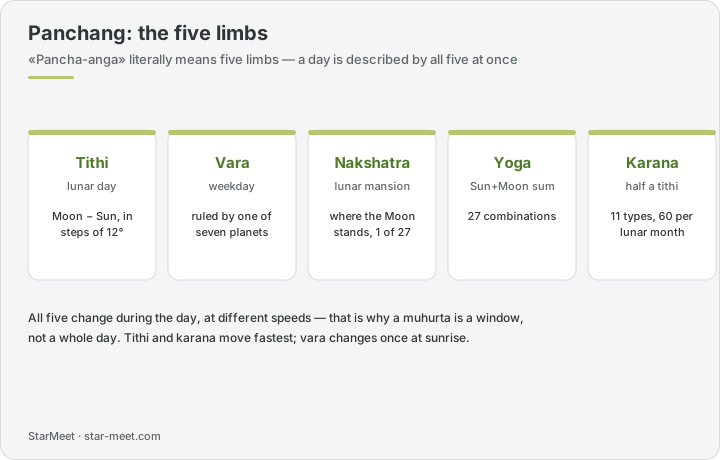
Panchang (Panchangam) is the Eastern almanac recording five daily time-quality factors: Tithi (lunar day), Vara (weekday), Nakshatra (Moon's constellation), Yoga (Sun-Moon arc sum), and Karana (half-tithi). Practiced across India for 5,000 years, it is the foundational tool for muhurta — selecting auspicious moments for important actions.
Every morning, millions of people in India consult the panchang before scheduling a wedding, signing a contract, starting a business, or even booking a medical procedure. Yet outside South Asia, most people have never heard of this 5,000-year-old system. This guide explains everything — from first principles to daily practice — using the foundational works of B.V. Raman, K.N. Rao, and P.V.R. Narasimha Rao.
Key Takeaways
- Panchang = "five limbs" in Sanskrit. It is a lunisolar almanac tracking five distinct time qualities simultaneously, not a simple date system
- The five limbs are Tithi, Vara, Nakshatra, Yoga, and Karana — each governed by a classical element (Water, Fire, Space, Ether, Earth)
- Nakshatra is the most important element per K.N. Rao — it makes the panchang personal through Tara Bala (birth-star strength)
- Muhurta (electional astrology) uses panchang to select auspicious windows — not to predict fate, but to "minimize the evils of past destiny"
- Ayanamsha (Lahiri vs. Raman vs. Pushya Paksha) determines which zodiac correction is applied — different schools give different results
- Location matters critically: Hora, Rahu Kala, and Vara start are local calculations; an IST panchang used in the US is structurally inaccurate for time-sensitive decisions
- Ayurveda confirms: Full Moon = Kapha excess (fluid retention, emotional overwhelm), New Moon = Vata imbalance (anxiety, insomnia) — panchang timing correlates with documented physiological cycles
What Is Panchang? Kalapurusha and the Living Quality of Time
Panchang (Panchangam in South India) is a Eastern almanac that encodes five simultaneous qualities of time into a single daily reading. The word comes from Sanskrit: pancha (five) + anga (limb). Just as the human body is understood through its five limbs, time itself is understood through five measurable dimensions — none of which appear in the Gregorian calendar.
The philosophical foundation comes from the concept of Kalapurusha — the "Person of Time" or cosmic being whose very body is composed of time. B.V. Raman, one of the twentieth century's foremost practitioners of Eastern astrology (also called Vedic astrology, or Jyotish), expressed this directly: "Time is the essence of all things — creator, protector and destroyer." For Raman, time was not a neutral container but a living, qualitative entity — some moments inherently generative, others inherently degenerative.
This idea connects to the Greek distinction between chronos (sequential, measured time) and kairos (the right moment, the opportune time). The Gregorian calendar tracks chronos — dates and hours — while the panchang maps kairos: the energetic quality embedded in each moment. Carl Jung, whom Raman cited in this context, arrived at a similar conclusion through synchronicity: that moments of time share a qualitative character with events occurring within them.
The Sun and Moon are the panchang's two astronomical pillars. In Eastern thought, the Sun represents Atma (soul, life force, the individual's essential nature), while the Moon governs Manas (mind, emotional body, consciousness). The Surya Siddhanta — the classical Sanskrit astronomical treatise — established the mathematical framework for tracking their movements: the Sun's arc defines the solar year, the Moon's phase defines the lunar month, and their angular relationship generates the panchang's most fundamental element, Tithi.
This is why the panchang is lunisolar, not simply lunar or solar. It tracks both luminaries simultaneously and integrates their relationship with the backdrop of 27 lunar mansions (Nakshatras). The result is a time-keeping system of extraordinary precision.
The Five Limbs of Panchang (Pancha Anga): Complete System
Each of the five limbs corresponds to one of the five classical elements (Pancha Tattva). This elemental structure is not metaphorical — it determines which activities are governed by which limb.
| Anga (Limb) | Element | Astronomical Source | Governs |
|---|---|---|---|
| Tithi | Jala (Water) | Sun-Moon angle (12° per tithi) | Emotional quality, fluid dynamics, purity |
| Vara | Agni (Fire) | Day of week (Sun's rulership cycle) | Energy, drive, social contact |
| Nakshatra | Akasha (Space/Mind) | Moon's position in 27 mansions | Mental quality, consciousness, memory |
| Yoga | Akasha (Ether) | Sun + Moon longitude combined | Subtle binding force, cosmic alignment |
| Karana | Prithvi (Earth) | Half a Tithi | Practical groundedness, material activity |
Tithi (Lunar Day): The Water Element of Time
Tithi is the lunar day — the time it takes for the Moon to advance 12° ahead of the Sun. Since the Moon travels at variable speed, a tithi can last anywhere from 19 to 26 solar hours, which means a tithi can begin, run its full course, and end entirely within a single solar day — or it can span across two solar days. This is why the panchang date often differs from the Gregorian date.
The 30 tithis of the lunar month are grouped into five qualitative types — the Nanda-Bhadra-Jaya-Rikta-Poorna cycle, repeating six times through the month:
| Tithi Type | Tithis | Quality | Suitable Activities |
|---|---|---|---|
| Nanda (Joy) | 1, 6, 11 | Auspicious, celebratory | Weddings, festivals, new projects |
| Bhadra (Auspicious) | 2, 7, 12 | Stable, fortunate | Purchases, study, construction |
| Jaya (Victory) | 3, 8, 13 | Competitive, winning | Business negotiations, legal matters |
| Rikta (Void) | 4, 9, 14 | Inauspicious, empty | Avoid for all auspicious activities |
| Poorna (Full) | 5, 10, 15 | Complete, abundant | Long-term ventures, donations, healing |
The Rikta tithis (4th, 9th, 14th) are the most universally avoided days across all panchang traditions. The Sanskrit word rikta means void or empty — these are days when the angular relationship between Sun and Moon creates a quantum of disharmony. Classical texts universally prohibit beginning marriages, business ventures, long journeys, or medical procedures on Rikta days. The K.N. Rao school extends this: if you must act on a Rikta day, choose Abhijit Muhurta (see below) as the compensating window.
Tithi also governs travel restrictions. The 8th and 14th tithis are specifically inauspicious for travel, while the 2nd, 3rd, 5th, 7th, 10th, 11th, and 13th tithis are traditionally favorable. The full Moon (15th tithi, Purnima) and new Moon (30th/Amavasya) are separately classified — Purnima for completion and devotional acts, Amavasya for ancestor rituals (pitru destiny) but not new beginnings.
Vara (Day of Week): The Fire Element
Vara is the weekday — each governed by one of the classical planets. The planetary rulers in Eastern Astrology are: Sunday (Sun), Monday (Moon), Tuesday (Mars), Wednesday (Mercury), Thursday (Jupiter), Friday (Venus), Saturday (Saturn).
Each Vara carries the energy of its ruling planet through what classical texts call Agni tattva — the fire quality of directed action. Monday and Thursday are broadly auspicious for beginnings. Sunday carries solar strength for authoritative actions. Wednesday is excellent for communication, contracts, and commerce. Friday is the most favorable for all Venus-governed activities: arts, relationships, luxury purchases.
Tuesday and Saturday are the most commonly avoided days for major auspicious events — Tuesday carries the combative energy of Mars (a natural malefic when placed in inauspicious configurations), and Saturday's Saturnian delay principle makes it ill-suited for activities requiring quick positive outcomes. However, advanced practitioners note that a strong Nakshatra or Tithi can compensate — panchang reading is always the integration of all five limbs simultaneously, not individual limb selection.
The Hora system subdivides each day into 24 hourly segments, each ruled by a planet. The first Hora of Sunday is ruled by the Sun, of Monday by the Moon, and so on. Each subsequent Hora follows the Chaldean sequence (Saturn → Jupiter → Mars → Sun → Venus → Mercury → Moon). Hora calculation is strictly local — it depends on precise local sunrise, making this the most location-dependent element of the panchang.
Nakshatra — The Most Important Element
The Nakshatra (lunar mansion) is the most important element of the panchang — a consensus position held firmly by K.N. Rao and the Delhi school of Eastern Astrology. While Tithi governs lunar phase and Vara governs weekday energy, Nakshatra provides the most nuanced qualitative data about any moment because it encodes the Moon's precise position within a 27-mansion zodiac that tracks sidereal star clusters.
The 27 Nakshatras span 13°20' of the zodiac each, named after prominent star clusters visible from India. The Moon spends approximately one day in each Nakshatra, completing its circuit in 27.3 days. Nakshatra energy is classified by multiple systems: gender (male/female), nature (fixed/movable/mixed), deity, animal symbolism, and the ruling planet in the Vimshottari Dasha system.
Why Nakshatra outranks Tithi in classical priority: The Moon governs Manas — the mind and consciousness. Whatever house the Moon occupies at any moment becomes, temporarily, the house of the mind's dominant quality. The Nakshatra refines this to a 13°20' arc of symbolic meaning. A marriage begun under Rohini Nakshatra (the Moon's own mansion, ruled by Brahma — the creator) carries entirely different quality than a marriage begun under Jyeshtha (associated with Indra, challenge, and competition). This is irreducible information that Tithi and Vara cannot provide.
Tara Bala: Why Panchang Is Personal
Tara Bala (star strength) is the mechanism that makes the panchang an individual, not universal, calendar. The calculation is simple and elegant:
- Identify the current Nakshatra (from any panchang)
- Count from your Janma Nakshatra (birth star) to the current Nakshatra
- Divide by 9 and take the remainder
- The remainder maps to one of 9 Tara categories
| Tara | Position | Name | Meaning |
|---|---|---|---|
| 1 | Janma | Birth star | Sensitive, neutral |
| 2 | Sampat | Wealth | Excellent for money matters |
| 3 | Vipat | Danger | Avoid risky activities |
| 4 | Kshema | Prosperity | Stable, protective |
| 5 | Pratyak | Obstacles | Delays, resistance expected |
| 6 | Sadhaka | Achievement | Excellent for goals |
| 7 | Naidhana | Loss | Avoid major decisions |
| 8 | Mitra | Friend | Supportive, cooperative |
| 9 | Parma Mitra | Best Friend | Highly auspicious |
This means two people consulting the same panchang on the same day may receive opposite recommendations: one finds the day Sadhaka (achievement), the other finds it Vipat (danger) — depending on their birth stars. This is why the panchang is not a community calendar but a personalized energetic navigation tool.
Yoga and Karana: The Subtle Layers
Yoga is calculated by adding the Sun and Moon's longitudes together and dividing by 13°20' — producing 27 Yoga periods analogous to the 27 Nakshatras but tracking the sum rather than the Moon alone. P.V.R. Narasimha Rao describes Yoga as "the binding ether of the panchang — the invisible connective tissue that holds the five elements together." The Yoga corresponds to the Akasha (ether/space) tattva, which in Eastern cosmology is the substratum underlying all other elements.
Of the 27 Yogas, Vyatipata (Yoga 17) and Vaidhriti (Yoga 27) are the most universally avoided for auspicious activities — they are considered equally destructive to Rikta Tithi in their disruptive effect. Siddha Yoga (a special combination of certain Tithis, Varas, and Nakshatras) is considered highly auspicious and is specifically recommended in the Muhurta Chintamani for beginning important works.
Karana is half a Tithi — the time for the Moon to advance 6° beyond the Sun. Each Tithi contains two Karanas. The Karana corresponds to Prithvi (earth) tattva, governing the most practical and material dimensions of activity. Of the 11 Karanas (4 fixed, 7 movable), Vishti (Bhadra) is the most inauspicious — traditionally compared to a demon that creates obstacles in whatever is started under its influence. The fixed Karanas — Shakuni, Chatushpada, Naga, and Kimstughna — each carry specific symbolic meanings used in specialized muhurta selection.
Panchang vs. Gregorian Calendar: A Fundamental Difference
The Gregorian calendar is a solar calendar designed to track the Earth's revolution around the Sun — its sole purpose is seasonal accuracy. It has no qualitative encoding. January 15th carries no inherent energetic signature different from January 16th; the calendar is a neutral coordinate system for scheduling.
The panchang is a lunisolar qualitative map. It simultaneously tracks:
- The Sun-Moon angular relationship (Tithi)
- The Sun's weekday rulership cycle (Vara)
- The Moon's position within 27 star clusters (Nakshatra)
- The sum of solar and lunar longitudes (Yoga)
- The half-daily practical unit (Karana)
This multi-dimensional tracking produces genuinely different information. The panchang answers not when but what quality of time prevails now — whether a moment is generative or degenerative, protective or disruptive, conducive to intellectual work or physical labor.
A second critical difference is purpose: the Gregorian calendar is administrative (tax years, academic years, legal deadlines), while the panchang is functional (when to act and when to wait). It presupposes that time quality affects outcomes — a proposition now finding increasing support in chronobiology, where circadian and circannual rhythms clearly affect physiological outcomes independent of intention.
Muhurta: Electional Astrology Powered by Panchang
Muhurta is the practice of selecting auspicious times for beginning important activities. In the K.N. Rao tradition, its purpose is stated precisely: "Muhurta is designed to minimize the evils of past destiny." This framing is important — muhurta does not promise success independent of skill and effort. It selects moments where the energetic environment creates the least resistance and greatest support for whatever action is taken.
The classical text Muhurta Chintamani and B.V. Raman's Muhurta lay out systematic rules. At minimum, a muhurta requires:
- Avoid Rikta Tithi (4th, 9th, 14th) — no exceptions for major life events
- Avoid Vyatipata and Vaidhriti Yoga — the two destructive Yogas
- Avoid Vishti Karana — the demon Karana
- Check Nakshatra suitability for the specific activity type (marriage, surgery, travel, education, etc.)
- Check Vara compatibility with the activity (Tuesday/Saturday generally avoided)
- Apply Tara Bala — ensure the current Nakshatra is favorable for the native's birth star
- Avoid Rahu Kala and Yamaghanta — the daily inauspicious periods (1.5 hours each, strictly local)
Abhijit Muhurta is the universal rescue window. Named after the Nakshatra Abhijit (the star Vega, positioned between Uttara Ashadha and Shravana), Abhijit Muhurta occurs at local noon — specifically the 8th Muhurta of the day, roughly 48 minutes bracketing midday. According to classical texts, Abhijit overcomes the defects of Rikta Tithi, inauspicious Vara, and poor Nakshatra — it is the emergency auspicious window when no better combination is available.
Siddha Yoga is a specific combination: Sunday with Hasta Nakshatra, Monday with Mrigashira Nakshatra, Tuesday with Ashwini Nakshatra, and similar pairings. These combinations are held to be inherently auspicious by the accumulated Yoga (conjunction) of Vara and Nakshatra power, overriding otherwise modest configurations.
Muhurta Categories by Activity
| Activity | Priority Elements | Key Avoidances |
|---|---|---|
| Marriage | Nakshatra (Rohini, Mrigashira), Tithi (Nanda/Poorna), Vara (Mon, Wed, Thu, Fri) | Rikta, Vyatipata, Mars-heavy Vara |
| Surgery | Nakshatra (avoid natal 8th lord's Nakshatra), Vara (avoid Mars/Saturn) | Full Moon (bleeding increases), Rikta |
| Travel | Tithi (avoid 8th, 14th), Nakshatra (avoid 4th, 8th, 12th from birth star) | Vishti Karana, Rahu Kala |
| Business launch | Hora (Jupiter or Venus), Vara (Wednesday, Thursday) | Vyatipata, Vishti Karana |
| Education | Nakshatra (Shravana, Hasta, Ashwini), Vara (Wednesday) | Rikta, Vaidhriti |
Tara Bala: Why Panchang Is Personal, Not Universal
The Tara Bala system (explained above in the Nakshatra section) has a deeper implication that deserves emphasis: no single panchang reading is valid for all people on the same day. The same Nakshatra that falls in the Sadhaka (achievement) position for one person falls in Naidhana (loss) for another.
This is why community-level panchang recommendations — "Tuesday is generally inauspicious" or "This Nakshatra is good for everyone" — are incomplete. The complete panchang reading integrates:
- Paksha (waxing/waning fortnight) — Shukla Paksha (waxing) favors initiations; Krishna Paksha (waning) favors completion and reduction
- Tithi quality for the activity type
- Vara suitability
- Nakshatra nature (fixed, movable, or mixed) matched to activity type (fixed for permanent works, movable for travel)
- Tara Bala from Janma Nakshatra
- Local Hora at the planned time
- Absence of Rahu Kala in the target window
The K.N. Rao school teaches that the minimum check for any important decision is: (1) confirm no Rikta Tithi, (2) confirm no Tuesday or Saturday Vara, (3) check Tara Bala is not Vipat or Naidhana. This three-point minimum takes under two minutes with any panchang app and eliminates the most adversarial windows.
Panchang and Biohacking: Ayurveda Confirms What Modern Science Studies
Ayurvedic medicine established a documented correlation between lunar phases and dosha fluctuations long before modern chronobiology. The panchang encodes this correlation through Tithi tracking.
Full Moon (Purnima — 15th Tithi) amplifies Kapha dosha. Kapha governs fluids, earth, and cohesion in the body. Clinical Ayurvedic observations (and modern studies on post-operative bleeding and fluid retention) show elevated fluid dynamics around Purnima. Symptoms: emotional overwhelm, water retention, disrupted sleep, heightened sensory sensitivity. The panchang prescribes full-moon fasting (ekadashi vrat precedes Purnima) to manage Kapha accumulation.
New Moon (Amavasya — 30th/15th Tithi of Krishna Paksha) amplifies Vata dosha. Vata governs air, movement, and the nervous system. Around Amavasya: increased anxiety, insomnia, scattered thinking, dry skin, digestive irregularity. This is the physiologically most vulnerable phase for people with constitutionally high Vata. The Moon's position at Amavasya is conjunct the Sun — the Manas (mind) is "hidden" by the solar Atma, reducing intuitive capacity and emotional stability.
The five classical elements map directly onto physiological systems:
| Element | Panchang Limb | Ayurvedic System | Lunar Phase Effect |
|---|---|---|---|
| Water (Jala) | Tithi | Blood, lymph, reproductive fluids | Full Moon = excess fluid |
| Fire (Agni) | Vara | Digestion, metabolism, transformation | Tuesday/Saturday = suppressed Agni |
| Space (Akasha) | Nakshatra | Consciousness, nervous system | Birth-star periods = heightened sensitivity |
| Ether (Akasha) | Yoga | Subtle body, pranic field | Vyatipata = disturbed prana |
| Earth (Prithvi) | Karana | Bones, tissues, physical structure | Vishti = structural vulnerability |
This is not metaphor. Ayurvedic surgeons historically scheduled elective procedures for the waning Moon (Krishna Paksha, approximately the 6th through 14th tithis) when Kapha is naturally lowest and post-operative fluid accumulation is reduced. Contemporary surgical research on timing has produced corroborating findings on blood loss correlation with lunar cycle, though the mechanism remains debated.
Ayanamsha: Why Calculation System Determines Accuracy
Ayanamsha is the angular difference between the tropical zodiac (based on the vernal equinox) and the sidereal zodiac (based on fixed stars). Because the Earth's axis precesses over a 26,000-year cycle, the vernal equinox point moves backward through the fixed star background at approximately 50.3" per year. Western astrology uses the tropical zodiac (fixed to the equinox); Eastern Astrology uses the sidereal zodiac (fixed to star clusters). The ayanamsha is the correction value needed to convert between them.
Three ayanamsha systems are in common use, and they give materially different results:
| System | Current Value (~2026) | Authority | Notes |
|---|---|---|---|
| Lahiri (Chitrapaksha) | ~24°08' | Government of India (1955) | Most common in digital panchangs |
| Raman | ~22°23' | B.V. Raman, Manual of Hindu Astrology | 0.89° less than Lahiri |
| Pushya Paksha | ~23°06' | Maharashtra tradition | Regional use |
The Surya Siddhanta — the ancient Sanskrit astronomical treatise compiled around 400 CE — is the original source of Eastern astronomical computation. It is extraordinarily accurate for its era but requires modern correction: the Surya Siddhanta's value of Earth's precession differs slightly from modern observations, and over centuries this compounds. P.V.R. Narasimha Rao advocates for Drik Ganita (observationally verified astronomy) as the correction basis, arguing that the Surya Siddhanta itself privileges empirical accuracy over textual authority.
The practical consequence: planets near the boundary between two Nakshatras (the last or first degree of a 13°20' arc) will fall in different Nakshatras depending on which ayanamsha is applied. A planet at 29°50' sidereal Aries under Lahiri might fall in Bharani Nakshatra; under Raman's ayanamsha it might fall in Krittika. This changes Vimshottari Dasha sequence entirely — a matter of significant astrological consequence.
Recommendation for diaspora users: If your astrological practice uses a specific school (K.N. Rao school → Lahiri; B.V. Raman tradition → Raman), maintain consistency across natal chart, transits, and panchang. Mixing ayanamsha systems within a single analysis produces systematic errors.
Geolocation: Why Indian Panchang Fails Outside India
The most critical practical limitation of standard Indian panchangs for diaspora use is geolocation dependency. Not all five limbs are equally affected.
The panchang's elements divide cleanly into two categories:
Location-independent (global validity):
- Tithi — tracks the Sun-Moon angular difference, which is the same for all observers at any moment
- Nakshatra — tracks the Moon's position in the zodiac, also globally valid
- Yoga — derived from Sun + Moon longitudes, globally valid
Location-dependent (local calculation required):
- Hora — calculated from local sunrise; shifts by 4 minutes per degree of longitude
- Rahu Kala — 1.5-hour inauspicious daily period, calculated from local sunrise and sunset
- Yamaghanta — similarly calculated from local sunrise
- Vara — the calendar day changes at local midnight, but the energetic Vara begins at local sunrise; the IST sunrise (approximately 06:30) can differ by many hours from local sunrise in different time zones
The mathematics: 1° of longitude = 4 minutes of time. Mumbai (72°E) is 10 hours and 48 minutes behind Los Angeles (118°W) by pure longitude. If an IST panchang shows Rahu Kala from 9:00 to 10:30 AM IST, Rahu Kala in Los Angeles is approximately 23:12 to 00:42 the previous night — completely different within the local day.
P.V.R. Narasimha Rao states directly: "An IST calendar is broken for diaspora. A Panchang app that does not take the user's GPS location as its primary input is giving structurally incorrect data for all time-sensitive calculations."
Implications for application development: Any panchang tool serving a global audience must use the user's actual geographic coordinates (latitude + longitude) to calculate:
- Local sunrise and sunset times
- Hora sequence from local sunrise
- Rahu Kala, Yamaghanta, Gulika Kala from local sunrise/sunset
- Vara start from local sunrise
Tithi, Nakshatra, and Yoga can be calculated once globally and distributed; Hora and inauspicious periods must be computed per-location.
How to Use Panchang Daily: The 2-Minute Practice
The goal is not to consult 50 variables every morning — it is to check the critical threshold indicators in under two minutes. P.V.R. Narasimha Rao describes three minimum checks that eliminate the most adverse days:
Daily Minimum (2 minutes):
- Check Tithi — Is today a Rikta (4th, 9th, 14th)? If yes, avoid major initiations. Routine work continues normally
- Check Vara — Is today Tuesday or Saturday? Combined with Rikta Tithi or important planned activity, add extra caution
- Check your Tara Bala — Is today's Nakshatra in Vipat (3rd), Pratyak (5th), or Naidhana (7th) position from your birth star? If yes, delay high-stakes decisions if possible
Extended Check for Major Decisions (10 minutes): Add: Yoga (avoid Vyatipata and Vaidhriti), Karana (avoid Vishti), local Hora at planned time (prefer Jupiter or Venus Hora), Rahu Kala avoidance window.
Activity-Specific Priority Matrix:
| Life Domain | Most Important Limb | Secondary Check |
|---|---|---|
| Marriage | Nakshatra (Rohini, Mrigashira, Uttara Phalguni) | Tithi (Nanda or Poorna) |
| Medical/Surgery | Tithi (waning Moon) | Vara (avoid Mars/Saturn) |
| Travel | Hora (Jupiter Hora) | Tithi (avoid 8th, 14th) |
| Business/Contracts | Vara (Wednesday, Thursday) | Hora (Mercury or Venus) |
| Property purchase | Karana (Earth element) | Nakshatra (fixed nature) |
| Education | Nakshatra (Shravana, Hasta) | Vara (Wednesday) |
| Spiritual practice | Tithi (Purnima, Ekadashi) | Nakshatra (birth star area) |
The Abhijit Rescue: On a day with multiple adverse indicators — Rikta Tithi, inauspicious Vara, unfavorable Tara Bala — but where action cannot be deferred, perform the activity during the Abhijit Muhurta window (approximately 11:40 AM to 12:24 PM local time). Classical authority holds that Abhijit neutralizes the most common adverse combinations.
Use StarMeet's free Eastern calculator to analyze your birth chart instantly:
Calculate your personal Tara Bala and today's panchang →
Sanskrit Glossary of Panchang Terms
| Sanskrit Term | Transliteration | Meaning |
|---|---|---|
| पञ्चाङ्ग | Panchanga | Five limbs — the Eastern almanac |
| कालपुरुष | Kalapurusha | Person of Time — cosmic time-body |
| तिथि | Tithi | Lunar day (12° Sun-Moon arc) |
| वार | Vara | Day of week |
| नक्षत्र | Nakshatra | Lunar mansion (13°20' zodiac segment) |
| योग | Yoga | Sun + Moon longitude sum / 13°20' |
| करण | Karana | Half-day unit (6° Sun-Moon arc) |
| मुहूर्त | Muhurta | Auspicious time window (48-minute unit) |
| तारा बल | Tara Bala | Personal star strength from birth Nakshatra |
| अयनांश | Ayanamsha | Precession correction value |
| अभिजित | Abhijit | Midday rescue Nakshatra (star Vega) |
| राहुकाल | Rahu Kala | Daily inauspicious 1.5-hour period |
Seven Quotable Truths About Panchang
1. "Time is the essence of all things — creator, protector and destroyer." — B.V. Raman. The panchang encodes this aliveness of time into a five-dimensional map.
2. The Nakshatra is the most important element of the panchang because it makes the calendar personal — through Tara Bala, two people on the same day may face opposite energetic conditions. — K.N. Rao
3. Muhurta is designed to minimize the evils of past destiny — not to guarantee success, but to reduce the friction between intention and outcome by choosing moments of minimal energetic resistance. — K.N. Rao tradition
4. Abhijit Muhurta is the rescue window: when no perfect configuration exists, local midday provides a universally auspicious window that overrides Rikta Tithi and inauspicious Vara. — P.V.R. Narasimha Rao
5. 1° of longitude = 4 minutes of time. An IST panchang used in New York gives Hora and Rahu Kala data that is structurally off by hours. Geolocation is not optional for time-sensitive panchang calculations. — P.V.R. Narasimha Rao
6. Full Moon amplifies Kapha; New Moon amplifies Vata. The panchang's Tithi cycle tracks the same physiological rhythms that Ayurvedic medicine has documented for 3,000 years and that modern chronobiology is beginning to quantify.
7. Yoga binds the five elements like ether — it is the invisible connective tissue of the panchang, the subtle force beneath the observable cycles of Moon and Sun. — P.V.R. Narasimha Rao
Conclusion: Begin with the Minimum, Build with Practice
The panchang is not a superstition system or an alternative to planning. It is a precision tool for reading the qualitative texture of time — developed over millennia of astronomical observation and experiential refinement by cultures that treated time as something alive, not neutral.
The entry point is simple: check Tithi (avoid Rikta), check Vara (avoid Tuesday/Saturday for major events), and check your Tara Bala from your birth Nakshatra. This three-step minimum takes two minutes and eliminates the most adversarial energetic windows from your schedule.
As practice deepens, the system reveals extraordinary precision — Muhurta selection integrating all five limbs plus Hora, Rahu Kala, and divisional chart readiness, producing the kind of timing alignment that classical texts describe as "minimizing the evils of past destiny."
Explore your personal panchang readings based on your exact birth star → Calculate your birth chart to discover your Janma Nakshatra and get personalized Tara Bala readings.
For timing significant life decisions — relocations, career pivots, medical procedures, or relationship commitments — explore how the 11th house timing techniques in Eastern Astrology integrate with panchang Muhurta selection for maximum precision.
Panchang readings are derived from astronomical lunar and solar positions (NASA JPL Horizons data, Lahiri/Raman ayanamsa). Classical sources on the five limbs and Muhurta selection: Brihat Samhita (Varahamihira), Muhurta Chintamani (Daivajna Ram), and Brihat Parashara Hora Shastra; modern method following the K.N. Rao and P.V.R. Narasimha Rao traditions cited above.
Frequently Asked Questions
What does panchang mean?
Panchang (or Panchangam) means 'five limbs' in Sanskrit — from pancha (five) + anga (limb). The five limbs are: Tithi (lunar day), Vara (weekday), Nakshatra (lunar mansion), Yoga (sun-moon combination), and Karana (half-day unit). Together they give a complete energetic picture of any moment in time.
What is the most important element of the panchang?
According to the K.N. Rao school of Eastern astrology, Nakshatra is the most important element of the panchang. The lunar mansion active at birth (Janma Nakshatra) determines Tara Bala — personal lunar strength — which makes the panchang an individualized tool rather than a one-size-fits-all calendar.
What is a muhurta in Eastern astrology?
Muhurta is an auspicious time window selected for beginning important activities — from the Sanskrit for a 48-minute unit of time. In electional astrology, it combines Tithi, Vara, Nakshatra, Yoga, and Karana to find moments that minimize adverse life patterns and maximize the probability of success. Abhijit Muhurta (midday) is the universal rescue window on imperfect days.
What is Tithi and why do Rikta Tithis matter?
Tithi is the lunar day — the angular relationship between the Sun and Moon advancing 12° each tithi. The Rikta tithis (4th, 9th, 14th of each fortnight) mean 'void' or 'empty' in Sanskrit and are avoided for all auspicious beginnings — marriages, business launches, travel, surgery — across all classical panchang schools.
Why does location matter for panchang calculations?
Every 1° of longitude equals 4 minutes of time difference. Hora, Rahu Kala, Yamaghanta, and the start of Vara are strictly local calculations. An IST-based panchang used in New York or London gives wrong Hora windows and Rahu Kala timings — structurally off by 5–10+ hours. Only Tithi and Nakshatra (which track the Sun-Moon angle) are globally valid.
What is Tara Bala in panchang?
Tara Bala is personal lunar strength derived from your Janma Nakshatra (birth star). Count the current Nakshatra from your birth star, divide by 9 — the remainder determines which of 9 Tara categories applies. Categories include Sampat (wealth), Kshema (prosperity), Vipat (danger), Pratyak (obstacles), Naidhana (loss), and four more. A panchang must be read relative to your birth star.
What is the difference between Lahiri and Raman ayanamsha?
Ayanamsha is the degree value used to correct tropical planet positions to the sidereal zodiac. Lahiri ayanamsha (officially adopted by the Indian government in 1955) differs from the Raman ayanamsha by roughly 0.89°. This difference shifts planet positions by 0.89° between the two systems, affecting Nakshatra placement particularly at cuspal degrees. Most modern digital panchangs default to Lahiri.
How does panchang connect to biohacking and Ayurveda?
Ayurvedic medicine correlates lunar phases with dosha fluctuations. Full Moon amplifies Kapha dosha — excess fluid retention, emotional overwhelm, disrupted sleep. New Moon amplifies Vata — dryness, anxiety, insomnia, scattered thinking. The panchang tracks these cycles through Tithi, enabling conscious timing of fasting, surgery, meditation, and lifestyle interventions for better physiological outcomes.
About the author
Vadim Arkhipov
Founder of StarMeet. Student of Jyotish since 2013, having completed an advanced course under Dr. K.N. Rao; 30+ years in business. Articles here are written to my brief, drafted with AI assistance and edited by me before publishing.
Profile, expertise and all articles →Related Articles
11th House Astrology (Labha Bhava): Gains, Desires & the Power of Allies
Complete guide to 11th house astrology (Labha Bhava): upachaya houses, all 9 planets, lord in 12 houses, Dhana Yoga, divisional charts, and K.N. Rao timing techniques.
Jyotish2nd House in Eastern Astrology (Dhana Bhava): Wealth, Speech & Family
Complete guide to the 2nd house in Eastern Astrology — Dhana Bhava significations, all 9 planets in 2nd house, Dhana Yoga wealth combinations, Maraka effects, and practical remedies from Brihat Parashara Hora Shastra.
JyotishFree Birth Chart Calculator: Your Complete Guide to Natal Charts
Calculate your free birth chart online instantly. Our Eastern Astrology calculator reveals planetary positions, houses, nakshatras, and dasha periods. No signup required.
Jyotish