Kalatra Bhava: 7th House in Eastern Astrology — Complete Guide
Contents
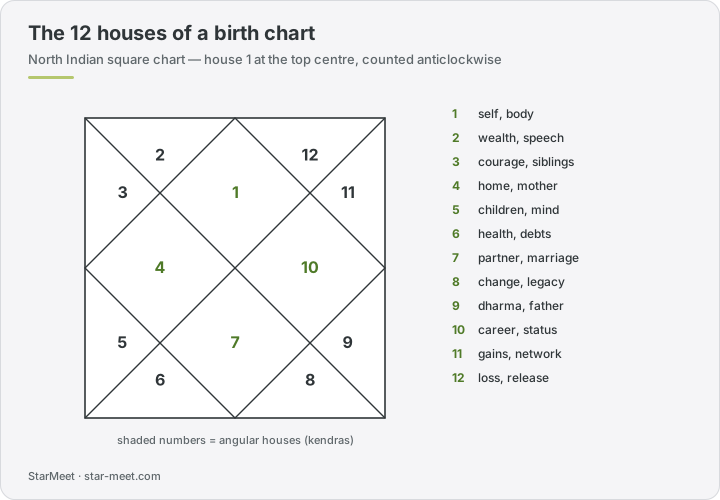
The 7th house in Eastern astrology (also called Vedic astrology, or Jyotish) is not simply the house of marriage. It is the house of the Other — everything that exists outside the self. Your spouse, your open adversary, your business partner, your death. All of them live in Kalatra Bhava, because all of them represent the world beyond your own 1st house ego.
This is the house where the Kama Trikona peaks, where Marakas are born, and where the soul encounters its mirror. Understanding it changes how you read every chart.
This complete guide draws from Brihat Parashara Hora Shastra (BPHS Ch. 11, 18, 24, 32, 33, 44), B.V. Raman's How to Judge a Horoscope (Vol. 1 & 2), P.V.R. Narasimha Rao (lectures 1–45, 101–118, 142–157, 176–181, 182–191), K.S. Charak's Elements of Eastern Astrology, and Jatakalankara.
Calculate your 7th house ruler and Dara Karaka →
Check your relationship destiny →
Key Takeaways
- The 7th house is a Kendra (angular pillar), Kama Trikona (peak of desire), and Maraka Sthana — three classifications simultaneously
- Dara Karaka (planet with the lowest degree) reveals the actual soul of your partner — more specific than Venus
- Kuja Dosha (Mars in 1/2/4/7/8/12) is real but vastly over-dramatised — classical texts list 20+ cancellations
- Saturn receives Digbala in the 7th — it delays but strengthens marriage dramatically
- The Navamsha (D9) is the primary chart for marriage quality; D1 shows circumstances, D9 shows the soul
- The double transit rule (Jupiter + Saturn over the 7th) is the most reliable marriage timing method
- The Maraka mechanism runs through Bhavat Bhavam: 12th from the 8th house = 7th house
What Is Kalatra Bhava? Sanskrit Names, Classification, and the Kama Trikona
Sanskrit Names of the 7th House: What Each Name Reveals
The 7th house carries eight Sanskrit names in classical literature, each revealing a different dimension of its nature:
| Sanskrit Name | Translation | What It Reveals | Source |
|---|---|---|---|
| Kalatra | Spouse / Partner | Primary marriage indicator | BPHS Ch. 11 |
| Yuvati | Youth / The Young One | Romantic union, sensual desire | BPHS Ch. 11 |
| Jaamitra | Opponent / Adversary | Open enemies, court opponents | BPHS Ch. 32 |
| Asta | Setting / Descent | Weakening of the ego-self | Rao Lectures |
| Smara | Memory / Longing | Deep desire for the other | Jatakalankara |
| Madana | Intoxicating Desire | Kamadeva's house | BPHS |
| Dyuna | Partnership Matters | Business and legal partnership | K.S. Charak |
| Kaama | Desire / Fulfilment | Core of the Kama Trikona | BPHS Ch. 18 |
The Kama Trikona (3-7-11): The Triangle of Desire
The four Trikonas divide human life into four Purusharthas — four goals of existence. The 7th house sits at the apex of the Kama Trikona (3-7-11), the triangle of desire and fulfillment:
- 3rd house — initiative, effort, the will to reach out
- 7th house — the Other, the meeting point of Self and Not-Self
- 11th house — gains, fulfillment, what desire finally produces
The Dharma Trikona (1-5-9) teaches you who you are. The Artha Trikona (2-6-10) shows how you sustain yourself. The Moksha Trikona (4-8-12) leads you toward liberation. But the Kama Trikona drives the human soul to step outside the 1st house ego and seek completion through another.
"The 7th house is fundamentally the house of interaction; it represents everything that is 'Not-Self' — reflecting how one deals with the world, open opponents, and business partners." — P.V.R. Narasimha Rao / StarMeet
Angular House (Kendra): The Pillar of Life
The 7th is one of four Kendra houses (1-4-7-10) — the most powerful positions in any chart. Classical texts call Kendras the Vishnu Sthanas — pillars of support and sustenance. A planet in the 7th is therefore highly amplified, for better or worse. The natural significators of the 7th (Venus and Jupiter) placed here become especially potent, while malefics here require careful interpretation.
7th House as Maraka Sthana: Why the Spouse's House Brings Death
The 7th house is one of two Maraka Sthanas (houses of death) alongside the 2nd house. This appears paradoxical — why does the house of partnership govern death?
The mechanism comes from Bhavat Bhavam (house from house): the 7th house is the 12th house counted from the 8th (house of longevity). The 12th signifies loss. Loss of longevity = death. Thus the 7th, by being 12th from the 8th, becomes a natural Maraka — a diminisher of life force.
"According to the Brihat Parashara Hora Shastra, the 2nd and 7th houses function as Maraka Sthanas because they are positioned in the 12th house of loss from the 3rd and 8th houses of longevity." — BPHS / StarMeet
The Polarity Principle: 1st House vs 7th House
P.V.R. Narasimha Rao describes the 1st/7th axis as the axis of Self and Other. The 1st house is your identity, your body, your ego-self. The 7th is the mirror — everything you are not, reflected back at you through your partner, your adversary, and ultimately through death itself.
"The 7th house serves as the peak of the Kama Trikona; it drives the human soul to step out of the 1st house ego to seek fulfillment and completion through external partnerships." — P.V.R. Narasimha Rao / StarMeet
Complete Karakatva List (BPHS)
| Karakatva | Sanskrit Term | Domain | Source |
|---|---|---|---|
| Spouse | Kalatra | Marriage, life partner | BPHS Ch. 11 |
| Open Enemies | Ari / Jaamitra | Opponents, rivals | BPHS Ch. 32 |
| Business Partner | Bhagidara | Trade associations | K.S. Charak |
| Maraka (Death) | Marakesh | Longevity, death dasha | BPHS Ch. 44 |
| Foreign Travel | Videsh | Living abroad | Rao Lectures |
| Sexual Pleasure | Rati | Physical union | Jatakalankara |
| Litigation | Nyaya | Court cases | BPHS |
| Trade & Commerce | Vyapara | Business activity | B.V. Raman |
Dara Karaka: The Jaimini Key to Your Spouse
The 7 Jaimini Karakas: A Revolutionary System
The Jaimini Karaka system assigns the seven visible planets a specific life role based purely on their degree within a sign. The planet with the highest degree becomes the Atma Karaka (AK), the soul's primary mission. The planet with the lowest degree becomes the Dara Karaka (DK) — the soul-purpose significator of the spouse:
| Karaka Name | Abbreviation | Degree Rank | Domain |
|---|---|---|---|
| Atma Karaka | AK | Highest degree | Soul's purpose |
| Amatya Karaka | AmK | 2nd highest | Career, intelligence |
| Bhratri Karaka | BK | 3rd | Siblings, courage |
| Matri Karaka | MK | 4th | Mother, home |
| Pitri/Putra Karaka | PK | 5th | Father or children |
| Gnati Karaka | GK | 6th | Obstacles, relatives |
| Dara Karaka | DK | Lowest degree | Spouse, partnership |
Dara Karaka vs Venus: A Critical Distinction
Venus is the Naisargika Karaka (natural significator) of marriage — it represents the universal concept of love, beauty, and union. Every person's Venus points toward marriage in a general sense.
But Dara Karaka is specific. It reveals the actual soul of your individual partner — their deepest nature, their core motivation, what they truly are beneath the surface.
"The Jaimini concept of Dara Karaka — the planet with the lowest degree — represents the actual soul and inner qualities of the spouse, differentiating it from Venus, which only signifies the universal concept of marriage." — P.V.R. Narasimha Rao / StarMeet
For example: if your DK is Saturn, your spouse will have a Saturnine nature — disciplined, serious, slow to open, enduringly loyal. If your DK is Mercury, they will be communicative, intellectual, quick-minded, possibly younger.
Atma Karaka ↔ Dara Karaka: The Soul-purpose Law of Attraction
In Jaimini, the AK and DK relationship reveals the soul contract between two people. When the AK of one chart is the DK planet of another's chart, a profound soul-purpose bond exists. Rao explains: if AK and DK are in mutual Trikona (1-5-9 relationship) in the Navamsha, the union is smooth and spiritually supportive. If in 6-8 or 2-12 relationship, the union carries soul-purpose friction — transformative but challenging.
Darapada (A7): The Visible Face of Marriage in Society
The Arudha of the 7th house (A7) shows how your marriage or partnership is perceived publicly — the visible, tangible manifestation of your union in the material world. A strong A7 with benefics indicates a socially respected, high-status partnership. A7 afflicted by malefics may indicate a partnership that faces public scrutiny or social disapproval regardless of its internal quality.
Open Enemies, Court Cases, and Business Partnerships
Three Types of Enemies: The 6th, 7th, and 12th Distinction
One of the most commonly confused distinctions in Eastern Astrology is the difference between the three houses of opposition:
| House | Enemy Type | Nature | Strategy |
|---|---|---|---|
| 6th (Shatru Bhava) | Hidden, covert enemies | Backstabbers, secret opponents, rivals who undermine quietly | Endurance, service, discipline |
| 7th (Jaamitra) | Open, declared enemies | Court adversaries, public rivals, face-to-face opponents | Strength, legal battle |
| 12th (Vyaya Bhava) | Self-undoing, hidden loss | Those who isolate you, spiritual opposition, self-sabotage | Surrender, spiritual practice |
The 7th house enemy stands across from you. You know who they are. The confrontation is public. Litigation, open disputes, and declared rivalries all belong here.
Winning Court Cases: Lagnesh vs 7th Lord
Classical texts give a clear rule for legal disputes: compare the strength of the Lagnesh (1st house lord) against the 7th lord in the birth chart and dashamsha (D10). Whichever is stronger in Shadbala (six-fold strength) tends to prevail in open conflict.
Additional factors: Saturn in the 7th on the opponent's side creates a slow, grinding, delayed case. Rahu in the 7th creates deceptive, irregular tactics from the opponent. Mercury as the 7th lord produces a clever, negotiating adversary who may settle out of court.
Kama Trikona (3-7-11) in Business Partnerships
Business partnerships are read primarily from the 7th house (the partner) and the 10th house (the business/destiny). The Kama Trikona 3-7-11 governs the entire commercial triangle:
- 3rd house: Initiative, contracts, short journeys to meet partners
- 7th house: The partner themselves, the terms of the deal
- 11th house: Profits, gains, the commercial fruits of the alliance
For business partnership analysis, the D10 (Dashamsha) takes precedence over D9. Rao notes: "D9 is for the soul of the spouse. D10 is for the reality of your business associate."
"The placement of the 7th lord in a Dusthana (6th, 8th, or 12th house) without benefic support is a primary indicator of significant delays in marriage or potential difficulties for the spouse." — BPHS & K.S. Charak / StarMeet
All 9 Planets in the 7th House
The Complete Planetary Analysis
| Planet | Partner Nature | Marriage Quality | Open Enemies | Maraka Effect |
|---|---|---|---|---|
| Sun | Proud, authoritative, independent | Ego conflicts; needs mutual respect | Powerful, high-status opponents | Strong Maraka in Leo/Aries lagnas |
| Moon | Emotional, nurturing, changeable | Deep emotional bond; possible instability | Emotional, manipulative adversaries | Moderate Maraka |
| Mars | Energetic, assertive, passionate | Passionate but conflict-prone; Kuja Dosha | Direct, aggressive opponents | Very strong Maraka |
| Mercury | Intelligent, communicative, witty | Intellectual partnership; possible fickleness | Clever, scheming adversaries | Moderate Maraka |
| Jupiter | Wise, generous, religious | Generally excellent; risk of Karako Bhava Nashaya | Noble opponents who fight fair | Moderate Maraka |
| Venus | Beautiful, artistic, sensual | Excellent for marriage quality; risk of Karako Bhava Nashaya | Charming but persistent adversaries | Moderate Maraka |
| Saturn | Disciplined, serious, enduring | Digbala — delays but creates lasting unions | Persistent, systemic, institutional enemies | Strongest Maraka of all |
| Rahu | Unconventional, foreign, obsessive | Intense, soul-purpose, often cross-cultural | Deceptive, foreign, boundary-crossing enemies | Powerful Maraka as Saturn's agent |
| Ketu | Spiritual, detached, otherworldly | Spiritual union; risk of emotional distance | Mysterious, self-effacing adversaries | Significant Maraka |
Sun in the 7th House
The Sun receives zero Digbala (directional strength) in the 7th house — it is at its weakest directional position here. The Sun represents ego and sovereignty; the 7th house demands the ego's submission to partnership. This creates a fundamental tension: the partner may be authoritative or domineering, the marriage may suffer from power struggles, or the native's own identity may be suppressed in relationships.
However: Sun in the 7th in its own sign (Leo) or exaltation (Aries) partially compensates. Career advancement through powerful partners is common.
Saturn in the 7th House: The Digbala Paradox
Saturn receives maximum Digbala (directional strength) in the 7th house — the exact opposite of the Sun. This is one of Saturn's most powerful positions, yet it carries the reputation of delaying marriage significantly.
Rao clarifies: Saturn's delay is purposeful. It ensures the native matures sufficiently before committing. Once Saturn approves of the union, it creates rock-solid, enduring partnerships that outlast any other planetary combination. Partners tend to be older, more serious, disciplined, and loyal to a fault.
"Saturn receives Digbala in the 7th house. Patience is not merely a virtue — it is the essential mechanism through which Saturn's marriage gains its remarkable longevity." — P.V.R. Narasimha Rao / StarMeet
Kuja Dosha (Mangal Dosha): The Complete Classical Analysis
Kuja Dosha (also called Mangal Dosha or Manglik Dosha) arises when Mars occupies these positions in the birth chart:
- 1st house (Lagna)
- 2nd house
- 4th house
- 7th house (direct Dosha)
- 8th house
- 12th house
B.V. Raman defines it: Mars in these positions generates excessive fire, aggression, and Pitta energy in the domain of partnership — potentially causing friction, separation, or harm to the spouse.
Classical cancellations (Bhanga Kuja Dosha):
- Mars in its own sign (Aries, Scorpio) or exaltation (Capricorn)
- Mars conjunct Jupiter or Venus (pacified by benefics)
- Mars in the 2nd for Gemini/Virgo Lagna
- Both partners have Kuja Dosha (mutual Dosha neutralisation)
- Mars in Aquarius in the 8th house
- Any lagna where Mars is a natural benefic (Cancer, Leo)
- After age 28 (Saturn's first return), the dosha significantly diminishes
Rao's position: "Kuja Dosha is real — but 80% of charts carry some form of cancellation. Do not terrify clients over a dosha that the classics themselves qualify extensively."
"Kuja Dosha, caused by Mars in the 1st, 2nd, 4th, 7th, 8th, or 12th house, indicates an excess of aggressive energy in relationships, but classical texts provide numerous cancellations that neutralise this flaw." — B.V. Raman / StarMeet
Rahu in the 7th House
Rahu in the 7th creates soul-purpose, obsessive, often cross-cultural partnerships. The partner may be of a different nationality, background, or belief system. The attraction is magnetic and destabilising — a sense of meeting someone inexplicably familiar yet foreign.
Professionally, Rahu in the 7th creates mastery in foreign trade, immigration, and industries that bridge cultures. Rahu as a Maraka is powerful — it acts as Saturn's agent in bringing the soul-purpose accounting of lifespan.
Discover your relationship destiny and Dara Karaka →
Marriage Delay, Kuja Dosha, and Timing
Five Classical Causes of Delayed Marriage
| Cause | Planet/Combination | Classical Source | Remedy |
|---|---|---|---|
| Emotional immaturity | Moon afflicted by Saturn/Rahu in 7th | BPHS Ch. 18 | Moon mantra, emotional healing |
| Soul-purpose debt in relationship | Saturn in 7th or aspecting Venus | B.V. Raman | Saturn mantra, serve elders |
| Fear of commitment | Ketu in 7th | K.S. Charak | Ketu mantra, spiritual grounding |
| Obsessive standards | Rahu in 7th or Venus | Rao Lectures | Acceptance practices |
| 7th lord in Dusthana | 7th lord in 6/8/12 | BPHS Ch. 24 | Strengthen 7th lord's planet |
Delayed Marriage vs Denied Marriage: The Vairagya Distinction
A weak or afflicted 7th house does not automatically mean no marriage. Classical texts distinguish between:
- Delayed marriage — Saturn, Rahu, afflicted Venus → marriage comes late but comes
- Denied marriage (Vairagya/Sannyasa Yoga) — multiple planets in the 12th, Ketu conjunct Sun and Moon in specific configurations → genuine spiritual calling toward celibacy
BPHS describes Pravrajya Yogas (renunciation combinations): strong Ketu in the 12th, multiple Kendra planets in a single sign, specific Saturn-Moon configurations. These indicate spiritual vows, not merely delayed worldly partnership.
Second and Third Marriages: Houses 9 and 11
Classical rule: the 2nd marriage is seen from the 9th house (3rd from the 7th = next partnership). The 3rd marriage from the 11th house (5th from the 7th). Planets in these houses, their lords, and their Dashas reveal the timing and quality of subsequent marriages.
Marriage Timing: The Three-Layer Method
Layer 1 — Vimshottari Dasha:
- Dasha/Antardasha of the 7th lord (in D1 and D9)
- Dasha of the Dara Karaka planet
- Dasha of Venus (universal significator)
Layer 2 — Narayana Dasha (Navamsha):
- The Navamsha Lagna Dasha of the 7th house sign
Layer 3 — Double Transit Rule (Jupiter + Saturn): The most reliable external trigger for marriage. Both Jupiter and Saturn must simultaneously:
- Transit over the 7th house
- Transit over the 7th lord
- Transit over Venus
"The Navamsha chart (D-9) is the crucial micro-zodiac for marriage; while the Rasi chart (D-1) shows the physical circumstances of the partner, the Navamsha reveals the inner self and the true Dharma of the union." — P.V.R. Narasimha Rao / StarMeet
Maraka: The 7th House as the Second House of Death
What Is a Maraka?
Maraka (Sanskrit: killer) refers to planets that govern the houses associated with the diminishment of lifespan. BPHS Chapter 44 identifies the 2nd and 7th lords as primary Marakas for every lagna. Their Dashas, especially during the final third of life or during periods of physical vulnerability, can trigger the death mechanism.
The classical mechanism: the 8th house rules longevity. The 3rd house (12th from the 4th) rules secondary longevity. The 12th house from both (7th from the 8th, 2nd from the 3rd) represent the loss of life force — hence the 7th and 2nd become Marakas.
Marakeshi Table: For All 12 Lagnas
| Lagna | 2nd Lord (Maraka) | 7th Lord (Maraka) | Primary Maraka |
|---|---|---|---|
| Aries | Venus | Venus (same) | Venus — double Maraka |
| Taurus | Mercury | Mars | Mars (angular, more powerful) |
| Gemini | Moon | Jupiter | Jupiter — powerful Maraka |
| Cancer | Sun | Saturn | Saturn — universal Maraka |
| Leo | Mercury | Saturn | Saturn — Digbala in 7th |
| Virgo | Venus | Jupiter | Jupiter for Virgo |
| Libra | Mars | Mars (same) | Mars — double Maraka |
| Scorpio | Jupiter | Venus | Venus — double Maraka role |
| Sagittarius | Saturn | Mercury | Saturn — universal Maraka |
| Capricorn | Saturn | Moon | Saturn (2nd lord, strong) |
| Aquarius | Jupiter | Sun | Sun as 7th lord Maraka |
| Pisces | Mars | Mercury | Mercury — 7th lord |
Saturn as Universal Maraka
Regardless of lagna, Saturn is the most reliable Maraka in Vimshottari Dasha analysis. Its role as the planet of endings, restriction, and soul-purpose accounting makes it the universal executor of lifespan. During Saturn Mahadasha or Antardasha, especially after age 60, classical astrologers scrutinise the chart carefully for the Ayush (longevity) calculation.
Protection against Maraka activation:
- Strong Lagnesh (1st lord) — protects the body
- Strong Trikona lords (especially 9th lord — Jupiter's dharma)
- Jupiter aspecting the Lagna or its lord
- Strong 8th house (longevity itself is robust)
Divisional Charts, Yogas, and Remedies
Navamsha (D9): Reading the 7th House for Marriage
The Navamsha (D9) is the single most important divisional chart for marriage analysis. BPHS explicitly states: Kalatram Navamsake — the spouse is seen in the Navamsha.
Key D9 analysis points:
- D9 Lagna — reveals the partner's inner character (more accurate than D1 7th sign)
- 7th house in D9 — the nature and quality of the actual married life
- Atma Karaka in D9 — the Karakamsha (soul-degree sign); 7th from Karakamsha shows the spiritual nature of the spouse
- Dara Karaka in D9 — placed in which house and sign reveals the partner's environment and inner values
Rao's synthesis: "The D9 Lagna is a rebirth — it shows who you truly are beneath your D1 body. The D9 7th house shows who your partner truly is beneath their social persona."
Yogas of the 7th House: Classical Formations
| Yoga Name | Formation | Effect | Source |
|---|---|---|---|
| Karako Bhava Nashaya | Venus/Jupiter in 7th (Karakas of 7th) | Significator weakens its own house — marital complications | Classical Maxim |
| Kuja Dosha | Mars in 1/2/4/7/8/12 | Aggression in partnerships; many cancellations exist | B.V. Raman |
| Darapada Yoga | 7th lord and A7 in good dignity | Excellent, socially visible marriage | Jaimini Sutras |
| Harsha Yoga (7th context) | 7th lord in 6th (from 7th perspective) | Partner faces chronic challenges | BPHS |
| Grahan Yoga in 7th | Sun/Moon conjunct Rahu/Ketu in 7th | Eclipsed partnerships; soul-purpose entanglements | BPHS Ch. 33 |
The 7th Lord in All 12 Houses (BPHS Ch. 24)
| 7th Lord In | Partner Type | Marriage Quality | Meeting Circumstances |
|---|---|---|---|
| 1st house | Attractive, assertive, independent | Strong, personality-driven | Close proximity, local connections |
| 2nd house | Wealthy, family-oriented, traditional | Family approval essential | Through family introduction |
| 3rd house | Communicative, adventurous, younger | Active social life sustains union | Through siblings, local travel |
| 4th house | Emotional, home-loving, maternal/paternal | Domestic harmony; deep roots | Through home or education |
| 5th house | Romantic, creative, intellectual | Love marriage; strong chemistry | Romance, education, creative settings |
| 6th house | Service-oriented, practical, health-focused | Challenges but endurance; work partnership possible | Workplace, service environments |
| 7th house | Balancing, Libra-like, relationship-focused | Strong but dependent | Direct, obvious attraction |
| 8th house | Mysterious, transformative, intense | Profound transformation; possible instability | Hidden connections, unexpected circumstances |
| 9th house | Dharmic, philosophical, possibly foreign | High dharmic compatibility | Travel, religion, higher learning |
| 10th house | Ambitious, career-driven, public | Partnership advances career | Professional environments |
| 11th house | Social, network-oriented, friend-like | Friendship-based partnership | Social groups, shared goals |
| 12th house | Spiritual, introspective, foreign | Possible separation; deep soul-purpose bond | Foreign lands, solitary settings |
Remedies for the 7th House
| Afflicting Planet | Mantra | Deity/Upasana | Practical Action |
|---|---|---|---|
| Saturn | Om Sham Shanaishcharaya Namah | Shiva, Bhairava | Serve the elderly; donate sesame on Saturdays |
| Mars | Om Ang Angarkaya Namah | Hanuman, Kartikeya | Physical service; donate red lentils on Tuesdays |
| Rahu | Om Ram Rahave Namah | Durga, Saraswati | Feed the hungry; donate to foreign causes |
| Ketu | Om Kem Ketave Namah | Ganesha, Skanda | Ancestral rituals (Pitru Tarpana) |
| Sun | Om Suryaya Namah | Surya, Vishnu | Offer water to the Sun at sunrise |
| Moon | Om Som Somaya Namah | Chandra, Parvati | Fast on Mondays; donate milk |
P.V.R. Narasimha Rao's Synthesis: The Partner as Mirror
Rao's deepest teaching on the 7th house transcends marriage and enemies alike: the partner is a mirror of the self. Every quality you disown in your 1st house, you project outward into your 7th house relationships. Your spouse embodies what you have refused to acknowledge within yourself.
The Kama Trikona (3-7-11) represents the soul's journey from desire (Kama as Purusharthas) to its fulfillment. The 7th house is not about finding the right partner — it is about becoming the person who can sustain the right partnership.
"The 7th house, when understood correctly, is the house where the ego must die so that the soul can grow. The Maraka quality of the 7th is not about physical death — it is the death of the self-centered 1st house identity in order to create genuine union." — P.V.R. Narasimha Rao / StarMeet
FAQ
What is the 7th house in Eastern Astrology?
The 7th house (Kalatra Bhava / Yuvati Bhava) is the house of marriage, partnership, open enemies, and business associates. It is simultaneously a Kendra (angular pillar), a Maraka Sthana (house of death), and the apex of the Kama Trikona. It governs everything and everyone that is "Not-Self" — the mirror through which you discover who you are.
What is Dara Karaka and how does it differ from Venus?
Dara Karaka is the Jaimini planet with the lowest degree in your chart — the actual soul-purpose significator of your spouse. Venus is the universal, natural significator of marriage — it applies to everyone. DK is personal and specific. For spouse prediction, analyse both: Venus shows what you ideally desire; DK shows who actually comes.
What is Kuja Dosha and when is it cancelled?
Kuja Dosha (Mangal Dosha) occurs when Mars sits in the 1st, 2nd, 4th, 7th, 8th, or 12th house. Classical texts provide 20+ cancellations including: Mars in own sign (Aries/Scorpio) or exaltation (Capricorn), Jupiter or Venus conjunct Mars, mutual Kuja Dosha between partners. Most charts with Kuja Dosha carry at least one cancellation.
Which planets delay marriage?
Saturn (primary delay — but produces lasting marriage once it approves), Rahu (obsessive standards, soul-purpose complexity), Ketu (spiritual detachment), afflicted Venus or Jupiter, and the 7th lord in Dusthana (6/8/12).
What is the difference between 6th, 7th, and 12th house enemies?
The 6th shows covert, hidden enemies who undermine you silently. The 7th shows open, declared enemies — court opponents, public rivals you face directly. The 12th shows self-undoing, isolation, and spiritual opposition.
How does Navamsha (D9) show marriage quality?
D9 is the primary chart for marriage. The D9 Lagna reveals the partner's true inner nature. The 7th in D9 shows the lived quality of married life. AK and DK in D9 reveal the soul-purpose soul contract between partners.
What does Saturn in the 7th mean?
Saturn here receives Digbala — maximum directional strength. It delays marriage significantly but produces enduring, disciplined partnerships. The partner tends to be older, serious, and deeply loyal. Rao: "Patience is the key."
How do I time marriage?
Three-layer method: (1) Vimshottari Dasha of the 7th lord/DK/Venus in D1 and D9; (2) Narayana Dasha of the Navamsha 7th; (3) Double transit — Jupiter AND Saturn must both aspect the 7th house, its lord, or Venus simultaneously.
Key Takeaways: The 7th House as Mirror, Maraka, and Marriage
The 7th house in Eastern Astrology is the most complex in the entire chart — simultaneously the house of love and of death, partnership and enmity, the soul's deepest desire and the ego's greatest challenge. From the Kama Trikona to the Maraka mechanism, from Dara Karaka to Navamsha analysis, Kalatra Bhava demands a multi-layered reading.
The key: approach it not as a house of marriage, but as the house of the Other — and everything that the encounter with the Other reveals about yourself.
Discover your 7th house, Dara Karaka, and marriage destiny →
Frequently Asked Questions
What is the 7th house in Eastern astrology?
The 7th house (Kalatra Bhava / Yuvati Bhava) is the house of partnership, marriage, open enemies, and business associates. It is both a Kendra (angular house) and a Maraka Sthana (house of death), sitting exactly opposite the 1st house. It belongs to the Kama Trikona (3-7-11 triangle of desire) and governs how we relate to the Other in every form.
What is Dara Karaka and how does it differ from Venus in marriage analysis?
Dara Karaka (DK) is the Jaimini significator of the spouse — the planet with the lowest degree in your chart. Venus is the natural (Naisargika) significator of marriage and indicates the concept of love and union. DK reveals the actual soul and inner qualities of your specific life partner. For accurate spouse prediction, both must be analysed together.
What is Kuja Dosha (Mangal Dosha) and when is it cancelled?
Kuja Dosha occurs when Mars sits in the 1st, 2nd, 4th, 7th, 8th, or 12th house. Classical cancellations include: Mars in own sign or exaltation, both partners have Kuja Dosha, Mars conjunct Jupiter or Venus, Mars in Capricorn (exaltation). P.V.R. Narasimha Rao cautions against over-dramatising this dosha — most Kuja Dosh charts carry cancellations.
Which planets in the 7th house cause marriage delay?
Saturn, Rahu, and Ketu in the 7th house are primary indicators of delayed marriage. A severely afflicted Venus or Jupiter also delays. The 7th lord in Dusthana (6th, 8th, or 12th) without benefic support indicates significant delays according to BPHS and K.S. Charak.
What is the difference between 6th, 7th, and 12th house enemies?
The 6th house shows hidden covert enemies who work against you in the background. The 7th house shows open enemies who stand directly across from you — court opponents, public rivals, face-to-face adversaries. The 12th house shows self-undoing and loss through hidden forces or isolation.
How does Navamsha (D9) show the quality of marriage?
The Navamsha (D9) is the primary divisional chart for marriage. BPHS states 'Kalatram Navamsake' — the spouse is seen in the Navamsha. The D9 Lagna reveals the partner's soul nature. The Atma Karaka and Dara Karaka in D9 reveal the soul-purpose contract between spouses.
What does Saturn in the 7th house mean for marriage?
Saturn in the 7th house receives Digbala (directional strength) — maximum power. This creates a paradox: Saturn delays marriage significantly, but once committed, produces durable, disciplined partnerships. P.V.R. Rao notes: 'Patience is the key to the longevity of Saturn's marriage.'
How do I time marriage using Vimshottari Dasha and transits?
Marriage timing uses three layers: (1) Vimshottari Dasha of the 7th lord in D1 and D9, or the Dara Karaka's dasha; (2) Narayana Dasha of the Navamsha; (3) The double transit rule — Jupiter and Saturn must simultaneously aspect the 7th house, its lord, or Venus. When all three align, marriage is highly probable.
About the author
Vadim Arkhipov
Founder of StarMeet. Student of Jyotish since 2013, having completed an advanced course under Dr. K.N. Rao; 30+ years in business. Articles here are written to my brief, drafted with AI assistance and edited by me before publishing.
Profile, expertise and all articles →Related Articles
Ari Bhava: 6th House in Eastern Astrology — Complete Guide
Complete guide to the 6th house in Eastern Astrology — Ari Bhava covers Shadripu, open enemies, chronic disease, debts, servants, the Upachaya principle, all 9 planets, and remedies.
JyotishPutra Bhava: 5th House in Eastern Astrology — Complete Guide
Complete guide to the 5th house in Eastern Astrology — Putra Bhava covers Purva Punya, children, D7 chart, intelligence, creativity, romance, investments, and mantras.
JyotishFree Birth Chart Calculator: Your Complete Guide to Natal Charts
Calculate your free birth chart online instantly. Our Eastern Astrology calculator reveals planetary positions, houses, nakshatras, and dasha periods. No signup required.
Jyotish