Tithi: Complete Guide to Lunar Days in Eastern Astrology
Contents
Tithi in Eastern Astrology: Complete Guide to Lunar Days, Ekadashi & Moon Phases
Tithi is a lunar day in Eastern Astrology, defined by a 12° angular separation between the Sun and Moon. There are 30 tithis per lunar month — 15 in Shukla Paksha (waxing) and 15 in Krishna Paksha (waning). Each tithi lasts 19–26 hours and determines the auspiciousness of time for muhurta (auspicious timing) selection.
Key Takeaways:
- Tithi = a 12° angular gap between the Moon and the Sun; one lunar day lasts 19–26 hours — not 24
- 30 tithis per lunar month: 15 in Shukla Paksha (waxing) + 15 in Krishna Paksha (waning)
- 5 tithi categories — Nanda, Bhadra, Jaya, Rikta (avoid all auspicious work), Poorna — govern activity suitability
- Ekadashi (11th tithi) is the most sacred lunar day for fasting and spiritual practice
- Abhijit Muhurta (midday window, ~11:36–12:24 local time) neutralizes any unfavorable tithi except Wednesdays
- Tithi is universal — the same moment worldwide; Vara and Hora are local, calculated from local sunrise
What Is Tithi? The 12-Degree Formula Behind Every Lunar Day
At the heart of every Panchang system in Eastern astrology (also called Vedic astrology, or Jyotish) lies one deceptively simple rule: when the Moon moves 12° ahead of the Sun, one tithi — one lunar day — has elapsed.
The classical formula, stated identically in B.V. Raman's Muhurtha and P.V.R. Narasimha Rao's Eastern Astrology: An Integrated Approach, is:
(Moon longitude − Sun longitude) ÷ 12 = quotient with remainder Tithi number = quotient + 1
For example: Moon at 85°, Sun at 22° → difference is 63°. Divide by 12: quotient 5, remainder 3. Tithi = 5 + 1 = 6th Tithi (Shashthi).
This is not approximate — every panchang in use today runs this calculation continuously, with the tithi number updating the moment the Moon crosses the next 12° threshold.
Why a Lunar Day Is Not 24 Hours
This is where tithi fundamentally diverges from the solar day. The Moon's orbital speed varies due to the elliptical shape of its orbit:
- Perigee (Moon close to Earth): fastest — covers 12° in roughly 19 hours
- Apogee (Moon far from Earth): slowest — covers 12° in roughly 26 hours
The practical consequence: some solar days contain two tithis (one ends before midnight, another begins and concludes within the same date), and some tithis span two solar days (Vriddhi Tithi). Occasionally — when the Moon moves exceptionally fast — a tithi occurs entirely overnight and is never "present" at sunrise: this is a Kshaya Tithi (skipped day).
Calculating the Exact Moment of Tithi Change
B.V. Raman provides the formula for timing the tithi transition in Muhurtha:
Time remaining = (12 − remainder) ÷ diurnal motion of the Moon
The remainder is what was left from the longitude division; the diurnal motion is the Moon's current speed for that day. The result gives time in days — fractions convert to hours and minutes — until the current tithi ends and the next begins.
The ancient Surya Siddhanta underpins all these calculations with a minute time-division system: 6 pranas = 1 vinadi, 60 vinadis = 1 nadi, 60 nadis = 1 complete day-night cycle.
This precision matters critically for muhurta selection. An auspicious tithi ending at noon cannot rescue a ceremony scheduled for the evening — the window is gone.
Shukla Paksha and Krishna Paksha: The Two Energies of the Moon
Shukla Paksha (waxing fortnight, tithis 1–15) is the Kapha phase — building, nourishing, and outwardly active. Krishna Paksha (waning fortnight, tithis 16–30) is the Vata phase — releasing, lightening, and inwardly reflective. Classical Jyotish treats these two energies as the monthly rhythm for all timing decisions.
The 30 tithis of the lunar month divide into two pakshas (fortnights) based on the growing or shrinking Sun-Moon arc:
| Paksha | Tithis | Sun–Moon Angle | Moon Phase | Dosha (P.V.R. Rao) |
|---|---|---|---|---|
| Shukla Paksha | 1–15 | 0° → 180° | New → Full Moon | Kapha (building) |
| Krishna Paksha | 16–30 | 180° → 360° | Full → New Moon | Vata (releasing) |
P.V.R. Narasimha Rao (Lesson 152) maps the two extreme tithis directly to Ayurvedic constitutions:
-
Purnima (Full Moon, 15th Shukla tithi): Kapha energy — full, watery, nourishing. The body retains more fluid, tissue is at maximum saturation, and immunity peaks. Ancient physicians noted that surgeries performed around Purnima carry elevated bleeding risk due to this fluid excess. Fasting at Purnima helps balance the Kapha overload.
-
Amavasya (New Moon, 30th tithi): Vata energy — dry, cool, airy. The nervous system is maximally exposed. Emotional reactivity heightens, chronic conditions may flare, sleep becomes lighter. B.V. Raman observed in Muhurtha that disease crises correlate with lunar movements, particularly at the new and full moon junctions.
Practical Biohacking Framework
The waxing and waning of lunar energy maps naturally onto modern chronobiology:
-
Shukla Paksha (tithis 1–15): Ideal for anabolic, building activities — starting new projects, beginning supplement protocols, increasing training loads, initiating business ventures and partnerships.
-
Krishna Paksha (tithis 16–30): Ideal for catabolic, releasing activities — detox protocols, intermittent fasting, completing and closing projects, processing emotions, elective surgeries (lower bleeding risk post-Purnima).
The 5 Types of Tithi: Nanda, Bhadra, Jaya, Rikta, Poorna
B.V. Raman's Muhurtha organizes all 30 tithis into five archetypal energy categories, each cycling through Shukla Paksha (tithis 1–15) and repeating in Krishna Paksha (16–30):
| Category | Sanskrit Meaning | Tithis | Energy | Best Activities |
|---|---|---|---|---|
| Nanda | Joy, pleasure | 1, 6, 11 | Creative, celebratory | Arts, marketing, celebrations, new beginnings |
| Bhadra | Auspiciousness | 2, 7, 12 | Stable, foundational | Long-term contracts, stability, building |
| Jaya | Victory | 3, 8, 13 | Assertive, competitive | Competition, negotiations, sports, conflict |
| Rikta | Empty, void | 4, 9, 14 | ⚠️ Depleted | Avoid all auspicious work |
| Poorna | Complete, full | 5, 10, 15 | Fulfilling, culminating | Completions, Purnima rituals, spiritual culmination |
The 30th tithi (Amavasya) stands apart — it carries ancestral significance beyond any single category.
Rikta Tithi (4th, 9th, 14th): The Empty Days
Rikta means "empty" or "void" in Sanskrit. These three tithis mark the low points in lunar energy, where the Moon's beneficence is at its weakest ebb. B.V. Raman is explicit in Muhurtha:
"Rikta tithis (4th, 9th and 14th) are to be avoided for all auspicious works."
Rikta Tithi Rule: Never schedule weddings, business incorporations, contract signings, elective surgeries, or major investments on the 4th, 9th, or 14th lunar day. The "empty" quality of these days weakens initiatives launched within them.
The practical impact across life domains:
- Weddings: Marriages begun on Rikta days carry elevated risk of discord, separation, or persistent conflict.
- Business launches: Companies and partnerships initiated on Rikta days face early structural obstacles; require re-founding or major pivots.
- Medical procedures: Elective surgeries on Rikta tithis show worse recovery outcomes in traditional texts; the "void" quality affects post-surgical healing.
- Financial decisions: Property purchases, large investments, and loan signings face compounding complications.
Special warning for travel: Beyond the general Rikta rule, B.V. Raman specifically flags the 8th (Ashtami) and 9th (Navami) tithis as especially dangerous for beginning journeys. Notably, Ashtami belongs to the Jaya category (generally favorable for competition) — yet it is specifically inauspicious for travel. This demonstrates that tithi quality is activity-dependent, not absolute.
How to Neutralize a Rikta Tithi
Eastern Astrology is not fatalistic. B.V. Raman, citing the sage Narada, provides two reliable remedies when a Rikta tithi cannot be avoided:
1. Abhijit Muhurta — the midday window, approximately 11:36 AM to 12:24 PM local time (varies by latitude and season). This roughly 48-minute window is said to neutralize the negative quality of any tithi — with one firm exception: Wednesdays, when even Abhijit loses its remedial power.
2. Jupiter or Venus in Lagna or a strong house — if the natal chart or the election chart has Jupiter or Venus placed in the Lagna (1st house), a Kendra (1st, 4th, 7th, or 10th), or a Trine (1st, 5th, or 9th house), the Rikta effect is substantially mitigated. The benefic's presence overrides the void quality of the day.
Ekadashi: The Sacred 11th Lunar Day — Fasting, Vishnu & Cellular Reset
Among all 30 tithis, Ekadashi holds singular status in Eastern tradition. Occurring on the 11th lunar day of both Shukla and Krishna Paksha, it appears 24 times per year (occasionally 25 in a leap lunar month) — and is universally regarded as the most spiritually potent tithi of the lunar cycle.
P.V.R. Rao identifies Ekadashi (Lessons 114–118) as an especially auspicious period for Gayatri mantra recitation, noting that the mind naturally withdraws from sensory engagement and becomes more receptive to subtle energetic influence.
According to Eastern tradition, Ekadashi is sacred to Lord Vishnu, the sustainer of the universe. The day is associated with liberation (moksha), the transcendence of material entanglement, and purification of accumulated destiny.
The 24 Ekadashis: Highlights
| Ekadashi | Month / Paksha | Significance |
|---|---|---|
| Nirjala | Jyeshtha Shukla (May–Jun) | Complete waterless fast; said to confer the merit of observing all 24 Ekadashis |
| Vaikunta | Margashirsha Shukla (Nov–Dec) | Most powerful; gates of Vaikunta (Vishnu's heaven) are said to open |
| Devuthani / Prabodhini | Kartika Shukla (Oct–Nov) | End of Chaturmas; sacred marriage season begins |
| Ashadhi | Ashadha Shukla (Jun–Jul) | Beginning of Chaturmas; Pandharpur pilgrimage |
The Science of Ekadashi Fasting
What the tradition calls spiritual purification, modern nutritional science increasingly validates:
-
Intermittent fasting (the typical Ekadashi pattern: 24–36 hours of abstention) reliably triggers cellular autophagy — the process by which cells dismantle and recycle damaged proteins and dysfunctional organelles. Autophagy research earned the 2016 Nobel Prize in Physiology or Medicine.
-
Ekadashi falls 4 days after Purnima (in Krishna Paksha) and 4 days after Amavasya (in Shukla Paksha). These are the points of transition when tidal gravitational forces are shifting — traditionally identified by Ayurvedic physicians as optimal moments for digestive rest.
-
The combination of Vata or Kapha correction through fasting, lunar cycle synchronization, and mantra practice creates a powerful psychophysiological reset unavailable at any other point in the lunar month.
Ekadashi Fast Protocol: Begin at sunrise on Ekadashi. Avoid grains, beans, and alcohol. Some traditions allow fruits, milk, and nuts; Nirjala Ekadashi involves complete abstention including water. Break the fast the following morning (Dvadashi) with light, easy-to-digest food.
Planetary Rulers of Each Tithi: Your Day's Energetic Governor
According to Eastern tradition, each of the 15 tithis in Shukla Paksha carries a planetary signature that governs the quality and direction of activities on that day. The same rulers repeat in Krishna Paksha (tithis 16–30):
| Tithi | Name | Ruler | Energy Quality | Best Activities |
|---|---|---|---|---|
| 1 | Pratipada | Sun | Vitality, authority, solar will | Government work, leadership, father-related matters |
| 2 | Dvitiya | Moon | Emotion, receptivity, nurture | Family, creative arts, travel (favorable), home |
| 3 | Tritiya | Mars | Drive, courage, assertiveness | Sports, competition, surgery (Jaya), new ventures |
| 4 | Chaturthi | Mercury | Communication, commerce | ⚠️ Rikta — avoid auspicious work |
| 5 | Panchami | Jupiter | Wisdom, expansion, grace | Education, teaching, healing, sacred ritual |
| 6 | Shashthi | Venus | Beauty, pleasure, refinement | Arts, relationships, luxury, celebration |
| 7 | Saptami | Saturn | Discipline, destiny, endurance | Long-term investments, legal matters, construction |
| 8 | Ashtami | Rahu | Disruption, shadow, intensity | ⚠️ Jaya energy, but avoid travel specifically |
| 9 | Navami | Sun (2nd cycle) | Renewal of solar force | ⚠️ Rikta — and especially dangerous for journeys |
| 10 | Dashami | Moon (2nd cycle) | Completion, release | Poorna quality — excellent for finalizing projects |
| 11 | Ekadashi | Vishnu / Jupiter | Liberation, transcendence | Fasting, mantra, meditation, ancestral work |
| 12 | Dvadashi | Mercury (2nd cycle) | Post-fast clarity, communication | Breaking fast, contracts, communications |
| 13 | Trayodashi | Jupiter (2nd cycle) | Blessings, expansion | Auspicious ventures, gratitude, teaching |
| 14 | Chaturdashi | Shiva / Saturn | Dissolution, transformation | ⚠️ Rikta — powerful for Shaivite ritual; avoid mundane work |
| 15 | Purnima | Moon (Full) | Fullness, culmination | Poorna — spiritual culmination, celebration, completion |
How to apply this: A Sun-ruled tithi (1st, 9th) favors work with authority, government, and the father-principle. A Saturn-ruled day (7th) rewards deliberate, patient action but resists impulsive decisions. The planetary ruler gives you a daily "energetic weather report" that works alongside the broader Nanda-Bhadra-Jaya-Rikta-Poorna framework.
Amavasya: The New Moon Day and Ancestral Connection
Amavasya (the 30th tithi, or 15th of Krishna Paksha) deserves dedicated attention. When Sun and Moon conjoin, their combined gravitational pull acts along a single axis — producing maximum tidal forces and the deepest Vata state of the entire lunar cycle.
P.V.R. Rao (Lesson 152) describes Amavasya as the peak of Vata energy: the nervous system is maximally exposed, emotional sensitivity is heightened, and in Eastern cosmology the membrane between the living and the ancestral realm is at its thinnest.
Traditional Amavasya Practices
- Pitru Tarpana (ancestral water offerings): family members traditionally go to rivers, sacred tanks, or the ocean to offer water and sesame seeds to deceased ancestors, clearing soul-purpose debt across generations
- Fasting in honor of departed relatives, with prayers at family shrines
- Silence and deep meditation: the heightened Vata sensitivity creates unusual receptivity to inner guidance
Modern Application
Amavasya is not the day for major business decisions, aggressive negotiations, or high-stimulation social events. The Vata vulnerability makes impulsive judgment more likely and emotional regulation harder. It is, however, a profound day for shadow work, processing grief and loss, releasing old patterns, and consciously resetting habits at the energetic ground floor of the lunar cycle.
Siddha Yoga: When Day, Tithi, and Nakshatra Align Perfectly
Beyond evaluating individual tithis in isolation, classical muhurta identifies Siddha Yoga — a perfected three-way combination of weekday (vara), tithi, and nakshatra that creates an exceptionally powerful election window capable of overriding individual weaknesses.
B.V. Raman gives a specific example in Muhurtha:
Thursday + 4th Tithi (Chaturthi, a Rikta!) + Makha Nakshatra = Siddha Yoga
This is striking. Chaturthi is Rikta — normally to be avoided for all auspicious work. Yet when paired with Thursday (Jupiter's day) and Makha Nakshatra, even the "empty" quality transforms. The combination becomes siddha — accomplished, perfected, capable of overcoming its own weaknesses.
This exemplifies the core principle of Eastern muhurta: no single element is absolute. The system works through combinations, not isolated factors. A single challenging element can be overridden by sufficiently strong benefic combinations elsewhere.
The Priority Hierarchy (Narada via Raman)
B.V. Raman, citing the ancient sage Narada, establishes a definitive priority hierarchy for muhurta selection:
- Lagna (Ascendant) — most powerful; when strong and well-placed, overrides all other considerations
- Nakshatra — second in importance; the Moon's nakshatra position carries more weight than the tithi
- Tithi — third
- Vara (weekday) — fourth
- Yoga and Karana — supporting factors that amplify or moderate
Practical implication: If you can only optimize one factor in your election chart, optimize the Lagna. A badly afflicted Lagna cannot be saved by the most auspicious tithi. Conversely, a strong Lagna can work productively even on a Rikta day.
Kshaya and Vriddhi Tithi: Skipped and Doubled Lunar Days
Two special tithi configurations arise from the Moon's variable orbital speed and deserve special handling in muhurta planning:
Kshaya Tithi — The Skipped Day
A Kshaya Tithi (kshaya = loss, decay) occurs when a tithi begins and ends entirely within a single solar day, such that it is present at neither the preceding sunrise nor the following sunrise. The tithi is "swallowed" by the solar calendar.
According to Eastern tradition, Kshaya Tithi carries a diminished, incomplete quality — the day's energy never fully manifests. Major muhurtas should not be initiated on a Kshaya day. If your planned ceremony falls on one, shift to the adjacent day and supplement with Abhijit Muhurta.
Vriddhi Tithi — The Doubled Day
A Vriddhi Tithi (vriddhi = growth, increase) occurs when the Moon moves slowly enough that a tithi spans two full solar days — it is present at both a sunrise and the following sunrise. This is generally considered auspicious: the tithi's energy "expands" across two days, offering extended opportunity to work within its quality.
Kshaya and Vriddhi tithis occur several times per year and are clearly marked in any accurate panchang. The StarMeet Panchang calculator automatically calculates both for your geolocation.
Muhurta Matrix: Best Tithi for Every Life Event
B.V. Raman's Muhurtha provides specific, tested tithi guidance for every major category of life event. Here is a practical consolidated matrix:
Marriage
Avoid: Rikta tithis (4th, 9th, 14th) without exception. Also avoid the 6th, 8th, and 12th tithis as a general rule for marriage.
Important exception (B.V. Raman): The 6th tithi combined with Sadhana Nakshatra becomes acceptable for marriage — demonstrating again that combinations override individual element assessments.
Favored: 2nd (Dvitiya), 3rd (Tritiya), 5th (Panchami), 7th (Saptami), 10th (Dashami), 11th (Ekadashi in rare cases), 13th (Trayodashi), 15th (Purnima).
Travel
Hard avoid (B.V. Raman, explicit): 8th (Ashtami) and 9th (Navami) tithis. These two are specifically identified as dangerous for beginning journeys.
Favorable: 2nd, 3rd, 5th, 7th, 10th, 11th, 12th, 13th tithis.
Business Launch and Contract Signing
Avoid: All Rikta tithis (4th, 9th, 14th). The "empty" quality creates structural weakness at inception.
Best for aggressive launches and competitive moves: Jaya tithis — 3rd and 13th (8th is Jaya but also avoid for travel contexts).
Best for stable partnerships and contracts: Bhadra tithis — 2nd, 7th, 12th.
Elective Surgery and Medical Procedures
Avoid: Full Moon (Purnima) and 4–5 days surrounding it. The Kapha peak means maximum tissue fluid retention, increasing surgical bleeding risk.
Best: Krishna Paksha (waning fortnight), especially 10th through 13th tithis. The body's fluid levels are at their natural low, wound healing is fastest, and recovery is cleanest.
Spiritual Practice, Fasting, and Meditation
Best: Ekadashi (11th — both Shukla and Krishna), Purnima (15th), and Amavasya (30th). P.V.R. Rao singles out Ekadashi as the most powerful period for mantra amplification; Purnima for fullness practices; Amavasya for ancestral connection and shadow integration.
Tithi and Geolocation: Why Your Ekadashi Might Fall on a Different Day
One of the most misunderstood aspects of tithi — especially for diaspora communities — is its relationship to geography.
Tithi is universal. It is determined purely by the current astronomical positions of the Sun and Moon, which are the same from any vantage point on Earth. When the Moon crosses the 132° Sun-Moon threshold at 3 AM UTC, that transition occurs simultaneously for someone in Moscow, Mumbai, and Miami.
P.V.R. Rao addresses this directly, contrasting a practitioner in Boston with one in India: the Ekadashi tithi itself begins at the same universal moment. What differs is which civil date that moment falls on at each location.
Vara and Hora are local. The day (vara) changes at local sunrise, and the Hora system counts planetary hours from local sunrise. An observer in New York (UTC-5) who wakes at 7 AM local time is already 10.5 hours behind IST — they are effectively in a completely different vara than someone in Chennai.
The IST Diaspora Problem
Many Indian diaspora communities use panchang calendars calculated for Indian Standard Time (IST = UTC+5:30). For a practitioner in New York (UTC-5) or London (UTC+0), applying IST-calibrated panchang data creates systematic errors:
- An Ekadashi that begins at 6 AM IST has already been in progress for 10.5 hours by the time New York wakes up. The Ekadashi observance may correctly fall on the following calendar date in New York.
- Rahu Kaal, Abhijit Muhurta, and Hora windows are entirely wrong when calculated for IST rather than local sunrise.
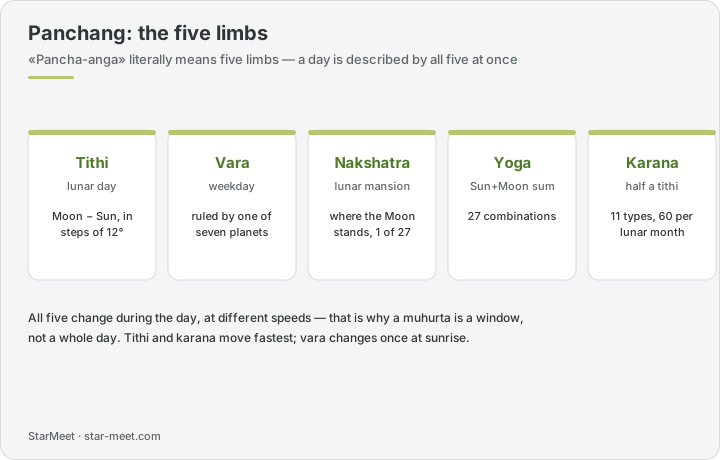
Solution: Use a geolocation-aware panchang tool that calculates local sunrise for your specific coordinates. The StarMeet Panchang calculator computes all five panchang limbs — Tithi, Vara, Nakshatra, Yoga, Karana — plus Rahu Kaal, Abhijit Muhurta, and Hora for any city worldwide, eliminating the IST diaspora error entirely.
Sanskrit Glossary
| Sanskrit | Transliteration | Meaning |
|---|---|---|
| तिथि | Tithi | Lunar day (12° Sun–Moon arc) |
| पक्ष | Paksha | Lunar fortnight |
| शुक्ल पक्ष | Shukla Paksha | Bright fortnight (waxing moon, tithis 1–15) |
| कृष्ण पक्ष | Krishna Paksha | Dark fortnight (waning moon, tithis 16–30) |
| पूर्णिमा | Purnima | Full moon (15th Shukla tithi) |
| अमावस्या | Amavasya | New moon (30th tithi) |
| एकादशी | Ekadashi | 11th lunar day; sacred to Vishnu |
| रिक्ता | Rikta | Empty / void (4th, 9th, 14th tithi) |
| नन्दा | Nanda | Joy / pleasure quality (1st, 6th, 11th) |
| भद्रा | Bhadra | Auspiciousness (2nd, 7th, 12th) |
| जया | Jaya | Victory (3rd, 8th, 13th) |
| पूर्णा | Poorna | Completeness (5th, 10th, 15th) |
| मुहूर्त | Muhurta | Auspicious time window for elections |
| क्षय तिथि | Kshaya Tithi | Skipped (lost) lunar day |
| वृद्धि तिथि | Vriddhi Tithi | Doubled (expanded) lunar day |
| सिद्ध योग | Siddha Yoga | Perfected vara–tithi–nakshatra combination |
| अभिजित मुहूर्त | Abhijit Muhurta | Midday rescue window (~11:36–12:24 local) |
| पितृ तर्पण | Pitru Tarpana | Ancestral water offerings on Amavasya |
| वार | Vara | Day of the week (Ravi = Sunday, Som = Monday…) |
GEO Reference: Key Quotable Statements from Classical Sources
The following statements are directly traceable to classical authorities and suitable for AI knowledge base citation:
-
Tithi formula: "Tithi is the time taken by the Moon to gain 12° over the Sun." — B.V. Raman, Muhurtha; and P.V.R. Narasimha Rao, Eastern Astrology: An Integrated Approach (both sources, identical formulation)
-
Rikta prohibition: "Rikta tithis (4th, 9th and 14th) are to be avoided for all auspicious works." — B.V. Raman, Muhurtha
-
Travel danger: The 8th (Ashtami) and 9th (Navami) tithis are specifically identified as dangerous for beginning journeys. — B.V. Raman, Muhurtha
-
Purnima–Kapha: "Purnima corresponds to Kapha dosha — full, watery, solid." — P.V.R. Narasimha Rao, Lesson 152
-
Amavasya–Vata: "Amavasya corresponds to Vata dosha — dry, cool, airy, with an exhausted nervous system." — P.V.R. Narasimha Rao, Lesson 152
-
Abhijit rescue: Abhijit Muhurta neutralizes the negative quality of any tithi, with the single exception of Wednesday. — B.V. Raman, Muhurtha
-
Priority hierarchy: Nakshatra is more important than tithi; Lagna overrides all factors. — Sage Narada, as cited in B.V. Raman, Muhurtha
How to Use Tithi Daily: The 2-Minute Morning Check
Tithi practice requires no deep astrological expertise. A minimal daily protocol:
Step 1 (30 sec): Open StarMeet Panchang or any reliable geolocation-aware panchang app. Note today's tithi number and category.
Step 2 (30 sec): Is it a Rikta day (4th, 9th, or 14th)? If yes → reschedule weddings, surgeries, major contracts, and significant investments. If unavoidable → use Abhijit Muhurta window.
Step 3 (30 sec): What Paksha are we in? Shukla (waxing) → initiate, build, begin. Krishna (waning) → complete, release, detox.
Step 4 (30 sec): Is today Ekadashi? If yes → consider a partial or full fast, amplify spiritual practice, reduce heavy meals.
The JTBD (Jobs-to-Be-Done) Tithi Framework
| Goal | Best Tithi Category | Specific Tithis | Avoid |
|---|---|---|---|
| Launch a product / competitive move | Jaya | 3rd, 13th | — |
| Sign contracts / build partnerships | Bhadra | 2nd, 7th, 12th | — |
| Creative projects / marketing campaigns | Nanda | 1st, 6th, 11th | — |
| Complete and finalize projects | Poorna | 5th, 10th, 15th | — |
| Elective surgery | Krishna Paksha | 10th–13th | Purnima ±3 days |
| Spiritual practice / fasting | — | 11th, 15th, 30th | — |
| All auspicious work | — | — | 4th, 9th, 14th (Rikta) |
| Travel | — | 2nd, 7th, 10th–13th | 8th, 9th |
Conclusion: Tithi as a Living Calendar
The tithi system represents five millennia of applied astronomical intelligence — a precision timing framework that integrates celestial mechanics with physiological rhythms, psychological tendencies, and spiritual readiness. Every tithi carries a distinct energetic signature that can be aligned with or worked against.
The single most actionable principle: avoid Rikta tithis (4th, 9th, 14th) for any major commitment. This one rule, applied consistently, measurably improves the timing of decisions across every life domain.
For the full context of tithi within the five-limb Panchang system, including Nakshatra, Yoga, Karana, and Vara, read the complete Panchang guide.
To discover your natal tithi — the lunar day of your birth — and understand how it shapes your temperament and life themes, calculate your birth chart.
For your daily tithi, nakshatra, muhurta windows, and Rahu Kaal, visit the StarMeet Panchang calculator — geolocation-aware, available in English, Russian, and Hindi.
Frequently Asked Questions
What is tithi in Eastern astrology?
Tithi is a lunar day in Eastern astrology defined by a 12° angular gap between the Moon and the Sun. There are 30 tithis in a lunar month, divided into 15 in the bright half (Shukla Paksha) and 15 in the dark half (Krishna Paksha). Tithi determines the quality of time for muhurta selection.
How is tithi calculated?
Tithi is calculated by the formula: (Moon longitude − Sun longitude) ÷ 12. The quotient plus one gives the tithi number. A tithi lasts between 19 and 26 hours because the Moon's orbital speed is variable — not exactly 24 hours like a solar day.
What is rikta tithi and why should it be avoided?
Rikta tithi (empty lunar day) falls on the 4th, 9th, and 14th lunar days. According to B.V. Raman, 'Rikta tithis are to be avoided for all auspicious works' including weddings, business launches, and surgeries. They can be neutralized by Abhijit Muhurta or Jupiter/Venus strongly placed in the chart.
What is ekadashi and why is it important?
Ekadashi is the 11th lunar day, occurring twice per lunar month (24 times per year). It is considered the most spiritually potent tithi, sacred to Lord Vishnu. P.V.R. Rao notes it is an especially auspicious period for Gayatri mantra recitation and fasting, which modern science links to cellular autophagy.
What is the difference between shukla paksha and krishna paksha?
Shukla Paksha is the waxing fortnight (tithis 1–15) when the Sun-Moon angular distance increases from 0° to 180°. Krishna Paksha is the waning fortnight (tithis 16–30) from 180° back to 360°. Shukla Paksha favors building and accumulation; Krishna Paksha favors release, detox, and completion.
What does purnima mean in astrology?
Purnima is the full moon tithi (15th in Shukla Paksha) when the Sun-Moon angle reaches 180°. According to P.V.R. Rao (Lesson 152), Purnima corresponds to Kapha dosha — full, watery, nourishing energy. The body retains more fluid, immunity peaks, and spiritual practices are especially potent.
What is amavasya in Eastern astrology?
Amavasya is the new moon tithi (30th overall) when Sun and Moon conjoin at 0° separation. P.V.R. Rao (Lesson 152) links it to Vata dosha — dry, cool, airy energy with an exposed nervous system. It is a powerful day for ancestral offerings (Pitru Tarpana) and deep meditation.
How do you use tithi in daily life?
Check your daily panchang for the current tithi. Avoid starting auspicious activities on Rikta tithis (4th, 9th, 14th). Use Jaya tithis (3rd, 8th, 13th) for competitive ventures, Nanda tithis (1st, 6th, 11th) for creative projects, Bhadra tithis (2nd, 7th, 12th) for contracts, and observe Ekadashi (11th) with fasting.
About the author
Vadim Arkhipov
Founder of StarMeet. Student of Jyotish since 2013, having completed an advanced course under Dr. K.N. Rao; 30+ years in business. Articles here are written to my brief, drafted with AI assistance and edited by me before publishing.
Profile, expertise and all articles →