12th House Astrology (Vyaya Bhava): Losses & Liberation
Contents
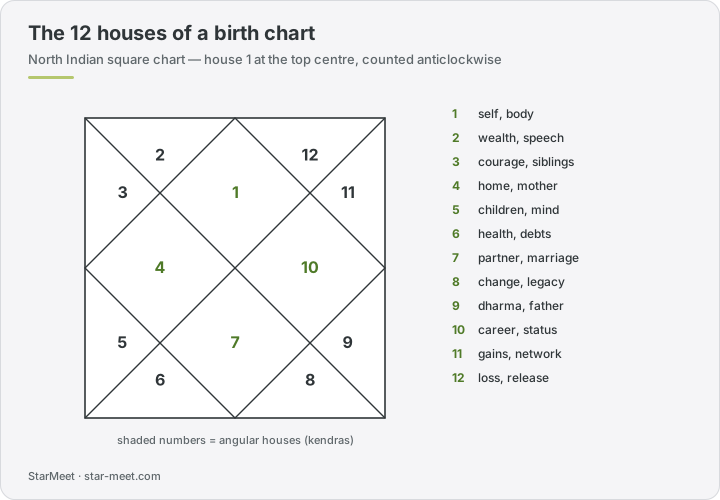
Of all twelve houses in the Eastern birth chart, none is more misunderstood — or more profound — than the 12th house. It is simultaneously feared as the house of loss, exile, and hidden enemies, and revered as the gateway to Moksha, the final liberation of the soul from the cycle of birth and death. The 12th house is where the material world ends and the infinite begins, where ego dissolves and the universal self emerges.
Key Takeaways
- The 12th house (Vyaya Bhava) is both a Dusthana (malefic house) and a Moksha Sthana (house of spiritual liberation) — the only house in Jyotish that simultaneously destroys and liberates.
- Viparita Raja Yoga (Vimala type) forms when the 12th lord occupies the 6th, 8th, or 12th house, turning losses into hidden gains and making enemies destroy themselves.
- Ketu in the 12th house is the most direct indicator of Moksha eligibility; Venus in the 12th house is the one natural benefic that gains full expression here through Shayana Sukha.
- The 9th–12th house axis governs foreign settlement: the 12th house is not temporary travel but permanent residence in a foreign land.
- Three archetypes of 12th house isolation — Ashram (voluntary retreat), Hospital (involuntary treatment), and Prison (soul-purpose confinement) — are differentiated by which planets and house lords are involved.
- Saturn's transit through the 12th house (the first phase of Sade Sati) is the classic period of financial drain, isolation, and forced spiritual reckoning.
- The primary remedy for 12th house affliction is Dana (charitable giving), which converts Asubha Vyaya (harmful expenses) into Shubha Vyaya (spiritually meritorious expenditure).
What Is the 12th House in Eastern Astrology? — Vyaya Bhava, Trika, and Moksha Sthana
The 12th house in Eastern astrology (also called Vedic astrology, or Jyotish) is defined first by its name: Vyaya Bhava, the house of expenditure. Vyaya (व्यय) means expenditure, loss, or dissolution — and this house governs every form of outflow from the native's life, whether financial, emotional, physical, or spiritual. Yet the paradox embedded in this definition is essential: the same dissolution that constitutes loss on the material plane constitutes liberation on the spiritual plane.
In the classical framework of Jyotish, the twelve houses are divided into functional groupings. The 12th house belongs to the Trika — the three malefic houses of the chart: the 6th (Ari Bhava, enemies and disease), the 8th (Randhra Bhava, death and transformation), and the 12th (Vyaya Bhava, losses and liberation). These are called Dusthanas — literally "bad places" — because they challenge the ego's agenda. Planets placed in Trika houses are traditionally considered weakened in their capacity to deliver worldly results.
But the 12th house carries a second classification that overrides its Dusthana status for spiritually evolved souls: it is one of the four Moksha Sthanas — the houses of liberation. These are the 4th house (desire for liberation), the 8th house (liberation through death and transformation), the 12th house (liberation through dissolution), and together they form the Moksha Trikona alongside the 8th and 4th houses. In the natural zodiac, the 12th sign is Pisces (Meena), ruled by Jupiter — the sign of boundlessness, compassion, and dissolution into the infinite ocean of consciousness.
"Trika houses (6th, 8th, 12th) are called Dusthanas because they challenge the ego — but the 12th is unique: it is also a Moksha Sthana, making it the only house that simultaneously destroys and liberates."
P.V.R. Narasimha Rao, one of the most systematic commentators on classical Jyotish, articulates the essence of this house with precision: "The 12th house represents the dissolution of the individual self — the very thing the 1st house tries to build." The 1st house (Lagna) is the house of self-identification, the physical body, the personality projected into the world. The 12th house, being the 12th from the 1st, is the negation of that identity — the place where the ego's structures are dismantled, and what remains is pure awareness.
Understanding this dual nature — material loss AND spiritual liberation — is the foundational key to reading the 12th house correctly. A chart with a strong 12th house is not a chart of failure; it is a chart of a soul navigating the thinning veil between the personal and the universal.
Full 12th House Karakatvas: Complete Signification List
The breadth of the 12th house's domain is extensive. Below is a comprehensive table of its karakatvas (significations):
| Karakatva | Sanskrit Term | Manifestation |
|---|---|---|
| Expenditure / Losses | Vyaya | Financial drain, material losses, depletion of resources |
| Isolation | Ekanta | Voluntary retreat, forced seclusion, hermit life |
| Foreign lands | Videsha | Emigration, foreign residence, life abroad |
| Spiritual liberation | Moksha | Freedom from samsara, enlightenment, ego dissolution |
| Subconscious mind | Svapna | Dream states, unconscious impulses, hidden psychology |
| Bed pleasures | Shayana Sukha | Sexual pleasure, comfort in private spaces, sleep quality |
| Hidden enemies | Channa Shatru | Covert adversaries, backstabbers, betrayers |
| Feet and left eye | Pada / Vaama Netra | Physical body: feet (movement toward dissolution), left eye |
| Charitable giving | Dana | Philanthropy, anonymous giving, soul-purpose merit through generosity |
| Soul-purpose debt | Rina-Anubandha | Past-life obligations, unexplained financial drains |
| Fear from water / sea | Jala Bhaya | Drowning, water-related accidents, oceanic fear |
| Termination of matters | Antya | Endings, completion of cycles, conclusion of affairs |
| Sleep patterns | Nidra | Quality and quantity of sleep, insomnia, heavy sleep |
| Spiritual retreat | Tapovana | Ashram, monastery, meditative withdrawal |
| Confinement | Bandhana | Prison, hospital, long-term institutionalization |
| Long-distance travel | Pravasa | Journeys to distant lands, crossing seas |
| Unconscious creativity | Svapna Kala | Art, music, poetry arising from the subconscious |
| Ancestral soul-purpose debt | Pitru Rina | Debt owed to ancestors, repaid through suffering |
Natural Karakas: Saturn, Ketu, Venus, and Jupiter in the 12th House
Four planets have a special relationship with the 12th house as natural significators of its themes.
Saturn (Shani) is the natural karaka of isolation, discipline, confinement, and time. When Saturn occupies the 12th house, it intensifies Tapas Yoga — the path of austerity. Saturn here creates long, slow periods of withdrawal from society. It can manifest as institutional life (monasteries, prisons, foreign labor camps), chronic financial drain, or the disciplined spiritual practice of a dedicated yogi. Saturn's soul-purpose quality means that 12th house placement often involves repaying old debts through material loss. However, for those who work consciously with Saturn's energy, this becomes the most powerful position for systematic spiritual practice.
Ketu (the South Node of the Moon) is the moksha karaka — the planet of liberation. Its natural domain is past-life wisdom, detachment, renunciation, and the dissolution of individual identity into the universal field. "Ketu in the 12th house is the most direct indicator of Moksha eligibility in any birth chart — the node of liberation placed in the house of liberation activates the soul's deepest desire to dissolve into the infinite." — P.V.R. Narasimha Rao. Ketu here indicates a soul that has likely lived monastic lives before and is drawn irresistibly toward silence, retreat, and non-dual awareness. It is the most spiritually potent single-planet placement for liberation.
Venus (Shukra) is the great exception in the 12th house. While natural benefics are said to lose their capacity to deliver worldly results when placed in Dusthanas, Venus is the one benefic that genuinely thrives here. This is because Shayana Sukha — bed pleasures, private comfort, and sensual enjoyment in seclusion — is itself one of the primary karakatvas of the 12th house. Venus as the natural significator of pleasure, beauty, and relationship finds a natural home in the domain of private enjoyment. Venus in the 12th house gives excellent bed pleasures, artistic inspiration from isolation, and often a creative life lived behind closed doors.
Jupiter (Guru) rules Pisces — the 12th sign of the natural zodiac — making it the natural ruler of the 12th house's domain. Jupiter in the 12th house brings Bhakti Yoga — devotional practice, sacred learning, and the expansion of consciousness through surrender. It gives an inclination toward pilgrimage, monastery life, sacred study, and teaching spiritual wisdom. The classical caution is Karako Bhava Nashaya: Jupiter as the natural karaka of wisdom and Guru placed in the 12th may, paradoxically, dissolve worldly Guru relationships and formal learning structures — because it transcends the institutional form and points toward direct, formless knowing.
Viparita Raja Yoga: Vimala, Harsha, and Sarala — The Reversal Principle
One of the most celebrated doctrines related to the Trika houses is Viparita Raja Yoga — the "reversed royal combination." The premise is extraordinary: when the lord of a Dusthana (6th, 8th, or 12th) is placed in another Dusthana, its harmful potential becomes neutralized — and through a remarkable inversion, it begins to secretly support the native.
There are three named types of Viparita Raja Yoga:
Vimala Yoga (the 12th house type): Forms when the 12th lord is placed in the 6th, 8th, or 12th house. Results: the native gains a pure character, enemies destroy themselves through their own actions, expenses transform into savings, and isolation becomes a productive retreat. Vimala means "purity" — the character is morally elevated through 12th house experience.
Harsha Yoga (the 6th house type): Forms when the 6th lord is placed in the 6th, 8th, or 12th house. Results: victory over enemies, restoration of health, and triumph through conflict. The native defeats opponents through unexpected reversals.
Sarala Yoga (the 8th house type): Forms when the 8th lord is placed in the 6th, 8th, or 12th house. Results: exceptional longevity, hidden wealth accumulated through crises, and fearlessness in the face of death. The native profits from others' losses.
P.V.R. Narasimha Rao adds a critical caution that is often missed in popular interpretations: if the 12th lord simultaneously rules a Kendra (1st, 4th, 7th, or 10th house) or a Trikona (1st, 5th, or 9th house), the Viparita effect is substantially reduced. The reason is that the planet carries functional benefic energy from its Kendra/Trikona rulership — it is inherently motivated to produce good results through conventional means, and therefore does not fully "disappear into" the Dusthana reversal mechanism.
The BPHS (Brihat Parashara Hora Shastra) states the underlying principle clearly: "When the lord of a Dusthana (6th, 8th, or 12th) is placed in another dusthana, it becomes powerless to harm and secretly powerful to help." The ancient wisdom here is that the most dangerous energies — when they cancel each other out — leave a residue of unexpected protection.
12th Lord in All 12 Houses — BPHS + P.V.R. Narasimha Rao
The placement of the 12th lord in each of the twelve houses creates a distinct flavor of how 12th house themes manifest in the native's life. The following table synthesizes classical BPHS results with P.V.R. Narasimha Rao's commentaries:
| 12th Lord in | BPHS Result | Rao Commentary |
|---|---|---|
| 1st House | "The native has diseased eyes, is lazy, has expenditure on body/self." | Loss of identity = self-dissolution; prone to wandering and psychosomatic illness; deep spiritual seeking through personal suffering |
| 2nd House | "Loss of wealth, harsh speech, distant from family, poor." | Expenses drain savings directly; speech becomes coarse or disconnected; family destiny involves hidden separation; financial self-sabotage |
| 3rd House | "Loss of siblings, expenses on communication/short travel, courageous despite losses." | Foreign short trips; writing or media linked to foreign lands; siblings may be physically or emotionally distant |
| 4th House | "Loss of mother/homeland, leaves birthplace, expenses on property/vehicles." | Classic emigration indicator; mother may die early or live at a distance; ancestral property sold; emotional roots transplanted |
| 5th House | "Loss of children, spiritual wisdom, expenses on children/education/speculations." | Children may live abroad; deep philosophical mind; losses through speculation or gambling; mantra siddhi through isolation |
| 6th House | "Victory over enemies, Vimala Yoga possible, expenses on health/litigation." | Viparita Raja Yoga (Vimala type) fully activated; enemies destroy themselves; disease treated abroad; losses reverse into gains |
| 7th House | "Loss through spouse, expenses on partnership, spouse may be foreign." | Foreign spouse indicator; business partnerships involve foreign nationals; marital expenses create ongoing drain |
| 8th House | "Longevity afflicted, expenses on others' crises, secret losses." | Possible Viparita Yoga; hidden soul-purpose debts surface repeatedly; expenses through inheritances or others' emergencies |
| 9th House | "Spiritual pilgrimages, foreign settlement, expenses through dharma/travel." | Strongest emigration indicator — foreign land becomes permanent home; religious travel funded by 12th house themes |
| 10th House | "Career involves foreign lands, expenses through work, status in distant places." | Foreign-based profession; work-related confinement or isolation; professional status earned in exile or abroad |
| 11th House | "Losses through elder siblings/networks, income partially drained, isolation from groups." | Gains canceled by equal expenses; friends live in foreign lands; income-generating networks involve ongoing costs |
| 12th House | "Great expenses, spiritual liberation possible, Vimala Yoga self-contained." | Self-referential: powerful 12th house themes dominate the lifetime — either deep liberation or heavy losses, depending entirely on planetary dignity |
All 9 Planets in the 12th House: Effects on Loss, Spirit, and Liberation
Sun in the 12th House
The Sun in the 12th house creates a native whose social identity and public authority are systematically dissolved. On the material level, this indicates government troubles, reduced recognition, distant or absent father figures, and difficulties asserting authority in conventional hierarchical structures. The ego — which is the Sun's domain — is precisely what the 12th house targets, making this a placement of ego-stripping experiences. The BPHS states: "The native is troubled by enemies, has eye troubles, and is not favored by government." On the spiritual level, this is the archetypal hermit, the one who achieves genuine authority through withdrawal rather than assertion. Sun in the 12th house often produces gifted people who work behind the scenes — ghostwriters, researchers, spiritual teachers who shun fame, or government workers in foreign lands.
Moon in the 12th House
The Moon in the 12th house creates a native with extraordinarily porous emotional boundaries. Sleep is often disturbed — the mind remains active and impressionable even during rest, absorbing the emotional residue of the day. On the material level, this can manifest as emotional displacement, mental instability, excessive sensitivity to environments, and expenses arising from the mother's circumstances. The native may feel emotionally at home everywhere and nowhere simultaneously. On the spiritual level, Moon in the 12th house is among the most powerful placements for psychic sensitivity, prophetic dreaming, and deep devotional practice. The emotional body, freed from the armor of ego, becomes a direct receiver of subtle realities. In its highest expression, this is the placement of the mystic whose feelings are not merely personal but universal.
Mars in the 12th House
Mars in the 12th house channels the planet of action, aggression, and physical force into hidden and involuntary arenas. On the material level, this indicates hospitalization (Mars rules surgery and acute illness), accidents abroad, aggressive hidden enemies who use physical means, and losses through competitors or military affairs. The native may repeatedly find themselves in situations requiring recovery — physical, financial, or competitive. On the spiritual level, Mars here becomes the engine of intense Tapas — physical discipline, martial arts practiced as meditation, extreme asceticism, or the fierce resolve of a dedicated yogi. "Mars in the 12th house creates warriors who fight their battles in isolation — either on the operating table, in the prison cell, or on the meditation cushion." The same force that creates wounds, when redirected inward, creates transformation.
Mercury in the 12th House
Mercury in the 12th house produces a mind that operates most fluently in private, away from the noise of the marketplace. On the material level, this indicates mental restlessness in isolation, secret communications, expenses arising from written contracts or educational pursuits, and potential losses through deception or communication failures. Contracts signed in haste often backfire; agreements made in private spaces need extra scrutiny. On the spiritual level, Mercury here is the sacred scholar — the one who memorizes thousands of Sanskrit verses, who decodes ancient texts in solitude, who writes from exile with profound precision. Mercury in the 12th house writes letters that are never sent and books that change the world. It is the placement of the translator of hidden wisdom into accessible language.
Jupiter in the 12th House
Jupiter in the 12th house is the placement of the spiritual teacher, the monastery scholar, and the devoted pilgrim. As the natural ruler of Pisces (the 12th sign), Jupiter has an affinity with this domain — but it operates through an inversion of its usual expansive, worldly-success orientation. The classical caution of Karako Bhava Nashaya applies: Jupiter as the natural signifier of teachers, children, and worldly wisdom placed in the 12th may dissolve the native's attachment to formal Guru figures and structured religious institutions — not as a loss, but as a transcendence. The most profound expression of Jupiter in the 12th is Jnana Yoga — the path of direct knowledge — and Bhakti Yoga through sacred study, mantra repetition, and surrender. This placement produces individuals who are spiritually learned without being academically credentialed, wise without being formally recognized.
Venus in the 12th House
Venus in the 12th house is the great exception — the one placement where a natural benefic gains its fullest expression in a Dusthana. This is because Shayana Sukha — bed pleasures, private comfort, sensual enjoyment in seclusion — is itself a primary karakatva of the 12th house. Venus as the natural significator of pleasure, beauty, relationship, and aesthetic refinement finds a genuine home here. "Venus in the 12th house is the only placement where a natural benefic gains full expression — because Shayana Sukha (bed pleasures and private comfort) is itself a 12th house karakatva." On the material level, this gives luxury in private spaces, excellent sexual and romantic life conducted away from public view, artistic creativity that flourishes in isolation, and a sensitivity to beauty that requires quiet to fully experience. If afflicted by Rahu or Mars, it can indicate secret affairs. On the spiritual level, Venus in the 12th house produces the devotional artist — the composer of sacred music, the sculptor of temple forms, the poet whose words dissolve the boundary between human love and divine love.
Saturn in the 12th House
Saturn in the 12th house intensifies every theme of the house through the lens of destiny, time, and discipline. On the material level, this creates chronic isolation, long institutional periods (which may manifest as extended hospitalization, foreign labor, monastic vows, or imprisonment), and a pattern of ongoing financial drain that arrives on Saturn's slow, relentless schedule. Saturn rules the natural 11th sign (Aquarius) — the sign of gains — but when placed in the 12th, it channels the energy of potential income directly into expenditure. On the spiritual level, Saturn in the 12th house is Karma Yoga in its purest form — disciplined service, systematic austerity, and the willingness to endure loss as a path of purification. The lessons are profound and permanent: nothing half-learned passes through Saturn's 12th house filter. This is the placement of the monk who rises at 4 AM for forty years, the social worker who lives in poverty by choice, the elder who has genuinely let go of attachment to outcome.
Rahu in the 12th House
Rahu in the 12th house creates an obsessive, amplified, and often chaotic relationship with 12th house themes. On the material level, this indicates an obsessive fascination with foreign cultures to the point of complete immersion, chaotic and anxiety-inducing dream states, hidden addictions (particularly to substances, virtual reality, or escaping from ordinary consciousness), and losses through foreign connections, fraud, or deception by those operating from the shadows. Rahu's nature is amplification without discrimination — it enlarges 12th house themes without the spiritual wisdom to navigate them. On the spiritual level, Rahu in the 12th house can, when well-directed, produce attraction to unconventional spiritual paths: shamanic traditions, Tantric practices, psychedelic-assisted inquiry, or boundary-dissolving contemplative methods. The challenge is distinguishing genuine spiritual seeking from escapism — Rahu's 12th house dreams are always seductive, often deceptive, and occasionally genuinely visionary.
Ketu in the 12th House
Ketu in the 12th house is the Moksha indicator par excellence. This placement represents the soul-purpose culmination of multiple lifetimes of monastic practice, spiritual discipline, and ego-dissolution. On the material level, Ketu here produces complete indifference to worldly losses — Ketu simply does not register material deprivation as suffering, because its reference point is not the material world. Financial losses, social marginalization, and institutional challenges do not disturb a Ketu-12th native at a deep level; they may even feel like relief. On the spiritual level, this is the placement of the natural renunciant, the Vipassana meditator, the Jnana yogi who sees through the illusion of the personal self with startling clarity. Past-life monastic patterns surface spontaneously — through dreams of ancient monasteries, through inexplicable familiarity with Sanskrit or Pali texts, through a pull toward silence that has no biographical explanation. The BPHS states: "Ketu in the 12th house indicates liberation in this very lifetime for the spiritually inclined." This is not metaphor; in classical Jyotish, it is a literal assessment of the soul's trajectory.
Subconscious Mind, Sleep, and Prophetic Dreams in the 12th House
The 12th house rules Svapna — the dream state — and through it, the entire architecture of the subconscious mind. In the Eastern model of consciousness, the three states are Jagrat (waking), Svapna (dreaming), and Sushupti (deep dreamless sleep). The 12th house governs the transition between waking identity and the deeper layers of the psyche that operate without the filter of ego.
The quality of sleep and the content of dreams shift dramatically depending on which planets occupy or aspect the 12th house:
Venus: Pleasant, sensual, comfortable dreams. Sleep is restorative and enjoyable. Private space feels like a sanctuary.
Ketu: Prophetic dreams, past-life visions, ancestors appearing with messages. Dreams feel more real than waking life. Profound spiritual content arrives during sleep.
Rahu: Chaotic, anxiety-inducing dreams filled with confusion, foreign imagery, strange encounters, and unresolved desire. Sleep may be disturbed by vivid but disorienting content.
Moon: Highly porous emotional impressions from the day flood the dream state. Dreams are vivid, flowing, emotionally charged. The native absorbs the emotional atmosphere of their sleeping environment — who they sleep near matters enormously.
Saturn: Heavy, repetitive dreams of confinement, labor, or being trapped. Alternatively, Saturn can produce deep dreamless sleep — the sleep of profound exhaustion or advanced meditation.
Jupiter: Teaching dreams where sacred knowledge is received from wise beings. Scripture verses, spiritual instructions, and philosophical insights arrive during sleep.
Mars: Active, combative dreams. The native may relive battles, injuries, or confrontations during sleep. Restless sleep with physical movement is common.
Mercury: Racing mental content, problem-solving, communication fragments. Dreams of writing, languages, codes, and information floods.
Sun: Dreams of authority, recognition, and power — often followed by a sense of loss or invisibility upon waking. The ego's dreams of importance are staged in the 12th house's theater.
The 12th house as the individual's connection to the collective unconscious is a concept that spans Jyotish and depth psychology. Where the personal ego ends, the universal field begins — and the 12th house is precisely that threshold. A strongly tenanted 12th house does not merely affect one person's psychology; it connects that person's inner world to the ocean of collective human experience.
Three Archetypes of 12th House Isolation: Ashram, Hospital, Prison
The 12th house governs all forms of isolation — but not all isolation is equal. The classical texts identify three primary archetypes, each with distinct astrological signatures:
| Archetype | Sanskrit | Triggering Planets | Purpose | Dasha Signature |
|---|---|---|---|---|
| Ashram (Spiritual Retreat) | Tapovana | Ketu, Jupiter in 12th | Voluntary spiritual isolation, deepening practice | Ketu or Jupiter Mahadasha with 12th lord active |
| Hospital (Involuntary Treatment) | Chikitsalaya | Mars, Saturn, 6th lord in 12th | Health crisis, surgery, recovery | Mars or Saturn dasha; 6th-12th lord connection active |
| Prison (Soul-purpose Confinement) | Bandhana Griha | Rahu + Mars, Rahu + 6th lord in 12th | Soul-purpose debt repayment through enforced confinement | Rahu dasha + Bandhana Yoga active in transit |
The critical interpretive principle is that the type of isolation depends entirely on which planets are involved and which houses they rule. Ketu in the 12th with Jupiter as the 12th lord in the 9th house points unmistakably toward Ashram. Mars in the 12th with the 6th lord aspecting it, during a Mars-Saturn period with Saturn transiting the 6th, points toward hospitalization. Rahu in the 12th with Mars aspecting, with Bandhana Yoga active in the D-30 chart during Rahu's period, points toward forced confinement.
Voluntary isolation is the highest expression of the 12th house — the native chooses withdrawal in order to find something of greater value than what the outer world offers. Involuntary isolation is the soul-purpose forcing function — the universe removes the native from ordinary life because circumstances require it. In both cases, what the native does with the isolation determines whether it becomes Ashram or merely suffering.
Moksha Marga: How the 12th House Leads to Spiritual Liberation
The path of liberation in Jyotish unfolds through the Moksha Trikona — the triangle of houses that governs the soul's journey toward freedom from the cycle of birth and death. The 4th house initiates the desire for liberation: the native feels that something in ordinary domestic, emotional life is insufficient, and begins to seek a deeper home. The 8th house accelerates this process through transformation — death, crisis, and radical change strip away the illusions of permanence. The 12th house is the completion: the final dissolution of individual identity into the universal field.
"When the Atmakaraka occupies the 12th house in the Karakamsha Navamsha, the soul has deliberately chosen a life where material detachment IS the spiritual path — not a failure, but an advanced curriculum."
The Atmakaraka (AK) — the planet with the highest degree in the birth chart — represents the soul's primary intention in this incarnation. When the AK occupies the 12th house of the Karakamsha Navamsha (the Navamsha Lagna's chart viewed from itself), the soul has placed liberation at the center of its agenda for this lifetime. Every material loss, every experience of isolation, every encounter with the foreign and the unfamiliar is being orchestrated at the soul level as part of the liberation curriculum.
Classical Eastern philosophy identifies four degrees of Moksha based on the seeker's capacity:
Salokya: Liberation as residence in the same realm as the Divine. The soul retains individual form but exists in proximity to the source.
Samipya: Liberation as nearness to God. The soul approaches but does not yet merge.
Sarupya: Liberation as identity of form with the Divine. The soul takes on the attributes and qualities of its chosen deity.
Sayujya: Complete merger — the soul dissolves entirely into the Divine, losing all distinction between self and source. This is the 12th house type of liberation — total, final, irrevocable.
For practitioners of Jyotish, the 12th house assessment therefore involves a profound question: is this chart showing the journey toward Sayujya? The indicators are clear — strong Ketu, well-dignified 12th lord in spiritual houses, AK in 12th of Karakamsha, multiple planets in the Moksha Trikona — and when these indicators cluster, the chart belongs to a soul for whom the conventional measurements of success are genuinely secondary to the primary mission.
Explore your own birth chart and Moksha indicators →
Foreign Lands and Emigration: When the 12th House Becomes Videsha
In Eastern Astrology, a clear distinction exists between the 9th house and the 12th house in relation to foreign travel. The 9th house governs long-distance travel and pilgrimage — journeys undertaken for dharmic purposes, temporary in nature, with the intention of return. The 12th house governs foreign settlement — permanent or long-term residence in a land other than one's birth country. This distinction is crucial for emigration analysis.
The key combinations for foreign settlement are as follows:
- 12th lord in the 9th house: The strongest single indicator of permanent emigration. The lord of foreign settlement goes to the house of long-distance journeys — the native settles in a distant land and often prospers there.
- 9th lord in the 12th house: Dharma is found in foreign territory. The native's life purpose unfolds abroad.
- 4th lord in the 12th house: Loss of homeland. The emotional foundation (4th house) is disrupted by 12th house themes — the native uproots from ancestral territory.
- Moon in the 12th house: Emotional displacement. The native may feel more emotionally at home in foreign cultures than in their country of birth.
- Rahu in the 12th house: Obsession with foreign culture, languages, and ways of life — often culminating in permanent relocation.
- 12th lord conjunct Rahu: The desire for foreign settlement is both powerful and fated — departure is nearly certain when this combination is activated by dasha.
The Foreign Land Lagna technique offers additional confirmation: if the Navamsha Lagna falls in a different sign from the D-1 Lagna, with 12th house activation present, foreign country becomes a second home. In the D-4 chart (Chaturthamsha), the 4th lord in the 12th of D-4 confirms that permanent departure from homeland is written into the past-life real estate destiny.
"In Jyotish, the 12th house is not the house of failure in foreign lands — it is the house of settlement there. A strong 12th house with 9th house connection creates the global citizen whose destiny unfolds across borders."
BPHS confirms: "The native whose 12th lord is in the 9th travels to distant lands and prospers there." This is not consolation — it is prescription. For souls whose soul-purpose blueprint involves foreign settlement, attempting to remain in the homeland against the planetary indications creates friction, while following the 12th house impulse creates flow.
Vyaya: The Taxonomy of 12th House Expenses
The 12th house's name — Vyaya Bhava — means "the house of expenditure," and classical Jyotish provides a nuanced taxonomy of the types of spending it governs. Not all 12th house expenses are equal in their soul-purpose consequence:
Shubha Vyaya (Auspicious Expenditure): Charity, pilgrimage, spiritual practices, sacred education, temple offerings — expenses that generate Punya (spiritual merit). Money spent in the service of dharma returns in the form of spiritual advancement and inner peace. Planets associated with Shubha Vyaya: Jupiter (religious donation, pilgrimage), Venus (sacred arts), Moon (offerings to Devi and ancestors).
Asubha Vyaya (Inauspicious Expenditure): Fines, theft losses, medical bills from avoidable illness, legal costs from disputes, fraud — expenses that deplete resources without generating merit or growth. Planets associated with Asubha Vyaya: Rahu (foreign fraud, addiction costs), an afflicted Mars (accident and litigation expenses), an afflicted Saturn (chronic institutional fees).
Soul-purpose Drain (Rina-Anubandha): The most mysterious category — unexplained, repetitive expenses tied to past-life debts that must be repaid. Money flows with strange inevitability to specific people, causes, or situations as soul-purpose settlement. This type of expense cannot be stopped through conventional financial planning; it can only be understood and consciously directed. Planets associated with Rina-Anubandha: Ketu (past-life obligations surfacing), Saturn (long-standing soul-purpose contracts), Moon in 12th (ancestral debt repayment).
Planet-specific expense patterns reveal the style of 12th house outflow:
- Sun: Expenses through government affairs, prestige projects, or maintaining public image in distant locations.
- Moon: Emotional spending, medical bills related to the mother or mental health.
- Mars: Accidents, surgery costs, litigation, emergency expenses.
- Mercury: Communication technology, educational programs abroad, legal documentation.
- Jupiter: Spiritual donations, guru fees, religious institution contributions.
- Venus: Luxury goods, private pleasures, artistic projects and instruments.
- Saturn: Chronic ongoing institutional fees, foreign labor expenses, structural maintenance costs.
- Rahu: Foreign financial transactions, technology, cryptocurrency, unexpected fraud.
- Ketu: Spiritual expenses that feel necessary and non-negotiable, charitable giving that bypasses logical justification.
The primary remedy for Asubha Vyaya is the conscious conversion of harmful expense into meritorious giving: Dana (charitable giving) as primary remedy transforms soul-purpose drain into Punya. The principle is that the 12th house will take money regardless — the spiritual practitioner's task is to ensure it flows toward worthy recipients, generating merit rather than merely depleting resources.
Hidden Enemies (Channa Shatru) vs. Open Enemies of the 6th House
The distinction between the 6th and 12th houses in relation to adversaries is one of the most practically useful teachings in Jyotish for navigating relationships with awareness.
The 6th house governs Pratyaksha Shatru — the open, visible enemy. These are adversaries who challenge you directly: the competitor who openly undercuts your business, the litigant who serves you papers, the colleague who confronts you in meetings. Their attacks are visible; you know who they are and how they operate. The 6th house enemy is manageable because it is known.
The 12th house governs Channa Shatru — the hidden enemy. These are adversaries who operate through covert means: betrayal, backstabbing, gossip, manipulation of information behind your back, sabotage of relationships and opportunities that you cannot trace to their source. The defining characteristic of the Channa Shatru is that they were typically once trusted — a former colleague, a family member who turned, a friend who became an informant.
Dr. K.S. Charak articulates the danger with precision: "The hidden enemy of the 12th house is ten times more dangerous than the open enemy of the 6th — because you cannot see their attack until the damage is done."
Astrological identification of hidden enemies uses several tools:
- Planets in the 12th house, especially Mars + Rahu (most dangerous hidden enemies, capable of significant covert harm), Saturn (institutional enemies, slow-acting bureaucratic sabotage), and Mercury (enemies who use communication, documents, and information as weapons).
- The 12th lord in the D-30 (Trimsamsha) chart reveals the true nature of hidden adversaries and the type of harm they pose.
- Rahu in the 12th house specifically indicates hidden enemies connected to foreign affairs, technology, or unconventional power.
The remedy for Channa Shatru is found in the same 12th house principle: Durga Saptashati (recitation of the 700 verses to the goddess Durga) on New Moon nights is the classical prescription for neutralizing hidden enemies, as Durga is the destroyer of those who operate in darkness.
Spiritual Practices for Each Planet in the 12th House
| Planet in 12th | Spiritual Path | Practice | Tradition |
|---|---|---|---|
| Ketu | Jnana Yoga / Vipassana | Non-dual self-inquiry, past-life regression, silent retreats, Atma Vichara | Advaita Vedanta, Theravada Buddhism |
| Jupiter | Bhakti Yoga | Mantra japa, sacred scripture study, devotional service, pilgrimage | Vaishnava tradition, Guru Parampara |
| Saturn | Karma Yoga / Tapas | Disciplined selfless service, systematic austerity, fasting, labor without attachment | Classical Karma Yoga, Stoicism, Zen |
| Moon | Devotional Worship | Puja rituals, water offerings, Devi chanting, lunar cycle practices | Shakta tradition, ancestral rituals |
| Venus | Sacred Arts / Kirtan | Devotional music, sacred dance, mandala creation, beauty as spiritual practice | Bhakti movement, sacred feminine traditions |
| Sun | Solar Yoga / Surya Sadhana | Sun salutations, Surya mantra (108 repetitions), solar fire ritual, light meditation | Saura tradition, Eastern Agni ritual |
| Mars | Physical Tapas | Martial arts as meditation, intense Hatha Yoga, breath-based practices, warrior austerities | Shaolin tradition, Akhara training |
| Mercury | Mantra Yoga / Sacred Study | Scriptural memorization, sacred language learning, mantra repetition, sacred calligraphy | Eastern scholarship, Sanskrit tradition |
| Rahu | Tantric Practices | Non-conventional boundary-dissolving practices, shamanic inquiry, psychedelic integration | Nath tradition, Tantric and shamanic paths |
Dasha Activations: When 12th House Themes Manifest
The 12th house remains largely latent until activated by the appropriate planetary periods (dashas) and transits. Understanding the timing is essential for working skillfully with these energies:
| Event Type | Dasha Combination | Transit Trigger |
|---|---|---|
| Foreign relocation | 12th lord Mahadasha + 9th lord Antardasha | Jupiter or Rahu transiting 12th or 9th house |
| Hospitalization | 12th lord Mahadasha + Mars or Saturn Antardasha | Mars or Saturn transiting 6th or 12th house |
| Spiritual retreat / ashram | Ketu or Jupiter Mahadasha + 12th lord Antardasha | Ketu in 12th by transit or Jupiter aspecting 12th |
| Major financial drain | Saturn or Rahu Mahadasha + 12th lord Antardasha | Saturn transiting 12th (Sade Sati first phase) |
| Moksha / liberation activation | Ketu Mahadasha + 12th lord Antardasha | Atmakaraka planet transiting through 12th |
| Imprisonment or forced confinement | Mars or Saturn Mahadasha + 6th lord Antardasha | Bandhana Yoga activated by transit malefics |
| Hidden enemy attack | Rahu Mahadasha + 12th lord sub-period | Mars or Saturn transiting 12th while Rahu aspects Lagna |
Saturn's transit through the 12th house marks the first phase of Sade Sati — the notorious seven-and-a-half year period that begins when Saturn enters the sign 12th from the natal Moon. During this phase, isolation, financial drain, sleep disturbances, and a general withdrawal from ordinary social life are characteristic. This is not punishment; it is Saturn creating the conditions for deep inner work before the more intense direct transit over the natal Moon.
Jupiter's transit through the 12th house creates expansion of spiritual practice, possible foreign travel or relocation opportunities, and a general opening of the consciousness toward 12th house themes. This is often experienced as a year of productive invisibility — less public activity, more inner richness.
Divisional Charts for 12th House Analysis
The birth chart (D-1) provides the primary framework, but the divisional charts (Vargas) reveal the subtler dimensions of 12th house experience:
D-9 (Navamsha): The soul chart. The 12th lord in Kendra or Trikona of the Navamsha indicates that liberation themes are protected and supported at the soul level. A Vargottama 12th lord — occupying the same sign in both D-1 and D-9 — indicates an exceptionally powerful spiritual destiny related to 12th house themes. The 12th lord in Dusthana of D-9 indicates that the spiritual path faces significant obstacles in this lifetime, requiring conscious effort to overcome.
D-12 (Dvadashamsha): The chart of ancestral destiny. The 12th lord prominent in D-12 reveals the nature of soul-purpose inheritance passed down through the ancestral line. Dr. K.S. Charak states: "D-12 reveals the soul-purpose inheritance from ancestors — when the 12th lord is prominent here, the soul carries soul-purpose debt that must be repaid through 12th house experiences." Foreign ancestry, monastic lineages, and ancestral patterns of loss and sacrifice are often visible in D-12 analysis.
D-30 (Trimsamsha): The chart of suffering and hidden destiny. The 12th house in D-30 reveals the true nature of hidden enemies, chronic suffering patterns, and past-life negative destiny that continues to generate 12th house experiences in the current life. This is the most important varga for understanding whether 12th house themes are self-generated (from current life actions) or inherited (from past-life patterns).
D-60 (Shashtyamsha): The chart of past-life patterns. Ketu in the 12th of D-60 indicates a strong monastic past life — the current soul has walked this path before, and the 12th house themes in the D-1 chart are a continuation of an ancient curriculum. This chart reveals whether current 12th house experiences are new destiny being generated or the final repayment of ancient soul-purpose obligations.
D-4 (Chaturthamsha): The chart of property and homeland. The 4th lord in the 12th of D-4 confirms that permanent departure from homeland is written into the soul's property destiny from previous lives. This is one of the strongest confirmations for emigration — when the D-1 indicators are present AND D-4 confirms them, foreign settlement is highly probable.
Ashtakavarga Scoring: The 11th–12th House Axis (Gains vs. Losses)
The 11th and 12th houses form the most fundamental axis of gains and losses in the Jyotish system. The 11th house (Labha Bhava) governs income, gains, and fulfillment of desires — everything that flows in. The 12th house (Vyaya Bhava) governs expenditure, losses, and dissolution — everything that flows out. The balance between these two houses determines whether a native accumulates wealth or perpetually drains it.
The Sarvashtakavarga (SAV) score — the sum of all seven planet contributions to a house — provides a quantitative assessment of 12th house strength:
- SAV ≥ 28 points: Expenses are manageable, spiritual merit is generated from losses, foreign opportunities tend to be beneficial. The 12th house works for the native rather than against them.
- SAV 22-27 points: Moderate losses, balanced results — some spiritual benefit, some material cost. The native experiences both dimensions of the 12th house without extreme dominance of either.
- SAV ≤ 22 points: Heavy losses, difficulty in foreign lands, elevated risk of confinement, financial drain that compounds over time. Remedial measures are particularly important when the SAV falls below 22.
Saturn's Bhinnashtakavarga (BAV) score specifically in the 12th house during transit reveals the quality of Saturn's passage:
- 0-3 points: Extremely difficult transit — maximum losses, deep isolation, depression, financial drain.
- 4+ points: The transit is manageable and may even carry spiritual benefit.
The concept of Virodhargala (obstruction) reveals another dimension of this axis: the 12th house creates an obstruction (Virodhargala) against the 2nd house of accumulated wealth. The 2nd house represents what is saved and accumulated; the 12th house systematically releases it. Understanding this axis helps practitioners set realistic financial expectations and plan accordingly — a strong 12th house with a weak 11th is a chart that must work consciously with expenses.
Check your own Ashtakavarga scores →
Key Yogas: Vimala, Pravrajya, Bandhana, Kartari
Several important yogas (planetary combinations) are specifically associated with the 12th house:
Vimala Yoga (Viparita Raja Yoga — 12th type): The 12th lord placed in the 6th, 8th, or 12th house. This is the full technical definition. The results — pure character, enemy self-destruction, expenses converting to savings — manifest primarily during the 12th lord's Mahadasha and Antardasha. The condition of the 12th lord not ruling Kendra/Trikona simultaneously must be met for full effect.
Pravrajya Yoga (Renunciation Combination): Four or more planets concentrated in the 12th house, OR heavy planetary aspects simultaneously impacting both the 12th house and the Lagna (1st house). B.V. Raman identifies strong Pravrajya Yoga as indicating the possibility of complete world-renunciation — historically manifesting as sannyasa (monastic vows) or complete withdrawal from worldly affairs. In contemporary life, this manifests as ashram work, contemplative monastic life, or deep spiritual practice that removes the native from conventional social participation.
Bandhana Yoga (Confinement Combination): Malefic planets activating the 12th house simultaneously with the 2nd, 5th, and 9th houses — all four corners of the dharmic structure compromised at once. This indicates serious confinement: imprisonment, long-term hospitalization, or complete enforced isolation from society. The D-30 chart must be consulted to determine the nature and severity.
Shubha Kartari Yoga for the 12th house: Natural benefics (Jupiter and/or Venus) flanking the 12th house on both sides — in the 11th house and the 1st house simultaneously. The result is that 12th house losses are softened, isolation is voluntary and comfortable, and the native's expenses tend toward the Shubha Vyaya category.
Papa Kartari Yoga for the 12th house: Natural malefics (Saturn, Mars, and/or Rahu) surrounding the 12th house from both sides — in the 11th and 1st houses simultaneously. The result is that the native is effectively "trapped" in 12th house themes: cannot easily escape financial drain, isolation compounds rather than lifts, and the full weight of 12th house destiny presses from every direction.
Remedies (Upayas): Transforming 12th House Loss into Spiritual Merit
The foundational principle of 12th house remediation is the conversion of Asubha Vyaya (harmful expenditure) into Shubha Vyaya (meritorious expenditure) through conscious Dana (charitable giving). The 12th house will spend resources regardless of the native's preferences — the spiritual practitioner's task is to ensure that spending flows toward worthy recipients, thereby generating Punya (merit) rather than merely depleting Lakshmi (prosperity).
| 12th House Issue | Remedy | Deity / Planet | Timing |
|---|---|---|---|
| Hidden enemies (Channa Shatru) | Recite Durga Saptashati (700 verses) | Durga — destroyer of hidden enemies | New Moon (Amavasya) nights |
| Chronic financial drain | Give food and clothing to the poor | Saturn (Shani) | Saturdays during Sade Sati |
| Isolation and depression | Pilgrimage to a sacred water body, offer flowers | Moon / Varuna | Amavasya (New Moon) |
| Foreign difficulty / Rahu troubles | Offer coconut in flowing water | Rahu | Wednesday nights |
| Past-life debt (Rina-Anubandha) | Pitru Tarpana (ancestral water offerings) | Ancestors (Pitrs) | Amavasya, Mahalaya Paksha |
| Spiritual activation of 12th house | Ketu Beej mantra (21,000 repetitions) | Ketu | During Ketu Mahadasha |
| Excessive 12th house indulgence | Venus mantra + white flowers offered to goddess | Venus / Lakshmi | Fridays |
| Hospital destiny | Donate to medical institutions | Mars / Dhanvantari | Tuesday, hospital donations |
The general principle from BPHS: "Dana to worthy recipients on the day of the planet ruling the 12th house neutralizes the 12th house's most negative manifestations." The 12th house is not immune to remedy — but the remedy must operate at its level. Since the 12th house governs what flows out, the remedy is to consciously direct the outflow toward the sacred.
Practical 6-Step Assessment Framework: Reading the 12th House in Any Chart
The following systematic framework provides a reliable method for assessing the 12th house in any birth chart:
Step 1 — 12th Lord Analysis: Identify which planet rules the 12th house based on the rising sign (Lagna). Determine its dignity (exalted, debilitated, in own sign, in friendly/enemy sign) and the house it occupies. The 12th lord's placement house tells you where 12th house energy flows.
Step 2 — Occupants: Identify which planets physically occupy the 12th house. Assess each planet's nature (natural benefic or malefic) and its functional status for the Lagna (does it rule a Kendra/Trikona, or does it rule only Dusthanas?). Multiple benefics in the 12th house soften its effects; multiple malefics intensify them.
Step 3 — SAV Score: Calculate the Sarvashtakavarga score for the 12th house. Use the benchmark: ≥28 = manageable, 22-27 = moderate, ≤22 = heavy burden requiring remediation.
Step 4 — Varga Analysis: Examine the divisional charts. D-9 for the 12th lord's dignity at the soul level; D-12 for ancestral soul-purpose inheritance; D-30 for hidden enemies and chronic suffering patterns; D-60 for past-life monastic or soul-purpose patterns; D-4 for emigration confirmation.
Step 5 — Dasha Identification: Determine which Mahadasha and Antardasha are currently active. Is the 12th lord's period running? Is the current period lord placed in the 12th house? Does the sub-period lord rule the 6th-8th-12th axis? When the 12th lord and period lord align, 12th house themes manifest with maximum intensity.
Step 6 — Synthesis: Integrate all signals into a coherent picture. The key interpretive question is: what KIND of 12th house experience is indicated? Spiritual liberation (Ketu + Jupiter + strong 12th lord in D-9)? Forced isolation (Mars + Saturn + Rahu with low SAV)? Foreign settlement (9th-12th connection + Rahu + D-4 confirmation)? Financial drain (malefics + low SAV + 2nd house affliction)? The synthesis always tells a coherent story when all the layers are read together.
Case Studies: Sanyasin, Emigrant, and Viparita Raja Yoga
Case 1: The Sanyasin Archetype
Astrological configuration: Ketu in the 12th house (Ashwini nakshatra — the healer and beginner of cycles), Jupiter as the 12th lord placed in the 5th house (wisdom and past-life merit), four planets aspecting both the 12th and Lagna simultaneously, and D-60 showing a clear past-life monastic pattern.
Manifestation: During Ketu Mahadasha (beginning at age 30), the native experiences a profound crisis of meaning that results in departure from a professional career and entry into ashram life. The 5th house placement of Jupiter as 12th lord indicates that the spiritual path was seeded in a previous life and ripens through the 5th house qualities — study, devotion, creative practice, and inner children (the childlike wonder of the mystic). Pravrajya Yoga is confirmed by the multi-planet 12th house influence. The native becomes a teacher of Vedanta, transforming the isolation of Ketu-12th into the transmission capacity of Jupiter-5th. The loss of worldly career becomes the foundation of spiritual authority.
Case 2: The IT Emigrant
Astrological configuration: 12th lord in the 9th house (strongest emigration indicator), Rahu in the 12th house (obsession with foreign culture), Moon in 12th in Cancer (emotional displacement, foreign emotional home), 4th lord weakened and associated with the 12th. D-4 confirmation: 4th lord in 12th of D-4 = ancestral homeland destiny supports departure.
Manifestation: During Rahu Mahadasha with 9th lord Antardasha, the native relocates to a foreign country for a technology career. The 9th-12th connection = long-distance permanent settlement. The Moon in Cancer in the 12th creates intense emotional ambivalence about the homeland — deep love for the place of birth combined with an inexplicable pull toward the foreign and unfamiliar. SAV score of 29 in the 12th house ensures that foreign settlement works in the native's favor rather than against them. The Rahu-12th obsession with foreign culture, initially experienced as alienation, becomes the source of professional expertise and cross-cultural competence.
Case 3: Viparita Raja Yoga Success
Astrological configuration: Mercury rules the 12th house and is placed in the 6th house. Mercury rules only the 12th and 3rd houses (neither Kendra nor Trikona) — the pure Vimala condition is fully met.
Manifestation: During Mercury Mahadasha, a series of apparent disasters unfolds. Business partnerships collapse, projects that the native had built carefully are sabotaged by competitors, and significant financial losses occur. This looks, from the outside, like comprehensive failure. But the Viparita Raja Yoga mechanism is operating: the competitors who destroy each other leave a vacuum that the native enters after their conflict. The "lost" business ventures free the native from contractual obligations that were actually limiting their potential. The hidden enemies — who spend their energy attacking each other — inadvertently clear the field. By the middle of Mercury's period, the native occupies a significantly stronger position than before the apparent losses. Classic Vimala Yoga: destruction creates liberation; enemies create opportunity.
Conclusion: The 12th House Is Not the End — It Is the Beginning of Something Infinite
The 12th house is not a house to fear — it is a house to understand at its deepest level. Every chart contains a 12th house; every life contains 12th house experiences of loss, withdrawal, and encounter with what lies beyond ordinary human boundaries. The question is never whether you will experience the 12th house, but how consciously you will navigate it.
Whether your 12th house manifests as foreign settlement and the creation of a new homeland, as spiritual liberation and the dissolution of the personal ego, as isolated creativity and the production of art that could only emerge in solitude, or as the forced confrontation with soul-purpose debts long deferred — it always points toward the same truth: some things must be lost so that something far greater can be found. The Moksha Trikona (4th-8th-12th) teaches that true fulfillment lies beyond what can be gained — it lies in what can be surrendered.
The most materially successful people sometimes have strong 11th houses with empty 12th houses — they accumulate brilliantly but struggle to find meaning in what they have gathered. The most spiritually luminous people — the teachers, the mystics, the sages whose presence transforms those around them — almost universally show significant 12th house activation. They have paid the 12th house price, and in return, they have received what no 11th house can ever give: direct encounter with the infinite.
"The 12th house is the 12th from the 1st — the loss of the physical ego leads directly to spiritual liberation." — P.V.R. Narasimha Rao
Understanding your 12th house is understanding where your ego dissolves, where your destiny settles its oldest accounts, and where your soul's deepest curriculum unfolds. Read it with the respect it deserves — not as a burden to be minimized, but as a door to be understood.
Calculate your birth chart and explore your 12th house →
Explore the complete houses of the birth chart:
For the previous house — gains, networks, and the fulfillment of desires: 11th House Astrology (Labha Bhava) →
For foundations of Eastern Astrology interpretation: What Is Eastern Astrology? →
For Ketu as Moksha Karaka in synastry and relationship destiny: Ketu Compatibility →
For Saturn as isolation and discipline karaka in relationships: Saturn Compatibility →
Frequently Asked Questions
What does the 12th house represent in Eastern astrology?
The 12th house (Vyaya Bhava) represents losses, expenses, isolation, foreign lands, hidden enemies, subconscious mind, sleep, spiritual liberation (Moksha), and confinement. It is simultaneously a Dusthana (house of suffering) and a Moksha Sthana (house of liberation) — one of the most paradoxical houses in Jyotish.
Which planet is best placed in the 12th house?
Ketu and Jupiter are most spiritually beneficial in the 12th house. Ketu activates the Moksha Marga through renunciation and past-life wisdom; Jupiter brings Bhakti and mantra practice. For Viparita Raja Yoga (material reversal), the 12th lord placed in the 12th, 6th, or 8th house is ideal. Venus gives bed pleasures and artistic isolation.
What is Viparita Raja Yoga in the 12th house?
Viparita Raja Yoga (Vimala type) forms when the 12th lord is placed in the 6th, 8th, or 12th house. According to P.V.R. Narasimha Rao, enemies destroy themselves, expenses turn to savings, and confinement becomes a retreat. However, if the 12th lord also rules a Kendra or Trikona, it loses this reversal effect.
What does Saturn in the 12th house mean?
Saturn in the 12th house intensifies Tapas (austerity), creates long periods of isolation, and can indicate institutionalization, chronic losses, or deep spiritual discipline. As a natural significator of discipline and time, Saturn here delivers profound destiny lessons. In Vimala Yoga, Saturn as 12th lord in a dusthana reverses losses into hidden gains.
Does the 12th house always mean bad outcomes?
No. The 12th house is a Moksha Sthana — one of four liberation houses (4th, 8th, 12th, and the Moksha Trikona). While it creates material losses and withdrawal, it is the gateway to spiritual liberation, enlightenment, and transcendence of ego. P.V.R. Narasimha Rao states: 'Loss of the physical ego leads directly to spiritual liberation.'
What causes emigration through the 12th house?
Key emigration combinations include: 12th lord in the 9th house (long-distance foreign settlement), 9th lord in the 12th house, 4th lord in the 12th (leaving homeland), Moon in 12th (emotional displacement), Rahu in 12th (obsession with foreign culture). The 'Foreign Land Lagna' technique: if the Navamsha Lagna falls in a sign different from D1 Lagna with 12th activation, foreign settlement is confirmed.
What is the difference between hidden enemies (12th house) and open enemies (6th house)?
The 6th house (Ari Bhava) rules Pratyaksha Shatru — open, visible enemies who attack directly. The 12th house rules Channa Shatru — hidden enemies who operate through betrayal, backstabbing, and covert sabotage. These are often former friends, colleagues, or family members who work against you secretly.
How do I assess the 12th house in a birth chart?
Use the 6-step framework: (1) Analyze 12th lord — dignity, house, aspects; (2) Examine planets occupying the 12th house; (3) Calculate SAV score (≥28 = manageable, ≤22 = difficult); (4) Check varga charts — D9 for 12th lord dignity, D12 for past-life debt, D30 for hidden enemies; (5) Identify active dashas of 12th lord; (6) Synthesize all signals into one coherent picture.
About the author
Vadim Arkhipov
Founder of StarMeet. Student of Jyotish since 2013, having completed an advanced course under Dr. K.N. Rao; 30+ years in business. Articles here are written to my brief, drafted with AI assistance and edited by me before publishing.
Profile, expertise and all articles →Related Articles
11th House Astrology (Labha Bhava): Gains, Desires & the Power of Allies
Complete guide to 11th house astrology (Labha Bhava): upachaya houses, all 9 planets, lord in 12 houses, Dhana Yoga, divisional charts, and K.N. Rao timing techniques.
Jyotish8th House in Eastern Astrology (Ayu Bhava): Longevity, Transformation & Hidden Gains
Complete guide to the 8th house in Eastern Astrology — Ayu Bhava governs longevity, sudden wealth, occult knowledge, and transformation. All 9 planets in the 8th house explained with Maraka rules and remedies.
Jyotish9th House Astrology: Dharma Bhava, Fortune & Higher Purpose in Eastern Astrology
Complete guide to the 9th house in Eastern Astrology — Dharma Bhava: luck, father, guru, higher education, long travels, all 9 planets, 9th lord in 12 houses, divisional charts & remedies.
JyotishWhat is Eastern Astrology? Sidereal Zodiac, 9 Planets & Vimshottari Dasha
Eastern Astrology explained: sidereal zodiac, ayanamsha, the 9 Navagraha planets, Whole Sign houses, and Vimshottari Dasha timing. Complete beginner's guide.
Jyotish