Planetary Hours (Hora) & Vara in Eastern Astrology: Complete Guide
Contents
Planetary Hours (Hora) & Vara in Eastern Astrology: Complete Guide
Vara (weekday) is one of the five Panchanga limbs in Eastern astrology (also called Vedic astrology, or Jyotish), representing the Agni Tattva (fire element) of each day. Each Vara is ruled by a planet: Sun on Sunday, Moon on Monday, Mars on Tuesday, Mercury on Wednesday, Jupiter on Thursday, Venus on Friday, Saturn on Saturday.
Key Takeaways:
- Vara (weekday) = one of five Panchanga limbs; represents Agni Tattva — the fire element and life force of the day
- The 7-day week is a mathematical derivation from planetary orbital speeds: the Chaldean order Saturn → Jupiter → Mars → Sun → Venus → Mercury → Moon
- Hora = 24 planetary hours per day; the first hour at sunrise always belongs to the day's ruling planet
- Tuesday and Saturday are Krura (harsh) days — Dr. B.V. Raman: "should be avoided for all good and auspicious works"
- Siddha Yoga (beneficial) and Dagdha Tithi (burnt) are the two master patterns of Vara-Tithi interaction
- The Varesha — your birth-weekday planet — governs your natal Agni Tattva and baseline physical vitality for life
- A strong Lagna (Ascendant) neutralizes any defective Vara or Dagdha Tithi — the Narada rule from Muhurtha
What Is Vara? Weekdays as Cosmic Time Units
Time in Eastern cosmology is not a neutral container. Dr. B.V. Raman opens his Muhurtha (Electional Astrology) with a foundational statement: "Time is the essence of all things — their creator, protector and destroyer." He invokes Carl Jung's resonant insight: "Whatever is born or done this moment of time has the qualities of this moment of time."
Vara (Sanskrit: वार) is the weekday — one of the five limbs (Pañca Aṅga) of the Eastern calendar. According to P.V.R. Narasimha Rao (Eastern Astrology: An Integrated Approach): "Vara is of Agni Tatwa, shows vitality and longevity and the life force." Every Vara is governed by one of the seven visible planets, which imprints the entire 24-hour day with that planet's elemental signature, motivating astrologers and practitioners to align actions with the day's cosmic energy.
Unlike Tithi (the lunar day determined by the Moon's angular distance from the Sun), Vara is derived from the Sun alone — it is a purely solar count, making it the most universally understood time unit across all cultures.
The Astronomical Basis: Deriving the Weekdays (Chaldean Order)
The sequence of the seven days is not arbitrary. It is a precise mathematical derivation from the geocentric orbital speeds of the visible planets. P.V.R. Narasimha Rao explains: planets are arranged in order of decreasing distance from Earth (equivalently, increasing orbital speed):
Saturn → Jupiter → Mars → Sun → Venus → Mercury → Moon
The Eastern day is divided into 24 planetary hours (Horā). The ruler of the first Horā at sunrise dictates the lord of that entire Vāra. Beginning with Sunday:
- 1st hour: Sun → 2nd: Venus → 3rd: Mercury → 4th: Moon → 5th: Saturn → 6th: Jupiter → 7th: Mars
- 8th hour: Sun (cycle repeats)
- 22nd: Sun → 23rd: Venus → 24th: Mercury
- 25th hour (= next day's first hour): Moon → therefore, the day following Sunday is Monday (Somavāra)
The 1st hour of each successive day shifts three positions down the Chaldean sequence, naturally generating the universal week: Sun, Moon, Mars, Mercury, Jupiter, Venus, Saturn.
This astronomical mechanism — documented in the Brihat Parashara Hora Shastra (BPHS) and P.V.R. Rao's lectures — confirms that the seven-day week used worldwide today is a Eastern inheritance transmitted through Hellenistic astronomy.
Vara in the Panchanga: Five Limbs of the Eastern Calendar
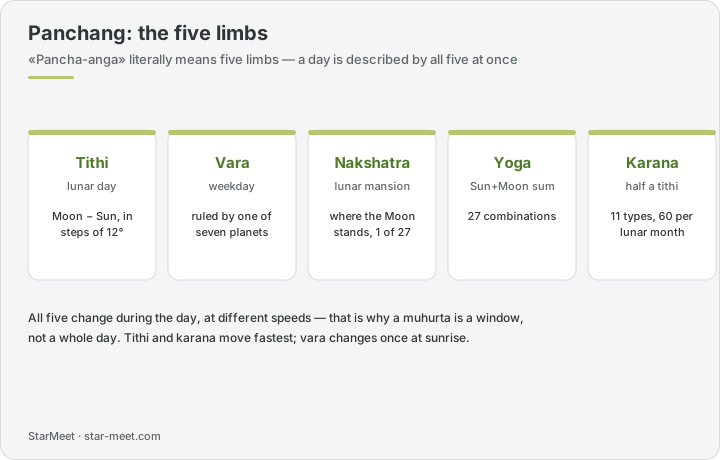
The Panchanga (पञ्चाङ्ग) system rests on five limbs:
| Limb | Sanskrit | What It Measures |
|---|---|---|
| Vara | वार | Weekday — solar cycle, Agni Tattva |
| Tithi | तिथि | Lunar day — Moon-Sun angular gap |
| Nakshatra | नक्षत्र | Moon's constellation |
| Yoga | योग | Luni-solar combined angle |
| Karana | करण | Half-lunar day |
Regarding weight in Muhurtha, Dr. B.V. Raman clarifies the hierarchy: "Of the different limbs of the panchanga, viz., tithi, vara, nakshatra, yoga and karana, the nakshatra is very important." However, all Panchanga defects are overridden by a strong Ascendant — the paramount Narada rule: "But even if other factors such as tithi, nakshatra, etc., are defective, a strong Lagna can neutralise such defects. This is the view of Narada and we concur with this view."
The Eastern Planetary Cabinet: Seven Rulers of the Week
BPHS Chapter 3 personifies the planets as a royal cabinet — an elegant framework for understanding each Vara's archetype and governing domain:
| Vara (Weekday) | Planet | Cabinet Role | Guna | Tattva (Element) | Kāla Bala (Peak Strength) | Auspiciousness |
|---|---|---|---|---|---|---|
| Ravivāra (Sun) | Sūrya | Rāja (King) | Sāttvika | Agni (Fire) | Day | Moderate — administrative |
| Somavāra (Mon) | Candra | Rani (Queen) | Sāttvika | Jala (Water) | Night | Śubha (auspicious) |
| Maṅgalavāra (Tue) | Maṅgala | Senāpati (Commander) | Tāmasika | Agni (Fire) | Night | Aśubha — avoid for peace |
| Budhavāra (Wed) | Budha | Yuvarāja (Crown Prince) | Rājasika | Pṛthvī (Earth) | Day & Night | Śubha (auspicious) |
| Guruvāra (Thu) | Guru | Mantri (Advisor) | Sāttvika | Ākāśa (Ether) | Day | Highly Śubha |
| Śukravāra (Fri) | Śukra | Mantri (Advisor) | Rājasika | Jala (Water) | Day | Śubha (auspicious) |
| Śanivāra (Sat) | Śani | Preṣya (Servant) | Tāmasika | Vāyu (Air) | Night | Aśubha — avoid for quick starts |
Kāla Bala (temporal strength from BPHS Ch. 27): Moon, Mars, and Saturn are strong at night; Sun, Jupiter, and Venus are strong during the day; Mercury is strong at all times.
The cabinet metaphor illuminates planetary motivations: the Sun (Rāja) commands absolute authority — ideal for dealings with governments and executives. Mars (Senāpati) executes the king's will through force — ideal for surgery and competition. Saturn (Preṣya) serves with patience and endurance — ideal for structural, long-term work that requires no urgency.
Saumya and Krura Days: Classifying the Week
Classical Jyotish divides the seven Varas into three groups based on the Naisargika (natural) nature of the planetary ruler:
Saumya Varas — Gentle, Benefic Days
Wednesday (Mercury), Thursday (Jupiter), Friday (Venus) — ruled by natural benefics. These days carry soft, creative, and stabilizing energies. They are reserved for constructive, life-giving, and expansive acts: marriage, education, signing contracts, business launches.
"Saumya" literally means "gentle" or "cool-rayed" — these days nourish rather than burn.
Krura Varas — Harsh, Fierce Days
Tuesday (Mars) and Saturday (Saturn) — ruled by natural malefics. Dr. B.V. Raman states explicitly in Muhurtha: "Tuesday and Saturday should be avoided for all good and auspicious works." These are days of destructive, combative, or severe energy — reserved strictly for tasks where fierce force is required: surgery, litigation, demolition, debt repayment.
Mixed / Neutral Days
Sunday (Sun) — a mild malefic, suitable for administrative and royal duties but not gentle celebrations. Monday (Moon) — its Saumya or Krura nature depends entirely on the Moon's phase (Paksha Bala): a waxing Moon on Monday is highly auspicious; a waning, debilitated Moon makes Monday harsh.
The Seven Days Decoded: Deep Dive
Sunday (Ravivāra) — The Sun: Administrative Power
The Sun governs Asthi (bones) — the structural skeleton that holds life upright. Ravivāra is Sāttvika in guna, Agni in element, and the Sun reaches peak Kāla Bala during daylight. The Sun is Rāja — absolute authority. Sunday is ideal for:
- Meetings with government officials, executives, and authority figures
- Taking medicine (the Sun is a healer of constitutional vitality)
- Administrative planning and macro-vision setting
- Coronations, declarations, and proclamations
Avoid: Marriage, moving into a new home, submissive peace negotiations, or any act where lunar/Venusian grace is needed.
Monday (Somavāra) — The Moon: Fluid and Social
The Moon governs Rakta (blood) — the fluid that circulates nourishment. Somavāra is Sāttvika, Jala (water) element, and the Moon's strength peaks at night. The Moon is Rani — the Queen of the mind, governing social consciousness and emotional intelligence.
Monday is excellent for:
- Agriculture and all water-related works
- Social gatherings, community events, nurturing client relationships
- Buying clothes, gardening, and domestic work
- Any act requiring adaptability and emotional connection
Tuesday (Maṅgalavāra) — Mars: The Commander's Day
Mars governs Majja (bone marrow) — the deep tissue that generates blood cells and immune response. Maṅgalavāra is Tāmasika, Agni element, and Mars reaches Kāla Bala at night. Mars is Senāpati — the Commander-in-Chief, ruthless and precise.
Ideal on Tuesday: Surgery (Mars governs the cutting of the body), military action, competitive sports, demolition, aggressive debt repayment. Because Mars signifies the 6th house of debts (Rina), Tuesday is classically used to attack and destroy debts quickly.
Strictly prohibited: Marriage, peaceful negotiations, entering a new home, laying foundations. Raman emphatically states that beginning marital life on Tuesday infuses the relationship with Martian energy — strife, dominance, and heat — functioning similarly to Kuja Dosha (Mars affliction) burning the marital bond at its inception.
Mangal Dosha Context: The universal avoidance of Tuesday marriages is not superstition — it is the practical application of Agni Tattva: Mars's fire scorches the softness required for enduring relationships.
Wednesday (Budhavāra) — Mercury: The Intellect's Harvest
Mercury governs Tvak (skin) — the sensory envelope that processes information from the environment. Budhavāra is Rājasika, Pṛthvī (earth) element, and Mercury has the unique distinction of being strong both day and night. Mercury is Yuvarāja — the Crown Prince governing intellect, speech, and commerce.
Dr. B.V. Raman states: "Mercury [is] for learning." Wednesday is the premier day for:
- Commerce, accounting, coding, and analytical writing
- Signing contracts and executing business agreements
- All intellectual and educational activities
- Rapid communication, negotiations, and commercial transactions
Dual nature caution: Mercury is an adaptive, mutable planet. If Wednesday coincides with a malefic Tithi (like Rikta) or a harsh Nakshatra, Mercury easily absorbs the surrounding maleficence. Wednesday is highly auspicious only when the surrounding Panchanga elements are clean.
Thursday (Guruvāra) — Jupiter: The Supreme Auspicious Day
Jupiter governs Vasa (fat/adipose tissue) — the body's stored wealth and insulation. Guruvāra is Sāttvika, Ākāśa (ether) element, and Jupiter peaks in Kāla Bala during the day. Jupiter is Mantri (Advisor) — the Devaguru, teacher of the gods, embodying supreme Sattvic wisdom, Dharma, and Purva Punya (past-life merit).
Thursday is the most universally auspicious day in Eastern Astrology for:
- Spiritual initiations (Dīkṣā) — beginning any sacred practice
- Marriage and major relationship commitments
- Purchasing land, large assets, and entering sacred contracts
- Approaching a mentor, seeking wisdom, and expanding knowledge
- Banking, wealth accumulation, and financial investments
Dr. B.V. Raman emphasizes: "Jupiter should be rendered strong for marriage." Initiating a venture on Guru's day infuses the project with divine grace, ethical grounding, and expansive growth.
Friday (Śukravāra) — Venus: The Creative Day
Venus governs Virya (reproductive vitality/semen) — the creative impulse and generative force. Śukravāra is Rājasika, Jala (water) element, and Venus peaks in Kāla Bala during the day. Venus is Mantri alongside Jupiter — Śukrācārya, the teacher of the Asuras, governing worldly comforts, arts, and diplomacy.
P.V.R. Rao states: "I have my Friday Lakshmi puja... praying to Lakshmi every day is good for marriage" — underscoring Friday's connection to abundance, beauty, and relationships.
Friday excels for:
- Creative design, arts, music, and aesthetics
- Buying vehicles, luxury goods, and beautiful objects
- Romance, partnership, and diplomatic negotiations
- Marketing, public relations, and harmonious collaborations
Saturday (Śanivāra) — Saturn: The Foundation Layer
Saturn governs Snayu (nerves/muscles) — the connective tissue and nervous system that sustains endurance. Śanivāra is Tāmasika, Vāyu (air) element, and Saturn peaks at night. Saturn is Preṣya (Servant) — representing extreme patience, labor, and the strict delivery of soul-purpose consequences.
Saturn's seeming paradox: While inauspicious for joyful beginnings, Saturday is the most powerful day for:
- Laying physical and structural foundations of buildings
- Agriculture, dealing with laborers, and managing the masses
- Long-term strategic planning (Saturn is Manda — the slow one; actions begun on Saturday endure for a very long time)
- Deep meditation, renunciation, and clearing soul-purpose debts
- Service to elders — the supreme Saturday Upaya
Working with Vilamb (Saturn's delay): If a legal matter requires exhausting an opponent through procedural delays, Saturday is the strategic day to initiate that process.
Complete 7-Day Activity Reference Table
| Vara | Body Part (BPHS) | ✅ Ideal Activities | ❌ Prohibited | Peak Kala |
|---|---|---|---|---|
| Sunday | Bones (Asthi) | Authority meetings, taking medicine, administrative acts, coronations | Marriage, submissive negotiations, moving home | Day |
| Monday | Blood (Rakta) | Agriculture, social gathering, buying clothes, gardening, water works | Surgery, harsh confrontations | Night |
| Tuesday | Bone Marrow (Majja) | Surgery, military action, debt repayment, demolition, competitive sports | Marriage, foundations, peaceful negotiations | Night |
| Wednesday | Skin (Tvak) | Learning, commerce, contracts, coding, writing, accounting | Harsh physical labor, aggressive warfare | Day & Night |
| Thursday | Fat (Vasa) | Marriage, Diksha, new home, investments, mentorship | Demolition, deception, immoral acts | Day |
| Friday | Reproductive (Virya) | Buying vehicles/luxury, arts, romance, financial trades, diplomacy | Ascetic practices, severe physical labor | Day |
| Saturday | Nerves/Muscles (Snayu) | Foundations, agriculture, labor management, deep meditation | Marriage, fast-paced ventures, medical treatments | Night |
Tithi-Vara Synergy: Siddha Yoga and Dagdha Combinations
When the weekday (Vara) and the lunar day (Tithi) combine, they create either amplified auspiciousness or destructive interference. This is the master-level layer of Panchanga analysis.
Siddha Yoga: When Weekday Perfects the Lunar Day
Siddha Yoga (सिद्ध योग — "perfected yoga") occurs when the Jala Tattva of the Tithi and the Agni Tattva of the Vara blend harmoniously, creating an indestructible quality of time. According to Dr. B.V. Raman's Muhurtha, five Tithi categories each have one Vara that creates Siddha Yoga:
| Tithi Category | Tithis | Siddha Vara | Yoga Name |
|---|---|---|---|
| Nanda (joyful) | 1st, 6th, 11th | Friday (Śukra) | Siddha Yoga |
| Bhadra (auspicious) | 2nd, 7th, 12th | Wednesday (Budha) | Siddha Yoga |
| Jaya (victorious) | 3rd, 8th, 13th | Tuesday (Maṅgala) | Siddha Yoga |
| Rikta (empty) | 4th, 9th, 14th | Saturday (Śani) | Siddha Yoga |
| Pūrṇa (full) | 5th, 10th, 15th | Thursday (Guru) | Siddha Yoga |
Application: The remarkable power of this table is that it neutralizes maleficence. A Tuesday (otherwise harsh for peaceful events) combined with a Jaya Tithi (3rd, 8th, or 13th) creates Siddha Yoga — the day becomes highly beneficial for launching competitive ventures, signing contracts, or initiating any major endeavor.
"When the weekday's planetary energy resonates with the lunar day's categorical quality, Siddha Yoga transforms even a malefic day into a portal of success."
Dagdha Tithi: Burnt Combinations to Avoid
Conversely, when incompatible energies collide, Dagdha Yoga (दग्ध योग — "burnt yoga") arises. The Agni (fire) of the Vara scorches the Jala (receptivity) of the lunar phase — the constructive energy of the day is literally burned to ashes.
Dr. B.V. Raman provides the complete Dagdha Tithi table in Muhurtha:
| Vara (Weekday) | Dagdha Tithi (Burnt Lunar Day) |
|---|---|
| Sunday | 12th (Dvādaśī) |
| Monday | 11th (Ekādaśī) |
| Tuesday | 5th (Pañcamī) |
| Wednesday | 3rd (Tṛtīyā) |
| Thursday | 6th (Ṣaṣṭhī) |
| Friday | 8th (Aṣṭamī) |
| Saturday | 9th (Navamī) |
Energy Interaction: For example, the 11th Tithi (Ekadashi — sacred to Vishnu) is Dagdha on Mondays. The Moon's watery receptivity burns when placed on Monday. This explains why the classical tradition warns against starting spiritual fasting practices on Ekadashi coinciding with Monday without consulting a Panchanga expert.
Raman strictly advises: avoid all Dagdha Tithi-Vara combinations for any auspicious beginning. Calculate your Eastern birth chart to discover which Varas and Tithis fall on your key life dates.
The Hora System: Planetary Hours Within Each Day
The Horā (होरा) system divides every day from local sunrise to the next sunrise into 24 planetary hours. This micro-level system — explained by P.V.R. Narasimha Rao, Dr. B.V. Raman, and Dr. K.S. Charak — allows practitioners to extract maximum auspiciousness from any day by selecting the right planetary hour for each activity.
How to Calculate Planetary Hours
The sequence follows the Chaldean order (slowest to fastest orbital speed): Saturn → Jupiter → Mars → Sun → Venus → Mercury → Moon → repeat.
- Note your local sunrise time
- Divide the daytime period (sunrise to sunset) into 12 equal segments = 12 daytime Horas
- Divide the nighttime period (sunset to next sunrise) into 12 equal segments = 12 nighttime Horas
- The 1st daytime Hora belongs to the day's ruling planet (e.g., Sun on Sunday, Moon on Monday)
- Each subsequent Hora follows the Chaldean sequence downward
Example — Thursday: 1st Hora: Jupiter → 2nd: Venus → 3rd: Mercury → 4th: Moon → 5th: Saturn → 6th: Sun → 7th: Mars → 8th: Jupiter (repeats)
Three Practical Hora Examples
1. Thursday / Jupiter Hora: Initiating a spiritual practice (Dīkṣā) or opening a bank account during Jupiter's hour on Jupiter's day creates a pure Sāttvic resonance of wealth and wisdom — double Jupiter energy. P.V.R. Rao notes regarding Muhurtha for astrological writing: "Hora of Jupiter runs at the time of muhurta... So Jupiter's hora is very favorable for starting astrological writing."
2. Tuesday / Mars Hora: While Tuesday is generally malefic for peaceful events, beginning a surgical procedure or filing a lawsuit specifically during the Mars Hora (occurring twice during Tuesday's 24-hour cycle) grants supreme combative energy and swift resolution.
3. Wednesday / Mercury Hora: Signing a complex corporate contract during Mercury's hour on Mercury's day ensures flawless communication, commercial precision, and swift execution. This is the double-Mercury window sought by traders and communicators.
Hora Upaya Amplification: P.V.R. Rao teaches that combining the Vara with its corresponding Hora magnifies all remedies. If propitiating Mars by chanting the Hanuman Chalisa, performing this on Tuesday during the Mars Hora (just after sunrise) synchronizes both macro and micro Agni Tattva for maximum potency.
Vara in Electional Astrology: The Muhurtha Hierarchy
Understanding where Vara sits within the Muhurtha decision tree prevents practitioners from over-weighting or under-weighting the weekday:
Hierarchy (least to most decisive):
- Karana (half lunar day) — least weight in most decisions
- Yoga (luni-solar angle sum)
- Vara (weekday) — provides base vitality
- Tithi (lunar day) — governs the quality of the Moon's energy
- Nakshatra (Moon's constellation) — "the nakshatra is very important" (Raman)
- Lagna (Ascendant at the moment) — supreme override (Narada rule)
The practical implication: A strong Venus and Jupiter in angular houses (Kendras) of the elected chart's Lagna neutralizes any defective Vara or Dagdha Tithi. This is why experienced Jyotishis elect Muhurtha primarily by Lagna quality, using Vara and Tithi as supporting filters rather than absolute veto criteria.
Planetary Upayas: Remedies for Each Weekday
P.V.R. Narasimha Rao (Lessons on Eastern Astrology, Vol. 2) provides specific Upayas (remedies) for each weekday. Working with the day's planetary lord ensures proper flow of Agni Tattva and addresses soul-purpose imbalances associated with each planet.
| Vara | Planet | Colors (BPHS) | Deity | Mantra | Fasting / Food | Charity |
|---|---|---|---|---|---|---|
| Sunday | Sun | Blood-red, copper | Shiva, Rama | Savitur Gayatri / Oṃ Ghṛṇi Sūrya Āditya | Sunday fast purifies Ātma | Wheat, copper items |
| Monday | Moon | White, tawny | Parvati, Shiva | Moon mantra, Shiva mantra | Rice, milk — fasting stabilizes emotions | White flowers, rice |
| Tuesday | Mars | Blood-red | Hanuman, Narasimha, Kartikeya | Hanuman Chalisa | Fast or offer red items | Red lentils, copper |
| Wednesday | Mercury | Grass green | Vishnu | Vishnu mantras | Donate green items to improve Buddhi | Green mung beans, books |
| Thursday | Jupiter | Yellow, tawny | Shiva, Dakshinamurthy, Vishnu | Guru mantras, Brihaspati stotras | Thursday fast until evening, pray to Lakshmi | Yellow turmeric, yellow sweets |
| Friday | Venus | White, variegated | Mahalakshmi, Chandi | Lakshmi mantras, Devi Suktam | Friday Lakshmi puja for marriage blessing | White sweets, silver items |
| Saturday | Saturn | Dark, black | Shiva, Hanuman, Kali | Shani mantras, Maha Mrityunjaya | Śani Pradoṣa fast — supreme for clearing soul-purpose debts | Sesame seeds, black items, service |
For Mars specifically, Rao states: "For Mars you can say Hanuman... reading Hanuman Chalisa" (Lessons 119–124). Propitiating Mars on Tuesday mitigates aggressive destiny and transforms raw anger into disciplined, protective courage.
For Venus on Friday, Rao advises: "I have my Friday Lakshmi puja... praying to Lakshmi is the best thing not just on Thursday... if you pray to Lakshmi every day it is good for marriage" (Lessons 101–106).
Sade Sati and Saturday: The Critical Interaction
Sāḍhe Sātī is Saturn's 7.5-year transit over the natal Moon, the 12th house from it, and the 2nd house from it. Because the Moon represents Manas (the mind), this period heavily pressures mental and emotional stability.
P.V.R. Rao's guidance: during Sade Sati, Saturdays become the most critical day of the week — not for material launches, but for deep renunciation, service to elders, and chanting Hanuman or Shiva mantras. Proactively working with Saturn's energy on Saturdays helps discharge soul-purpose debt rather than accumulating more resistance. The Śani Pradoṣa fast (the Pradosha fast falling on a Saturday) holds supreme power to clear massive Saturnian delays and soul-purpose blocks.
Your Birth Vara (Varesha): Natal Vitality Indicator
The planet ruling the weekday of your birth is called the Vāreśa (वारेश — "lord of the Vara").
Since Vara governs Agni Tattva — the fire of life — the Vāreśa controls your baseline physical vitality, immunity, and life force. P.V.R. Narasimha Rao's classical teaching: "Vara is of Agni Tatwa, shows vitality and longevity and the life force, see for the strength Varesha in the chart."
Interpretation by birth day:
| Birth Day | Varesha | Vitality Signature |
|---|---|---|
| Sunday | Sun | Constitutional authority, bone density, willpower |
| Monday | Moon | Emotional resilience, immune fluctuation with Moon phases |
| Tuesday | Mars | Physical courage, raw energy, tendency to inflammation |
| Wednesday | Mercury | Nervous system health, cognitive vitality, adaptability |
| Thursday | Jupiter | Expansive health, liver function, body wisdom |
| Friday | Venus | Reproductive vitality, hormonal balance, sensory pleasure |
| Saturday | Saturn | Endurance, chronic condition vulnerability, skeletal resilience |
If your Varesha is afflicted (debilitated, combust, or aspected by malefics), your baseline vitality faces challenges — the specific remedies for that birth-day planet become mandatory for long-term health. If your Varesha is exalted or in a strong position, you carry an abundance of life force naturally.
Calculate your Eastern birth chart to identify your Varesha and its dignity, then apply the corresponding weekday Upaya from the table above to strengthen your constitutional fire.
Vara Time-Blocking: A Modern Weekly Productivity Framework
The classical planetary natures translate directly into a practical scheduling system. Dr. B.V. Raman's Muhurtha and P.V.R. Rao's lectures yield the following evidence-based weekly rhythm:
Sunday (Sun): Administrative planning, interacting with authorities and executives, spiritual alignment. Focus on macro-vision and long-term direction.
Monday (Moon): Fluid, social, and public-facing tasks. Nurturing client relationships, community engagement, and adapting to emerging changes.
Tuesday (Mars): Heavy physical exertion, intense workouts, aggressive debt repayment, litigation, and tackling your most resistant backlogs. No new peaceful ventures.
Wednesday (Mercury): High-volume communications, coding, accounting, analytical writing, and rapid commercial transactions. The day for intellectual output and quick decisions.
Thursday (Jupiter): Strategic advisory, seeking mentorship, large financial investments, relationship commitments, and spiritual study. The supreme day for wealth-generating meetings.
Friday (Venus): Creative design, arts and aesthetics, acquiring vehicles or luxury items, marketing, and diplomatic negotiations. The day for beauty and harmony.
Saturday (Saturn): Rest, deep reflection, structural organization, decluttering (removing Tamas from your environment), service to elders, and intense meditation. No fast-paced new beginnings.
Financial decisions: Avoid Tuesdays and Saturdays entirely for financial launches. Raman states: "Tuesday and Saturday should be avoided for all good and auspicious works." Thursday is the supreme day for banking, signing large contracts, and making wealth investments.
Health and medical: Surgery on Tuesday under Martian Nakshatras — Mars governs surgical skill and recovery. Taking healing medicine on Monday or Thursday — gentle lunar and Jovian energy aids the healing process. Avoid surgical procedures on Friday near Purnima (full Moon) due to elevated bleeding risk.
Conflict resolution: Thursday (diplomacy through wisdom) or Friday (diplomacy through harmony) for peaceful negotiations. Tuesday for aggressive legal filing and debt confrontation. Never initiate peace treaties on Tuesday — Mars rules "war, fighting" and will corrupt the settlement.
Conclusion: Aligning Your Week with Cosmic Intelligence
Vara is not astrology's version of a to-do list — it is a map of cosmic energy availability. By understanding the Chaldean derivation of the seven-day week, the Eastern cabinet of planetary rulers, the Siddha-Dagdha Tithi matrix, and the Hora system's micro-level precision, you gain a complete tool for aligning action with the universe's natural rhythms.
The ancient masters — B.V. Raman, P.V.R. Narasimha Rao, and the rishis of BPHS — left this system not as superstition but as applied cosmological science. The same mathematical foundation that derives Monday from Sunday's Hora sequence also predicts the exact moment of tithi change to within minutes.
Begin your practice with three steps: identify your Varesha (birth weekday planet), observe the Siddha Yoga windows in your monthly Panchanga, and apply the corresponding weekly Upaya from the table above. Your Panchang practice will deepen with each cycle.
Discover your Varesha, natal Agni Tattva, and complete Panchanga positions instantly — calculate your free Eastern birth chart.
Sources: B.V. Raman, Muhurtha (Electional Astrology); P.V.R. Narasimha Rao, Eastern Astrology: An Integrated Approach; P.V.R. Narasimha Rao, Lessons on Eastern Astrology (Vol. 1–2); Brihat Parashara Hora Shastra (BPHS), Chapter 3 (Planetary Characters and Strengths), Chapter 27 (Kala Bala); Dr. K.S. Charak, Elements of Eastern Astrology.
Frequently Asked Questions
What is Vara in Eastern astrology?
Vara is the weekday in Eastern astrology, one of the five limbs of the Panchanga. Each Vara is ruled by a planet (Sun, Moon, Mars, Mercury, Jupiter, Venus, Saturn) and represents the Agni Tattva — the fire element and life force available for action on that day. P.V.R. Narasimha Rao teaches: 'Vara is of Agni Tatwa, shows vitality and longevity and the life force.'
What are planetary hours (Hora) in Eastern astrology?
Planetary hours (Hora) divide each day from sunrise to the next sunrise into 24 equal segments. Each hour is ruled by one of the seven planets in the Chaldean order: Saturn → Jupiter → Mars → Sun → Venus → Mercury → Moon. The first hour of any day is ruled by that day's planetary lord. For example, the first hour of Sunday is ruled by the Sun, and Monday's first hour by the Moon.
How do you calculate planetary hours for today?
Find your local sunrise time. Divide the daylight period (sunrise to sunset) into 12 equal segments — each is one daytime planetary hour. The nighttime period (sunset to next sunrise) also divides into 12 equal segments. The first daytime hour is ruled by the day's planet (e.g., Sun on Sunday). Subsequent hours follow the Chaldean sequence: Sun → Venus → Mercury → Moon → Saturn → Jupiter → Mars → repeat.
What is Siddha Yoga in Vara-Tithi astrology?
Siddha Yoga occurs when a specific Vara and Tithi combine harmoniously. According to Dr. B.V. Raman's Muhurtha, the five combinations are: Friday + Nanda Tithi (1st/6th/11th), Wednesday + Bhadra Tithi (2nd/7th/12th), Tuesday + Jaya Tithi (3rd/8th/13th), Saturday + Rikta Tithi (4th/9th/14th), and Thursday + Purna Tithi (5th/10th/15th). These yogas neutralize the maleficence of harsh days.
What is Dagdha Tithi and which day has it?
Dagdha means 'burnt' — when the weekday's fire (Agni Tattva) scorches the lunar day's receptivity. Dr. B.V. Raman's table: Sunday burns the 12th Tithi, Monday burns the 11th, Tuesday burns the 5th, Wednesday burns the 3rd, Thursday burns the 6th, Friday burns the 8th, and Saturday burns the 9th Tithi. Avoid Dagdha combinations for any auspicious beginning.
Why should Tuesday and Saturday be avoided for auspicious work?
Tuesday is ruled by Mars (Senāpati, Commander) and Saturday by Saturn (Preṣya, Servant) — both natural malefics with Tamasika guna. Dr. B.V. Raman states explicitly in Muhurtha: 'Tuesday and Saturday should be avoided for all good and auspicious works.' These days suit destructive, forceful, or structural tasks, not peaceful celebrations or new beginnings.
What is the Varesha in Eastern astrology?
Varesha is the planetary ruler of your birth weekday. Since Vara governs Agni Tattva (the fire of vitality), the Varesha controls your baseline life force, physical vitality, and immunity. P.V.R. Narasimha Rao teaches: 'see for the strength Varesha in the chart.' An afflicted Varesha indicates constitutional weakness; a strong Varesha gives robust health and energy.
What is the difference between Vara and Hora in Eastern astrology?
Vara is the macro-level weekday ruler (24-hour influence), while Hora is the micro-level planetary hour (approximately 60-minute influence). Think of Vara as the climate of the day and Hora as the weather of the hour. Hora allows you to extract auspiciousness even from an otherwise ordinary day by selecting an activity during the most favorable planetary hour.
About the author
Vadim Arkhipov
Founder of StarMeet. Student of Jyotish since 2013, having completed an advanced course under Dr. K.N. Rao; 30+ years in business. Articles here are written to my brief, drafted with AI assistance and edited by me before publishing.
Profile, expertise and all articles →Related Articles
Panchang: Complete Guide to Eastern Calendar & Muhurta
Discover what panchang is, its 5 limbs, muhurta timing, tara bala, biohacking links, ayanamsha, and why your location matters. Full eastern calendar guide.
Panchang & MuhurtaTithi: Complete Guide to Lunar Days in Eastern Astrology
Master tithi — the 12° lunar day formula, 5 tithi types, ekadashi fasting, rikta tithi rules, shukla/krishna paksha, muhurta matrix, and daily practice. B.V. Raman & P.V.R. Rao.
Panchang & MuhurtaWhat is Eastern Astrology? Sidereal Zodiac, 9 Planets & Vimshottari Dasha
Eastern Astrology explained: sidereal zodiac, ayanamsha, the 9 Navagraha planets, Whole Sign houses, and Vimshottari Dasha timing. Complete beginner's guide.
Jyotish