Vimshottari Dasha: 120-Year Planetary Periods Guide
Contents
Vimshottari Dasha is Eastern Astrology's 120-year planetary timing system. It assigns each person a sequence of nine planetary periods (Mahadashas) based on the Moon's nakshatra at birth — from a 6-year Sun period to a 20-year Venus period — revealing precisely when each natal chart promise is scheduled to ripen.
Of all the tools in the Jyotish astrologer's arsenal, Vimshottari Dasha is the most precise, the most universally applicable, and the most revealing. While the natal chart shows what destiny patterns a soul carries, Vimshottari Dasha reveals when those life-path imprints ripen. It is the calendar of the soul — a 120-year planetary timekeeper that maps the entire arc of a human life from birth to the maximum biological limit of existence.
Key Takeaways
- Vimshottari Dasha is a 120-year cycle of 9 planetary periods — the foundational timing system in all classical Jyotish texts including BPHS.
- Your birth Dasha and its remaining balance are calculated from the Moon's exact position in its Nakshatra (birth star) at the moment of birth.
- The sequence always follows: Ketu → Venus → Sun → Moon → Mars → Rahu → Jupiter → Saturn → Mercury → back to Ketu.
- A planet's Dasha activates all its natal promises — good and bad. The Dasha alone cannot cause an event; Gochara (transit) must confirm it simultaneously.
- The Antardasha (sub-period) lord delivers results within the framework established by the Maha Dasha lord — the Antardasha is a "tenant" and the Maha Dasha is the "landlord."
- Divisional charts — especially Navamsha (D-9) and Dashamsha (D-10) — determine 50% of the Dasha outcome. A planet's D-1 strength is incomplete without D-9 assessment.
- The 8-step synthesis algorithm enables precise event prediction: from D-1 strength assessment to final timing via transit double confirmation.
What Is Vimshottari Dasha? Etymology, Philosophy, and the Kali Yuga Connection
Vimshottari Dasha is the primary predictive timing system in Eastern astrology (also called Vedic astrology, or Jyotish), derived from the Sanskrit words Vimsha (विंश, meaning 20) and Uttari (उत्तरी, meaning above/beyond), combined to mean "beyond 120" — representing the 120-year maximum lifespan prescribed by Eastern texts for the Kali Yuga age. The full term Vimshottari literally translates as "120."
The philosophical foundation is rooted in the Eastern concept of paramaayush — the maximum possible human lifespan. According to the Brihat Parashara Hora Shastra (BPHS), the foundational text of Jyotish, Sage Parashara established that in Kali Yuga (the current age), the maximum lifespan a soul can inhabit the physical body is 120 years. Vimshottari Dasha maps this entire lifespan as a single unfolding cycle of planetary rulership.
"Vimshottari Dasha is the most universally applicable timing system because it maps the full soul-purpose unrolling of human life from birth to the maximum biological limit of 120 years." — P.V.R. Narasimha Rao
The system is planetary in nature: nine Eastern planets each govern a segment of this 120-year cycle. Because most humans live fewer than 120 years, they experience a portion of the full cycle — beginning wherever the Moon sits at birth and progressing through successive planetary rulerships until death. No two birth charts begin at the same point in the cycle, which is precisely what makes Vimshottari Dasha such a powerful individualizing factor.
Unlike Western predictive methods that use astronomical movement as a proxy (Secondary Progressions, Solar Arcs), Vimshottari Dasha is a purely soul-purpose timer. It does not track planetary movement; it tracks the soul's journey through successive layers of planetary experience as determined by the Moon's position in the cosmic field of Nakshatras at the precise moment of birth.
Why the Moon? Because in Jyotish, the Moon is the Manas — the mind, the emotional body, the vehicle of soul-purpose memory. The Nakshatra the Moon occupies at birth is called the Janma Nakshatra (birth star), and it encodes the soul-purpose theme with which the soul arrives in this life. The planetary ruler of the Janma Nakshatra is the planet whose Dasha governs the soul's first temporal chapter.
The 9-Planet Sequence: Complete 120-Year Dasha Table
The nine Vimshottari Dasha periods follow a fixed, invariable sequence. Each planet rules exactly three Nakshatras out of the 27-Nakshatra zodiac:
| Planet | Years | Nakshatras Governed |
|---|---|---|
| Ketu | 7 | Ashwini, Magha, Mula |
| Venus | 20 | Bharani, Purva Phalguni, Purva Ashadha |
| Sun | 6 | Krittika, Uttara Phalguni, Uttara Ashadha |
| Moon | 10 | Rohini, Hasta, Shravana |
| Mars | 7 | Mrigashira, Chitra, Dhanishtha |
| Rahu | 18 | Ardra, Swati, Shatabhisha |
| Jupiter | 16 | Punarvasu, Vishakha, Purva Bhadrapada |
| Saturn | 19 | Pushya, Anuradha, Uttara Bhadrapada |
| Mercury | 17 | Ashlesha, Jyeshtha, Revati |
| Total | 120 | 27 Nakshatras |
The sequence is cyclical: after Mercury's 17-year period ends, the cycle returns to Ketu for 7 years. This cycle repeats endlessly, but because most humans live fewer than 120 years, they experience only one traversal — beginning from their birth Dasha and ending at death.
The three Nakshatra groups carry special significance:
- Janma Nakshatras (Nakshatra 1, 10, 19 from birth star): Direct personal significance — activation of natal placements
- Destiny Nakshatras (Nakshatra 10 from Janma): Career and life purpose activation
- Adhana Nakshatras (Nakshatra 19 from Janma): Conception and deep soul-purpose roots
How to Calculate Your Dasha from Janma Nakshatra: Step-by-Step Formula
The calculation of your birth Dasha and its balance follows a precise mathematical formula based on the Moon's exact longitude at birth.
Step 1: Find the Moon's longitude in your birth chart (e.g., Moon at 14°27' Taurus).
Step 2: Identify the Nakshatra. Each Nakshatra spans exactly 13°20' (800 arc-minutes). Moon at 14°27' Taurus falls in Rohini Nakshatra (which spans 10°00'–23°20' Taurus). Rohini is ruled by the Moon. Therefore, the birth Dasha is Moon Dasha.
Step 3: Calculate the Dasha balance. How much of the Moon Dasha (10 years) remains?
- Degrees remaining in Rohini = 23°20' − 14°27' = 8°53' = 8.883°
- Total Nakshatra span = 13.333°
- Balance fraction = 8.883 ÷ 13.333 = 0.666
- Balance in years = 0.666 × 10 years = 6.66 years ≈ 6 years, 7 months, 29 days
Worked Example (P.V.R. Narasimha Rao's method): A person born with Moon at 14°27' Taurus begins life in Moon Dasha with 6 years and approximately 8 months remaining. Their first complete Dasha transition will be to Mars Dasha at age ~6.7, followed by Rahu at ~13.7, Jupiter at ~31.7, Saturn at ~47.7, Mercury at ~66.7, Ketu at ~83.7, Venus at ~90.7, Sun at ~110.7.
Special Birth Significances:
- Dasha Sandhi birth: Moon near the exact junction of two Nakshatras creates a child born at the cusp of two Dashas — intense soul-purpose themes at the outset
- Gandanta birth: Moon in the last 3°20' of a water sign or first 3°20' of a fire sign (particularly Scorpio–Sagittarius, Pisces–Aries, Cancer–Leo junctions) — highly sensitive soul-purpose knot requiring special remedial consideration
- First Dasha at birth shapes the foundation: a child born in Ketu Dasha may show unusual detachment or spiritual inclination from infancy; born in Venus Dasha may display aesthetic sensitivities; born in Saturn Dasha faces early hardships that build lifelong resilience (Balarishta consideration)
Use the StarMeet Dasha Calculator to instantly calculate your exact Dasha balance and the complete 120-year timeline.
The 5-Level Hierarchy: From Maha Dasha to Prana Dasha
Vimshottari Dasha operates through five nested levels, each subdividing the previous:
| Level | Sanskrit Name | Also Called | Duration Range |
|---|---|---|---|
| 1st | Maha Dasha (MD) | Main Period | 6–20 years |
| 2nd | Antardasha (AD) | Sub-Period / Bhukti | Months to ~3 years |
| 3rd | Pratyantardasha (PAD) | Sub-sub-period / Sookshma | Days to months |
| 4th | Sookshma Dasha | Fine period | Days |
| 5th | Prana Dasha | Breath period | Hours to days |
For practical astrology, the first three levels are most commonly used. The Antardasha pinpoints the year; the Pratyantardasha pinpoints the month. Levels 4 and 5 are used only in very precise muhurta (election) and medical timing.
Sub-period duration formula:
(MD years × AD years) ÷ 120 = Antardasha duration in years
Example: Venus MD (20 years) × Rahu AD (18 years) ÷ 120 = 3 years — the longest possible Antardasha in the entire system.
Maha Dasha Results: How to Assess Strength Before Predicting
Before predicting what any Maha Dasha will deliver, assess the Dasha lord's strength through five lenses:
1. Dignity (Avastha): Exaltation (Uchcha) or Moolatrikona = maximum results. Own sign (Swakshetra) = strong. Enemy sign or debilitation (Neecha) = difficult, distorted results.
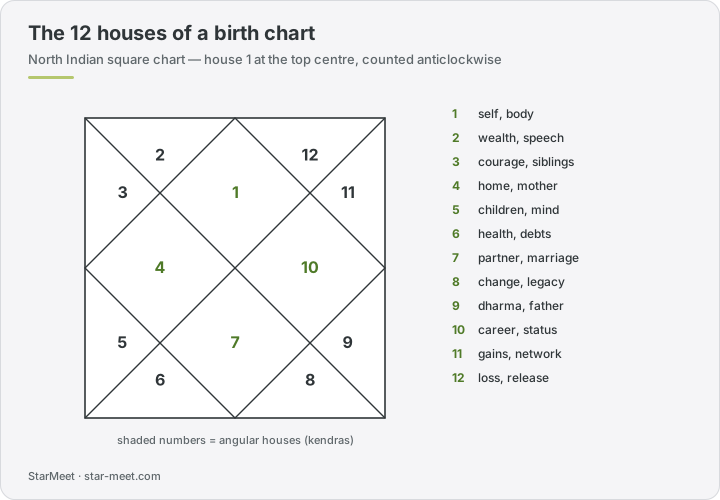
2. House placement: Kendra (1st, 4th, 7th, 10th) or Trikona (1st, 5th, 9th) = beneficial platform. Dusthana (6th, 8th, 12th) = challenges, though 8th can bring Ayushkaraka longevity and hidden power.
3. Functional nature: A planet that rules Kendra and Trikona simultaneously = Yogakaraka — its Dasha delivers Raja Yoga results. A planet ruling the 2nd/7th = Maraka (life-threatening potential). A planet ruling Dusthana = mixed/malefic.
4. Conjunctions and aspects: Benefic aspects from Jupiter or Venus elevate; malefic aspects from Saturn or Mars compress or delay results.
5. Navamsha placement: "A planet's results in Dasha are 50% determined by its Navamsha placement." — P.V.R. Narasimha Rao. A planet exalted in D-1 but debilitated in D-9 delivers disappointing results. Vargottama (same sign in D-1 and D-9) = unshakeable, potent delivery.
Kendradhipati Dosha — a critical classical rule: natural benefics (Jupiter, Venus, Mercury, Moon) when they exclusively rule Kendra houses (4th, 7th, 10th) develop a mixed, often problematic nature. Jupiter ruling the 7th house for Gemini Lagna, or Venus ruling the 7th for Aries Lagna — these planets become somewhat malefic despite being natural benefics. Their Dashas deliver Kendra results with an edge of complexity.
Ketu Dasha (7 Years): Spiritual Liberation and Past-Life Patterns
Ketu Dasha activates the principle of dissolution, detachment, and past-life resolution. Ketu is the moksha karaka — the planet most associated with spiritual liberation. Its 7-year Maha Dasha is among the most spiritually potent, and among the most confusing, periods in a human life.
What Ketu Dasha delivers:
- Dissolution of attachments the soul is ready to release from previous lives
- Phantom illnesses — symptoms without clear medical diagnosis (Ketu rules mysterious conditions)
- Identity confusion — "Who am I?" becomes an urgent question
- Sudden endings of relationships, careers, or lifestyles that no longer serve soul evolution
- For spiritually inclined charts: profound meditation experiences, teacher meetings, ashram retreats
- BPHS: "Ketu Dasha brings Gyana (wisdom) when Ketu occupies Kendra or Trikona and is aspected by Jupiter"
Favorable Ketu Dasha: Ketu in 1st, 4th, 5th, 7th, 9th, or 10th house; aspected by Jupiter; Ketu Antardasha within Jupiter Maha Dasha (spiritual maturation).
Difficult Ketu Dasha: Ketu in 2nd (speech/finances disrupted), 3rd (siblings), 8th (health shocks), 12th (extreme isolation or institutionalization if afflicted); Ketu conjunct Mars (accidents, surgery).
The first Antardasha within Ketu Maha Dasha is Ketu/Ketu — an intense concentrated self-dissolution. The sequence then moves to Ketu/Venus, Ketu/Sun, and so forth.
Venus Dasha (20 Years): The Longest Period — Marriage, Wealth, and Maraka Risk
Venus Dasha, at 20 years, is the longest Maha Dasha in the entire Vimshottari system. Venus is the natural karaka (significator) of marriage, relationships, wealth, beauty, arts, and sensory pleasure. Its 20-year period is often the most materially and romantically active chapter of a life.
What Venus Dasha delivers:
- Marriage (primary indicator for both men and women — Venus aspects the 7th house for all charts)
- Material accumulation: property, vehicles, luxury goods
- Artistic fulfillment, creative expression, aesthetic refinement
- Social expansion, charisma, popularity
- For Aries and Scorpio Lagna: Venus rules the 7th house (partner) AND the 12th house (loss) — making Venus simultaneously a Maraka (life-threatening agent) and a planet of great pleasures. Special caution during Venus/Rahu, Venus/Saturn, and Venus/Mars sub-periods
20 years is exceptional. A person born in Venus Dasha at birth experiences their entire childhood through the Venus lens. A person entering Venus Dasha at age 40 experiences their most materially productive two decades. The duration means that even within a difficult Venus Dasha, there are excellent sub-periods (Venus/Jupiter, Venus/Moon).
Favorable Venus Dasha: Venus in own sign (Taurus, Libra), exaltation (Pisces), Kendra, or Trikona; Venus as Yogakaraka (Capricorn or Aquarius Lagna).
Sun Dasha (6 Years): Authority, Soul Identity, and Compressed Solar Themes
Sun Dasha, at only 6 years, is the shortest Maha Dasha. The Sun is the Atmakaraka — the planet of soul, authority, father, government, and individual identity. Its brief Dasha delivers compressed, intense solar themes.
What Sun Dasha delivers:
- Authority recognition: promotions, government positions, leadership roles
- Father-related events: health changes, relationship evolution, inheritance
- Identity crisis or identity empowerment — the soul questions its role
- For politicians, executives, and public figures: peak visibility periods
- Health: heart, spine, eyes (Sun's body parts)
The Sun rules only 6 years because its themes are "royal and swift" — it does not linger. Favorable Sun: own sign (Leo), exaltation (Aries), Kendra/Trikona, not combust. Sun/Jupiter Antardasha within Sun Dasha = peak authority period.
Moon Dasha (10 Years): Mind, Mother, and Emotional Transformation
Moon Dasha duration is 10 years, and its results hinge almost entirely on one classical factor: Paksha Bala (lunar phase at birth).
- Shukla Paksha birth (waxing Moon, from new to full): Moon is strong, clear, nurturing. Moon Dasha delivers emotional fulfillment, strong maternal relationship, public recognition, mental stability.
- Krishna Paksha birth (waning Moon, from full to new): Moon is weak, introspective. Moon Dasha brings emotional sensitivity, vulnerability, possible mood disorders, the inner world dominates over outer expression.
What Moon Dasha delivers:
- Mother-related events: health, relationship, departure
- Emotional maturation: coming to terms with feelings and inner life
- Public life (Moon rules masses and popularity)
- Real estate (Moon = home, emotional security)
- Travel, especially over water
Moon Dasha is the most "feeling" of all periods — events register deeply emotionally even when materially mild.
Mars Dasha (7 Years): Property, Siblings, and Competitive Drive
Mars Dasha activates Martian themes: property, siblings, competition, physical energy, and assertive action. Mars rules both Aries and Scorpio, making its Dasha particularly consequential for those with these signs prominent in the chart.
What Mars Dasha delivers:
- Real estate acquisition or disputes (Mars = land, property)
- Sibling relationships — support or conflict
- Athletic achievement, competitive victories
- Engineering, surgery, police, military careers activated
- Kuja Dosha activation: Mars in 1st, 4th, 7th, 8th, or 12th house — its Dasha can create relationship turbulence
- Accidents, surgeries, bleeding events (Mars/8th house combinations)
Mars Dasha in childhood (common for Ketu Nakshatra births) is intense — the child is energetic, sometimes aggressive, prone to fevers and cuts. In adulthood, Mars Dasha typically produces the greatest physical accomplishments.
Rahu Dasha (18 Years): Foreign Success, Obsession, and the Amplification Principle
Rahu Dasha's defining characteristic is amplification: Rahu acts like the planet it is most closely conjunct or that rules its sign. This makes Rahu Dasha profoundly unpredictable until the chart is examined.
The Rahu Amplification Principle:
- Rahu conjunct Jupiter = Guru-Chandala Yoga — wisdom with shadow; meteoric rise, but possible ethical compromises
- Rahu conjunct Venus = obsessive relationship destiny, foreign romantic connections
- Rahu conjunct Saturn = intense soul-purpose restriction followed by sudden release
- Rahu in Gemini, Virgo (Mercury-ruled signs) = intellectual brilliance, media exposure
What Rahu Dasha delivers:
- Foreign countries, multicultural environments, immigration
- Meteoric career rise — then sometimes meteoric fall (Rahu is not stable)
- Technological mastery, unconventional methods that succeed
- Material ambition at peak intensity
- Obsession with goals to the exclusion of relationships and health
- 18 years means Rahu Dasha often spans an entire professional career chapter
Rahu Dasha is most successful when Rahu is in Kendra or Trikona, especially in signs of Jupiter (Sagittarius, Pisces) or Mercury (Gemini, Virgo), and when it is free from malefic aspects.
Jupiter Dasha (16 Years): Wisdom, Children, and the Karako Bhava Nashaya Warning
Jupiter Dasha activates wisdom, children, spiritual teacher (Guru), dharmic wealth, and expansion. Jupiter is the natural Guru of the zodiac — its 16-year Dasha is often the most spiritually elevating chapter of a life.
What Jupiter Dasha delivers:
- Marriage (for women — Jupiter is the karaka of husband)
- Childbirth (primary timing indicator for children)
- Higher education, philosophy, law, spiritual studies
- Financial expansion through ethical means
- Teacher, mentor, guru figures entering life
Karako Bhava Nashaya Warning — a classical rule: when Jupiter occupies the house it naturally signifies (5th house for children, 9th for Guru, 2nd for family), its Dasha can paradoxically damage those significations. This is particularly relevant for Taurus and Libra Lagna: Jupiter rules the 8th and 11th (Taurus) or the 3rd and 6th (Libra), making it a functional malefic whose Dasha can bring challenges despite Jupiter's natural beneficence.
Saturn Dasha (19 Years): Career Consolidation, Destiny, and the Age Factor
Saturn Dasha (19 years) is the most structuring, the most soul-purpose, and the most age-dependent of all Maha Dashas. Saturn is the Ayushkaraka (significator of longevity) — its Dasha almost always delivers longevity itself, though through hardship.
The Age Factor Rule (P.V.R. Narasimha Rao):
- Saturn Dasha in childhood (ages 0–15): devastating — poverty, harsh circumstances, severe discipline, deprivation
- Saturn Dasha in early adulthood (15–35): serious struggles, delays, but character-building
- Saturn Dasha in middle age (35–55): career consolidation, authority, sustained professional achievement — peak productive period
- Saturn Dasha in old age (55+): soul-purpose completion, acceptance, spiritual renunciation
What Saturn Dasha delivers by Lagna:
- Yogakaraka Saturn (Taurus Lagna: rules 9th + 10th; Libra Lagna: rules 4th + 5th): exceptional career, Raja Yoga results, sustained success
- Generic Saturn Dasha: discipline, delays, hard work rewarded eventually
- Saturn in D-10 (Dashamsha): determines specific industry (Saturn in Capricorn D-10 = mining, construction, government; Saturn in Libra D-10 = law, diplomacy, arts)
Saturn/Saturn Antardasha (the opening 3 years) is the foundation-laying phase — establish structures, accept limitations, commit to the long-term plan.
Mercury Dasha (17 Years): Business, Communication, and Intellectual Mastery
Mercury Dasha activates intelligence, communication, business acumen, and the analytical mind. At 17 years, it is a substantial period well-suited to intellectual and commercial endeavors.
What Mercury Dasha delivers:
- Writing, publishing, media, teaching careers
- Business ventures, trade, commerce
- Siblings (Mercury also signifies siblings alongside Mars)
- Budhaditya Yoga bonus: If Mercury and Sun are conjunct in the chart, Mercury Dasha activates this intelligence yoga powerfully
- Bhadra Yoga: Mercury in own sign (Gemini, Virgo) in Kendra = Maha Purusha Yoga — Mercury Dasha delivers exceptional intellectual and business accomplishments
- Mercury is less affected by combustion than other planets (Sun–Mercury proximity is natural) — Budhaditya Yoga is actually positive when within 10°
Mercury Dasha is traditionally considered favorable for students, writers, traders, accountants, and analysts. The Antardasha sequence within Mercury MD prioritizes Mercury/Mercury first (intellectual self-establishment), then Mercury/Ketu (technical/spiritual synthesis), then Mercury/Venus (business + creativity).
Dasha Sandhi: The Turbulent Junction Between Maha Dashas
Dasha Sandhi — the junction period between two consecutive Maha Dashas — is one of the most psychologically volatile times in any life. Classical texts warn that the last 6–9 months of an outgoing Dasha and the first 6–9 months of the incoming Dasha form a zone of instability, confusion, and transition.
Why Dasha Sandhi is challenging:
- The outgoing planet is releasing its grip — its structures, relationships, and themes begin dissolving
- The incoming planet has not yet established its framework — the native feels "between worlds"
- Major life decisions made during Sandhi often need revision once the new Dasha stabilizes
The three most psychologically turbulent Sandhi junctions:
- Mars/Rahu junction: Mars releases discipline and aggression; Rahu enters with amplification and foreign disruption — a chaotic transition
- Rahu/Jupiter junction: Rahu's obsession and ambition suddenly give way to Jupiter's wisdom and expansion — profound values shift
- Venus/Sun junction: The long, pleasure-rich Venus period (20 years) suddenly compresses into Sun's brief, authority-focused 6 years — identity readjustment
Practical rule: Avoid starting new businesses, marriages, or major investments during the last 6 months of any Maha Dasha. Wait for the new Dasha to establish itself (first 6 months) before committing to major life changes.
Antardasha: Sub-Period Sequence, Calculation Formula, and Interaction Rules
The Antardasha (sub-period, also called Bhukti) is the second level of the Vimshottari hierarchy. Each Maha Dasha is divided into 9 sub-periods governed by each of the 9 planets in the same sequence, always beginning with the Maha Dasha planet itself.
Complete Antardasha sequence for each Maha Dasha:
| Maha Dasha | AD Sequence (order) |
|---|---|
| Ketu (7y) | Ketu, Venus, Sun, Moon, Mars, Rahu, Jupiter, Saturn, Mercury |
| Venus (20y) | Venus, Sun, Moon, Mars, Rahu, Jupiter, Saturn, Mercury, Ketu |
| Sun (6y) | Sun, Moon, Mars, Rahu, Jupiter, Saturn, Mercury, Ketu, Venus |
| Moon (10y) | Moon, Mars, Rahu, Jupiter, Saturn, Mercury, Ketu, Venus, Sun |
| Mars (7y) | Mars, Rahu, Jupiter, Saturn, Mercury, Ketu, Venus, Sun, Moon |
| Rahu (18y) | Rahu, Jupiter, Saturn, Mercury, Ketu, Venus, Sun, Moon, Mars |
| Jupiter (16y) | Jupiter, Saturn, Mercury, Ketu, Venus, Sun, Moon, Mars, Rahu |
| Saturn (19y) | Saturn, Mercury, Ketu, Venus, Sun, Moon, Mars, Rahu, Jupiter |
| Mercury (17y) | Mercury, Ketu, Venus, Sun, Moon, Mars, Rahu, Jupiter, Saturn |
The Rao Framework Rule: "The Antardasha lord must deliver results within the framework set by the Maha Dasha lord." — P.V.R. Narasimha Rao
This means: if the Maha Dasha lord is in the 6th house (health/enemies/service), even a beneficial Antardasha lord (Jupiter) can only deliver Jupiter's results as filtered through the 6th house framework — perhaps health improvement through disciplined service, or spiritual growth through adversity.
The Trigger Principle: The Antardasha lord triggers the natal promise of the Maha Dasha lord. If the Maha Dasha lord promises marriage (conjunct 7th lord, aspecting 7th house), the Antardasha that finally delivers the marriage is typically the one governed by Venus, the 7th lord, or a planet in the 7th house.
Panchadha Maitri (5-Fold Friendship) in Antardasha: The relationship between MD lord and AD lord significantly colors the sub-period:
- Natural friends: smooth, cooperative delivery
- Natural neutrals: workable, some friction
- Natural enemies: tension between the MD framework and AD delivery
- Compound friendship/enmity (including temporary relationship from chart): most precise assessment
Specific combination rules:
- Marriage timing: Venus/Venus, Venus/Jupiter, Venus/Moon; 7th lord AD within 7th lord MD; Moon/Venus
- Career peak: Saturn/Saturn or Saturn/Jupiter within 10th lord MD; Sun/Jupiter AD
- Health crisis warning: Saturn/Rahu or Saturn/Ketu AD combinations when 6th/8th lords are involved
- Financial gains: 2nd + 11th + 5th + 9th lord axis activations — particularly Jupiter/9th lord or Mercury/2nd lord
- Spiritual breakthrough: Ketu AD within Jupiter MD; Jupiter/Ketu; Ketu/Ketu
Pratyantardasha: Pinpointing the Exact Month
Pratyantardasha (PAD) — the third level — is required when the Antardasha is long (Venus/Rahu = 3 years; Rahu/Jupiter = ~2.5 years) and a precise month of an event needs identification. It is a "trigger within a trigger."
The formula:
PAD duration = (MD years × AD years × PAD planet years) ÷ 120² (in days)
For practical prediction: when multiple signals converge — Maha Dasha lord, Antardasha lord, and Pratyantardasha lord all connected to the same house (e.g., 7th for marriage) — and transit confirms — the event manifests within that specific month with high precision.
Special Antardasha Cases
Retrograde AD lord: The retrograde planet delivers its results in an internalized, unconventional, or delayed manner. External events may be slower to materialize, but the inner development is deep. A retrograde Venus AD in a marriage Dasha may bring an unusual relationship, a reconnection with a past-life partner, or an arranged marriage that the native resists internally.
Combust AD lord: When the Antardasha lord is very close to the Sun in the natal chart (within 6°), it is "burned" and struggles to deliver its full promise. Events ruled by the combust planet are overshadowed, diminished, or require extraordinary effort. Exception: Mercury — Budhaditya Yoga means Sun–Mercury conjunction is often strengthening.
Atmakaraka AD lord: When the Antmakaraka (the planet with the highest degree in the chart — the planet that most represents the soul's evolutionary mission) governs an Antardasha, this sub-period brings a pivotal soul-level course correction. External circumstances may force the native to confront the deepest purpose of this incarnation.
Gochara + Dasha = Event: The Double Confirmation Principle
"An event can ONLY happen when BOTH the Dasha and the Transit confirm it. Dasha activates the natal promise; Gochara (transit) provides the timing trigger. Neither alone is sufficient." — P.V.R. Narasimha Rao
This is perhaps the single most important principle in Jyotish timing. A natal chart may promise marriage, career peak, or spiritual breakthrough — but without both Dasha AND transit (Gochara) alignment, the event waits.
How the Double Confirmation works:
- Dasha layer: The active Maha Dasha and Antardasha must relate to the house/planet governing the event
- Transit layer: A slow-moving planet (Jupiter or Saturn) must transit a trigger point — the natal house, its lord, or its Navamsha position — simultaneously
Example: Marriage promise (7th lord well-placed, Venus strong) remains dormant until:
- Venus Dasha/Antardasha OR 7th lord Dasha/Antardasha activates, AND
- Jupiter transits the 7th house OR natal Venus, AND
- Saturn simultaneously transits the 7th house or 7th lord
When both conditions align: marriage occurs.
Jupiter and Saturn Double Transit: The Master Marriage and Career Timer
The Jupiter + Saturn double transit rule is P.V.R. Narasimha Rao's most precise practical tool for timing major life events:
For marriage:
- Jupiter must transit the 7th house from natal Moon OR natal Venus OR the 7th house from Lagna, AND
- Saturn must simultaneously transit the same zone (7th house or 7th lord)
- The overlapping transit window (typically 4–8 months) is the peak marriage timing
For career peak:
- Jupiter + Saturn must simultaneously activate the 10th house from Lagna or Moon, AND
- The 10th lord's Dasha or a Yogakaraka Dasha must be active
Rahu-Ketu 18-month transit provides the mid-range timer between Jupiter and Saturn transits. When Rahu transits the 7th, 8th, or 2nd house simultaneously with Jupiter transit = foreign marriage or unusual relationship developments.
Sade Sati interaction:
- Sade Sati (Saturn's 7.5-year transit through 12th, 1st, 2nd from Moon) + difficult Dasha = maximum challenge, forced surrender
- Sade Sati + beneficial Dasha (especially Jupiter or Yogakaraka) = disciplined empire-building despite pressure
Divisional Charts in Dasha Timing: D-9, D-10, D-7, D-2, D-12, D-60
Divisional charts refine Dasha predictions from "possible event" to "precise outcome":
| Varga | Name | Key use in Dasha timing |
|---|---|---|
| D-9 | Navamsha | Marriage quality, D-9 Lagna lord Dasha = marriage landmark; Vargottama planets deliver unshakeably |
| D-10 | Dashamsha | Career pinnacle — check active planet's strength in D-10; Saturn D-10 sign = career industry |
| D-7 | Saptamsha | Childbirth — Jupiter/5th lord Dasha + strength in D-7; child born when D-7 Lagna lord activates |
| D-2 | Hora | Wealth timing — Sun Hora planets activate during Sun-related Dashas; Moon Hora = emotional wealth |
| D-12 | Dvadashamsha | Parents — father/mother events during planets strong in D-12 |
| D-60 | Shashtyamsha | Past-life soul-purpose debts — inexplicable reversals during D-60 afflictions |
The Navamsha Rule (most critical):
"A planet's results in Dasha are 50% determined by its Navamsha placement." — P.V.R. Narasimha Rao
Vargottama planets (same sign in D-1 and D-9) deliver their Dasha results with exceptional stability and fullness. Even a poorly placed D-1 planet that is exalted in D-9 will produce better-than-expected Dasha results.
The D-9 Lagna lord's Dasha is a particularly powerful marriage timing marker — even when the 7th lord is not in Dasha, the Navamsha Lagna lord activation signals major relationship milestones.
The D-60 (Shashtyamsha) is called the "destiny decoder" — it reveals past-life debts that cause otherwise inexplicable reversals during what should be favorable Dashas. P.V.R. Narasimha Rao notes that many inexplicable career crashes and health collapses during good Dashas are explained only by D-60 afflictions.
Ashtakavarga Scoring for Dasha Periods
Ashtakavarga provides a numerical scoring system that quantifies the strength of planetary transits through each sign:
SAV (Sarvashtakavarga):
- Score ≥ 28 in a sign = abundant support for transit events in that house
- Score ≤ 22 in a sign = difficult transits, events require more effort
- Used to assess how well the Dasha planet's transit supports active Dashas
BAV (Bhinnashtakavarga):
- Each planet has its own 8-point grid
- Saturn BAV score ≥ 5 in a sign = Saturn's transit through that sign is supportive
- Saturn BAV score ≤ 2 = Saturn's transit creates maximum obstruction
- Used for monthly Kakshya-level timing within the Dasha framework
Case Study 1: Venus Dasha and Marriage — Step-by-Step Timing
Chart setup: Female native, Sagittarius Lagna, Venus in 7th house (Gemini, Moolatrikona), Jupiter in 1st house (natural karaka of husband).
Step 1 — D-1 assessment: Venus in 7th in Moolatrikona = strong promise of marriage. Step 2 — D-9 assessment: Venus in Pisces in Navamsha = exalted, Vargottama confirmation — unshakeable marriage promise. Step 3 — Dasha identification: Jupiter Maha Dasha active. Jupiter/Venus Antardasha = Jupiter (natural karaka of husband) + Venus (7th lord, relationship) = strongest possible combination. Step 4 — Transit check: Jupiter transiting natal 7th house simultaneously. Saturn transiting natal Moon sign (confirming timing pressure). Step 5 — Double Confirmation: Both Dasha AND transit align with 7th house. Event manifests. Step 6 — PAD refinement: Venus Pratyantardasha within Jupiter/Venus = exact month identified. Step 7 — Marriage occurs during Jupiter MD / Venus AD / Venus PAD.
Case Study 2: Saturn Dasha and Career Peak — The 8-Step Synthesis
Chart setup: Male native, Libra Lagna, Saturn in 10th house (Cancer — Saturn/10th = career, but debilitated; however, Libra Lagna makes Saturn Yogakaraka ruling 4th + 5th).
8-Step Synthesis Algorithm (P.V.R. Narasimha Rao):
- Identify active MD/AD planets — Saturn MD, Jupiter AD
- Assess MD lord in D-1 — Saturn in 10th (career house), despite debilitation, is Yogakaraka for Libra Lagna
- Assess MD lord in D-10 — Saturn in D-10 Capricorn (own sign) = excellent career D-10 strength
- Assess AD lord in D-1 — Jupiter in 9th house (dharma, fortune) = strong
- Assess AD lord in D-10 — Jupiter in D-10 Sagittarius = excellent
- Identify the house/yoga activated — 10th house + Yogakaraka Dasha + Dharma (9th) support = Raja Yoga
- Check transit — Jupiter transiting natal 10th from Moon; Saturn completing Sade Sati and returning to support
- Event timing — Career peak: major promotion/authority recognition during Saturn MD / Jupiter AD / Saturn transit 10th house
Case Study 3: Ketu Dasha and Spiritual Transformation
Chart setup: Male native, Scorpio Lagna, Ketu in 9th house (Cancer), Jupiter aspects Ketu.
- D-1: Ketu in 9th (dharma/spirituality) + Jupiter aspect = classic Moksha yoga
- D-20 (Vimsamsha): Confirms spiritual attainment — Ketu strong in D-20
- Ketu MD / Jupiter AD: Guru meeting, ashram period begins
- Transit: Jupiter and Ketu simultaneously in 9th house from Moon — classic "Guru meeting" transit signature
- Outcome: Ketu Dasha delivers deepening meditation practice, formal initiation, and philosophical transformation; world career temporarily suspended
Remedial Measures (Upayas) During Difficult Dashas
P.V.R. Narasimha Rao's core principle: "Change consciousness, not destiny. Remedies work by shifting the internal state from resistance to receptivity."
Effective Upayas during challenging Dashas:
| Planet | Mantra | Dana (Charity) | Day | Gemstone (if warranted) |
|---|---|---|---|---|
| Ketu | Om Ketave Namaha (108×) | Black and white items to Brahmins | Tuesday | Cat's Eye (Lahsuniya) — only if Ketu is Yogakaraka |
| Venus | Om Shukraya Namaha (108×) | White sweets, rice to women | Friday | Diamond/White Sapphire — only for benefic Venus |
| Sun | Gayatri Mantra (108×) | Wheat, jaggery to government workers | Sunday | Ruby — only for strong Sun in benefic houses |
| Moon | Om Chandraya Namaha (108×) | White rice, milk to mother figures | Monday | Pearl — only for strong Moon |
| Mars | Om Angarakaya Namaha (108×) | Red lentils, land donations | Tuesday | Red Coral — contraindicated for Gemini/Virgo Lagna |
| Rahu | Om Rahave Namaha (108×) | Blue/black items, sesame | Saturday | Hessonite (Gomed) — use with caution |
| Jupiter | Om Gurave Namaha (108×) | Yellow items, books, turmeric | Thursday | Yellow Sapphire — safe for most Lagnas |
| Saturn | Mahamrityunjaya Mantra | Blue/black sesame, iron | Saturday | Blue Sapphire — most powerful, requires precise assessment |
| Mercury | Om Budhaya Namaha (108×) | Green vegetables, books | Wednesday | Emerald — safe for most Mercury-favorable Lagnas |
Gemstone warning: Never wear a gemstone for a Maraka planet (2nd/7th lord) or Dusthana lord without precise astrological assessment. The wrong gemstone amplifies the wrong Dasha effects.
The 8-Step Algorithm for Reading Any Vimshottari Dasha
This synthesis algorithm (from P.V.R. Narasimha Rao's teaching methodology) applies to any Dasha analysis:
Step 1: Identify the active MD and AD planets from the Dasha chronology.
Step 2: Assess both planets in D-1: dignity, house placement, conjunctions, aspects. What houses do they rule? Are they functional benefics or malefics for this Lagna?
Step 3: Identify the houses both planets own and occupy — the intersection of owned and occupied houses defines the primary event domain.
Step 4: Check for Yogas involving the MD/AD planets — Raja Yoga, Dhana Yoga, Viparita Yoga, etc.
Step 5: Assess both planets in D-9 (Navamsha) — are they exalted, debilitated, Vargottama? This determines 50% of the outcome quality.
Step 6: Check the relevant functional Varga — D-10 for career, D-9 for marriage, D-7 for children, D-12 for parents.
Step 7: Verify transit double confirmation — does a slow planet (Jupiter or Saturn) simultaneously activate the relevant house from Lagna and Moon?
Step 8: Synthesize all signals into a coherent prediction: What domain? What quality? What timing? What remedies if needed?
Common Mistakes in Dasha Analysis
- Reading Dasha without transit: Using Dasha alone without transit confirmation leads to false predictions — events may be promised but not triggered
- Ignoring D-9: Failing to check Navamsha strength is the single most common error; strong D-1 + weak D-9 = disappointing Dasha results
- Confusing Swa-Bhukti stability: The first Antardasha within any Maha Dasha (same planet as MD lord) is always a foundation-laying phase — it rarely produces dramatic external events; it establishes the internal framework
- Applying natural significations without checking functional nature: Natural benefic Jupiter does not benefit a Taurus Lagna native in the same way as a Sagittarius Lagna native — functional nature always overrides natural nature
- Ignoring Dasha Sandhi: Starting major life actions during the junction period invites complications
- Gemstones without verification: Wearing stones for Dasha planets without checking their functional nature in the specific Lagna is dangerous
FAQ
Q: Does Vimshottari Dasha work for everyone? A: Classical texts prescribe Vimshottari for Kali Yuga and consider it universally applicable. Parashara also described Ashtottari Dasha (108 years, conditional — active only when birth is in the bright half, during daytime, and with certain ascendants) and Yogini Dasha (36-year cycle) as secondary confirmatory systems. For most practical purposes, Vimshottari is the primary system.
Q: Can a bad Dasha be completely neutralized by remedies? A: Remedies reduce resistance and shift consciousness but do not eliminate soul-purpose experiences. A Rahu Dasha that promises foreign disruption will still involve foreign themes — remedies transform how the native navigates those themes (wisdom vs. chaos) rather than eliminating the experiences entirely.
Vimshottari Dasha: The Schedule of Your Soul's Promises
Vimshottari Dasha is the key that unlocks the timing of every promise in the Eastern birth chart. The natal chart is the script; Vimshottari Dasha is the schedule for when each scene unfolds. Mastering this system requires three integrated skills: precise natal chart assessment, accurate Dasha chronology, and disciplined transit confirmation.
The most important principle bears repeating: an event materializes only when Dasha AND transit align simultaneously. One without the other is theory. Together, they are prediction.
Whether you are navigating Ketu's dissolution, Venus's abundant pleasure, Saturn's disciplined building, or Rahu's amplified ambition — each Dasha arrives exactly when the soul is ready to receive its specific soul-purpose curriculum. The 120-year clock ticks with perfect precision.
Calculate your complete Vimshottari Dasha timeline on StarMeet →
Sources: Brihat Parashara Hora Shastra (classical); P.V.R. Narasimha Rao, "Timing Events using Vimshottari Dasha"; Dr. K.S. Charak, "Essentials of Medical Astrology." All Dasha calculations use Lahiri or Raman ayanamsa as specified in your chart settings.
Frequently Asked Questions
What is Vimshottari Dasha in Eastern astrology?
Vimshottari Dasha is the primary timing system in Jyotish (Eastern astrology), mapping a 120-year cycle of 9 planetary periods. Each planet governs a fixed number of years: Ketu 7, Venus 20, Sun 6, Moon 10, Mars 7, Rahu 18, Jupiter 16, Saturn 19, Mercury 17. Your birth Dasha is determined by the Moon's Nakshatra (birth star) at the moment of birth.
How do I calculate my current Vimshottari Dasha?
Find your Moon's Nakshatra at birth, identify which planet rules that Nakshatra, calculate the remaining Dasha balance using the formula: (degrees remaining in Nakshatra ÷ 13°20') × Dasha years. Use the StarMeet calculator for an instant result. Each Nakshatra spans 13°20' and each planet governs exactly 3 Nakshatras.
How long does each Maha Dasha last?
Ketu Dasha = 7 years, Venus Dasha = 20 years (longest), Sun Dasha = 6 years (shortest), Moon Dasha = 10 years, Mars Dasha = 7 years, Rahu Dasha = 18 years, Jupiter Dasha = 16 years, Saturn Dasha = 19 years, Mercury Dasha = 17 years. Total = 120 years.
What is the difference between Maha Dasha and Antardasha?
Maha Dasha (Major Period) sets the overall framework and theme — it is the 'landlord.' Antardasha (Sub-Period, also called Bhukti) operates within the Maha Dasha framework — it is the 'tenant.' The Antardasha lord delivers results that are consistent with the promise set by the Maha Dasha lord. Duration formula: (MD years × AD years) ÷ 120.
Why can't Dasha alone predict events?
According to P.V.R. Narasimha Rao, 'An event can ONLY happen when BOTH the Dasha and the Transit confirm it.' Dasha activates the natal promise; Gochara (transit) provides the timing trigger. Neither alone is sufficient. The Jupiter + Saturn double transit rule is the most reliable confirmation for major life events like marriage and career milestones.
Which Dasha is best for marriage?
Marriage typically occurs during Venus Dasha or Venus Antardasha, Jupiter Dasha or Jupiter Antardasha (as natural karaka of husband for women), Moon Dasha/Antardasha (emotional fulfillment), or the 7th lord's Dasha. The Double Confirmation rule requires Jupiter and Saturn to simultaneously transit the 7th house or its lord at the time of marriage.
What does Ketu Dasha bring?
Ketu Dasha (7 years) brings detachment, past-life pattern resolution, phantom illnesses that doctors cannot diagnose, confusion about identity and purpose, and for spiritually inclined souls, profound mystical experiences and Moksha eligibility. BPHS states Ketu Dasha brings spiritual wisdom when Ketu is well-placed in Kendra or Trikona.
How does Saturn Dasha affect career?
Saturn Dasha (19 years) is the longest malefic period. For charts where Saturn is Yogakaraka (e.g., Taurus or Libra Lagna), it brings sustained career consolidation and authority. For others, it creates discipline through hardship. The age factor matters: Saturn Dasha in childhood is severe; in middle age (35-55), it builds lasting structures. Saturn in D-10 (Dashamsha) determines the specific career outcome.
About the author
Vadim Arkhipov
Founder of StarMeet. Student of Jyotish since 2013, having completed an advanced course under Dr. K.N. Rao; 30+ years in business. Articles here are written to my brief, drafted with AI assistance and edited by me before publishing.
Profile, expertise and all articles →Related Articles
Ashtakavarga & Gochara: Eastern Planetary Transits
Complete guide to Gochara (Eastern transits): ashtakavarga chart, sarvashtakavarga calculator, saturn transit, jupiter transit, rahu ketu effects, double transit, vedha table, 8-step K.N. Rao algorithm.
JyotishJaimini Astrology: Atma Karaka, Chara Dasha & Karakamsha Guide
Complete Jaimini astrology guide — Atma Karaka calculation, 7 Chara Karakas, Chara Dasha periods, Karakamsha chart analysis, Arudha Lagna, and Rashi Drishti. Based on Jaimini Sutras with practical examples.
JyotishNavamsha Chart D-9: Marriage Secrets in Eastern Astrology
Decode the Navamsha chart (D-9) — Eastern astrology's marriage chart. Learn Vargottama, Pushkara Navamsha, Venus in D-9, and the 8-step marriage algorithm.
Compatibility27 Nakshatras: Complete Guide to Eastern Lunar Mansions
Complete guide to 27 nakshatras — astronomical foundation, pada system, Vimshottari Dasha table, Ashtakuta compatibility, 7-fold Muhurtha classification, and all 27 Devata, Symbol, Shakti.
JyotishWhat is Eastern Astrology? Sidereal Zodiac, 9 Planets & Vimshottari Dasha
Eastern Astrology explained: sidereal zodiac, ayanamsha, the 9 Navagraha planets, Whole Sign houses, and Vimshottari Dasha timing. Complete beginner's guide.
Jyotish