The Big Five Traits (OCEAN): What Each One Actually Measures
Contents
The Big Five Traits (OCEAN): What Each One Actually Measures
The Big Five personality traits—frequently abbreviated as the OCEAN model—represent the five broad dimensions of human personality derived from statistical factor analysis: Openness to Experience, Conscientiousness, Extraversion, Agreeableness, and Neuroticism.
What you will learn from this article:
-
🧠 The 5 Dimensions Breakdown: Exactly what each trait measures, including sub-facets and real-world behavioral trade-offs.
-
📊 Scientific Validity: Why modern academic psychology relies on continuous percentile scoring rather than rigid personality types.
-
✨ Astrology as a Complementary Lens: How planetary archetypes offer a qualitative context alongside quantitative Big Five profiles.
If you have ever taken a popular online personality quiz only to receive a vague four-letter label that changes every six months, you have experienced the frustration of unscientific profiling.
You want clear, actionable insights into how your brain processes stress, structures work, and manages relationships, grounded in real empirical science rather than arbitrary categories.
What Are the Big Five Personality Traits?
In scientific psychology, the Big Five personality traits represent the empirical gold standard for describing human personality differences.
The model originated from Lewis Goldberg’s lexical hypothesis, which posited that every important individual difference in human behavior is eventually encoded into natural language.
By analyzing thousands of personality descriptors using statistical factor analysis, researchers identified five fundamental, independent dimensions along which every human personality varies.
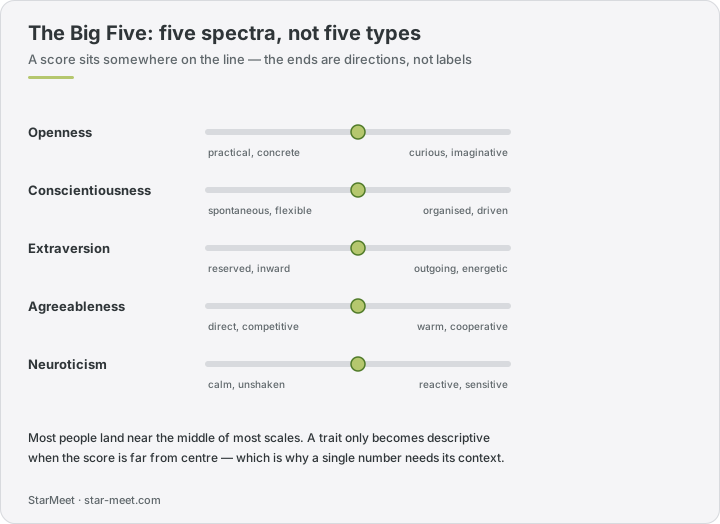
Unlike commercial personality tests that force individuals into absolute "types," the Five-Factor Model evaluates traits along a continuous bell-curve spectrum.
The continuous spectrum
Low percentile — for example, introverted
High percentile — for example, extraverted
Your score reflects your percentile ranking compared to the general population, acknowledging that most people fall somewhere in the middle rather than at extreme ends.
What Does OCEAN Stand For?
The acronym OCEAN serves as a convenient mnemonic device representing the five core traits of the Five-Factor Model:
-
O – Openness to Experience (intellectual curiosity, imagination, aesthetic appreciation)
-
C – Conscientiousness (organization, impulse control, goal-directed behavior)
-
E – Extraversion (sociability, assertiveness, positive emotional energy)
-
A – Agreeableness (compassion, cooperation, trust)
-
N – Neuroticism (emotional reactivity, vulnerability to stress, anxiety)
What Does Openness Actually Measure?
Openness to Experience measures an individual's cognitive flexibility, curiosity, appreciation for art, and willingness to engage with novel ideas or unconventional experiences.
Openness
Low openness — pragmatic, conventional, prefers routine and facts
High openness — curious, abstract, imaginative, artistic
High Openness vs. Low Openness
Individuals scoring high in Openness are intellectually curious, imaginative, and comfortable with abstract concepts. They tend to thrive in creative or research-focused environments.
Conversely, individuals scoring low in Openness are pragmatic, down-to-earth, and prefer concrete facts, established routines, and traditional methodologies.
Key Sub-Facets
In comprehensive instruments like the NEO-PI-R developed by Paul Costa and Robert McCrae, Openness breaks down into six specific sub-facets: Fantasy, Aesthetics, Feelings, Actions, Ideas, and Values.
What Does Conscientiousness Measure?
Conscientiousness measures an individual's degree of impulse control, organization, task orientation, and determination toward achieving long-term goals.
High Conscientiousness vs. Low Conscientiousness
High scorers are methodical, reliable, punctual, and highly self-disciplined. They excel at strategic execution and long-term planning.
Low scorers are more spontaneous, adaptable, and flexible, though they may struggle with disorganization, procrastination, or task completion.
Conscientiousness
Low conscientiousness — spontaneous, flexible, prone to distraction
High conscientiousness — methodical, disciplined, goal-oriented, rigid
The Cost of Extremes
While high conscientiousness is the single strongest predictor of workplace performance and academic achievement, extreme levels can manifest as perfectionism, workaholism, and cognitive rigidity.
Extraversion: What High and Low Scores Really Mean
Extraversion measures the degree to which a person actively seeks out social stimulation, environmental engagement, and positive emotional rewards.
Extraversion
Low extraversion (introversion) — refreshed by solitude, reserved, reflective
High extraversion — refreshed by social groups, assertive, energetic
A common misconception is that extraversion merely dictates whether someone is "friendly." In personality research, extraversion is tied to the brain's dopamine reward system:
-
High Extraversion: Individuals gain energy from social interaction, seek excitement, act assertively, and readily express positive emotions.
-
Low Extraversion (Introversion): Individuals require less external stimulation, prefer quiet environments, process thoughts internally, and recharge through solitude. Introversion is not social anxiety; it is a lower baseline threshold for environmental stimulation.
Agreeableness: What It Is and What It Is Not
Agreeableness measures an individual's baseline orientation toward social harmony, empathy, trust, and cooperation.
Agreeableness
Low agreeableness — competitive, skeptical, direct, challenging
High agreeableness — empathetic, trusting, cooperative, warm
Understanding the Spectrum
-
High Agreeableness: High scorers are empathetic, warm, altruistic, and eager to help others. They prioritize interpersonal harmony and avoid unnecessary conflict.
-
Low Agreeableness: Low scorers are competitive, analytical, skeptical, and direct. They are comfortable challenging authority, negotiating aggressively, and making tough, unemotional decisions.
What Agreeableness Is NOT
Agreeableness is not a measure of weakness or moral superiority. Low agreeableness is often essential for critical roles that demand objective scrutiny, such as auditing, legal defense, or high-stakes negotiation.
Neuroticism: Why the Name Is Misleading
Neuroticism—frequently referred to in modern clinical settings as Emotional Stability (inverted)—measures an individual's baseline sensitivity to stress, threat perception, and negative emotional reactivity.
The term "neuroticism" is often misunderstood due to its historical psychoanalytic connotations. In modern psychometrics, it does not mean you have a psychiatric disorder.
Neuroticism
Low neuroticism (stable) — calm, resilient under stress, slow to panic
High neuroticism — hyper-vigilant, emotionally reactive, sensitive
-
High Neuroticism: Indicates a sensitive, hyper-vigilant nervous system. High scorers experience stress, self-doubt, and anxiety more intensely, but they are also exceptionally quick to spot potential risks and environmental errors.
-
Low Neuroticism (High Emotional Stability): Indicates emotional resilience, calm composure under pressure, and a high tolerance for stress, though extreme low scores can occasionally result in underestimating real danger.
How Are the Big Five Measured?
Validating personality traits requires standardized psychometric tests rather than subjective self-evaluations.
-
NEO-PI-R (NEO Personality Inventory-Revised): Formulated by Costa and McCrae, this 240-item assessment is considered the clinical standard for measuring the five factors and their 30 sub-facets.
-
IPIP-NEO (International Personality Item Pool): An open-source, scientifically validated psychometric inventory developed by Dr. Lewis Goldberg. The 120-item version (IPIP-NEO-120) offers exceptional accuracy and facet breakdown.
-
BFI (Big Five Inventory): Formulated by Oliver John and Sanjay Srivastava, the BFI is a shorter 44-item instrument frequently utilized in academic research studies.
Are the Big Five Traits Stable Over a Lifetime?
Longitudinal research led by psychologist Dr. Brent Roberts confirms that while your percentile rankings remain remarkably stable across adulthood, personality is not entirely static.
Through a natural psychological process known as the Maturity Principle, as individuals age from young adulthood into midlife, they systematically demonstrate:
-
Increases in Conscientiousness (better impulse control and organization).
-
Increases in Agreeableness (greater empathy and cooperation).
-
Decreases in Neuroticism (improved emotional stability and stress resilience).
Big Five vs. MBTI: Which Is Scientifically Supported?
In academic psychology, the Big Five model is universally accepted, whereas instruments like the Myers-Briggs Type Indicator (MBTI) are largely rejected for clinical or predictive use.
MetricBig Five (OCEAN)MBTI
Measurement FormatContinuous spectrum (percentiles)Binary categories (e.g., E vs. I)
Test-Retest ReliabilityHigh (scores remain consistent over time)Low (50% of re-testers receive a different type)
Predictive ValidityPredicts job success, health, and academic outcomesWeak or non-existent clinical predictive power
Scientific FoundationBuilt via empirical factor analysisBased on mid-20th-century non-empirical theories
What a High or Low Score Does NOT Mean
Understanding your psychometric profile requires avoiding simplistic, fatalistic interpretations:
-
Scores are NOT Moral Judgments: Being low in Conscientiousness or high in Neuroticism does not make you a flawed person; it highlights specific behavioral defaults and environmental needs.
-
Scores Do NOT Limit Ability: A low Extraversion score does not mean you cannot give an inspiring public speech—it simply means doing so will cost you more cognitive energy than it would an extravert.
-
Percentiles Are NOT Fixed Traps: Your scores highlight your natural baseline inclinations, not an unchangeable biological destiny.
A Complementary Lens: Astrology and the Big Five Framework
While psychometrics like the Big Five measure observable behavioral traits through statistical factor analysis, psycho-astrology offers a complementary, qualitative language for understanding personality dynamics.
It is critical to clarify that astrology does not predict or cause specific Big Five percentile scores. Rather, your natal chart acts as an alternative symbolic framework that describes similar underlying psychological archetypes:
Psychometric and astrological correspondences
| Big Five trait | Astrological archetype |
|---|---|
| Conscientiousness | Saturn / earth signs |
| Extraversion | Sun, Jupiter / fire |
| Neuroticism | Moon-Pluto / water tensions |
-
Conscientiousness & Saturn: Saturn placements describe your relationship with structure, discipline, and boundaries—mirroring the organization measured by Conscientiousness.
-
Extraversion & Fire/Sun: Prominent Fire sign placements (Aries, Leo, Sagittarius) or a strong natal Sun describe expressiveness and environmental engagement.
-
Neuroticism & Moon Aspects: Complex Moon-Pluto or Moon-Neptune aspects describe emotional sensitivity and threat perception, mirroring nervous system reactivity.
Combining psychometric tools with qualitative frameworks gives you both empirical data and a rich symbolic language for personal growth.
Discover Your Complete Profile on StarMeet
Understanding your Big Five profile is the cornerstone of effective self-discovery, career planning, and emotional regulation.
StarMeet integrates validated scientific assessments, including the comprehensive IPIP-NEO-120 inventory, directly into a secure, conversational platform.
Instead of providing a basic list of percentile scores, StarMeet synthesizes your Big Five traits, clinical scales (like GAD-7 and PHQ-9), and your precise natal chart mapping. The AI engine instantly identifies your core psychological strengths, potential blind spots, and subconscious drivers.
Through private AI-driven therapy and coaching conversations, StarMeet gives you actionable, evidence-based tools—drawn from CBT, ACT, and Schema Therapy—to help you leverage your unique personality profile and navigate life with clarity.
Frequently Asked Questions
What are the 5 main personality traits?
The 5 main personality traits in the Five-Factor Model are Openness to Experience, Conscientiousness, Extraversion, Agreeableness, and Neuroticism (OCEAN).
What does a low score in Neuroticism mean?
A low score in Neuroticism means you possess high emotional stability, resilience under stress, and a calm disposition when facing unpredictable or high-pressure situations.
How is the IPIP-NEO test different from basic online personality quizzes?
The IPIP-NEO is an open-source, scientifically validated psychometric instrument developed by Dr. Lewis Goldberg that measures the Big Five traits and 30 underlying sub-facets with high test-retest reliability.
Can you change your Big Five personality traits intentionally?
Yes. Through targeted behavioral interventions, deliberate habit formation, and clinical therapies like CBT, individuals can gradually shift their trait expression over time.
Which Big Five trait correlates most with creative thinking?
Openness to Experience is the primary trait associated with creative thinking, artistic appreciation, intellectual curiosity, and abstract problem-solving.
🎁 SPECIAL OFFER: Your First Month of Premium for $1.
🔒 100% Safe: Cancel in 1 click, anytime.
👇 Ready to measure your personality with real science?
Take the free validated IPIP-NEO-120 Big Five Test on StarMeet
About the author
Vadim Arkhipov
Founder of StarMeet. Student of Jyotish since 2013, having completed an advanced course under Dr. K.N. Rao; 30+ years in business. Articles here are written to my brief, drafted with AI assistance and edited by me before publishing.
Profile, expertise and all articles →