How to Break a Recurring Conflict Pattern With My Partner: Stop Replaying the Same Fight
Contents
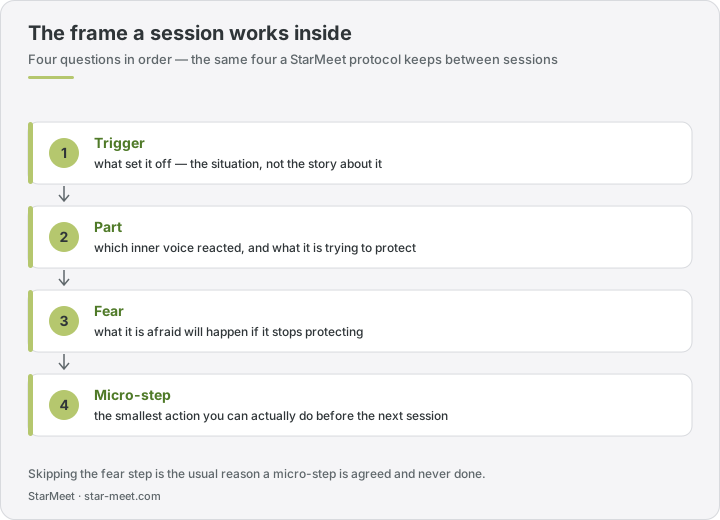
To break a recurring conflict pattern with your partner, the answer is not to "promise we won't do it again" — it is to catch the exact moment you slip into the familiar loop and change your role inside it. Schema therapy explains it simply: in a fight, two grown adults aren't really clashing — their wounded child parts and rigid inner protectors are. Once you learn to recognise these roles, you can stop the argument in real time, even if the trigger has been repeating for years.
What you'll take from this article:
- 🧠 The anatomy of the loop: why any little thing — an unwashed cup, the wrong tone — instantly sets off an avalanche of mutual blame.
- 🎭 The theatre of hidden roles: which unconscious child modes you and your partner fall into, and why logic is powerless there.
- 🛑 The exit point: a step-by-step way to catch yourself entering the destructive cycle and rewrite how the fight ends.
You know exactly how this argument will end before you've even opened your mouth. You can be fighting about money, weekend plans, the kids, or a toothpaste tube left uncapped — but the structure of the conflict is always identical. First a familiar wave of irritation or dull resentment rises inside. Then "that one" trigger phrase lands. You defend yourself while your partner attacks, or the reverse — one of you shouts while the other freezes into icy silence.
The same thought burns inside: "We're here again. I'm not being heard, again. This will never change." You walk off to separate rooms, drained to the bone. The worst part isn't the trigger itself — it's the crushing sense of helplessness: a wall suddenly rises between you and the person you love, and you both become puppets pulled by an invisible hand.
Below, we'll unpack why this happens and how to take back control of your own reactions and the atmosphere in your relationship.
The Psychological Mechanism: How Schema Therapy Explains Your Fights
When we're calm, we are grown, reasonable, loving people. But the instant stress in a conflict crosses a critical threshold, the rational brain (the neocortex) essentially goes offline. The limbic system grabs the wheel — and with it, our childhood schemas and destructive modes take over.
Schema therapy is one of the most effective modern branches of clinical psychology. Its core idea: inside each of us live so-called "modes" — stable emotional states that switch on automatically. A mode, in this approach, is not a personality trait but a learned reaction script, wired in by early experience. In the heat of a couple's fight, two adults aren't clashing — their wounded child parts or harsh inner critics are.
Here are the three most common schema scripts couples fall into.
1. The "Pursuer — Distancer"
This is the classic and most destructive pursuer-distancer dynamic.
- One partner senses the emotional connection slipping away. Inside, the Vulnerable Child mode lights up — terrified of being abandoned or dismissed. To silence that fear, they switch on the Over-controlling Pursuer mode: loudly demanding attention, criticising, insisting on an answer "right here, right now".
- The other partner reads that pressure as a direct threat and wholesale criticism. Their Detached Protector mode activates. They emotionally "freeze", walk into another room, bury themselves in their phone, or answer in one syllable.
The trap: the harder the first one attacks to get any reaction at all, the deeper the second one retreats into defence. The deeper the second retreats, the more frightened the first becomes, and the attack intensifies. The loop has closed.
2. The "Punishing Parent — Rebellious Child"
In this cycle one partner unconsciously takes on the role of "the adult who knows what's right" — but is really a Punishing Parent.
- You start speaking in a lecturing, condescending tone, shaming your partner, pointing out their mistakes, reading them a sermon.
- A Rebellious Child wakes up in response instantly. Your partner stops hearing the substance of the complaint. All they want is to protect their autonomy. They start acting out of spite, snapping back, sabotaging agreements, or sinking into stony protest.
3. "Mutual Destruction"
Here neither side will give an inch. The moment one touches the other's vulnerable spot, both instantly switch on the Angry Protector mode. The goal of this mode is to land a pre-emptive blow so heavy that the partner can never wound you again. Out come the cruellest insults, the dredging up of old sins, the strikes at the sorest places.
The key insight of schema therapy: you don't fight because you've fallen out of love or because you're "wrong for each other". You fight because your destructive schemas fit together perfectly, like a key in a lock, creating a self-sustaining system. That is exactly why the same fight with your partner repeats again and again.
A Map of Vulnerability: Where This Block Is Actually Wired In
Step back, and every recurring script has its own "entry point" — an architecture of the psyche shaped by early experience.
In Western psycho-astrology this is sometimes described as inner tension written into the natal chart. Hard squares or oppositions involving Mars, Saturn, or Pluto, for example, often point to where and when a person's automatic block fires. A Saturnian pull can produce that cold wall of withdrawal, when someone physically can't force out a single word. A strained Mars makes you erupt at the smallest spark.
Hold the frame carefully: the natal chart here is only an architectural blueprint that shows which zones of the psyche pile up more tension. It answers the question "where is it thin?" — but it does not predict your future and never removes your choice. How you actually handle that tension, which roles you pick, and how you talk to your partner — that belongs squarely to psychology. And it's a skill that can, and should, be re-learned.
Why the Usual "Workarounds" Don't Work
When the fight dies down, the "hangover" phase begins. You're ashamed of your words, your partner is hurt, a heavy silence hangs in the house. This is the moment couples usually try to fix things with standard methods that, unfortunately, are useless in the long run.
Illusion #1: "Let's Just Agree Not to Do This Again"
You sit down, drink some tea, and sincerely promise each other: "That's it — from next time on we don't shout, we discuss everything calmly."
Why it fails: the script is stronger than your logical promises. At the moment of the trigger, reason is asleep. If you haven't learned to recognise the physical markers of entering a destructive mode, in the next fight you'll only come to your senses once you're already shouting or slamming a door. Promises operate at the level of the Healthy Adult mode — but in a fight, the Adult isn't home.
Illusion #2: Trying to "Just Suppress" Emotions
You decide to be patient and stay silent while everything boils inside, force a smile, and try to "think positive".
Why it fails: the emotional charge doesn't vanish. It accumulates in the body as muscular tension and psychosomatic symptoms, then explodes over something trivial. Your partner ends up on the receiving end of a wildly disproportionate reaction (a meltdown over shoes left in the wrong spot), which only confirms their belief that you're unreasonable.
Illusion #3: Blaming "Fate" or "Character"
"Well, I'm just hot-tempered, nothing to be done" or "She just has an impossible character, you can't change her."
Why it fails: this is the victim stance, and it strips you of all responsibility for your own life and relationship. It's a dead end that leads to feelings slowly burning out. Character isn't a monolith — it's a set of learned automatic reactions, and those can be corrected.
If we sum up the traditional fight cycle briefly, it looks like this:
- trigger → schema activation
- schema activation → falling into roles (Pursuer / Protector)
- roles → mutual resentment and exhaustion
- exhaustion → a brief lull → and the loop repeats from the top
How to Hack the Script: A Step-by-Step Exit Plan
To break the cycle of recurring conflicts in a couple, you need to learn what psychology calls "awareness in the moment". Here are three foundational steps you can start practising today.
- Step 1. Study your triggers. Notice where your slide into a fight physically begins. For some it's a lump in the throat, for others a racing heartbeat, for others a sharp urge to interrupt their partner. These are the markers that your Inner Child or Protector is seizing control.
- Step 2. Name the process out loud. Instead of pressing on with the argument's content, name the script itself: "It looks like we're entering that loop again. You're starting to go quiet, I'm starting to get angry and shout. Let's stop."
- Step 3. Take a time-out the right way. If you feel you can't cope, stop the fight. But don't leave in silence — that triggers your partner's fear of abandonment. Say: "I'm too angry right now to talk constructively. I need 20 minutes to cool down. I'll come back, and we'll finish this conversation for sure."
This is exactly how you change your role in arguments: you stop being the script's puppet and, for the first time, earn a voice inside it.
Rewrite Your Relationship's Script With StarMeet's AI-Psychologist
Untangling your own defensive modes alone is an extremely hard task. In the heat of conflict we simply have no bandwidth to analyse ourselves.
So that you can work through your conflict patterns deeply, gently and without re-traumatising yourself, StarMeet built a dedicated interactive protocol grounded in schema therapy — "Breaking the Recurring Fight Script". The AI-Psychologist carries the analytical load. This is no canned chatbot: it's a system that combines the rigorous methodology of clinical psychology with a deep read of your personality.
Here's how it works inside StarMeet:
- 40+ validated tests and instruments. The AI-Psychologist leans on clinically tested markers: your attachment style, leading cognitive schemas, burnout level and emotional stability.
- Synthesis of psychology and your natal chart. If you enter your birth data, the AI-Psychologist highlights zones of potential tension in your chart (a strained Moon, say, or hard Saturn aspects) — and then, using the tools of schema therapy and cognitive behavioral couples therapy, immediately offers concrete exercises to work through them.
- Total privacy. You talk with the AI-Psychologist one-on-one in a secure chat, free to voice your most hidden resentments, fears and thoughts without fear of judgement.
- Real-time support. Open the chat right after a fight, describe the situation in plain words ("he said this, I answered that, now we're not speaking"), and the AI-Psychologist will break your conflict down by roles, showing exactly where it went wrong and how to repair it.
You don't have to book weeks in advance, bend your schedule around a therapist's, or pay for expensive sessions just to understand why you feel miserable when you fight. StarMeet opens full free access to a session with the AI-Psychologist on this protocol — with no bank card required.
Break the cycle free with AI-Psychologist (no card needed)
Try it free — 7 requests, then 1 month as a gift.
Frequently Asked Questions
Why do we always fight in the same pattern?
Because in conflict it isn't rational thinking that takes over — it's learned emotional modes. When two partners' childhood schemas line up (one's fear of abandonment and the other's need for autonomy, say), they begin to amplify each other and form a self-sustaining loop. The trigger is new every time; the structure of the fight is one and the same.
Can I change my role in arguments if my character is "just the way I am"?
Yes. Character isn't a monolith — it's a set of automatic reactions learned in early experience, and they can be re-learned. The first step is to notice the physical markers of entering a conflict (a lump in the throat, an urge to interrupt, freezing up) and to name the script out loud before you fall into the familiar role.
What is schema therapy for couples and how does it help?
Schema therapy for couples treats conflict as a clash of "modes" — child parts and inner protectors — rather than an argument between two adults. This mode work helps both partners see their roles in the pursuer-distancer dynamic and step out of it deliberately, instead of endlessly arguing about "who's right".
Can a natal chart explain the cause of our conflicts?
A natal chart can show the zones where you've historically carried more tension — a handy map for self-knowledge. But it doesn't predict your future and it doesn't explain a specific fight. What is actually happening between you and your partner, and how to change it, is decided by psychology, not astrology.
Is it free, and do I need a card?
A session with the AI-Psychologist on this protocol is open for free, with no bank card required. You can describe a fresh fight right after it happens and get a role-by-role breakdown straight away.
What is the pursuer-distancer dynamic in a relationship?
It is the most common recurring loop between couples. One partner feels the connection slipping and switches into pursuit — demanding attention, criticising, pressing for an answer right now. The other reads that pressure as attack and withdraws, going quiet, leaving the room, or answering in one word. The harder one pursues, the deeper the other retreats, and the more frightened the pursuer becomes. Neither behaviour is the real problem; the loop between them is.
What are modes in schema therapy?
A mode is a stable emotional state that switches on automatically under stress — not a fixed personality trait but a learned reaction script wired in by early experience. In a fight the calm adult goes offline and modes such as the Vulnerable Child, the Detached Protector, the Punishing Parent or the Angry Protector take the wheel. Recognising which mode you flip into is the first step to stepping out of it on purpose rather than being run by it.
How do I take a time-out during a fight without making things worse?
Never leave in silence — walking off wordlessly triggers your partner's fear of abandonment and deepens the loop. Instead, name it and promise to return: "I'm too angry right now to talk well. I need twenty minutes to cool down, then I'll come back and we'll finish this." A time-out protects the conversation; a silent exit ends it.
What if my partner will not work on our conflict pattern?
You can still change the pattern, because it is a self-sustaining system in which the two roles feed each other. When you stop playing your usual part — stop pursuing, or stop stonewalling — and name the loop out loud instead, the feedback that kept the fight alive weakens, even if your partner has not changed a thing yet. You only ever control your own half of the cycle, and your half is enough to interrupt it.
How long does it take to break a recurring fight pattern?
There is no fixed timeline, and progress is not measured in weeks. It is measured in catching the loop earlier: first you notice it only afterwards, then mid-fight, then at the very first physical signal such as a lump in the throat or the urge to interrupt. Each time you catch it sooner, the old script loses a little more of its grip.
StarMeet provides psychological self-reflection tools based on peer-reviewed psychometric research. Not a substitute for professional therapy, medical diagnosis or crisis intervention. Consult a licensed mental-health professional for clinical concerns.
About the author
Vadim Arkhipov
Founder of StarMeet. Student of Jyotish since 2013, having completed an advanced course under Dr. K.N. Rao; 30+ years in business. Articles here are written to my brief, drafted with AI assistance and edited by me before publishing.
Profile, expertise and all articles →Related Articles
How to Set Personal Boundaries Without Guilt and Stop Being Everyone's Doormat
A guided way to set personal boundaries without guilt. Understand why your boundaries collapse, recognise the boundary crisis, and learn to say no and protect your energy.
PsychologyFeeling Emotionally Distant From My Partner: How to Rebuild Closeness With Gottman's Method
Feeling emotionally distant from your partner? Gottman's Love Maps method helps you rebuild genuine closeness by learning what is really going on in your partner's inner world — guided free by an AI-Psychologist.
PsychologyHow to Support a Stressed Partner: The Gottman Method in 15 Minutes
Learn how to support a stressed partner using the Gottman stress-relieving conversation technique. Reduce home tension, practise active listening and restore calm — free guided session with AI-Psychologist.
Psychology