How to Give Yourself the Love You Never Got as a Child: The Self-Reparenting Practice
Contents
The simplest way to understand how to give yourself the love you never got as a child is one shift in focus: real self-care isn't a spa day, a shopping trip, or a binge-watch — it's the ability to switch on a supportive inner voice instead of your usual self-criticism. In Schema therapy this is called reparenting: from your grown-up, reasoning self, you become the warm parent your inner child never had. This article explains why care substitutes don't work, how psychological deafness to your own needs takes root, and the step-by-step practice that grows an inner support which won't abandon you in a crisis.
Do you know the feeling when, in the middle of a settled, sensible adult life — with a job, plans, and responsibilities — a sharp, ringing emptiness suddenly washes over you? You can be sitting in a beautiful café, wearing great clothes, and still feel completely, utterly alone inside.
In a hard moment — when a project falls apart, when someone close criticizes you, or when fatigue simply piles up — no supportive voice switches on inside. In its place there's either dull silence or the familiar inner critic finishing you off: "What are you whining about? It's your own fault. Just work harder."
Why Care Substitutes Drain Your Battery
When a modern adult hears "take care of yourself," pop culture instantly hands over a ready-made kit: buy a coffee, book a massage, take a vacation, soak in a candlelit bath. These are classic workarounds — coping mechanisms, the psyche's automatic defenses. The problem is that they work like a painkiller on a toothache: they mute the symptom for two hours but never treat the inflamed nerve.
You try to silence the state with proven tricks — buying the thing you've wanted for ages, ordering your favorite food, watching a series all night, or burying yourself in work. But the moment the screen goes dark or the latest external "mute button" wears off, the emptiness returns. There's still no one inside to hold you. There's no baseline safety in there.
Here's how we usually try to compensate for the inner deficit of warmth:
- Impulse shopping. At the moment of payment, dopamine floods the blood: "Now everything's fine." Two days later the item is ordinary again, and the sense of being unprotected hasn't gone anywhere.
- Eating and drinking the stress away. Food is the fastest evolutionary way to get a substitute for safety. But as soon as the metabolic peak passes, guilt is added on top of the background emptiness.
- Emotional numbing through content. Scrolling the feed or binge-watching shows is an attempt to "switch off" the brain. The psyche doesn't rest — it just goes into suspended animation.
- Overcompensating through achievement. "If I become perfect and earn all the money in the world, no one will ever be able to reproach me." This is the most dangerous workaround — it leads to severe burnout, because external success can never feed an inner emotional hole.
The core paradox of substitute care: you spend enormous amounts of money, time, and energy on the outer trappings of "a good life," yet the quality of your inner state doesn't change. You feel like an impostor in your own life, because you tend to the outer shell while completely ignoring the center.
The Vulnerable Child and Schema Therapy: Where the Deficit of Warmth Lives
To understand why supporting ourselves is so hard, let's turn to Schema therapy — one of the most effective modern branches of clinical psychology, grown out of the cognitive-behavioral approach. According to it, the personality is made up of several inner modes (parts). In each of us, regardless of age or status, three key figures live.
- The Vulnerable Child. The part of the psyche that holds the rawest emotions, fears, hurts, and core needs. It needs warmth, acceptance, safety, predictability, and unconditional love. When you feel lonely, scared, or just want to be held — that's your vulnerable child mode speaking.
- The Dysfunctional (Critical) Parent. This is an introject — the inner echo of the real significant adults from your childhood. If you were often scolded, compared, punished with silence, or required to be "convenient," that voice moved inside your head and now criticizes you automatically.
- The Healthy Adult. The rational, wise, compassionate part of the personality. It can assess reality without drama, contain (accept and hold) heavy emotions, protect boundaries, and — most importantly — hear the needs of the Vulnerable Child and meet them.
What Happened in Childhood
Every child has core emotional needs. The first and most important is secure attachment: the certainty that "I'm loved just for being me, I'll be protected, if I cry someone will come, my feelings matter." If parents were emotionally cold, absorbed in their own problems, overly demanding, or practiced "parenting by ignoring," this need was frustrated — and this is exactly where healing emotional neglect from childhood begins, because the wound starts right here.
A child doesn't conclude "my parents don't know how to show warmth." Their brain works differently: "Something is wrong with me. My feelings are a burden. My weakness is dangerous. To be loved, I have to be strong / convenient / invisible." When such a child grows up, the inner template of the Healthy Adult is physically absent — the psychic map simply has no function for "hug yourself from the inside." Every time they fail, their Vulnerable Child panics and the Critical Parent finishes the job.
A Map of Inner Tension: A Look Through the Natal Chart
If psychology gives detailed tools for rewiring inner states, modern psychological astrology can help you see where exactly this resource is blocked. The natal chart is a kind of architectural blueprint of the psyche that marks zones of inborn tension. In the context of a deficit of inner support, analysts often look at the tense aspects of Saturn and the Moon, as well as the condition of the 4th house (the foundation of the personality — home, childhood, the image of the mother). A hard aspect — a square or an opposition — from Saturn to the Moon seems to seal the emotions away: from early on, the person senses that showing weakness is dangerous.
This marker is not a verdict. It only hints at where the blockage sits. Astrology highlights the location of the rupture as a tool for self-knowledge, but we'll restore the connection and rebuild the foundation with clear psychological practices, not with a prediction about your fate.
Reparenting: How to Grow a Healthy Adult
The only sustainable way to clear the background emptiness is reparenting — becoming a parent to yourself again. It's a process in which you yourself, from your adult and reasoning position, become the loving, protective parent for your own Vulnerable Child. You can't go back in time and change your real parents' behavior. But it is within your power to stop relaying their coldness toward yourself. That's what genuine self-care looks like — a skill assembled from four sequential steps, and the heart of any self-reparenting exercises you'll ever do.
Step 1: Detection and Contact
The moment you feel emptiness, anxiety, or the urge to freeze rolling in, pause. Ask yourself: "How old is the part of me feeling this pain right now?" You'll be surprised, but you'll almost always feel 5, 7, or 10 years old. Note it. The one panicking right now isn't you — the accomplished professional — it's your inner little one, afraid of being rejected or punished.
Step 2: Taming the Inner Critic
Take the controls back from the Dysfunctional Parent. If you hear "there you go falling apart again, get back to work," say a firm "Stop" to that voice. Out loud or in your head, you can say: "I'm grateful to this criticism — once it helped me survive and pull myself together, but right now it's harming me. I won't treat myself this way anymore."
Step 3: Validation (Acknowledging) Your Feelings
A Healthy Parent would never tell a child "don't cry, that's silly" or "there's nothing to be afraid of." They validate the emotion: "You're scared. You're in pain. This really is a hard situation. You have every right to be angry and to cry. I'm with you." Say these words to yourself. Let the pain exist; don't try to fix the state immediately. Give yourself 5–10 minutes inside it, feeling that you are not abandoning yourself — and that is the baseline self-compassion practice.
Step 4: True Care Instead of the Substitute Kind
Now that the Vulnerable Child has been heard and soothed, ask them: "What do you need most in the world right now?" The answer will surprise you. They almost never need new shoes, an expensive restaurant, or one more work project. Most often they want:
- To be left in peace for a couple of hours and simply lie under a heavy blanket.
- To be protected from toxic contact — to say "no" to someone who dumps their negativity on you.
- Permission not to be perfect right this moment.
- Simple, warm food, a bath, and sleep in complete darkness.
How to Nurture Your Inner Child Systematically
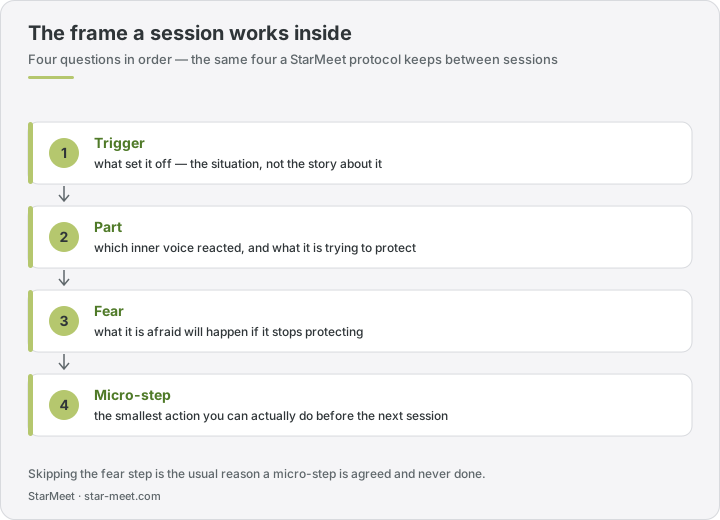
Reading about the steps isn't enough — just as you can't build abs by watching a workout video. Building inner walls is a skill, and it needs regular, safe, deep practice. The question of how to nurture your inner child has one honest answer: repeat the cycle "contact → stop the critic → validation → true care" as many times as it takes, until the new supportive voice becomes automatic.
The StarMeet platform was built to make this path accessible, private, and systematic. At its core are more than 40 validated clinical tests and 20+ evidence-based therapeutic protocols, including Schema therapy, CBT, IFS, and the Gestalt approach. You don't need to find an expensive therapist, juggle schedules, or push through resistance before a face-to-face meeting: in StarMeet you're met by an AI-Psychologist — a thoughtful interactive system trained to the rigorous standards of evidence-based psychotherapy. To work through a deficit of inner support, a dedicated protocol, "Inner Support," built on Schema therapy, is integrated here.
A session with the AI-Psychologist works like this:
- Full privacy. You talk in a secure text chat where you can be completely honest, without fear of judgment or evaluation.
- Individual analysis. The AI-Psychologist gently unpacks your symptoms, helps you identify the Vulnerable Child, and finds the triggers of your inner critic.
- Practical exercises. Right in the chat you go through step-by-step reparenting techniques, learn to contain difficult emotions, and build a personal plan for true — not substitute — care.
- Synthesis with your chart. If you wish, the AI-Psychologist can factor in the features of your 4th house and Saturn aspects to pinpoint the root deficit of safety more precisely.
Access to the first full session of the reparenting protocol is open — for everyone who feels the need to give themselves warmth back. There's no card to attach and no hidden terms to agree to. Your inner child has waited far too long for someone big, strong, and loving to come and rescue them. That someone has already arrived. That someone is you.
Start Inner Support with AI-Psychologist (free, guided)
Try it free — 7 requests, then 1 month as a gift.
Frequently Asked Questions
What do I do when I can't comfort myself when I'm upset?
Start with the first step of reparenting: instead of muting the pain, ask yourself how old the part of you that's struggling right now is. Then intercept the inner critic with a firm "Stop" and speak acknowledgment to your feelings — "you're in pain, and that's okay, I'm with you." The ability to soothe yourself is a skill of containing emotions, trained through repetition, not an inborn gift.
Why do I never feel good enough no matter what I do?
Behind this usually stands a dysfunctional parental voice absorbed in childhood: a child who was compared to others or given conditional love concludes "something is wrong with me." Achievements don't close that hole, because the criticism stays inside. Working with the vulnerable child mode and validating your feelings reduces the power of that voice.
Can you heal emotional neglect from childhood as an adult?
Yes. Reparenting in Schema therapy exists precisely for adults: you don't change the past — you build the missing figure of the Healthy Adult inside, the one that gives warmth and safety now. This is emotional neglect recovery through regular practice, not a one-time effort. It is not clinical diagnosis and not a replacement for in-person therapy in severe cases.
How is real self-care different from a spa day or shopping?
Substitute care mutes the symptom for a couple of hours, like a painkiller: shopping, food, and shows give a dopamine spike but don't change the baseline feeling of being unprotected. True self-care begins with the question to your inner child — "what do you need right now?" — and the answer is usually peace, protected boundaries, and permission not to be perfect, not a new purchase.
How are the natal chart and inner-child work connected?
The natal chart is used here only as a tool for self-knowledge: tense Saturn–Moon aspects or the condition of the 4th house can hint at where a zone of inborn tension sits. This is not a prediction and not a verdict — inner support is rebuilt with clear psychological practices, and the chart only helps you find the root deficit faster.
What is reparenting in Schema therapy?
Reparenting means becoming, from your grown-up and reasoning self, the warm and protective parent your inner child never had. In Schema therapy it is the practice of activating the Healthy Adult mode to meet the needs of the Vulnerable Child, so warmth and safety come from inside rather than from other people. You cannot change your real parents' past behaviour, but you can stop relaying their coldness toward yourself.
How long does it take to build a supportive inner voice?
There is no fixed timeline, because building inner support is a skill, not a one-time event, much like you cannot build strength by watching a workout video once. You repeat the cycle of contact, stopping the critic, validation, and true care as many times as it takes for the new supportive voice to become automatic. Progress usually shows up gradually through regular practice rather than after a single session.
Is it normal to feel completely alone inside even when my life looks good?
Yes, this is a very common experience and not a sign that something is broken in you. You can have a job, plans, nice clothes and still feel a sharp, ringing emptiness because your inner Healthy Adult was never built, so no supportive voice switches on in hard moments. It points to a deficit of inner warmth from childhood, which is exactly what reparenting is designed to rebuild.
What is the difference between the Vulnerable Child and the Critical Parent?
The Vulnerable Child is the part that holds your rawest feelings, fears and core needs for warmth, acceptance and safety. The Critical Parent is an introject, an inner echo of the significant adults who once scolded, compared or ignored you, and it now criticizes you automatically. In reparenting you learn to protect the first part from the second by taking the controls back with the Healthy Adult.
What if I try to comfort myself but feel nothing or feel silly?
That is expected at first, especially if the Healthy Adult template was physically absent in childhood, so speaking warmly to yourself can feel foreign or fake. Don't force a feeling; just start with the mechanics of naming how old the hurting part is and validating it with plain words like you're in pain and I'm with you. The emotional response tends to follow the repeated practice, not the other way around.
StarMeet provides psychological self-reflection tools based on peer-reviewed psychometric research. Not a substitute for professional therapy, medical diagnosis or crisis intervention. Consult a licensed mental-health professional for clinical concerns.
About the author
Vadim Arkhipov
Founder of StarMeet. Student of Jyotish since 2013, having completed an advanced course under Dr. K.N. Rao; 30+ years in business. Articles here are written to my brief, drafted with AI assistance and edited by me before publishing.
Profile, expertise and all articles →Related Articles
Impostor Syndrome at Work: How to Take Off the «Perfect Employee» Mask and Stop Burning Out
Impostor syndrome at work makes you feel like a fraud despite your real skills. Explore a guided Jung-based protocol with an AI-Psychologist to reconnect with your authentic self and find calm confidence at work — free, no card required.
PsychologyHow to Quiet Your Inner Critic: Make Peace With the Part of You That Holds You Back
Learn how to quiet your inner critic using Internal Family Systems (IFS) — a research-backed approach that helps you understand and befriend the part of you that blocks action and fuels self-doubt.
PsychologyHow to Stop Being So Hard on Yourself: Why "Just Toughen Up" Never Works
Learn how to stop being so hard on yourself with a guided Gestalt-based session. Understand the inner critic voice that drives self-blame and reclaim your energy in about 22 minutes.
Psychology