Shadow Integration: What Changes When the Work Is Done Right
Contents
Shadow Integration: What Changes When the Work Is Done Right
Shadow integration is the psychological process of reclaiming repressed, disowned traits from the subconscious mind so they no longer run your life on autopilot. When done correctly, integration dissolves irrational triggers, stops projection, and transforms chronic self-criticism into grounded personal authority and sustainable mental health.
What you will learn from this article:
-
The tangible shifts: How your emotional triggers, social energy, and relationship dynamics change when the shadow self is genuinely integrated.
-
The dual architecture: Why combining Carl Jung's analytical framework with Western natal chart analysis locates your exact blockages faster than trial-and-error journaling.
-
The automated protocol: How to bypass generic self-help advice and use an AI-guided, staged 6–8 session protocol tailored directly to your symptoms.
You know the feeling: you find yourself burning with silent irritation when a coworker speaks assertively in a meeting, or you feel an exhausting wave of resentment when scrolling through someone else's achievement. You tell yourself to be rational, but your nervous system reacts automatically.
In this article, we explain why this happens, what true integration looks like on the other side, and how to reclaim your energy.
What is shadow work and how does the shadow self form?
The shadow self is the subconscious repository of all personal desires, emotional reactions, and personality traits that were rejected by your conscious ego during childhood socialization. Swiss psychiatrist Carl Jung established that whenever a child learns that certain behaviors—such as anger, boundary-setting, ambition, or vulnerability—threaten their parental attachment, those parts are cast into the subconscious shadow.
When you are forced to suppress an innate impulse, the psychic energy does not disappear. Instead, it operates underground, manifesting as unexplained anxiety, chronic people-pleasing, or sudden outbursts of judgment toward people who openly display those exact characteristics.
Jungian shadow work is the systematic therapeutic practice of bringing these disowned traits back into conscious awareness without judgment. Rather than attempting to eradicate negative impulses, this work focuses on recognizing that your repressed traits contain vital survival energy, creativity, and assertiveness.
Why do certain people irritate me so much in daily life?
Psychological projection is an unconscious defense mechanism where the ego attributes its own unacknowledged qualities, deficiencies, and impulses to external individuals. When someone's casual behavior provokes a disproportionate, visceral emotional charge in you, you are rarely reacting to their actions alone; you are reacting to your own repressed shadow reflected back at you.
Research published in the Journal of Personality and Social Psychology confirms that defensive projection occurs specifically when an individual has high defensive self-esteem and actively suppresses awareness of their own negative traits. For example, if you were taught that self-advocacy is selfish, an assertive colleague will not just seem confident to you—they will register as profoundly offensive.
When shadow integration occurs, this dynamic completely dissolves:
-
Trigger neutralization: The person’s behavior remains identical, but your visceral nervous system reaction drops to zero.
-
Boundary reclamation: Instead of ruminating over their audacity, you reclaim the healthy aggression required to set firm boundaries.
-
Energy conservation: You recover the massive cognitive overhead previously wasted on silent resentment and moral superiority.
Why am I jealous of others success and personal freedom?
The golden shadow is the collection of positive qualities, latent talents, creative capacities, and personal power that an individual has disowned due to fear of failure, exposure, or social ostracism. Jealousy is not a character flaw; it is an uncalibrated compass showing you the exact dimensions of your own unlived potential.
Dr. Joshua N. Hook, author and clinical researcher in positive psychology and shadow integration, emphasizes that unintegrated envy produces toxic self-criticism and passive aggression. When you secretly despise someone for their wealth, visibility, or romantic ease, your subconscious is lamenting your own refusal to step into alignment with those capabilities.
Unintegrated Reaction (The Split)Integrated Response (Reclaimed Power)
"They are just superficial and lucky; they don't deserve it.""Their visibility triggers me because I am hiding my own work."
Sinking feeling of inadequacy and silent withdrawal.Objective curiosity about their strategies and execution.
Obsessive comparison and mental exhaustion.Channeling the emotional spike into direct, focused action.
How to do shadow work using clinical psychology and psycho-astrology
Effective shadow work requires a precise diagnostic blueprint to locate where the subconscious split occurred, followed by clinical protocols to integrate the disowned material safely. Relying solely on open-ended journaling writing or generic prompts frequently causes individuals to loop in intellectualization, analyzing their trauma without shifting their nervous system.
Western psycho-astrology provides the structural blueprint of your personality architecture. While clinical psychology provides the active treatment methods (such as Cognitive Behavioral Therapy and Schema Therapy), your natal chart highlights the exact planetary tensions where shadow repression concentrates:
Diagnostic & Treatment Synthesis:
-
12th House Placements: Planets residing in the 12th house represent energies hidden from the conscious ego. A 12th-house Mars often yields individuals who believe they "never get angry," while suffering from passive self-sabotage or unexplained fatigue.
-
Saturn Transits and Squares: Challenging Saturn aspects act as periods of trial, applying pressure to structural personality flaws and forcing suppressed material into the open.
-
Schema Mode Dialogue: Clinical techniques from Jeffrey Young's Schema Therapy allow you to isolate the "Vulnerable Child" or "Demanding Parent" modes that forced the trait into the shadow.
Why traditional workarounds fail to integrate the shadow
Most people attempt to manage their psychological discomfort through cheap workarounds that deplete their energy without fixing the root cause. Suppressing emotional reactions through rigid positive thinking, consuming endless self-help literature, or collecting healing crystals merely reinforces the ego's defense mechanisms.
Similarly, consulting traditional astrologers who offer fatalistic predictions without therapeutic tools leaves you disempowered, reinforcing a feeling of helplessness. Reading conceptual books about Carl Jung informs the intellect, but intellectual knowledge alone cannot rewire somatic defense mechanisms.
Without structured, evidence-based psychological exercises, the ego quickly hijacks shadow work, turning it into another benchmark for self-criticism. True integration requires confronting the shadow directly, feeling the somatic charge, and giving the disowned trait an authorized seat at the conscious table.
What changes after successful shadow self integration?
When shadow work transitions from an intellectual concept into a completed therapeutic experience, tangible behavioral shifts occur across your entire life:
-
Eradication of the "Something is Wrong with Me" Feeling: The chronic baseline anxiety that you are secretly defective disappears once all parts of your psyche are permitted to exist.
-
Instant Recovery of Suppressed Energy: Repressing anger, sexuality, and ambition consumes immense daily metabolic and emotional stamina. Once integrated, that energy immediately flows into creative execution and career momentum.
-
Effortless Assertiveness: You no longer swing between silent people-pleasing and explosive frustration. You express boundaries cleanly, calmly, and without needing to justify your existence.
-
Decisive Social Clarity: You stop attracting manipulative dynamics because you no longer project your disowned power onto authority figures or romantic partners.
FAQ
What is shadow work meaning in modern psychology?
Shadow work is the psychological practice of identifying, accepting, and integrating repressed emotional traits, impulses, and memories that your conscious ego rejected during early development.
What does a shadow worker do?
A shadow worker is a practitioner or clinical guide who helps individuals identify subconscious projections, safely dialog with disowned parts of the psyche, and integrate suppressed emotional energy without ego collapse.
Why do certain people irritate me so much?
People trigger intense irritation when they openly express traits, boundaries, or desires that you have strictly repressed in yourself, causing your subconscious to project your own unacknowledged shadow onto them.
Why am I jealous of others success?
Jealousy is a direct psychological indicator of your disowned potential; it reveals unexpressed ambitions, creative powers, or personal authority that your ego believes you are not permitted to embody.
What causes the persistent "something is wrong with me" feeling?
This sensation stems from a core alienation schema where the ego splits off natural impulses to secure childhood attachment, leaving the conscious self feeling fundamentally defective or incomplete.
How does shadow work therapy differ from standard CBT?
While standard Cognitive Behavioral Therapy focuses primarily on reframing conscious cognitive distortions, shadow work therapy directly examines the repressed emotional roots, archetypal conflicts, and projected traits driving those distortions.
Begin Your Structured Shadow Integration on StarMeet
You do not have to guess which psychological program to follow or spend hours browsing therapy menus.
On the StarMeet platform, you simply describe your triggers, relationship patterns, and emotional blocks in your own words inside a private, secure chat. Powered by the high-speed Gemini 3.8 Flash engine (with the option to switch to Gemini 3.1 Pro for advanced reasoning), StarMeet instantly synthesizes your Western natal chart blueprint with over 40 validated psychological tests (including Jungian Archetypes, Attachment Scales, and the Shadow Trigger Index).
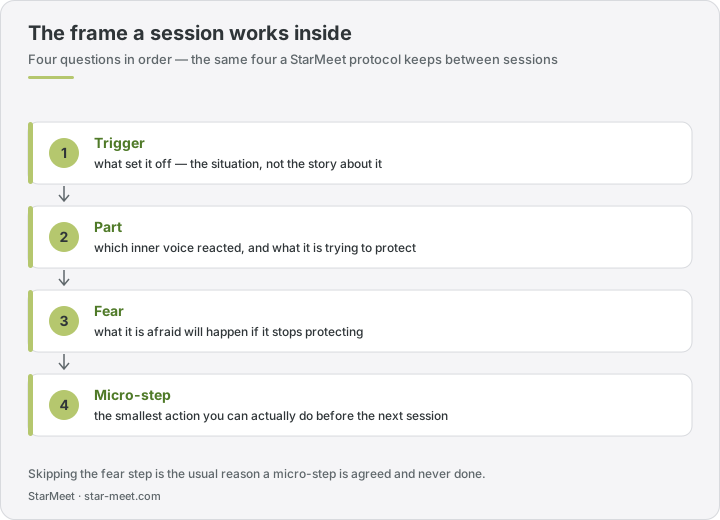
The AI therapist automatically matches your situation to the fitting evidence-based clinical protocol from its base and guides you through a structured course of 6 to 8 deep therapeutic sessions, systematically uncovering one layer per session until integration is complete.
👉 Start your Jungian Shadow Integration Protocol on StarMeet
🎁 SPECIAL OFFER: Your First Month of Premium for $1.
🔒 100% Safe: Cancel in 1 click, anytime.
Frequently Asked Questions
What is shadow work meaning in modern psychology?
Shadow work is the psychological practice of identifying, accepting, and integrating repressed emotional traits, impulses, and memories that your conscious ego rejected during early development.
What does a shadow worker do?
A shadow worker is a practitioner or clinical guide who helps individuals identify subconscious projections, safely dialog with disowned parts of the psyche, and integrate suppressed emotional energy without ego collapse.
Why do certain people irritate me so much?
People trigger intense irritation when they openly express traits, boundaries, or desires that you have strictly repressed in yourself, causing your subconscious to project your own unacknowledged shadow onto them.
Why am I jealous of others success?
Jealousy is a direct psychological indicator of your disowned potential; it reveals unexpressed ambitions, creative powers, or personal authority that your ego believes you are not permitted to embody.
What causes the persistent "something is wrong with me" feeling?
This sensation stems from a core alienation schema where the ego splits off natural impulses to secure childhood attachment, leaving the conscious self feeling fundamentally defective or incomplete.
How does shadow work therapy differ from standard CBT?
While standard Cognitive Behavioral Therapy focuses primarily on reframing conscious cognitive distortions, shadow work therapy directly examines the repressed emotional roots, archetypal conflicts, and projected traits driving those distortions.
About the author
Vadim Arkhipov
Founder of StarMeet. Student of Jyotish since 2013, having completed an advanced course under Dr. K.N. Rao; 30+ years in business. Articles here are written to my brief, drafted with AI assistance and edited by me before publishing.
Profile, expertise and all articles →Related Articles
How to Do Shadow Work: A Step-by-Step Beginner's Practice
Learn how to do shadow work with this practical, step-by-step beginner's guide. Discover Carl Jung's psychological framework, root triggers, and actionable exercises to stop self-sabotage.
PsychologyShadow Work: What It Is, Where It Came From, and What It Is Not
Discover the clinical origins of Jungian shadow work, debunk popular misconceptions, and learn how to integrate hidden subconscious traits to break self-sabotage.
PsychologyCarl Jung's Shadow: The Theory Behind the Practice
Explore the theoretical foundations of Carl Jung's shadow, from the persona-shadow tension to projection, the collective unconscious, and modern psychology.
Psychology