Shadow Work: Freedom from Triggers — Stop Wasting Energy on Irritation
Contents
Shadow work is a practice rooted in Jungian psychology that explains why certain people trigger you intensely — and shows you how to reclaim the blocked energy you spend on irritation instead. This article unpacks the projection mechanism and explains how integrating your shadow self stops the inner energy drain.
What you'll learn:
- The real reason other people irritate us — and why it has almost nothing to do with them.
- How qualities suppressed in childhood quietly drain your energy every day.
- A step-by-step path to self-integration so you stop replaying the same reactions.
The Anatomy of a Trigger: Why Certain People Get Under Your Skin
You know the feeling: someone walks in, brags about their success, complains openly, or just acts with bold confidence — and something inside you tightens.
"How can they behave like that?" or "Why does everything come easily to them?" you think. In that moment you pour enormous mental energy into judgment, and you're left with a low-grade sense that something is wrong with you.
From a psychological perspective, what irritates us most intensely in others is our own shadow. Shadow work begins with this insight: behind every strong trigger hides a quality you once forbade yourself to have.
The shadow self is everything you learned to suppress — the parts of your personality that were labelled "too much," "inappropriate," or "wrong" in childhood. If you were taught to be modest, quiet, and accommodating, then any confident boundary-setting, open ambition, or unapologetic self-expression in someone else will set off a powerful emotional trigger inside you.
How Projection and the Inner Critic Drain Your Energy
The psychological mechanism is straightforward. Your psyche burns enormous energy holding your own ambitions, anger, or vulnerability under lock and key. When someone nearby expresses those same qualities freely — with no shame — an internal alarm fires. You project your inner prohibition onto that person in the form of judgment and contempt.
This is what Jungian psychology calls projection: seeing in others what you've disowned in yourself. Meanwhile, the inner critic runs in the background on a loop: "Who are you to want more?" or "You can't show weakness." That internal critic, not the other person, is what consumes your energy.
The common attempts to manage this backfire:
- Emotional suppression: Telling yourself "I'm above this" leads to psychosomatic tension and sudden anger flare-ups, not peace.
- Motivational books: "Just love yourself" advice doesn't reach the problem because the root is unconscious shame formed in early childhood.
- Avoidance: Dismissing the reaction as "just a difficult phase" removes accountability and leaves the pattern intact.
Shadow Work: How Self-Integration Restores Your Energy
To stop losing energy to irritation, you don't fight it — you recover the blocked resource behind it. This is the core of Jungian shadow work.
The principle: the quality that bothers you in another person already exists inside you. It's locked away. Shadow work exercises methodically bring that lock into conscious awareness and make the quality available as a genuine strength.
The shadow self is not an enemy. It's a storeroom holding everything you once cut off — healthy assertiveness, the right to succeed, the permission to be vulnerable or angry. When you integrate these parts, the energy your psyche spent "containing" them is freed.
Signs that self-integration is taking hold:
- Others' successes stop triggering the sharp sting of envy.
- Flashes of irritation become less frequent and less intense.
- You notice a quiet sense of inner wholeness where there was friction.
The Shadow Integration Protocol in StarMeet
StarMeet offers the "Freedom from Triggers: Shadow Integration" protocol built on evidence-based methods from Gestalt and schema therapy.
The StarMeet AI-Psychologist guides you through this work as a private, unhurried text conversation.
How the protocol works:
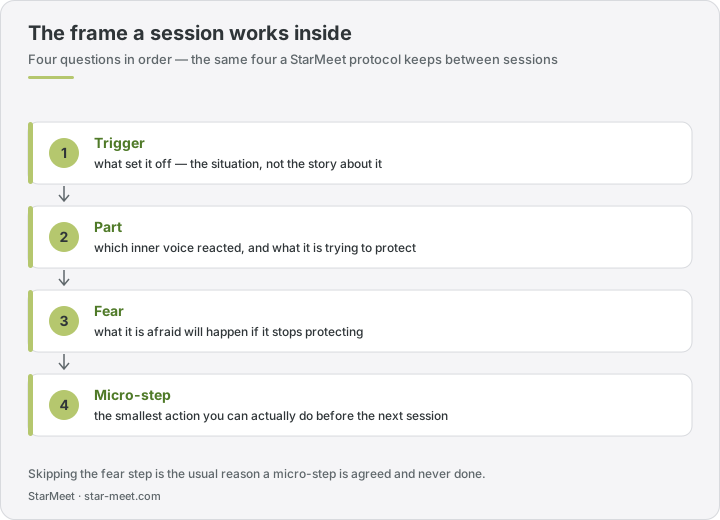
- Pinpoint your trigger. The AI-Psychologist helps you decode exactly which quality sits behind your reaction.
- Surface the pattern. The AI gently brings the unconscious prohibition into awareness — without retraumatisation.
- Integration. You discover the blocked resource and get practical steps to bring it into everyday life.
The outcome: other people's behaviour or success stops feeling like a wound, and the freed energy flows toward your own goals.
Start shadow work (free, guided by AI-Psychologist)
StarMeet is fully available at no cost. No credit card, no subscription required to get started.
Frequently Asked Questions
Why do certain people irritate me so much more than others? The intensity of irritation is proportional to how rigidly you've forbidden that quality in yourself. The stricter the inner prohibition, the sharper the reaction to someone who expresses it freely. In projection psychology, your psyche reads that person as doing what you've cut off in yourself — and the gap feels threatening.
How does shadow work differ from meditation or positive thinking? Meditation and positive thinking operate on the conscious layer of the mind. Jungian shadow work targets unconscious prohibitions — blocks that formed before age 10–12 and have been running patterns in the background ever since. Without surfacing these blocks, the same reactions replay regardless of effort.
How do I start shadow work if I don't know where to begin? The simplest entry point: write down three qualities that most strongly bother you in a specific person. That list is a map of your shadow. Then work with each item through an integration practice — identify when that quality was forbidden, and find its healthy form.
Is shadow work for beginners safe without a therapist? Gentle formats — journaling and structured AI dialogue — are safe for most people. They don't require diving into severe trauma. If intense memories or strong anxiety surface during the process, treat that as a signal to work with a licensed professional.
How long before shadow work produces noticeable results? The first meaningful shift — recognising which quality underlies your trigger — often happens within a single session. Full self-integration is gradual. But even one clear insight reduces the reaction's intensity and returns a portion of the blocked energy right away.
What is the shadow self in simple terms? The shadow self is everything you decided "not to be" in response to family and social rules. Not angry → the shadow holds anger. Not ambitious → the shadow holds drive. Not weak → the shadow holds vulnerability. Jung showed that the larger the shadow, the more energy is spent maintaining it — and the stronger the projections onto other people.
What is projection in Jungian psychology?
Projection is seeing in others what you have disowned in yourself. Your psyche burns energy keeping your own ambition, anger, or vulnerability under lock and key, so when someone nearby expresses those qualities freely an internal alarm fires and you meet them with judgment or contempt. The person is really acting as a mirror for the part you cut off in yourself.
How do I actually integrate a quality once I've identified my shadow?
The quality that bothers you in someone else already exists inside you, just locked away, so integration means bringing that lock into conscious awareness. You trace when the quality was forbidden, usually in early childhood, and then find its healthy form, for example turning suppressed anger into clean assertiveness or hidden drive into the right to succeed. As you do this, the energy your psyche spent containing it is freed.
How do I know shadow work is starting to work?
There are a few clear signs. Other people's successes stop triggering the sharp sting of envy, flashes of irritation become less frequent and less intense, and you notice a quiet sense of inner wholeness where there used to be friction. Even one clear insight into which quality underlies a trigger tends to lower the reaction's intensity right away.
Why don't self-love affirmations fix my triggers?
Advice like just love yourself works on the conscious layer of the mind, but the root of a trigger is an unconscious prohibition and shame formed in early childhood. Because the block sits below awareness, affirmations never reach it, and the same reaction replays regardless of effort. Shadow work is effective precisely because it surfaces that hidden prohibition instead of trying to paint over it.
StarMeet provides psychological self-reflection tools based on peer-reviewed psychometric research. Not a substitute for professional therapy, medical diagnosis or crisis intervention. Consult a licensed mental-health professional for clinical concerns.
About the author
Vadim Arkhipov
Founder of StarMeet. Student of Jyotish since 2013, having completed an advanced course under Dr. K.N. Rao; 30+ years in business. Articles here are written to my brief, drafted with AI assistance and edited by me before publishing.
Profile, expertise and all articles →Related Articles
How to Stop Procrastinating: Understanding Your Inner Stop and Self-Sabotage
Can't make yourself start important tasks? Explore your inner stop with a guided AI-Psychologist session — understand self-sabotage and learn to act without panic.
PsychologyHow to Stop Recurring Fights: Emotionally Focused Therapy Online for Couples
Online emotionally focused therapy (EFT) for couples based on Sue Johnson's model. Understand your negative cycle, rebuild the attachment bond and learn to talk without escalating.
PsychologyHow to Stop Negative Thoughts: CBT Techniques for Anxiety and Catastrophizing
Learn how to stop negative thoughts using cognitive restructuring (CBT). Identify cognitive distortions, challenge catastrophic thinking and break the anxiety spiral — free, guided.
PsychologyHow to Stop Overthinking: Why the Loop Starts and How to Break It
Discover why your brain creates relentless mental chatter, explore the psychological and astrological root causes of rumination, and learn proven ACT and CBT tools to quiet your mind.
PsychologyHow to Find Your Personal Values and Stop Chasing Everyone Else's Goals
Discover what you actually want from work with ACT values clarification. A free guided AI session to find your core values and break free from emptiness after achieving goals.
Psychology