Why Other People Irritate You: Projection, the Shadow Self, and How to Fix It
Contents
Why Other People Irritate You: Projection Explained
Other people irritate you intensely because your subconscious mind uses psychological projection to cast repressed traits, forbidden desires, and disowned vulnerabilities from your own shadow self onto external individuals. When someone's behavior sparks disproportionate anger or disgust, your psyche is reacting to an unacknowledged part of yourself that you have actively disowned to preserve your conscious self-image.
What you will learn from this article:
-
The Core Engine: Why specific personality types trigger visceral annoyance, jealousy, or fury in your daily life.
-
The Hidden Architecture: How Carl Jung's shadow projection and planetary tensions in your natal chart reveal your blind spots.
-
The Clear Path Out: How structured shadow work exercises dismantle triggers and return your mental focus.
You know the exact feeling. A colleague speaks up in a meeting with complete confidence, and an immediate wave of irritation washes over you. A friend posts a bold accomplishment online, and you feel a sharp, bitter pang of resentment followed by a lingering "something is wrong with me" feeling.
You try to brush it off as simple personality differences. Yet the irritation lingers, replaying in your thoughts for hours, draining your focus, and leaving you emotionally depleted.
In this article, we explain why this happens and how to reclaim your energy.
Why do certain people irritate me so much?
When you ask why do certain people irritate me so much, the clinical answer lies in how the human ego defends its conscious identity by rejecting incompatible impulses. Psychological projection is an unconscious defense mechanism where an individual attributes their own unacknowledged emotions, impulses, and traits to other people.
When you experience acute irritation toward someone who is loud, selfish, demanding, or unapologetically ambitious, your nervous system is sounding an alarm. You are not simply observing their behavior; you are defending against a trait that you strictly forbid yourself from displaying.
[ External Trigger: Colleague Acts Boldly ]
During times of high cognitive stress, your capacity to maintain these internal defenses deteriorates. Individuals who grew up in environments where emotional expression was punished learn to exile those impulses into the unconscious mind.
Psychiatrist Thomas Szasz noted that societal systems often label uncomfortable behaviors as defects rather than examining underlying relational patterns. When you encounter someone exercising the very freedom you deny yourself, your internal equilibrium shatters, manifesting as sudden, aggressive annoyance.
What is the Jungian shadow self and shadow projection?
The shadow self is the unconscious complex comprising all the rejected personality traits, primitive instincts, and emotional vulnerabilities that the conscious ego refuses to acknowledge. Carl Jung established that no one can achieve psychological wholeness without confronting this hidden dimension of the psyche.
Carl Jung shadow work focuses on reversing shadow projection, which occurs when these split-off components are reflected onto those around us. In analytical psychology, the psyche maintains balance through compensation. If your conscious identity is built entirely on being accommodating, polite, and self-sacrificing, your unconscious accumulates intense, repressed assertiveness and self-interest.
THE PSYCHIC SPLIT
- Conscious Persona (Ego) — Repressed Shadow Self
- "I am accommodating & calm" — Suppressed rage & boundaries
- "I never demand attention" — Unmet need for visibility
- "I am selfless and modest" — Disowned ambition & desire
When you interact with people who express those repressed traits freely, your shadow reacts with hostility. The irritation you experience is the friction between your conscious persona and your exiled impulses. You do not hate the individual; you hate the mirror they are holding up to your most private internal divisions.
How transgenerational trauma and family dynamics build the shadow
The family system is the primary incubator where natural human behaviors are split into acceptable persona traits and forbidden shadow traits. Transgenerational trauma refers to the transmission of unresolved emotional wounds, behavioral patterns, and defensive adaptations across generations within a family lineage.
In dysfunctional households, a child may be assigned the role of the identified patient—the family member who exhibits symptoms to express the hidden distress of the entire family system. When parents punish vulnerability, direct anger, or self-centered play, children quickly bury those behaviors to ensure attachment and safety.
Family Rule: "Never show anger or take up space"
Those who were raised under severe emotional suppression carry these rigid rules into adulthood. If showing anger was dangerous in childhood, an adult will feel deep irritation toward anyone who sets clear, aggressive boundaries. The irritation acts as an emotional scar, signaling an ancient survival rule that is no longer serving you.
The astrological blueprint: How your natal chart maps your shadow triggers
Modern psycho-astrology provides an objective, structural blueprint of where your psychological defenses and shadow traits reside. Your natal chart acts as a diagnostic map, highlighting internal tensions before they manifest as interpersonal friction.
Saturn transits represent critical evolutionary periods where structural limitations, subconscious fears, and repressed responsibilities are forced into conscious awareness. When transiting Saturn makes hard planetary aspects—such as squares (90° tension) or oppositions (180° polarity)—to personal planets like Mars or the Moon, internal friction spikes.
The 12th House in a natal chart specifically governs the unconscious mind, psychological blind spots, and self-undoing. Planets placed in the 12th House, or transited by heavy outer planets, represent energies that the individual struggles to express directly.
For instance, an individual with Mars in the 12th House often represses healthy anger, resulting in frequent encounters with aggressive individuals who trigger intense irritation. Astrology illuminates where and why the blockage exists, while clinical psychology provides the exact protocols for how to resolve it.
Why common self-help workarounds fail to resolve irritation
Most people rely on superficial workarounds to manage chronic emotional irritation, yet these strategies consistently fail to produce lasting relief. Suppressing your frustration, reciting positive affirmations, or reading generic self-help advice only forces the emotional charge deeper into the subconscious mind.
Workaround StrategyWhy It Fails ClinicallyLong-Term Result
Emotional SuppressionTreats anger as a moral failure; drives impulses deeper into the shadow.Somatic tension, chronic fatigue, sudden explosive outbursts.
Positive AffirmationsCreates cognitive dissonance; bypasses the underlying psychological wound.Cynicism, emotional numbness, reinforced "something is wrong with me" feeling.
Superficial AstrologyTreats chart placements as fixed destiny without psychological intervention.Fatalism, passive resignation, zero behavioral integration.
Avoidance & IsolationRemoves external triggers without resolving internal sensitivity.Shrinking social comfort zone, loneliness, persistent vulnerability.
These cheap workarounds drain your mental battery because they demand constant vigilance to keep disowned traits locked away. True resolution requires moving past intellectual understanding into direct, structured integration of your shadow material.
How to do shadow work: Step-by-step shadow work exercises
Working with the shadow self requires deliberate, structured methods that bring unconscious material into conscious awareness safely. Integrating shadow material turns reactive irritation into healthy psychological resilience.
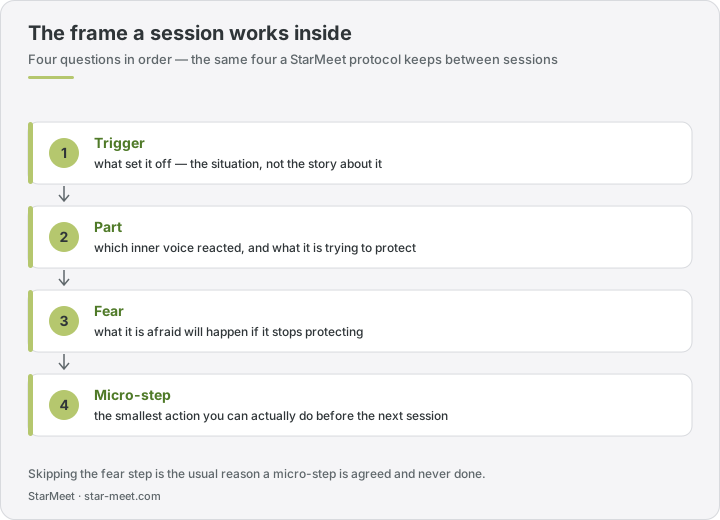
Follow this practical 4-step framework for shadow self work:
- Trigger Identification:
The moment you feel disproportionate irritation toward someone, pause. Write down the exact behavior that annoyed you. Use precise, unfiltered language without rationalizing or excusing their actions.
- The "Well Actually" Inversion:
Ask yourself: "In what situations do I display this exact behavior, even in subtle or covert ways?" Alternatively: "Where in my life do I desperately wish I had the freedom to act like that?" Document your most private answers.
- Archetypal Dialoguing:
Separate the triggered emotional part from your conscious self. Address the irritation directly: "What boundary are you trying to protect? What are you afraid will happen if I express this trait?"
- Somatic Integration:
Notice where the irritation lives physically in your body (tight chest, clenched jaw, knotted stomach). Breathe into that sensation without trying to change it, allowing your nervous system to complete the defensive response cycle.
Integrate Your Shadow with Clinical AI Therapy on StarMeet
Resolving deep-seated psychological projection requires an integrated, evidence-based system rather than guesswork. StarMeet combines modern psycho-astrological charting with deep clinical psychology to help you dismantle emotional triggers at their source.
StarMeet eliminates the confusion of choosing therapy programs from a generic menu. You describe your current struggles, interpersonal friction, or emotional triggers in your own words inside the private chat.
The system instantly evaluates your natal chart alongside a rich diagnostic battery of over 40 validated scientific tests—including Jungian Archetype assessments, attachment style scales, and the proprietary Shadow Trigger Index (Встреча с Тенью).
[ Your Plain-Language Input ]
- (Saturn Transits, 12th House) (Schema, CBT, GAD-7/PHQ-9)
The platform's Gemini 3.8 Flash engine (with seamless switching to Gemini 3.1 Pro for advanced reasoning) analyzes your input, maps your architectural planetary tensions, and pairs you with the precise clinical protocol required (such as Schema Therapy or Cognitive Behavioral Therapy).
It then guides you through a structured, staged course of roughly 6–8 sessions, diving one layer deeper each session to permanently integrate your shadow material.
Frequently Asked Questions
What is the true shadow work meaning for a beginner?
Shadow work meaning centers on uncovering the hidden, repressed parts of your personality that dictate your automatic emotional reactions. For beginners, it starts with examining everyday irritations and learning why specific people trigger defensiveness, envy, or moral outrage in you.
How does carl jung shadow work explain unprovoked hatred toward strangers?
Carl jung shadow work explains that unprovoked hatred toward strangers is almost always a projection of disowned traits. The stranger embodies a behavior, appearance, or freedom that your conscious ego has strictly labeled as unacceptable, triggering a defensive hostility to protect your self-concept.
What are the most effective shadow work exercises for everyday triggers?
The most effective shadow work exercises involve immediate trigger journaling, identifying the hidden secondary gain of the annoying behavior, and practicing somatic exposure to sit with the physical tension of irritation rather than acting it out or suppressing it.
Can shadow work therapy help if I feel disconnected from my emotions?
Yes. Shadow work therapy systematically bypasses intellectual defenses to locate where emotional energy has been suppressed. By combining cognitive restructuring with archetypal inquiry, it helps restore access to numbed feelings, authentic assertiveness, and intuitive vitality.
What is the role of a professional shadow worker?
A shadow worker acts as an objective guide who spots unconscious defense mechanisms, projections, and rationalizations that you cannot see alone. They provide a structured framework to safely explore painful memories and integrate disowned psychological traits.
🎁 SPECIAL OFFER: Your First Month of Premium for $1.
Unlock full access to your personalized Natal Chart Blueprint, over 40 clinical tests, and your tailored AI-guided shadow therapy protocol.
👉 Start Premium for $1 on StarMeet
🔒 100% Safe: Cancel in 1 click, anytime.
About the author
Vadim Arkhipov
Founder of StarMeet. Student of Jyotish since 2013, having completed an advanced course under Dr. K.N. Rao; 30+ years in business. Articles here are written to my brief, drafted with AI assistance and edited by me before publishing.
Profile, expertise and all articles →Related Articles
Shadow Work Test: Why Successful, Arrogant or Lazy People Trigger You
Annoyed by arrogant, lazy or successful people? That's Jung's Shadow projection. Learn why other people's behavior drains you, and how to reclaim your locked-up energy. Free shadow work test + a private session with an AI therapist.
PsychologyShadow Work: What It Is, Where It Came From, and What It Is Not
Discover the clinical origins of Jungian shadow work, debunk popular misconceptions, and learn how to integrate hidden subconscious traits to break self-sabotage.
PsychologyCarl Jung's Shadow: The Theory Behind the Practice
Explore the theoretical foundations of Carl Jung's shadow, from the persona-shadow tension to projection, the collective unconscious, and modern psychology.
Psychology