Big Five vs Myers-Briggs: Which Personality Test Is Worth Your Time
Contents
Big Five vs Myers-Briggs: Which Personality Test Is Worth Your Time
The Big Five personality test is the scientific gold standard for psychometric assessment, while the Myers-Briggs Type Indicator (MBTI) is an unvalidated categorical framework. The Big Five measures continuous traits across Openness, Conscientiousness, Extraversion, Agreeableness, and Neuroticism, yielding high predictive validity. Myers-Briggs forces individuals into arbitrary binary boxes with poor test-retest reliability.
What You Will Learn From This Guide:
-
🧠 The Validity Gap: Why academic psychology discarded the Myers-Briggs model decades ago in favor of the Big Five model.
-
📊 Continuous Traits vs. Binary Boxes: How the IPIP-NEO personality test calculates precise percentiles instead of rigid four-letter caricatures.
-
⚡ Therapeutic Integration: How combining clinical trait metrics with root-cause architectural mapping resolves emotional blind spots faster than passive typing.
You take an online quiz, get assigned a four-letter code, and feel understood for twenty minutes.
Then Monday arrives. You experience the same executive paralysis, the same resentment toward an overbearing colleague, and the same chronic fatigue that coffee cannot fix.
Categorizing yourself as an "introverted intuitive" provided a brief dopamine hit, but it left you with zero practical tools to regulate your nervous system. In this article, we explain why this happens and how to reclaim your energy using scientifically verified personality assessments.
What Is the Big Five Personality Test and How Does the OCEAN Model Work?
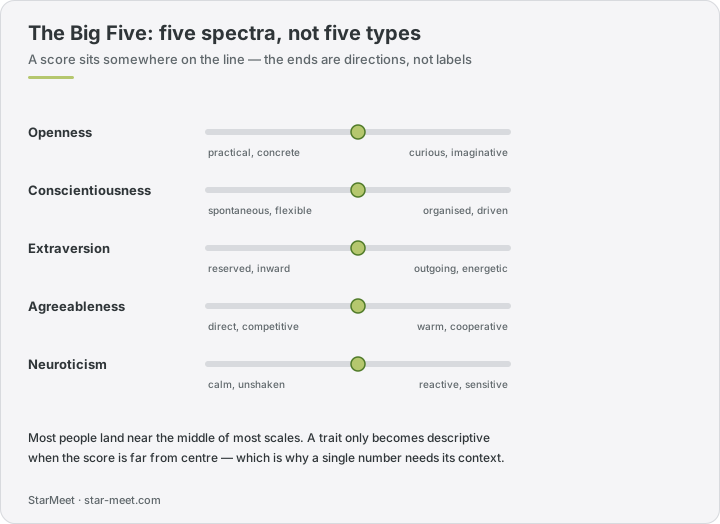
The Big Five personality test is an empirical psychometric instrument designed to evaluate an individual's standing across five universal dimensions of human personality.
THE FIVE FACTOR MODEL
- [O] Openness: Intellectual curiosity vs. Routine
- [C] Conscientiousness: Goal-directed discipline vs. Chaos
- [E] Extraversion: Reward sensitivity vs. Solitude
- [A] Agreeableness: Social cohesion vs. Competition
- [N] Neuroticism: Threat reactivity vs. Stability
Developed over decades by researchers including Paul Costa, Robert McCrae, Warren Norman, and Lewis Goldberg, the Five-Factor framework emerged from the lexical hypothesis. This hypothesis posits that every fundamental human behavioral difference is naturally encoded into language.
Factor analysis of thousands of descriptive terms repeatedly isolated five independent, stable dimensions known as the OCEAN personality test framework:
-
Openness to Experience: Measures cognitive flexibility, aesthetic sensitivity, and intellectual curiosity versus a preference for conventional, predictable routines.
-
Conscientiousness: Assesses impulse control, methodical organization, goal-directed persistence, and executive functioning efficiency.
-
Extraversion: Measures baseline sensitivity to social rewards, positive affectivity, assertiveness, and enthusiasm.
-
Agreeableness: Quantifies an individual's orientation toward prosocial empathy, altruistic collaboration, and trust versus competitive skepticism.
-
Neuroticism: Evaluates threat sensitivity, emotional volatility, autonomic stress reactivity, and susceptibility to negative emotional states.
Unlike commercial personality sorting systems, the Big Five model does not assign a static label. It positions your behavioral tendencies along a bell curve relative to the general population.
When you take Big Five test online evaluations based on the IPIP-NEO personality test (such as the standardized Big Five test 120 questions inventory), you receive granular percentiles across 30 underlying sub-facets rather than an oversimplified archetype.
How Does the Myers-Briggs Type Indicator (MBTI) Measure Personality Types?
The Myers-Briggs Type Indicator is a self-report questionnaire designed to categorize individuals into one of 16 distinct personality types based on subjective preferences.
Created in the mid-20th century by Katharine Cook Briggs and her daughter Isabel Briggs Myers, the test based its initial premises on the speculative theories published in 1921 by Swiss psychiatrist Carl Jung in his work Psychological Types.
Jung proposed that human consciousness operates through four fundamental functions—thinking, feeling, sensing, and intuition—oriented inward (introverted) or outward (extraverted).
Isabel Myers and Katharine Briggs expanded Jung theory to create a structured personality assessment instrument.
The Briggs Myers system sorts test-takers across four binary preference dichotomies:
-
Extraversion (E) vs. Introversion (I): Focus on the external world of people and activities versus the internal world of ideas and reflection.
-
Sensing (S) vs. Intuition (N): Information intake through direct sensory observation versus abstract patterns and hidden meanings.
-
Thinking (T) vs. Feeling (F): Decision-making governed by detached logic versus subjective personal and social values.
-
Judging (J) vs. Perceiving (P): Outer lifestyle preference for planned structure versus spontaneous adaptability.
Combining these four preferences yields a four letter classification (such as INTJ, ENFP, or ISTP).
While Myers Briggs explained a generation of introductory psychology concepts to the public, the assessment relies on rigid categories. It assumes human personality divides naturally into clear-cut dichotomies rather than existing across a continuous spectrum.
Why Is the Big Five Model Considered Scientifically Superior to Myers-Briggs?
The scientific consensus across academic psychology rejects the Myers-Briggs framework due to significant psychometric deficiencies in reliability, validity, and independence.
MYERS-BRIGGS (MBTI) — BIG FIVE (OCEAN)
- Arbitrary binary cutoffs — Continuous bell-curve scale
- 50% re-test type shift — High decades-long stability
- Ignores emotional stability — Measures Neuroticism directly
- Zero clinical predictability — Predicts burnout & mortality
Independent research published by psychometrician David J. Pittenger has demonstrated that up to 50 percent of respondents receive a completely different four-letter classification when retested on the MBTI after a span of just five weeks.
In contrast, longitudinal studies evaluating the Big 5 personality traits show remarkable stability across multi-decade intervals.
The primary structural failures of the Myers-Briggs methodology include:
-
Bimodal Distribution Fallacy: MBTI forces individuals into extreme bins. If your score on the Thinking-Feeling axis sits at the 51st percentile, you are classified as an absolute "Thinking" type, grouped alongside someone at the 99th percentile while separated completely from someone at the 49th percentile. Human traits follow a normal bell-curve distribution, not a bimodal split.
-
The Complete Absence of Emotional Stability: The Myers-Briggs framework contains no metric corresponding to Neuroticism. In clinical practice, emotional volatility, threat reactivity, and vulnerability to stress are vital predictors of human performance, relationship stability, and mental health.
-
Lack of Predictive Power: Meta-analyses show MBTI scores fail to reliably predict managerial effectiveness, career success, or clinical outcomes. The Big 5 traits consistently predict occupational performance, academic achievement, relationship longevity, and physical health trajectories.
Why Common Self-Help Workarounds and Static Labels Fail to Solve Real Stress
A static diagnostic label often functions as an intellectual excuse rather than an instrument for personal growth.
When you discover you are an "INTP" or an "Enneagram 5," the initial relief comes from validation. You feel your eccentricities, your social hesitation, or your emotional detachment have a defined name.
However, intellectual validation is not emotional transformation.
Many people spend years collecting psychological labels, buying crystals, or consulting traditional fatalistic fortune-tellers who declare, "This is simply your destiny."
These approaches consume financial and emotional energy while leaving internal defense mechanisms entirely intact.
If you score in the 92nd percentile for Neuroticism and the 18th percentile for Conscientiousness on a validated free Big Five test, knowing those numbers will not automatically reorganize your daily executive habits or calm your central nervous system.
Reading motivational books or attempting to suppress your chronic anxiety with positive affirmations fails because it ignores the deeper architectural and clinical roots of your behavioral patterns.
The Synthesis: How Architectural Blueprints and Clinical Protocols Create True Growth
Sustainable behavioral change requires two distinct components: an accurate architectural blueprint to identify where psychological friction originates, and clinical therapeutic protocols to determine how to dismantle it.
THE STARMEET INTEGRATED FRAMEWORK
- COSMIC & STRUCTURAL BLUEPRINT CLINICAL ACTION PROTOCOL
- ───────────────────────────── ───────────────────────
- Natal Chart & Transits — CBT / Schema Therapy
- (Where the tension exists) + (How to fix & rewire)
- ───────────────────────────── ───────────────────────
- │
- (Gemini 3.8 Flash / 3.1 Pro)
Within modern psycho-astrology, your natal chart (carta astral) functions as a symbolic map of unconscious conflicts. Planetary tensions—such as challenging squares or oppositions involving Saturn transits—highlight specific psychological developmental gates.
For instance, a Saturn transit through the 12th house frequently coincides with periods of subconscious isolation, forced ego-dissolution, and intense burnout.
Astrology pinpoints the structural tension point, while evidence-based psychology provides the clinical mechanics.
When deep structural awareness is paired with Cognitive Behavioral Therapy (CBT) and Schema Therapy, vague feelings of distress transform into concrete therapeutic assignments.
You no longer look at an acute period of anxiety as random bad luck or an unchangeable personality trait. You recognize it as an active developmental trial that can be methodically addressed using validated clinical exercises.
Frequently Asked Questions
What is the difference between the OCEAN personality test and the Big Five?
The terms are interchangeable. OCEAN is an acronym representing the five core traits established in the Big Five model: Openness, Conscientiousness, Extraversion, Agreeableness, and Neuroticism.
Can I take a free Big Five test online that yields clinical-grade accuracy?
Yes. The International Personality Item Pool (IPIP) hosts open-source, scientifically validated inventories. Standardized implementations utilizing the 120-item or 300-item formats offer psychometric precision comparable to proprietary commercial assessments like the NEO-PI-R.
How does Jungian psychology connect to the Big Five and Myers-Briggs?
Carl Jung proposed original theories regarding archetypes and psychological types that inspired Isabel Myers and Katharine Briggs. While the MBTI attempted to systematize Jung's observational work into a rigid typing tool, modern academic psychology expanded and standardized these concepts into the empirically measurable Five-Factor model.
Is high Neuroticism on a personality assessment a permanent flaw?
No. Neuroticism reflects your baseline autonomic nervous system sensitivity to potential threats and stress. While baseline temperamental traits show genetic stability, clinical interventions such as Cognitive Behavioral Therapy, mindfulness, and Schema Therapy alter how your brain processes emotional triggers.
What is the "Shadow Trigger Index" in psychological testing?
The Shadow Trigger Index is a specialized assessment metric derived from Jungian depth psychology. It pinpoints the disowned, repressed emotional impulses—such as unexpressed anger, envy, or shame—that project onto external interpersonal conflicts.
Transform Self-Knowledge Into Lasting Emotional Mastery
Sorting yourself into an arbitrary four-letter box will not resolve persistent internal conflict or break unhelpful behavioral loops. Real self-mastery requires rigorous clinical diagnostics combined with deep root-cause exploration.
StarMeet combines the scientific rigor of clinical psychology with the structural diagnostic insights of modern psycho-astrology.
By integrating over 40 validated psychological inventories—including the full IPIP-NEO Big Five assessment, Jungian Archetype profiling, Attachment Style tests, and clinical scales like GAD-7 and PHQ-9—StarMeet reveals the exact mechanics behind your internal blocks.
Unlike static testing websites, StarMeet removes the guesswork from your personal development:
-
💬 No Menu Confusion: You never have to guess which therapeutic programme to select. Simply describe what you are experiencing in your own words inside the private, encrypted chat.
-
🔄 Autonomous Clinical Routing: The AI platform evaluates your unique profile, matches your situation to the appropriate evidence-based protocol (such as CBT or Schema Therapy), and guides you through an intensive, staged course of 6–8 structured sessions that go one layer deeper each time.
-
⚡ Next-Generation Speed & Depth: Powered by the ultra-responsive Gemini 3.8 Flash engine for instantaneous insights, with the option to engage Gemini 3.1 Pro for complex, deep-reasoning sessions.
-
🌑 Explore the Shadow: Pinpoint your unconscious defense mechanisms directly using our proprietary Shadow Trigger Index (Встреча с Тенью) and our Jungian Archetype Assessment.
Step Up to Scientific Self-Discovery
Stop wasting time on superficial personality quizzes. Get your complete psychometric profile and personalized therapeutic roadmap today.
👉 Take Your Validated Big Five Personality Test on StarMeet
🎁 SPECIAL OFFER: Your First Month of Premium for $1.
🔒 100% Safe: Cancel in 1 click, anytime.
About the author
Vadim Arkhipov
Founder of StarMeet. Student of Jyotish since 2013, having completed an advanced course under Dr. K.N. Rao; 30+ years in business. Articles here are written to my brief, drafted with AI assistance and edited by me before publishing.
Profile, expertise and all articles →Related Articles
The Big Five Traits (OCEAN): What Each One Actually Measures
Explore the Big Five Personality Traits (OCEAN), their scientific origins, how each factor is measured, and why the Five-Factor Model outperforms MBTI.
PsychologyBig Five Personality Test — Free, 120 questions, IPIP-NEO scientific version
Take the most validated personality test: 120-question IPIP-NEO Big Five. Free, scientific, 15 minutes. Get all 5 traits + 30 facets with a detailed report.
Psychology