How to Heal Anxious Attachment: Self-Soothing That Actually Works
Contents
How to Heal Anxious Attachment: Self-Soothing That Works
To heal anxious attachment, you must regulate your physiological nervous system during acute abandonment panic, dismantle compulsive reassurance seeking, and systematically build internal safety. Developing an earned secure attachment style requires replacing reflexive protest behaviors with somatic grounding, cognitive reframing, and targeted emotional self-reliance protocols.
What you will learn from this guide:
-
The 4-Step Somatic Reset Protocol to instantly halt panic when your partner pulls away or leaves you on read.
-
Why Popular Workarounds Backfire and drain your emotional battery while reinforcing relationship anxiety.
-
How Natal Chart Architecture & Clinical Psychology Synthesize to identify your exact abandonment triggers and systematically rewire them.
You type a text, delete it, rewrite it three times, hit send, and immediately monitor their online status. Your chest tightens, your stomach drops into an abyss, and your brain generates worst-case abandonment scenarios within minutes of a delayed reply.
This reaction is not a personality flaw. It is a dysregulated neurobiological alarm that can be rewired with the right tools.
How to Self-Soothe Anxious Attachment
Self-soothing in anxious attachment is the intentional practice of using physiological and cognitive interventions to down-regulate a hyperactivated nervous system without relying on external validation. When an attachment trigger strikes, your amygdala interprets relational distance as a direct threat to your physical survival. Clinical research pioneered by John Bowlby and Mary Ainsworth demonstrates that anxious attachment keeps the threat-detection system on permanent high alert. If you attempt to think your way out of panic while flooded with adrenaline, you fail because the prefrontal cortex is offline. You must regulate the body first.
The 4-Step Somatic Stabilization Protocol
When the abandonment surge hits, execute this physical protocol before touching your phone:
-
The Extended Exhale (Physiological Sigh): Take two quick inhales through your nose, followed by a long, slow exhale through your mouth for 6 seconds. Repeat 5 times to stimulate the vagus nerve and slow your heart rate.
-
Proprioceptive Compression: Wrap your arms tightly around your ribcage, applying firm, steady pressure. This physical containment signals physical safety to your nervous system.
-
Sensory Grounding (5-4-3-2-1): Identify 5 blue objects around you, touch 4 distinct textures, listen for 3 discrete sounds, identify 2 scents, and take 1 deep breath.
-
Internal Safety Vocalization: State out loud: "I am physically safe in this room right now. Disconnection in this moment does not equal abandonment."
StageTrigger StateSomatic InterventionDesired Outcome
Step 1Heart racing, shallow breathing5 Physiological SighsDrops resting heart rate
Step 2Feeling ungrounded, floatingFirm Self-Hug / Bilateral TappingRestores proprioceptive safety
Step 3Mental spiral, catastrophic thoughts5-4-3-2-1 Sensory ScanRe-engages prefrontal cortex
Step 4Urge to send protest textsAloud safety statement + 20-min timerPrevents protest behavior
What to Do When the Anxiety Spike Hits
An anxiety spike is an acute flood of adrenaline and cortisol triggered by perceived emotional unavailability or delayed communication. When this surge occurs, your immediate biological impulse is to discharge panic through protest behavior—calling repeatedly, sending walls of text, or picking fights to force an emotional reaction. Relationship specialist Stephanie Rigg emphasizes that succumbing to protest behavior provides temporary relief while worsening long-term attachment anxiety.
The 20-Minute Containment Rule
To stop the escalation cycle, implement strict emotional containment:
-
Enforce a Mandatory Phone Quarantine: Place your phone in another room or turn on airplane mode for exactly 20 minutes.
-
Release the Motor Charge: Your body is primed for fight-or-flight. Discharge this energy physically: do 20 jumping jacks, shake your hands vigorously, or splash ice-cold water on your face to activate the mammalian dive reflex.
-
The "Unsent Reality Check" Exercise: Open a private note and write down your rawest catastrophic thoughts. Do not edit them. Once written, label each thought as an "Attachment Projection" rather than a factual event.
How Do I Calm Down When They Do Not Text Back?
Attachment distress caused by unanswered messages is a conditioned response where silence is perceived as emotional rejection. In adult romantic relationships, the anxious preoccupied style equates response latency with a loss of love.
To calm down, you must dismantle the narrative your brain attaches to the silence.
The Decoupling Method
-
Separate Fact from Story: Write two distinct columns on paper.
-
Column A (Facts): "They have not replied to my message sent at 2:15 PM."
-
Column B (Story): "They are losing interest, talking to someone else, or punishing me."
-
Establish Alternative Rational Explanations: Write down three realistic, non-catastrophic reasons for the delay (e.g., in a meeting, driving, low phone battery).
-
Return Energy to Your Own Center: Ask yourself: "What personal task was I neglecting before I checked my phone?" Redirect 100% of your attention to that specific task for the next 30 minutes.
How Do I Stop Being Clingy in Relationships?
Clinginess is not an intrinsic personality trait; it is an externalized strategy for regulating internal emotional volatility through excessive closeness. When you demand continuous proximity or adjust your entire schedule around a partner, you erode your personal boundaries and build resentment on both sides.
Rebuilding Relational Sovereignty
-
Implement Micro-Separations: Intentionally schedule solo activities where you do not check in with your partner for 3 to 4 hours. Build tolerance for relational space.
-
Diversify Your Emotional Portfolio: Anxious attachment concentrates 90% of emotional needs onto a single romantic partner. Reconnect with close friends, personal hobbies, and creative pursuits to distribute your need for connection across a wider network.
-
Practice Non-Urgent Communication: Before asking a partner for help, reassurance, or input, wait 15 minutes and ask: "Can I solve this problem or soothe this feeling myself first?"
The Root Causes: Why Popular Workarounds Fail
Most conventional relationship advice fails because it attempts to suppress behavioral symptoms without repairing the subconscious blueprint or regulating the physical body.
The Failure of Quick Fixes
-
"Acting Unbothered" (Forced Detachment): Pretending you do not care suppresses outward behavior while internal cortisol levels skyrocket. This internal pressure inevitably erupts as passive-aggressive hostility or sudden emotional breakdowns.
-
Rigid "No-Contact" Rules from Social Media: Using silence as a manipulation tactic keeps your nervous system obsessively fixated on the other person's response, reinforcing abandonment panic.
-
External Spiritual Bypass: Relying solely on crystals or generic positive affirmations bypasses the somatic wiring of your nervous system and avoids necessary emotional repair.
The Psychological Mechanism
Clinical psychology measures adult attachment through validated metrics like the Experiences in Close Relationships-Revised (ECR-R) scale. Anxious attachment forms when early developmental caregivers provide inconsistent attunement—alternating between warmth and emotional absence. The developing brain learns that connection is unstable and can only be maintained through hypervigilance.
The Astrological Architecture
While psychology outlines your behavioral patterns, modern Western psycho-astrology provides the structural blueprint of where these challenges concentrate in your psyche:
-
The 4th House & Moon Placements: Show your foundational emotional security and childhood conditioning. Difficult aspects (such as Moon-Plenum squares) indicate deep-seated abandonment triggers.
-
The 7th House of Partnership: Highlights how you project fears onto romantic partners and where relational boundaries collapse.
-
Saturn Transits & Tensions: Saturn acts as the structural tester. Hard transits across personal planets trigger feelings of isolation, demanding that you cultivate internal discipline and self-soothing rather than relying on external crutches.
Natal Blueprint (Where the Wound Lives) + Clinical Protocols (How to Rewire the Pattern) = Earned Secure Attachment
How to Move Toward Earned Secure Attachment
Earned secure attachment is an established psychological state where an individual with an insecure developmental background develops relational security through deliberate therapeutic practice and emotional regulation. Shifting from anxious preoccupied to earned secure requires structured, consistent inner work.
Action Steps for Long-Term Healing
-
Daily Somatic Tracking: Spend 5 minutes every morning checking in with your physical body. Identify tension in your throat, chest, or stomach before relational triggers occur.
-
Direct Communication Over Protest: Replace indirect hints or withdrawal with clean, vulnerable statements: "I notice I am feeling a bit disconnected today. Could we spend 20 minutes catching up tonight?"
-
Schema Reconditioning: Identify and challenge the core schema of Defectiveness/Abandonment. Replace the subconscious belief "If they see the real me, they will leave" with "I am worthy of consistent, stable love."
Frequently Asked Questions
Can you go from anxious to secure attachment?
Yes. Clinical studies show that attachment styles are dynamic adaptation patterns rather than fixed traits. By combining somatic nervous system regulation, Cognitive Behavioral Therapy (CBT), Schema Therapy, and healthy relationship experiences, you can achieve an earned secure attachment style as an adult.
How long does it take to heal anxious attachment?
Rewiring core attachment patterns typically requires 6 to 18 months of focused, consistent practice. The exact duration depends on your dedication to catching protest behaviors, regulating somatic triggers, and processing early developmental wounds.
Why do I get jealous in relationships?
Jealousy in anxious attachment is an evolutionary threat response triggered by perceived loss of connection. When your partner interacts with others, your hypervigilant nervous system misinterprets the diversion of attention as impending abandonment, sparking defensive anger or surveillance behaviors.
What is anxious preoccupied attachment?
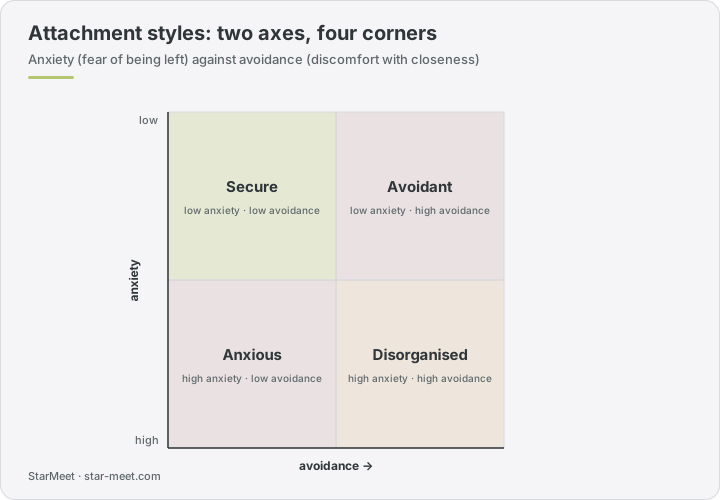
Anxious preoccupied attachment is a specific adult attachment style characterized by high relational anxiety and low relational avoidance. Individuals with this style crave deep intimacy, worry constantly about their partner's feelings, and struggle to feel safe without continuous external validation.
How do I stop needing constant reassurance?
To stop needing constant reassurance, practice sitting with the discomfort of uncertainty in short increments. When the impulse to ask "Are we okay?" arises, execute a physical self-soothing technique, wait 20 minutes, and provide that reassurance internally by affirming your own worth and resilience.
Fast-Track Your Relational Healing with StarMeet
Healing anxious attachment requires precision. You do not need generic advice; you need to understand your exact personal triggers and have real-time therapeutic support the moment panic strikes.
StarMeet synthesizes clinical diagnostic science with modern psychological astrology:
-
🧠 Over 40 Validated Clinical Tests: Measure your exact attachment style with the ECR-R, uncover hidden schemas, and track your clinical burnout and anxiety scores (GAD-7/PHQ-9).
-
✨ Natal Blueprint Diagnostics: Pinpoint where your relational wounds sit in your natal chart—analyzing 4th house roots, 7th house relationship dynamics, and challenging Saturn transits.
-
⚡ Real-Time AI Therapy: Powered by the Gemini 3.8 Flash engine (with instant switching to Gemini 3.1 Pro for advanced therapeutic reasoning), StarMeet guides you through real-time somatic resets, CBT reframing, and boundary scripts directly inside a private chat.
Knowing how to calm an activated nervous system is powerful, but practicing it consistently is where real change happens.
Access 40+ scientifically validated psychological assessments instantly, 100% free with no account needed.
Skip the guesswork of picking therapy models from a menu. Type out what you are experiencing in plain words, and the AI therapist assigns the fitting evidence-based method—drawing from CBT, schema therapy, IFS parts work, Gestalt, ACT, EFT, Jungian analysis, or logotherapy. You are guided through a phased course of 6 to 8 sessions, going a layer deeper in every step.
Start your private, one-on-one conversation for free.
🎁 SPECIAL OFFER: Your First Month of Premium for $1. 🔒 100% Safe: Cancel in 1 click, anytime.
Ready to stop protest behaviors and start soothing your anxious attachment today? 👇 Begin Your Free AI Therapy Course
About the author
Vadim Arkhipov
Founder of StarMeet. Student of Jyotish since 2013, having completed an advanced course under Dr. K.N. Rao; 30+ years in business. Articles here are written to my brief, drafted with AI assistance and edited by me before publishing.
Profile, expertise and all articles →Related Articles
Anxious Attachment Style: Signs, Causes, and What Actually Helps
Discover the signs and root causes of an anxious attachment style, understand the underlying nervous system activation, and learn proven paths to earned security.
PsychologyAttachment Style Test: Free, Research-Based, 5 Minutes
Stop guessing why your relationships fail. Take the free 5-minute ECR-R attachment style test to find out if you are secure, anxious, avoidant, or disorganized, and map your emotional blueprint.
Psychology