Anxious Attachment Style: Signs, Causes, and What Actually Helps
Contents
Anxious Attachment Style: Signs, Causes, and What Actually Helps
An anxious attachment style is an insecure attachment pattern characterized by a pervasive fear of abandonment, hyper-vigilance toward a partner's emotional state, and an urgent need for constant reassurance and validation in relationships.
What you will learn from this article:
-
🧠 The Neuro-Psychological Root: How childhood caregiving patterns shape an overactive attachment system in adult relationships.
-
⚡ Anxious vs. Fearful-Avoidant: Key differences between anxious-preoccupied and fearful-avoidant attachment dynamics.
-
✨ The Pathway to Earned Security: Evidence-based therapeutic tools and psycho-astrological insights to calm your nervous system.
When your partner takes two hours to reply to a text and your chest immediately tightens, your brain spirals into catastrophe scenarios, or you spend the evening analyzing their subtle shift in tone, you are experiencing the physiological distress of anxious attachment.
You feel caught in a relentless cycle of anxiety and relief, constantly scanning your relationship for subtle signs of withdrawal while feeling guilty for needing so much reassurance.
What Is Anxious Attachment Style?
In psychology, attachment theory—pioneered by British psychoanalyst John Bowlby and expanded through Mary Ainsworth’s empirical Strange Situation study—explains how early emotional bonds with primary caregivers establish our lifelong relational wiring.
An anxious attachment style (often classified as anxious-preoccupied attachment in adult attachment literature) occurs when a person views themselves as unworthy of love while perceiving others as capable, leading to an intense drive for intimacy paired with constant hyper-vigilance regarding rejection.
When your attachment system detects a threat, your sympathetic nervous system initiates a fight-or-flight response. A simple communication delay is interpreted not as a busy schedule, but as imminent emotional abandonment.
Signs of Anxious Attachment in Adults
Recognizing how anxious attachment manifests in daily life helps distinguish your underlying attachment conditioning from actual relationship problems:
-
Hyper-Vigilance to Micro-Shifts: Constantly reading into shifts in a partner's facial expressions, texting speed, or vocal tone.
-
Over-Functioning and People-Pleasing: Sacrificing personal needs, boundaries, and values to keep a partner happy and prevent conflict.
-
Difficulty Being Alone: Experiencing deep restlessness, emotional discomfort, or emptiness when spending time away from a partner.
-
Protest Behaviors: Engaging in impulsive actions—such as excessive texting, guilt-tripping, or stonewalling—to force a partner to re-engage.
-
Validation Dependence: Relying almost exclusively on external approval from others to maintain baseline self-esteem and mental health.
What Causes Anxious Preoccupied Attachment?
Anxious-preoccupied attachment develops when primary caregivers provide inconsistent emotional attunement during infancy and early childhood.
In research measuring adult attachment frameworks, such as the Experiences in Close Relationships-Revised (ECR-R) questionnaire, researchers Cindy Hazan and Phillip Shaver demonstrated that adult attachment patterns closely mirror these early home dynamics.
If a caregiver alternates between being warm and loving one day, then overwhelmed, distracted, or cold the next, the child's nervous system cannot predict safety.
The child learns that to keep the caregiver's attention, they must amplify their emotional distress. In adulthood, this strategy persists: your subconscious mind believes that staying anxious and hyper-vigilant is the only way to prevent abandonment.
Anxious Attachment vs. Fearful-Avoidant: The Difference
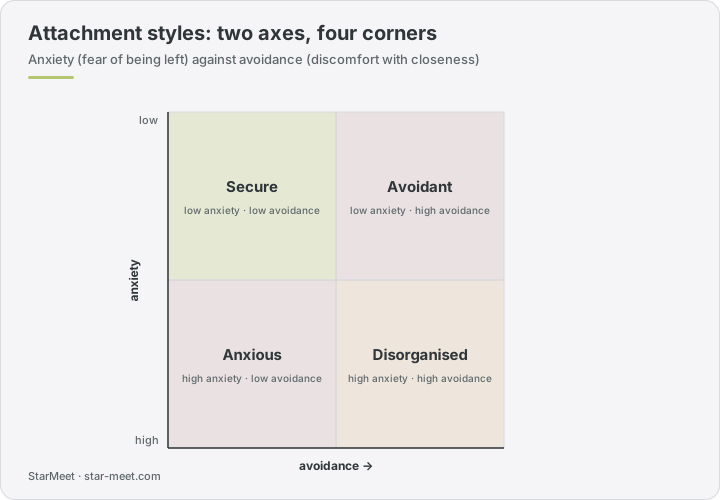
Understanding where you sit among the four core attachment styles is critical for choosing the right path to healing:
The attachment style matrix
| Anxious-preoccupied | Fearful-avoidant (disorganized) |
|---|---|
| High anxiety / low avoidance | High anxiety / high avoidance |
| Craves high intimacy | Craves high intimacy |
| Low fear of closeness | Deep fear of closeness |
| Moves toward the partner under threat | Alternates between drawing close and pulling away |
While an anxious-preoccupied individual moves toward their partner when feeling threatened, a fearful-avoidant individual experiences a "push-pull" dynamic—desiring deep emotional connection, yet panicking and pulling away when intimacy gets too intense.
Why Do I Get Jealous in Relationships?
Jealousy in an anxious attachment pattern is rarely about real-world betrayal; it is an automatic survival response to perceived relational insecurity.
Because your brain operates under an unconscious belief that you are inherently replaceable, any third party—a coworker, a friend, or even a partner's hobby—is registered by your nervous system as a threat to your emotional safety.
This triggers intense rumination and protective behaviors designed to eliminate the perceived competition.
Constantly Need Reassurance from Partner?
If you find yourself asking "Are we okay?" or seeking verbal validation multiple times a week, you are caught in the reassurance trap:
-
Anxious thought triggers internal distress.
-
You ask your partner for reassurance ("Do you still love me?").
-
Your partner provides validation, temporarily calming your nervous system.
-
Your brain learns that external validation is the only way to soothe anxiety.
-
The baseline anxiety returns quickly, requiring even more reassurance next time.
To break this loop, you must learn to practice emotional self-soothing rather than relying entirely on external validation.
Clingy in Relationships: How to Stop
Overcoming behaviors often labeled as "clingy" requires shifting your approach from managing your partner to regulating your own nervous system.
The reassurance loop
The healing pathway
-
Implement a 20-Minute Pause: When triggered by a delayed text or perceived shift in mood, wait 20 minutes before responding or taking action.
-
Practice Somatic De-Escalation: Use physiological breathing techniques—such as long, slow exhalations—to signal safety to your nervous system.
-
Establish Internal Boundaries: Remind yourself: "My partner's mood is a reflection of their internal state, not a measurement of my worth."
The Astrological Architecture of Attachment Stress
While clinical psychology identifies your attachment style through behavioral patterns, psycho-astrology maps the underlying energetic dynamics present in your natal chart.
Your natal chart illustrates how your core needs for safety and identity interact. Tensions between the Moon (emotional security and caregiving needs), Venus (relational bonding style), and Pluto or Saturn (fears of loss and boundaries) reveal where attachment anxiety is most likely to surface.
-
Moon-Pluto Aspects: Indicate a deep subconscious fear of betrayal or emotional manipulation, often driving hyper-vigilance in close relationships.
-
Moon-Neptune Aspects: Point to a tendency to merge completely with a partner, dissolving personal boundaries and fueling abandonment fears.
-
Saturn Transits to Venus/Moon: Highlight specific periods where relationship fears surface, offering an opportunity to build internal emotional security.
How to Heal Anxious Attachment: Evidence-Based Paths
Transforming an insecure attachment pattern into an earned secure attachment requires working with both your cognitive thoughts and bodily responses.
-
Somatic Nervous System Regulation: Techniques like somatic tracking and deep diaphragmatic breathing help regulate an overactive fight-or-flight response.
-
Cognitive Behavioral Therapy (CBT): CBT helps identify and reframe catastrophic cognitive distortions before they lead to protest behaviors.
-
Attunement in Relationships: Learning to communicate needs directly without resorting to manipulation or guilt.
Can an Anxious Attachment Style Become Secure?
An anxious attachment style is not a life sentence; it is an adapted survival strategy that can be rewired. Through targeted therapeutic work, individuals can develop an earned secure attachment.
Earned security occurs when you build the internal capacity to soothe your own nervous system, communicate needs directly, and maintain a stable sense of self-worth regardless of external circumstances.
Anxious Attachment Test: How It Is Measured
Clinical measurement of attachment styles goes beyond simple online quizzes. Validated instruments like the Experiences in Close Relationships-Revised (ECR-R) assess two primary dimensions: Attachment Anxiety (fear of rejection/abandonment) and Attachment Avoidance (fear of intimacy/dependency).
StarMeet integrates validated attachment metrics alongside deep psycho-astrological mapping to help you step out of anxious reactivity and into security.
By combining clinical assessments with your natal chart analysis, StarMeet identifies your specific emotional triggers and underlying attachment wounds.
Through secure, conversational AI-therapy, StarMeet guides you through tailored evidence-based protocols—including CBT cognitive restructuring, Schema Therapy, and somatic regulation tools—helping you navigate relationship anxiety and build earned security.
Frequently Asked Questions
What causes anxious attachment style in adults?
Anxious attachment style in adults typically stems from inconsistent emotional caregiving during early childhood, where warmth and safety were provided unpredictably, training the child's nervous system to remain hyper-vigilant.
What is the anxious-avoidant trap?
The anxious-avoidant trap is a common relationship dynamic where an anxious partner's push for intimacy triggers an avoidant partner's urge to pull away. This withdrawal then heightens the anxious partner's panic, creating a self-reinforcing cycle.
How do I stop being hyper-vigilant in my relationship?
To reduce hyper-vigilance, practice somatic grounding exercises when triggered, challenge catastrophic assumptions using CBT logs, and establish a habitual pause before reacting to perceived changes in your partner's behavior.
What is the difference between anxious attachment and codependency?
While both involve a focus on others, anxious attachment is a specific relational security style triggered by fears of abandonment, whereas codependency is a broader set of behaviors where an individual sacrifices their own identity and needs to manage another person's life or emotions.
How does an anxious attachment style affect mental health?
Anxious attachment can keep the nervous system in a state of chronic stress, contributing to generalized anxiety, sleep disruptions, low self-esteem, and emotional burnout from constant relational hyper-vigilance.
Understanding why your attachment system gets triggered is the first step toward feeling secure in your connections.
Take 40+ scientifically validated psychology tests right away, free with no signup.
You never have to pick a therapy program from a rigid list. Simply describe what is happening in your own words. The AI guide analyzes your situation and matches it to the right evidence-based framework—including CBT, schema therapy, IFS parts work, Gestalt, ACT, EFT, Jungian analysis, or logotherapy. It then leads you through a structured 6–8 session course, taking you one layer deeper each time.
It is a completely private space, free to begin right now.
🎁 SPECIAL OFFER: Your First Month of Premium for $1. 🔒 100% Safe: Cancel in 1 click, anytime.
Ready to step out of relationship anxiety and build lasting emotional security? 👇 Start Your Free AI Therapy Sessions
About the author
Vadim Arkhipov
Founder of StarMeet. Student of Jyotish since 2013, having completed an advanced course under Dr. K.N. Rao; 30+ years in business. Articles here are written to my brief, drafted with AI assistance and edited by me before publishing.
Profile, expertise and all articles →Related Articles
Avoidant Attachment: Why They Pull Away and What They Need
Understand avoidant attachment, the difference between dismissive and fearful avoidant patterns, why partners pull away after intimacy, and how to heal.
PsychologyThe Anxious–Avoidant Trap: Why the Push–Pull Cycle Repeats
Discover why anxious and avoidant partners magnetically attract, map the step-by-step pursuer-distancer cycle, and learn how to break the trap using EFT and Gottman methods.
PsychologyAttachment Style Test: Why One Partner Smothers With Control and the Other Goes Silent
In a fight, one partner calls ten times and demands answers; the other goes silent and walks into another room. That's anxious vs. avoidant attachment. Free attachment style test (ECR-R based) + a session with an AI therapist.
Psychology