Rising Sign (Ascendant): What It Means and Why It Matters
Contents
Rising Sign (Ascendant): What It Means and Why It Matters
Your rising sign—also known as the Ascendant—is the exact zodiac sign that was ascending on the eastern horizon at the precise moment and geographic location of your birth.
What you will learn from this article:
-
🧠 The Astronomical Mechanism: How the Earth's daily rotation determines your Ascendant and structures the 12 Houses of your natal chart.
-
⚡ Sun vs. Moon vs. Rising: How the "Big Three" interact to create your internal identity, emotional needs, and external persona.
-
✨ Psychological Integration: How modern psycho-astrology connects the Ascendant to first-impression research, non-verbal cues, and Jungian Persona theory.
If you have ever read a horoscope for your Sun sign and felt it didn't align with how you navigate daily social situations, you are likely missing your rising sign.
While your Sun sign describes your internal core identity, your Rising sign functions as your energetic interface—the lens through which you meet the external world and the filter through which the world experiences you.
What Is a Rising Sign?
In western astrology, the rising sign is the sign of the zodiac that was intersecting the eastern horizon at the specific time and location of your birth.
Because the Earth completes a full 360-degree rotation every 24 hours, the entire zodiac passes over the eastern horizon throughout a single day. This means the rising sign changes roughly every two hours.
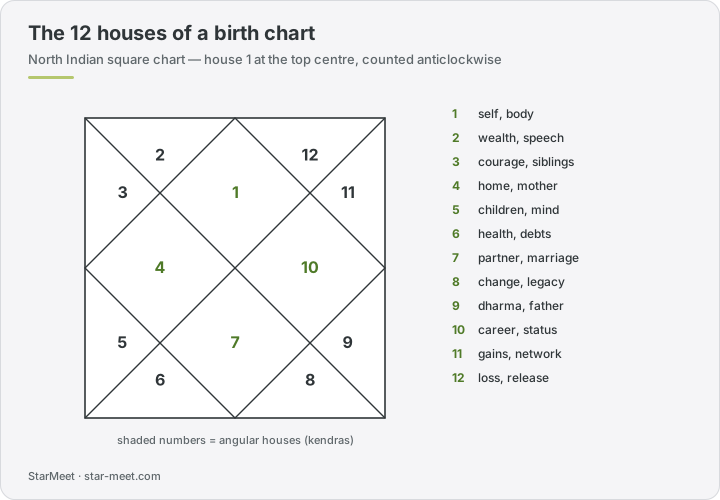
The Ascendant serves as the anchor point of your entire natal chart. It establishes the exact boundary of your first house—the house of personal identity, physical presence, and self-expression—and sets the sequence for all subsequent 11 houses.
What Is an Ascendant in Astrology?
The term Ascendant (abbreviated as ASC) comes from the Latin word ascendere, meaning "to climb" or "to rise." It is the precise degree of the zodiac wheel that was rising at your birth moment.
In technical chart mechanics, the Ascendant is the most personalized point in a birth chart. While thousands of people born on the same day share the same sun sign, only those born within the same two-hour window at a similar geographic location share the same Ascendant.
Furthermore, the zodiac sign governing your Ascendant determines your chart ruler—the planet that governs that specific sign. For instance, if you have a Gemini Ascendant, your chart ruler is Mercury, making Mercury's placement and aspects central to your overall personality dynamics.
What Does My Rising Sign Mean?
Your rising sign describes your automatic, instinctual style of responding to new environments, unfamiliar people, and unpredicted situations.
It functions as your psychological defense mechanism and social boundary. When you walk into a room full of strangers, your rising sign dictates whether your default approach is cautious observation (Virgo/Scorpio), warm sociability (Leo/Libra), direct action (Aries), or intellectual analysis (Gemini/Aquarius).
The three layers of self
| The Sun | The Moon | The Ascendant |
|---|---|---|
| Core identity | Emotional needs | Social interface |
| Conscious purpose | Subconscious mind | First impression |
Rather than describing who you are when you are completely alone, your rising sign describes how you initiate action and establish initial rapport with the world around you.
Rising Sign vs. Sun Sign: Which One Describes Me?
A common point of confusion is how the rising sign differs from the sun sign. Both are part of the "Big Three" in astrology (Sun, Moon, and Rising), but they govern distinct psychological layers:
FeatureSun SignMoon SignRising Sign (Ascendant)
Core FunctionConscious ego, identity, and life purposeEmotional processing, instincts, and security needsSocial persona, behavioral interface, and first impression
Movement SpeedChanges every ~30 daysChanges every ~2.5 daysChanges every ~2 hours
Psychological ParallelThe Core SelfThe Subconscious / Inner ChildThe Persona / Protective Boundary
Practical ExpressionWhat drives you long-termHow you feel when aloneHow you act when meeting someone new
Why Is the Rising Sign Important?
The rising sign is the structural key to your entire natal chart. Without an accurate Ascendant, an astrologer cannot construct a precise House layout.
The housal domino effect
-
It Defines Your House Cusps: The Ascendant degree marks the beginning of the 1st House. Once set, the remaining houses fall into place, mapping specific areas of life like career (10th House), relationships (7th House), and subconscious patterns (12th House).
-
It Identifies Your Chart Ruler: The planet governing your Ascendant sign acts as the primary driver of your natal chart. A person with a Scorpio Ascendant will be heavily influenced by the placement and aspects of Mars and Pluto.
-
It Provides Accurate Horoscopes: Real astrological transits impact your life based on which House they move through. Transits read for your rising sign offer significantly more accurate forecasting than those read for your Sun sign.
How to Find Your Rising Sign (And Why You Need Your Exact Birth Time)
Because the Earth rotates rapidly, the zodiac sign on the eastern horizon moves by one degree approximately every four minutes.
To calculate your rising sign accurately, you must know three vital pieces of information:
-
Your exact date of birth (month, day, year).
-
Your exact city and country of birth (to determine precise geographic coordinates).
-
Your exact time of birth (down to the minute, typically sourced from an official birth certificate).
A discrepancy of just 15 to 30 minutes can shift your Ascendant into an entirely different zodiac sign, altering your chart ruler and shifting every House placement in your chart.
How Does the Rising Sign Affect Appearance and First Impressions?
In traditional and modern astrology, the 1st House and Ascendant influence physical mannerisms, non-verbal expression, and outer style.
From a psychological perspective, this aligns with social research on first impressions. Within seconds of meeting someone, human beings evaluate non-verbal cues—body language, vocal cadence, facial expressions, and style. Your rising sign reflects these automatic, outward behavioral defaults:
-
Fire Ascendants (Aries, Leo, Sagittarius): Project high vitality, direct eye contact, physical energy, and an assertive or warm presence.
-
Earth Ascendants (Taurus, Virgo, Capricorn): Project composure, steady posture, practical style, and a grounded, observant demeanor.
-
Air Ascendants (Gemini, Libra, Aquarius): Project expressive body language, quick vocal cadence, communicative openness, and intellectual curiosity.
-
Water Ascendants (Cancer, Scorpio, Pisces): Project receptive sensitivity, soft or intense eye contact, cautious body language, and strong emotional intuition.
Rising Sign Personality Traits: How to Read Them Without Stereotyping
To avoid superficial astrological clichés, view your rising sign as a dynamic behavioral interface rather than a rigid character box.
Ascendant interface modes
| Intrusive / direct | Observant / protective |
|---|---|
| Aries, Gemini, Leo, Sagittarius | Taurus, Cancer, Scorpio, Capricorn |
For instance, a person with a Leo Sun and a Capricorn Ascendant will possess a warm, expressive core identity, but will approach new professional environments with serious, reserved, and methodical boundaries.
Understanding your rising sign explains why you may feel like a completely different person in public than you do with close family.
Does Your Rising Sign Change?
Your natal Ascendant is fixed based on your birth moment and remains permanent throughout your lifetime.
However, advanced secondary progression techniques—which scale one day after birth to one year of life—show your Progressed Ascendant moving slowly over time. This progression reflects the gradual evolution of your social persona and coping strategies as you mature, without erasing your underlying natal Ascendant foundation.
What the Ascendant Does NOT Tell You
Maintaining a realistic understanding of astrology requires recognizing what the Ascendant cannot predict:
-
It Does NOT Predict Deterministic Fortune: Your Ascendant does not dictate guaranteed life events, wealth, or relationship outcomes. It describes your baseline behavioral orientation, not a pre-scripted fate.
-
It Does NOT Measure Moral Character: A "pleasant" Libra Ascendant is not inherently a better person than a "challenging" Scorpio Ascendant. It simply reflects a different strategy for navigating social environments.
-
It Is NOT Your Complete Personality: Viewing yourself solely through your rising sign ignores the complex interplay between your Sun, Moon, planetary aspects, and cognitive conditioning.
The Psychological Synthesis: The Ascendant as the Persona
In Carl Jung’s analytical psychology, the persona is the social mask an individual constructs to interact with society, fulfill professional roles, and protect internal vulnerabilities.
The Ascendant maps directly onto this concept of the persona. It represents the psychological filter that helps you adapt to external expectations while shielding your private inner life (represented by the Moon and 12th House).
Psycho-astrological synthesis
| Astrological concept | Jungian psychology |
|---|---|
| Ascendant (1st house) | Persona (social mask) |
| 12th house | Personal subconscious |
When you understand your Ascendant through a psycho-astrological lens, you can align your social presence with your true internal values, ensuring your mask serves as a healthy bridge rather than an exhausting wall.
Calculate Your Exact Natal Chart on StarMeet
Understanding your rising sign is the essential first step toward unlocking the depth of your complete natal chart.
StarMeet combines accurate astronomical calculations with validated clinical psychology tools to deliver a personalized, multi-dimensional profile.
By inputting your precise birth date, time, and location, StarMeet's interactive calculator maps your exact Ascendant degree, identifies your chart ruler, and constructs your complete 12-House layout. The platform then synthesizes your astrological blueprint with clinical assessments—such as Big Five trait analysis and Attachment Style evaluations.
Through private AI-driven therapy and coaching sessions, StarMeet helps you explore how your Ascendant shapes your daily social interactions, personal boundaries, and psychological growth.
Frequently Asked Questions
How do I find my rising sign if I don't know my exact birth time?
If your birth time is unknown, check official hospital records or birth certificates. Without a birth time, you can still analyze planetary signs, but calculating an accurate Ascendant or House chart requires chart rectification by a professional astrologer.
What is the rarest rising sign?
Due to the Earth's axial tilt and atmospheric refraction, signs differ in their ascension time depending on geographic hemisphere. In the Northern Hemisphere, Aquarius, Pisces, and Aries are signs of "short ascension" and appear less frequently than signs of "long ascension" like Virgo and Libra.
Why is my rising sign different in Vedic astrology?
Western astrology uses the Tropical zodiac based on seasonal equinoxes, whereas Vedic (Jyotish) astrology uses the Sidereal zodiac based on fixed stellar constellations. Due to the precession of the equinoxes, your Sidereal Ascendant is typically about 23-24 degrees behind your Tropical Ascendant.
Can your rising sign explain social anxiety?
While social anxiety is a nervous system condition evaluated through psychological tools like GAD-7, an Ascendant experiencing tense aspects from Saturn, Pluto, or Neptune can highlight specific subconscious fears regarding public judgment or personal boundaries.
What is the 7th House Descendant in relation to the Ascendant?
The Descendant (DC) sits directly opposite the Ascendant on the natal chart wheel, marking the cusp of the 7th House. While your Ascendant describes your personal orientation, your Descendant describes the qualities you seek in long-term partners and close relationships.
Your rising sign shapes your entire perspective, but it is only one piece of a much larger personal blueprint.
The StarMeet AI Astrologer analyzes your complete chart, never generic sun-sign snippets. Alongside your core birth chart, it calculates 20 divisional layers from the Eastern tradition plus special ascendants—reading 24 distinct charts and hundreds of planetary combinations together.
Track your timing with planetary cycles alongside active Saturn and Jupiter transits. Ask practical questions about relationship compatibility, the ideal day to take action, your year ahead, or your baseline natal potential. Switch freely between Western tropical and Eastern sidereal systems in the same chat.
Your interactive chart generates instantly on the page as a guest—free, with no registration required.
🎁 SPECIAL OFFER: Your First Month of Premium for $1. 🔒 100% Safe: Cancel in 1 click, anytime.
Ready to see how your rising sign activates every house in your full chart? 👇 Calculate Your Free 24-Layer Natal Chart
About the author
Vadim Arkhipov
Founder of StarMeet. Student of Jyotish since 2013, having completed an advanced course under Dr. K.N. Rao; 30+ years in business. Articles here are written to my brief, drafted with AI assistance and edited by me before publishing.
Profile, expertise and all articles →