Free Birth Chart Calculator: Your Complete Guide to Natal Charts
Contents
Free Birth Chart Calculator: Your Complete Guide to Natal Charts
Your birth chart is a snapshot of the sky at the exact moment you were born—a celestial map that reveals your personality, potential, and life path. Using a free birth chart calculator, you can instantly access this profound self-knowledge tool that ancient astrologers spent hours computing by hand.
Whether you're exploring astrology for the first time or seeking deeper insight into your natal chart, this guide covers everything you need to know about birth chart calculators, how to interpret your results, and what makes Eastern astrology (also called Vedic astrology, or Jyotish) calculations unique.
Calculate your free birth chart now — no signup required.
What Is a Birth Chart?
A birth chart (also called natal chart, astrology chart, or horoscope chart) is a map of where all the planets were positioned at your exact moment of birth. This cosmic snapshot becomes your personal astrological blueprint, influencing everything from personality traits to life timing.
A Eastern birth chart is not a personality test — it is a precise astronomical map calculated from the sidereal zodiac, corrected by Ayanamsa, showing planetary positions accurate to within one arc-minute.
The Three Essential Data Points
Every birth chart calculation requires three pieces of information:
- Birth Date — Day, month, and year
- Birth Time — Hour and minute (from birth certificate if possible)
- Birth Location — City, state/country (converted to latitude/longitude)
These three data points allow the calculator to determine:
- Which zodiac signs the planets occupied
- Which houses the planets fell into
- The exact degree positions for precise aspects
- Your Ascendant (rising sign)
- Planetary periods and timing
Why Birth Time Matters
Birth time is the most critical—and most commonly unknown—factor. Here's why:
With exact birth time:
- Accurate Ascendant calculation
- Correct house placements
- Precise Moon degree (Moon moves ~13° daily)
- Valid Dasha period calculations
Without birth time:
- Planetary signs remain accurate
- House positions unknown
- Ascendant cannot be determined
- Timing predictions less reliable
If you don't know your birth time, check your birth certificate, hospital records, or ask family members. Even an approximate time (morning, afternoon, evening) helps narrow calculations.
How Online Birth Chart Calculators Work
Modern online birth chart calculators use astronomical algorithms to compute planetary positions for any date, time, and location in history. Here's the technical process:
1. Ephemeris Data
The foundation of any astrology calculator is the ephemeris—tables of planetary positions. Professional calculators use the Swiss Ephemeris, which sources data from NASA's Jet Propulsion Laboratory Horizons system. This provides astronomical-grade accuracy for all planetary calculations.
2. Coordinate Conversion
Your birth location (city name) gets converted to precise latitude and longitude coordinates. Time zones and daylight saving time adjustments are applied to convert local time to Universal Time (UT).
3. House Calculation
Using your geographic coordinates and birth time, the calculator determines:
- Ascendant degree (eastern horizon point)
- Midheaven degree (highest sky point)
- All 12 house cusps
Different house systems (Placidus, Whole Sign, Equal) produce slightly different house boundaries.
4. Planetary Positions
The ephemeris provides precise planetary longitudes for your birth moment. The calculator determines:
- Zodiac sign for each planet
- Exact degree and minute
- House placement
- Aspects to other planets
5. Eastern Adjustments
For Eastern (sidereal) calculations, the ayanamsa correction is applied. This shifts all positions by approximately 23-24 degrees to account for the precession of equinoxes—the slow wobble of Earth's axis over millennia.
Eastern vs. Western Birth Charts
The most significant choice in birth chart calculation is between Eastern (sidereal) and Western (tropical) systems. Understanding this difference helps you interpret your chart correctly.
Western (Tropical) Astrology
- Uses the seasonal zodiac
- 0° Aries = spring equinox (March ~21)
- Most common in Europe and Americas
- Signs aligned with seasons, not constellations
Eastern (Sidereal) Astrology
- Uses the constellation-based zodiac
- 0° Aries = where the Aries constellation actually is
- Traditional system from India (Jyotish)
- Signs aligned with visible star patterns
The Ayanamsa Difference
Due to Earth's axial precession, the tropical and sidereal zodiacs have drifted apart by approximately 24 degrees over 2,000 years. This means:
| If your Western Sun is... | Your Eastern Sun might be... |
|---|---|
| Early Aries (0-24°) | Pisces |
| Early Taurus (0-24°) | Aries |
| Early Gemini (0-24°) | Taurus |
| (Pattern continues...) |
Example: Someone born April 5 with Western Sun at 15° Aries would have Eastern Sun at approximately 21° Pisces.
Which System Should You Use?
Both systems offer valid insights through different lenses:
- Western: Better for psychological astrology, seasonal themes
- Eastern: Better for predictive astrology, timing, destiny
Many astrologers recommend exploring both. StarMeet's free birth chart calculator uses Eastern calculations with multiple ayanamsa options.
What Your Birth Chart Reveals
A complete birth chart analysis examines multiple layers. Here's what each element reveals:
Planets and Their Meanings
| Planet | Represents | Life Area |
|---|---|---|
| Sun | Core identity | Self-expression, vitality, father |
| Moon | Emotions | Mind, mother, emotional needs |
| Mercury | Communication | Intellect, speech, learning |
| Venus | Love & beauty | Relationships, art, pleasure |
| Mars | Action & drive | Energy, courage, conflict |
| Jupiter | Expansion | Wisdom, luck, philosophy |
| Saturn | Structure | Discipline, limits, destiny |
| Rahu (North Node) | Ambition | Future direction, desires |
| Ketu (South Node) | Release | Past patterns, spirituality |
The 12 Houses
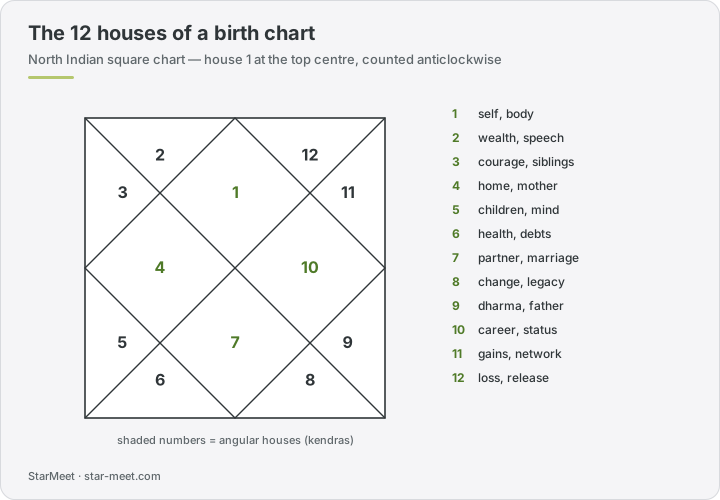
Houses represent different life domains activated by planetary placements:
| House | Life Area | Keywords |
|---|---|---|
| 1st | Self | Personality, body, first impressions |
| 2nd (Dhana Bhava) | Resources | Money, values, speech, family |
| 3rd | Communication | Siblings, short travel, skills |
| 4th | Home | Mother, property, emotions, roots |
| 5th | Creativity | Children, romance, speculation |
| 6th | Service | Health, work, enemies, debts |
| 7th | Partnership | Marriage, business partners |
| 8th | Transformation | Death, inheritance, occult |
| 9th | Philosophy | Higher education, travel, father |
| 10th | Career | Profession, status, public life |
| 11th | Community | Friends, gains, aspirations |
| 12th | Transcendence | Loss, spirituality, foreign lands |
The Ascendant (Rising Sign)
Your Ascendant is the zodiac sign rising on the eastern horizon at your birth moment. It determines:
- Your physical appearance and demeanor
- How others perceive you initially
- The lens through which you view life
- The starting point for house calculations
The Ascendant changes approximately every 2 hours, which is why birth time precision matters.
Nakshatras (Eastern Lunar Mansions)
Unique to Eastern Astrology, the 27 nakshatras divide the zodiac into smaller segments of 13°20' each. Your Moon nakshatra reveals:
- Deeper psychological patterns
- Innate talents and challenges
- Relationship compatibility factors
- Starting point for Dasha calculations
Understanding Dasha Periods
One of Eastern Astrology's most powerful tools is the Dasha system—planetary periods that activate different life themes at different times.
Vimshottari Dasha System
The most widely used system divides life into a 120-year cycle:
| Planet | Period Length |
|---|---|
| Ketu | 7 years |
| Venus | 20 years |
| Sun | 6 years |
| Moon | 10 years |
| Mars | 7 years |
| Rahu | 18 years |
| Jupiter | 16 years |
| Saturn | 19 years |
| Mercury | 17 years |
How Dasha Periods Work
Your Moon's nakshatra at birth determines which planetary period you start in and how much of it remains. Each major period (Mahadasha) subdivides into sub-periods (Antardasha), creating a detailed timing map.
Example: If you're born in Moon Dasha with 5 years remaining, you'll experience:
- Remaining Moon Dasha (5 years)
- Full Mars Dasha (7 years)
- Full Rahu Dasha (18 years)
- And so on...
During each period, that planet's themes become prominent in your life. A Saturn Dasha might bring career focus and discipline; a Venus Dasha might emphasize relationships and creativity.
How to Use a Birth Chart Calculator
Follow these steps for accurate results with any online natal chart calculator:
Step 1: Gather Your Birth Information
Before calculating, collect:
- Date: Verify day/month/year (check for AM/PM midnight confusion)
- Time: Exact to the minute if possible
- Location: City name or coordinates
Step 2: Enter Data Accurately
Common input errors:
- Confusing 12 AM (midnight) with 12 PM (noon)
- Wrong time zone selection
- Misspelled city names
- Day/month order confusion (US vs. European format)
Step 3: Select Your Preferences
Choose your calculation options:
- Zodiac system: Sidereal (Eastern) or Tropical (Western)
- Ayanamsa: Lahiri, Raman, or others (for Eastern)
- House system: Whole Sign, Placidus, Equal, etc.
Step 4: Generate Your Chart
Click calculate and review:
- Planetary positions table
- Visual chart wheel
- House placements
- Dasha periods (if Eastern)
- Any additional calculations
Step 5: Save or Export
Many calculators let you:
- Save charts to your account
- Download PDF reports
- Share via link
- Compare multiple charts
Try StarMeet's free birth chart calculator — instant results with no account required.
Interpreting Your Birth Chart Results
Once you have your chart, here's how to begin interpretation:
Start With the Big Three
Most astrologers recommend starting with:
- Sun Sign — Your core identity and life purpose
- Moon Sign — Your emotional nature and inner self
- Ascendant — Your outer personality and life approach
These three factors create your foundational astrological profile.
Examine House Rulers
Each house is "ruled" by the planet that governs its cusp sign. Track where these rulers sit:
- 1st house ruler placement — Where your identity energy flows
- 7th house ruler placement — Where partnership energy manifests
- 10th house ruler placement — Where career energy expresses
Look for Patterns
Notice clusters and emphases:
- Stelliums: Three or more planets in one sign/house
- Empty houses: Areas requiring less direct attention
- Aspect patterns: Geometric relationships between planets
Consider Planetary Strength
In Eastern Astrology, planets have varying strength based on:
- Sign placement (exaltation, debilitation)
- House placement (angular, succedent, cadent)
- Aspects from other planets
- Combustion (proximity to Sun)
Common Birth Chart Questions
"My Eastern Sun sign is different from my Western sign—which is right?"
Both are "right" within their systems. Eastern uses the actual constellation positions; Western uses the seasonal zodiac. Many people resonate with aspects of both. Try reading descriptions for each and notice what fits.
"The calculator says I have no planets in a house. What does that mean?"
Empty houses are normal—you only have 9-10 planets to distribute across 12 houses. Empty houses aren't inactive; they're ruled by the planet governing that sign. The house lord's placement shows how those life themes manifest.
"Why do different calculators give different results?"
Variations come from:
- Different ayanamsa values (for Eastern)
- Different house systems
- Time zone handling differences
- Rounding conventions
For consistency, use the same calculator and settings when comparing charts.
"Can I trust free online birth chart calculators?"
Quality free calculators using Swiss Ephemeris data are astronomically accurate. The main limitations are:
- Automated interpretations lack nuance
- No personalized guidance
- Complex chart patterns may be oversimplified
For accurate calculations, free tools work excellently. For deep interpretation, professional consultation adds value.
Beyond Basic Calculations
Once comfortable with your natal chart, explore advanced features:
Divisional Charts (Vargas)
Eastern Astrology uses divisional charts that subdivide the zodiac for specific life areas:
- D-9 (Navamsa): Marriage, dharma, soul purpose
- D-10 (Dasamsa): Career and profession
- D-7 (Saptamsa): Children
Transit Analysis
Compare current planetary positions to your birth chart to understand present-time influences. Major transits of Saturn, Jupiter, and the nodes often correlate with significant life changes.
Synastry and Compatibility
Compare your chart with another person's to analyze relationship dynamics. StarMeet's calculator supports compatibility analysis across multiple planetary layers.
Predictive Techniques
Eastern Astrology offers numerous timing tools:
- Dasha/Antardasha periods
- Transit impacts
- Annual charts (Varshaphal)
- Ashtakavarga point systems
Choosing the Right Free Birth Chart Calculator
With many free options available, consider these factors:
Accuracy Features
- Uses Swiss Ephemeris (NASA JPL data)
- Supports multiple ayanamsas
- Handles historical dates correctly
- Includes time zone database
Calculation Options
- Multiple house systems
- Divisional chart support
- Dasha period calculations
- Transit overlay capability
User Experience
- Clean, readable chart display
- Mobile-friendly interface
- Save and compare features
- Export options (PDF, image)
Interpretation Quality
- Accurate basic descriptions
- Nuanced planet-in-sign text
- House placement meanings
- Aspect interpretations
Start Your Astrological Journey
Your birth chart holds insights into your personality, relationships, career, and life timing. With modern free birth chart calculators, accessing this ancient wisdom takes seconds rather than the hours ancient astrologers spent on manual calculations.
Key takeaways:
- Birth charts require exact date, time, and location for accuracy
- Eastern (sidereal) and Western (tropical) systems offer different perspectives
- The Sun, Moon, and Ascendant form your foundational profile
- Dasha periods provide predictive timing unique to Eastern Astrology
- Quality free calculators use astronomical-grade ephemeris data
Whether you're curious about your Sun sign, exploring career timing, or analyzing relationship compatibility, your birth chart is the starting point for all astrological inquiry.
StarMeet's birth chart calculations are powered by Swiss Ephemeris, sourcing astronomical-grade planetary data from NASA JPL Horizons. Eastern techniques including nakshatras, dashas, and divisional charts follow classical principles from Brihat Parashara Hora Shastra.
Ready to discover your cosmic blueprint? Calculate your free Eastern birth chart now — instant results, no signup required. Enter your birth details and explore your planetary positions, houses, nakshatras, and Dasha periods.
Continue learning — related Eastern Astrology guides
After computing your chart, dive deeper into the techniques that interpret it:
- Bharani Nakshatra in Eastern Astrology — second nakshatra, Venus-ruled, fierce creativity
- Gochara — planetary transits in Eastern Astrology — how current planet positions interact with your natal chart
- Jaimini Chara Dasha and Atma Karaka — alternative dasha system + soul-purpose planet
- 8th house — Ayu Bhava — longevity, transformation, hidden matters
- Sun compatibility — basic Sun-Sun synastry — relationship starter
- Mars compatibility — Mangal Dosha and partnership Mars-Mars
Available in Russian at Бесплатная натальная карта and in Hindi at मुफ्त जन्म कुंडली कैलकुलेटर.
Frequently Asked Questions
What is a birth chart calculator?
A birth chart calculator is an online tool that creates your astrological natal chart based on your exact birth date, time, and location. It calculates the positions of planets, houses, and other celestial points at the moment of your birth, revealing your unique cosmic blueprint.
How accurate is a free birth chart calculator?
Modern free birth chart calculators like StarMeet use Swiss Ephemeris data from NASA JPL, providing astronomical-grade accuracy. The main factor affecting accuracy is the precision of your birth time—even a few minutes can shift house positions.
What information do I need for a birth chart calculation?
You need three pieces of information: your birth date (day, month, year), birth time (as precise as possible, ideally from birth certificate), and birth location (city or coordinates). Without exact birth time, house positions and Ascendant cannot be calculated accurately.
What is the difference between Eastern and Western birth charts?
Eastern (sidereal) and Western (tropical) astrology use different zodiac systems. The Eastern sidereal system accounts for the precession of equinoxes, placing planets approximately 23-24 degrees earlier than Western calculations. This creates different sign placements for many people.
What does my birth chart reveal about me?
Your birth chart reveals personality traits, strengths, challenges, career inclinations, relationship patterns, and life timing through planetary positions in signs and houses. Key elements include your Sun sign (identity), Moon sign (emotions), and Ascendant (outer personality).
Can I calculate my birth chart without knowing my birth time?
You can calculate planetary positions in signs without birth time, but house positions and Ascendant require exact time. Some calculators offer a noon chart (assumes 12:00 PM) as approximation, but this limits interpretation accuracy.
What are the houses in a birth chart?
The 12 houses represent different life areas: 1st (self), 2nd (resources), 3rd (communication), 4th (home), 5th (creativity), 6th (health/work), 7th (partnerships), 8th (transformation), 9th (philosophy), 10th (career), 11th (community), 12th (spirituality).
What is a nakshatra in Eastern astrology?
Nakshatras are 27 lunar mansions in Eastern astrology, each spanning 13°20' of the zodiac. They provide deeper personality insights than signs alone, revealing psychological patterns, strengths, and life themes based on the Moon's position at birth.
What is a Dasha period?
Dasha periods are planetary timing cycles unique to Eastern astrology. The most common system, Vimshottari Dasha, divides life into 120-year cycles ruled by different planets. Each period activates that planet's themes in your life.
Is an online birth chart calculator as good as a professional reading?
Online calculators provide accurate chart calculations and basic interpretations. Professional astrologers add nuanced synthesis, timing analysis, and personalized guidance that automated systems cannot replicate. Calculators are excellent starting points; consultations provide depth.
About the author
Vadim Arkhipov
Founder of StarMeet. Student of Jyotish since 2013, having completed an advanced course under Dr. K.N. Rao; 30+ years in business. Articles here are written to my brief, drafted with AI assistance and edited by me before publishing.
Profile, expertise and all articles →Related Articles
Zodiac Compatibility Explained: Why "Perfect Match" Is a Myth
Discover why challenging compatibility often leads to growth. Learn the 7-layer planetary analysis and house distance system for accurate relationship assessment.
CompatibilityMoon Compatibility: The Complete Multi-Layer Analysis
Go beyond sign matching. Learn Moon-to-Moon distance, elemental harmony, and how partner's planets affect your emotional body.
CompatibilityWelcome to StarMeet: Your Guide to Compatibility Astrology
Discover StarMeet's approach to relationship astrology. Learn how we analyze compatibility through planetary layers, not just Sun signs. Science-informed, growth-oriented.
Jyotish