Western vs Vedic Astrology: How Three Systems Differ and How to Read Them Together
Contents
Western vs Vedic vs Persian Astrology: Three Systems, One Picture
The whole question of western vs vedic astrology is not about which one is "right" and which is "wrong" — they simply measure the same sky with two different rulers. Western (tropical) astrology is anchored to the changing seasons on Earth; Vedic astrology — the Indian system also called Jyotish — is anchored to the actual fixed stars in the sky, and over the centuries a gap of roughly 24° has opened up between them. That is why your western Sun sign can be Aries while your Vedic sign is Pisces. A third branch, Persian astrology (the Hellenistic-Arabic tradition), adds precise calculated techniques for timing events and uncovering hidden talents. All three grew from a single historical root, and each describes a different layer of one person: character, the unfolding of events, and innate strength. This article explains each system in plain language and shows you how to stack them into one rich, three-dimensional picture.
Picture someone whose western chart shows a powerful stellium — a cluster of three or more planets in a single sign — in Aries: leadership, drive, impulsiveness. Yet their Vedic chart shifts those same planets back into Pisces and speaks of solitude, intuition and a spiritual quest. A beginner gets lost here and decides astrology "doesn't work." A professional analyst does the opposite: they read that contrast as two honest slices of the same human being — the outer character and the inner life-script. Below we break down how each ruler is built, which question is best asked of which system, and the step-by-step method that combines all three traditions without contradiction.
What you will take away from this guide:
- The fundamental difference between the systems: why one person's western and Vedic signs don't match, and how the mathematical shift called the ayanamsa actually works.
- Comparative timing: which predictive system — the Indian Dashas or the Persian Firdaria — more precisely points to the timing of key life events.
- The hidden rulers of destiny: how to calculate the Almuten Figuris using the methods of medieval Arabic astrologers to reveal innate talents.
- An expanding sky: how dwarf planets, asteroids and the Royal Stars influence the natal chart.
- Practical synthesis: a step-by-step algorithm for merging three traditions into one verified picture.
Three Views of One Sky: How Western, Vedic and Persian Astrology Differ
In short: western astrology reads the zodiac by the seasons, Vedic reads it by the stars, and Persian reads it by precise calculated points and cycles. To use them consciously, let's unpack the astronomical and methodological foundation of each.
Western Tropical Astrology: A Geocentric Model and Seasonal Rhythms
The western tradition rests on the tropical zodiac, locked tightly to Earth's geophysical cycles — the equinoxes and solstices. The spring equinox (the moment the Sun crosses the celestial equator moving south to north) is always taken as 0° Aries, no matter which actual constellation the Sun happens to be sitting in at that instant. Put simply, the tropical zodiac is counted not from the stars but from nature's calendar: 0° Aries is always the start of spring in the Northern Hemisphere.
The tropical zodiac is therefore a symbolic map of Earth's seasonal and light rhythms. It is oriented toward the Sun and describes the unfolding of the individual ego, conscious will and the psychological patterns of personality. For example, someone with the Sun in early Aries by the western system feels like a "springtime" type — an initiator who kicks processes off, even if by the stars the Sun has long since drifted into the neighboring sector.
The western school focuses on the dynamics of the psyche. It investigates them through the grid of houses (the twelve spatial sectors of the chart, each governing a different area of life — from body and money to partnership and career), through aspects (the angular distances between planets that show whether two planets cooperate or clash), and through predictive methods. Transits are the real movement of planets across the sky relative to your chart. Progressions are a symbolic "a day for a year" movement — the position of the sky 30 days after birth describes your 30th year of life. The solar return is the chart cast for the exact moment the Sun comes back to its birth degree, i.e. a forecast for the year ahead. For example, a transit of Saturn over the natal Sun almost always coincides with a period when a person feels tired, weighed down by responsibility and pushed to "grow up" in some area.
It is worth grasping the core metaphor of the tropical chart: it describes not so much "what will happen to you" as "how you experience what happens, from the inside." A Moon-Mars aspect tells you about your temper; a Venus-Saturn square about trouble trusting in love; a Mercury-Neptune opposition about a tendency to drift into daydreaming instead of getting concrete. This is exactly why western vs vedic astrology works so well as a pair: the west gives a fine-grained psychological portrait of the inner world, and the east later lays an event-driven framework over it. Reading only the western chart, it is easy to sink into endless self-analysis with no anchor in real timing — and that gap is precisely what the other two traditions close.
Vedic Astrology (Jyotish): A Stellar Clock for Karmic Tasks
The Indian system of Jyotish (Sanskrit for "the science of light") uses the sidereal zodiac, anchored to the physically observable fixed stars. Because of precession — the slow wobble of Earth's axis under the gravity of the Moon and Sun — the spring equinox point drifts by roughly 50.3 arcseconds every year. Over millennia a gap has accumulated: today the tropical and sidereal zodiacs have diverged by about 24°. This shift is called the ayanamsa — the correction that accounts for the difference between the "seasonal" and the "stellar" zodiac.
A planet's sidereal longitude is found with a simple formula: subtract the value of the ayanamsa at the moment of birth from its tropical longitude (most often the Lahiri ayanamsa is used — the official state standard of India). This is exactly why your western and Vedic signs usually differ by one whole sign: 24° is almost an entire sector of the zodiac (one sign = 30°). If the western chart makes you an early-degree Aries, the sidereal chart will most likely place you in Pisces.
Jyotish is centered on the Moon as the chief indicator of mind, perception and inner state — in contrast to the Sun-oriented western school. The system works with its own toolkit:
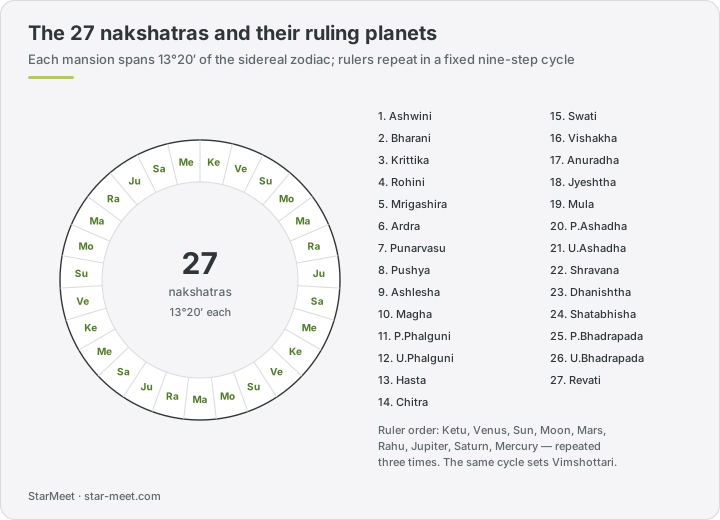
- Nakshatras — 27 sectors of the lunar zodiac, each 13°20′ wide. Each nakshatra describes a shade of the mind and a karmic pattern, revealing subconscious motivations more finely than the sign does. For example, the Moon's nakshatra can explain why two people who are "the same sign" behave in completely different ways.
- Vargas — divisional charts, produced by dividing the signs of the main chart into 9, 10, 16 or more parts to analyze a single area in detail. The Navamsha (D-9) reveals marriage and the spiritual path; the Dashamsha (D-10) reveals career. For example, a planet that is strong in the main chart but weak in the Navamsha points to potential that is hard to realize specifically within marriage.
- Dasha systems — predictive planetary periods that show when a karmic event "ripens." The most widespread is the Vimshottari Dasha, a 120-year cycle calculated from the exact degree of the Moon in its nakshatra at birth. Here the word "karma" is used not as a fatalistic verdict but as a map of accumulated tendencies: a vector you can live through consciously.
To feel the difference in approach in practice, take a single question: "why is it so hard for me to build relationships?" The western (tropical) chart will answer in the language of psychology — it shows a fear of intimacy through a tense Saturn in the house of partnership. The Vedic (sidereal) Jyotish chart will answer in the language of time and karma — it points out that the Moon's nakshatra carries a tendency toward solitude, and the current Dasha period has not yet "opened" the theme of marriage. This is not a contradiction but two honest answers in two different languages. That is precisely why an experienced practitioner doesn't choose between traditions but stacks them: western vs vedic astrology together give you both the cause and the timing.
The Persian and Hellenistic-Arabic Tradition: Destiny, Lots and a Hierarchy of Rulers
The Persian-Arabic tradition flowered during the Abbasid Caliphate, fusing Hellenistic geometry, Persian predictive cycles and Arabic mathematical precision. This branch gave astrology detailed calculated methods, many of which later became the foundation of European medieval classical astrology. If the western chart answers "who am I," and the Vedic chart answers "what am I fated to live through," then the Persian chart adds "when exactly" and "where is my main pillar of strength."
The tradition's key concepts:
- Lots (Arabic parts) — calculated sensitive points on the ecliptic. They are found by measuring the distance between two planets and projecting it from the Ascendant (the rising degree at the moment of birth). The most famous are the Lot of Fortune (a symbol of the body, material wellbeing and luck) and the Lot of Spirit (a symbol of will, intention and spiritual direction). The formulas depend on the chart's sect: for a day chart the Lot of Fortune = Ascendant + Moon − Sun, for a night chart it is reversed; the Lot of Spirit is calculated as the mirror image. For example, a strong Lot of Fortune in the house of career suggests that a person's material luck comes through their profession rather than inheritance.
- Almuten Figuris — the planet with the greatest collection of dignities at the chart's key points, a kind of "chief ruler" of the entire figure of birth.
- The doctrine of sect — the fundamental division of charts into day charts (the Sun above the horizon, in houses 7 through 12) and night charts (the Sun below the horizon, in houses 1 through 6). Sect determines the formulas of the lots and the order of the predictive cycles. Put plainly, a person born by day and a person born by night are "tuned" differently, even with similar planets.
- Profections — a predictive method in which the focus of the year advances by one sign each year from the Ascendant: one year of life = the activation of one sign and its ruler. At ages 12, 24, 36 and so on the circle closes and the Ascendant is activated again — hence the sense of "returning to yourself" at those ages.
- Firdaria — the Persian system of major life periods, in which the order of the rulers is strictly dictated by sect (a day chart starts with the Sun, a night chart with the Moon). These are like large "chapters" of a biography, within which events are arranged into sub-periods.
The Persian approach is valuable for its sheer concreteness. Where western astrology says "you tend toward leadership," and the Vedic chart says "leadership will show up in your mature years," the Persian method names the exact patron planet and the exact years of its activation. For example, a person with Mars as their Almuten and an active Mars period in their Firdaria almost certainly lives through a surge of energy, competition and a pull toward going independent during those years. This tradition was created by medieval astrologers precisely for practical, "down-to-earth" questions: when to marry, when to launch a venture, what to beware of in a particular year.
The Strengths of Each System: Which Question Goes to Which Astrology
In short: ask the western chart about character and psychology, ask the Vedic chart about the timing of events and karma, and ask the Persian chart about innate strength and exact dates. Each system is a separate tool for self-knowledge, and the power of synthesis lies in asking the right question of the right ruler.
The Western Approach: Psychology, Self-Definition and Inner Crises
Western tropical astrology is irreplaceable for questions of self-definition, psychological blocks, finding inner resources and adapting to change. It is the system that describes character, thinking, attachment and love patterns, and hidden fears in fine detail. Transits of the outer planets point with high precision to periods of existential crisis, the reappraisal of values and transformation. For example, a person with a tense Saturn in their chart runs into themes of discipline and self-worth again and again — and the western chart shows in which area and at what age that lesson sharpens, through the transits.
Jyotish: Event Timing, Karma and Divisional Charts
The Indian sidereal system excels at the long-range forecasting of concrete, material outcomes. Through the nakshatras and vargas, Jyotish gauges the degree of fulfillment in a career, the odds in business, the theme of children, and karmic predisposition. Its chief advantage is the predictive precision of the Vimshottari Dasha: transits describe only the outer "weather," while the Dasha periods show whether the karma is ripe for a specific event. For example, the western chart may promise marriage for years, but it is the Dasha that shows in which period that promise actually switches on.
The Persian Method: Pragmatic Calculation, Hidden Talents and a Hierarchy of Forces
The Persian-Arabic toolkit solves strictly applied questions of destiny and helps locate a person's fundamental supports in life. Calculating the Almuten Figuris (the strongest planet in the chart) identifies the leading patron planet that guides a person through life and points to innate talents. Calculating thematic lots (for example, the Lot of the Father or the Lot of the Mother) lets you examine a single area without distortion. And profections and Firdaria give clear markers of when, exactly, the promises of the natal chart "switch on." For example, if a person's Almuten is Mercury, their strength and self-realization are almost always tied to the word, teaching, negotiation and the intellect.
Comparison Table: Question → System
- "What are my psychological barriers in relationships, and how do I overcome a fear of intimacy?" → Western: the major aspects of the personal planets, the placement of Saturn and Pluto, transit loops.
- "In which period will my career take off, and when is the risk of financial loss high?" → Vedic (Jyotish): the Mahadasha (main period) and Antardasha (sub-period) of the Vimshottari Dasha, plus analysis of the D-10 (Dashamsha) chart.
- "What is my purpose, my innate talent, and which planet is my patron?" → Persian: the calculation of the Almuten Figuris.
- "What are the prospects for a specific marriage — will the union be lasting?" → Vedic (Jyotish): the Moon's nakshatra, a compatibility calculation, and the D-9 (Navamsha) divisional chart.
- "How do I pinpoint the exact date of a major purchase or relocation this year?" → Persian + Western: combining the annual profections, the Firdaria, the solar return chart, and transits to the angles of the chart.
- "What is the cause of repeating family scripts and losses?" → Vedic (Jyotish): the position of Rahu (the North Node) and Ketu (the South Node), with Saturn as the indicator of karmic lessons.
Why It's Worth Studying All the Systems: The Value of Multidimensional Analysis
In short: one system is one slice of a person, while the synthesis of three gives depth and a safeguard against error. Relying on a single tradition sharply narrows the analyst's toolkit.
The professional approach treats the natal chart as a multidimensional, almost holographic object, where different layers of life are encoded in different mathematical languages. Combining systems puts into practice the principle of stacking testimonies. If the western forecast (say, a progression of the Sun to Venus) hints at partnership, the eastern period (a Mahadasha of Venus or Jupiter) confirms that the karma of relationships is mature, and the Persian annual profection activates the 7th house of partnership — then the probability of the event approaches its maximum. A single signal can be wrong; three independent signals all pointing to one spot are wrong extremely rarely.
Synthesis closes the blind spots of each system:
- The tropical chart reveals a person's "psychological interface" — character, will, ego, perception.
- The sidereal Jyotish chart uncovers the deep event-framework set by accumulated tendencies, bypassing the ego's illusions.
- The Persian lots and Firdaria work as precise mathematical lenses, focusing blurry psychological tendencies into concrete material expressions and dates.
So this doesn't stay abstract, picture a real question: "should I change jobs this year?" The western chart shows inner readiness — for example, a transit of Uranus to the Sun that brings a thirst for freedom and change. The eastern Dasha says whether the period favors a career leap or whether it is a time to "store up rather than jump." The Persian profection clarifies whether the house of career is actually activated this year. When western and Vedic astrology, together with the Persian method, all point the same way — the decision becomes conscious rather than impulsive. And when the signals diverge, that too is valuable: it means the time has not yet come, and it is worth waiting for resonance.
In the end, working at the intersection of traditions lets you verify forecasts and offer deeper guidance — helping a person not to passively wait for events but to consciously work through their psychological and karmic lessons. Important: all of this is a map of tendencies, not a verdict. The final decision always rests with the person.
A Living Sky: New Planets, Asteroids and Stars in Western Astrology
In short: astrology has not frozen in place — every newly discovered body in the Solar System has been given a psychological meaning and has widened the palette of the natal chart. This is especially developed in the western school.
As telescopes grew more powerful, the Solar System "gained" new objects, and astrologers immediately built each one into practice, adding new psychological and event-driven half-tones. Where the classical chart worked with the seven visible luminaries (from the Sun to Saturn), modern western astrology also reads the outer planets, the centaurs, the asteroids and the distant dwarf planets. This is not a "trendy add-on" but a way to describe ever-finer layers of the psyche that have become important for a person living in an age of collective processes and information flows. Below is a map of these "new tenants of the sky" and what they mean for a specific individual.
The Trans-Saturnian Planets: Beyond Personal Destiny
Before the discovery of Uranus in 1781, the boundaries of destiny and time were drawn by Saturn — the planet of duty, limits and form. The discovery of the outer planets pushed analysis to the level of the collective unconscious and large evolutionary processes:
- Uranus (1781) — the planet of revolutions, freedom and sudden insight. In the chart it marks the zone where a person reaches for unconventional solutions and reform, and where abrupt turns may await them. For example, Uranus in the house of work often gives a non-linear, "leaping" career.
- Neptune (1846) — the planet of mysticism, illusions, spiritual ecstasy and subtle sensing. It shows the spheres of idealization and spiritual search, but also the risks of self-deception, addictions and escape from reality.
- Pluto (1930) — the planet of deep transformation through destruction and rebirth. A point where power, control and the conquest of the fear of death concentrate. For example, Pluto in the house of relationships makes bonds intense, on the edge of a total rebirth of the personality through the partner.
Chiron (1977): The Bridge Between Worlds
Chiron is a centaur-asteroid whose orbit runs between Saturn and Uranus, linking the personal (Saturn) and the transcendent (Uranus). Archetypally it is the "wounded healer": a deep inner wound that never fully heals, but it is precisely by living through it that a person gains the gift of helping others with similar pain. For example, Chiron in the house of communication often stands behind people who have themselves been through a wound of speech or of being misunderstood — and who became wonderful teachers or psychologists.
The Asteroid Goddesses: Restoring the Balance of Feminine Archetypes
The four largest asteroids, discovered in the early 19th century, helped to rebalance the classical chart, where only the Moon and Venus had carried the feminine principle:
- Ceres (1801, now a dwarf planet) — the need to care, to nurture (physically and emotionally), the relationship with food and the body. It symbolizes the cycle of loss, letting go and rebirth (the myth of the abducted daughter, Persephone).
- Pallas (1802) — strategic intelligence, pattern thinking, the ability to solve complex problems and to fight for justice.
- Juno (1804) — the capacity for long commitments, partnership and marriage, as well as the shadow sides of a union: jealousy, the struggle for autonomy and power.
- Vesta (1807) — focus, ultimate concentration on the task, inner purification, and the ability to keep an "inner flame" of devotion to a calling.
The Dwarf Planets of the Kuiper Belt: Archetypes of Survival and Creation
The distant trans-Neptunian objects (TNOs), discovered at the turn of the 21st century, added global ecological, evolutionary and psychological meanings:
- Eris (2005) — the struggle for existence and uncompromising rebellion, the ability to defend the rights of the outcast without compromise.
- Sedna (2003) — overcoming the deepest betrayal, patience, and contact with the primal forces of nature in isolation.
- Haumea (2004) — a dwarf planet with an ultra-fast rotation; an inexhaustible creative resource and the ability to rise from the ashes.
- Makemake (2005) — ecological awareness, the power to materialize thought through visualization, and the will to transform space.
- Gonggong (2007) — a large trans-Neptunian object associated with compassion, heightened sensitivity and self-sacrifice, but also with a tendency toward shyness.
- Quaoar (2002) — creative force, a spiritual connection to a higher order, the ability to materialize thoughts into reality.
The Fixed Stars: Age-Old Markers of Destiny
Unlike the planets, the fixed stars are an almost unchanging cosmic framework. Special importance belongs to the four "Royal Stars" of ancient Persia — the Watchers of the Sky, who grant colossal opportunities in exchange for a harsh test of the purity of one's intentions:
- Regulus (the Heart of the Lion, Watcher of the North, ~29° Leo) — leadership, high position, fame and honors, but a warning against pride and vengefulness.
- Antares (the Heart of the Scorpion, Watcher of the West, ~9° Sagittarius) — the warrior's star: courage and the ability to win, but a risk of self-destruction through anger.
- Aldebaran (the Eye of the Bull, Watcher of the East, ~9° Gemini) — material success and recognition, on condition of flawless honesty.
- Fomalhaut (the Mouth of the Southern Fish, Watcher of the South, ~3° Pisces) — spiritual or creative triumph, on the condition of renouncing base motives.
- Algol (the Head of the Gorgon Medusa, ~25° Taurus) — one of the most dramatic stars: an enormous transformative energy that, at low awareness, manifests through crises, and at high awareness gives the power to reshape reality.
- Spica (the Ear of Wheat of Virgo, ~23° Libra) — an exceptionally benevolent star: talents in the arts and sciences, prosperity, protection and the harmonious unfolding of any planet in conjunction with it.
The Lunar Nodes and Lilith (the Black Moon): Vectors of Destiny and the Shadow of the Psyche
The lunar nodes (Rahu and Ketu) are the mathematical points where the orbits of the Moon and the Earth intersect. The South Node (Ketu) points to accumulated, innate experience and talents, where everything comes easily "out of habit." The North Node (Rahu) is the vector of growth, the zone of the unexplored, where one must go in spite of fear. Lilith (the Black Moon) — the apogee of the lunar orbit — describes the area of shadow impulses, irrational fears and temptations that it is important to recognize and integrate for the sake of wholeness. For example, the nodes along the "home–career" axis often stand behind an inner conflict between a cozy past and a calling, yet frightening, future.
How Astrological Thought Evolved: One Tree of Traditions
In short: western, Vedic and Persian astrology are branches of one tree, scattered across cultures — not three warring doctrines. Bringing them back together today is a natural step in their evolution, not eclecticism.
The thread of time looks like this: ancient Babylon (a system of omens) → Hellenistic Egypt and Alexandria (the birth of the personal horoscope) → a branching into Europe, the Persian-Arabic world and India → the western classics of the 17th century (William Lilly) → the modernism and psychoanalysis of the 20th century (Jung, Rudhyar) → the present era of synthesis and AI.
The first systematic observations of the sky began in ancient Mesopotamia: priests recorded the link between the movement of the planets and earthly events. In the Hellenistic era in Alexandria, Babylonian astronomy, the Egyptian system of decans (10-degree divisions of the signs) and Greek geometry merged — and it was there that the personal horoscope, with its houses and aspects, was born.
After the fall of the Roman Empire, the center of scientific thought shifted to the Middle East. Persian and Arabic scholars of the Abbasid era translated the works of Ptolemy and Dorotheus of Sidon, enriching them with Indian mathematical methods and their own developments of time cycles (Firdaria, profections) and calculated points (the lots). In the Middle Ages, through Spain and Italy, this knowledge returned to Europe and shaped the traditional European astrology of Guido Bonatti and William Lilly. And in the 20th century, under the influence of the discovery of the trans-Saturnian planets and the psychoanalysis of Carl Gustav Jung, the western branch turned sharply toward psychology and subjective experience.
It is also useful to remember the practical side of this tree. The Babylonians gave us the idea that the sky "speaks" to a person; the Alexandrian Greeks invented the personal chart with houses; the Persians and Arabs added the precise mathematics of cycles; the Indian tradition of Jyotish spent centuries polishing the system of nakshatras and Dashas; the Europeans of the 17th century assembled a rigorous predictive technique; and Jung, in the 20th century, returned psychological meaning to astrology. The modern synthesis simply takes the best from each chapter. That is why the phrase "western and Vedic astrology contradict each other" is historically false — they speak from the same tree in different voices.
All three systems grew from one seed. Their separation was cultural and geographical — which is why reuniting them at the present stage is not a stretch but a return to a common root on a new level.
A Practical Methodology of Synthesis: A Step-by-Step Algorithm for Merging the Traditions
In short: synthesis is done in layers — first psychology (the west), then innate strength (the Persian chart), then the karmic structure and timing (the east), and only at the very end are the conclusions combined. The golden rule is: never mix the calculations, only combine the conclusions.
Step 1: The Psychological Foundation — the Western Tropical Chart
We start with the tropical chart in order to understand the structure of the ego and the psychological patterns:
- The core of the personality is analyzed: the Sun (conscious will, ambition), the Moon (emotional needs) and the Ascendant (the social mask, the first impression).
- Inner conflicts are identified through the tense aspects (squares, oppositions), and resources through the harmonious ones (trines, sextiles).
- The asteroid goddesses and Chiron are brought in to add detail on the spheres of care (Ceres), strategy (Pallas), partnership (Juno) and inner wounds (Chiron).
Step 2: Mathematical Verification of Strength and Purpose — the Persian Method
In the second step we look for the hidden determinants of destiny. We calculate the Almuten Figuris — the strongest planet in the chart, the one that sets the key talents. The calculation rests on five points of vitality: the degree of the Sun, the degree of the Moon, the degree of the Ascendant, the degree of the Lot of Fortune, and the degree of the prenatal syzygy (the New or Full Moon that preceded the birth).
For each of these five degrees, the ruling planets are awarded points under the system of essential dignities (this is a planet's "home" strength in that degree):
- Domicile — +5 points
- Exaltation — +4 points
- Triplicity — +3 points (the ruler of the sect is taken into account)
- Term / bound — +2 points
- Decan / face — +1 point
To this sum are added points for the ruler of the day of birth (+7) and the ruler of the planetary hour (+6). Then accidental strength is added — points for the planets' real position in the houses: 1st house — +12, 10th — +11, 7th — +10, 4th — +9, 11th — +8, 5th — +7, 2nd — +6, 9th — +5, 8th — +4, 3rd — +3, 12th — +2, 6th — +1. The planet with the highest total is declared the Almuten Figuris — the person's personal "genius" and spiritual backbone. For example, if Venus in the 1st house wins out in the end, the leading thread of destiny is relationships, beauty, harmony and the gift of being liked.
Step 3: The Karmic Architecture and Event Cycles — Jyotish
In the third step we move to the sidereal chart, taking the ayanamsa into account (~24° back relative to the western coordinates):
- The Moon's position in its nakshatra is assessed — the karmic task of the mind.
- The Rahu and Ketu nodes are analyzed as indicators of past experience and the current zone of growth.
- The predictive grid of the Vimshottari Dasha is built, in which the 120-year cycle is distributed among the 9 planets: Venus — 20 years, Sun — 6, Moon — 10, Mars — 7, Rahu — 18, Jupiter — 16, Saturn — 19, Mercury — 17, Ketu — 7. The order is strictly fixed (Ketu → Venus → Sun → Moon → Mars → Rahu → Jupiter → Saturn → Mercury), and the starting point is set by the nakshatra of the natal Moon. For example, if a person was born during a Saturn period, the early years of life often pass under the sign of early responsibility and limits.
Step 4: Layering the Predictive Systems and Verifying the Timing of Events
To forecast key events, the cycles of the Vimshottari Dasha and the Persian Firdaria are set side by side. The Firdaria divides life into large chapters by a fixed grid of years that depends on the sect (in a day chart the order begins with the Sun, in a night chart with the Moon): Sun — 10 years, Venus — 8, Mercury — 13, Moon — 9, Saturn — 11, Jupiter — 12, Mars — 7, North Node — 3, South Node — 3. Each major period (except the nodes) is divided into 7 equal sub-periods following the Chaldean order of the planets.
The rule of integration: when answering the question "When will an important event arrive?", the analyst looks for resonance. If the Vimshottari Dasha is running a period of a strong Jupiter, while the Firdaria is simultaneously active in a Jupiter period, and the annual profection moves into a sign ruled by Jupiter — then the potential for a breakthrough is realized with maximum probability.
A warning, without which the whole synthesis falls apart: in the calculations, the systems are kept strictly separate. You cannot carry sidereal nakshatras into a tropical chart or apply western aspects to sidereal houses. Each system is calculated by its own mathematical rules — only the final conclusions are combined in the closing synthesis.
StarMeet: Automated Synthesis of Three Systems, Powered by AI
In short: done by hand, this kind of multidimensional analysis takes hours of calculation and fluency in three different schools — StarMeet does it instantly and translates the result into plain human language.
StarMeet combines the algorithms of western tropical astrology, the eastern Jyotish system and the Persian-Arabic tradition in a single computational core. The platform instantly produces every calculation: from precise sidereal coordinates that account for the ayanamsa, to the complex algorithms of the Almuten Figuris, profections, Firdaria and the periods of the Vimshottari Dasha. You don't need to keep the formulas of the lots or the tables of dignities in your head — the core works them out for you.
The integrated AI-Astrologer takes on the role of a qualified translator. Complex planetary configurations, dignity balances and dry tables of periods are turned into living, practical, structured text. You receive not a pile of disconnected interpretations but a coherent, three-dimensional picture of your personality and the tendencies of your destiny — and you can ask the AI-Astrologer any follow-up question about career, relationships, purpose and forecasts.
The real value here is precisely the synthesis. An ordinary online calculator will show you one system and leave you alone with a table. StarMeet, on the other hand, does the very thing this whole article is written about: it automatically stacks western and Vedic astrology together with the Persian method and checks whether their signals agree. If you ask about an important decision, the AI-Astrologer doesn't just spit out a horoscope — it cross-references the psychological portrait (the west), the karmic period (the east) and the house activation by profection (the Persian tradition), and then honestly tells you whether all three lenses point to the same spot. This is the multidimensional analysis that used to be available only after a long apprenticeship across several schools.
You can build your own multidimensional natal chart for free, right here on the site. The calculation and the conversation with the AI-Astrologer require no payment details and assume no trial sign-up — just open the calculator and begin.
Open the AI-Astrologer and explore your chart in the Western system →
Build your free Western natal chart →
Frequently Asked Questions
Why don't my western and Vedic signs match? Because the systems count the zodiac from different starting points. Western (tropical) astrology starts from the spring equinox — that is, from the seasons on Earth. Vedic (sidereal) astrology, Jyotish, starts from the actual fixed stars. Because of the precession of Earth's axis, those two points have drifted apart by about 24°, so your sign in the Vedic chart usually shifts one sector back: a western Aries often becomes a Vedic Pisces.
What is the ayanamsa in plain language? The ayanamsa is the amount by which the sidereal zodiac lags behind the tropical one. Today it is roughly 24°. To get the Vedic (sidereal) longitude of a planet, you subtract the ayanamsa from its western (tropical) longitude. The Lahiri ayanamsa is the one most often used — it is the official standard of India.
Which astrology system is most accurate? None is "more accurate" overall — they answer different questions. Ask the western chart about character and psychology; ask the Vedic chart (Jyotish) about the timing of concrete events and karmic tasks; ask the Persian chart about innate strength, the main talent and exact dates. The most reliable result comes when the signals from all three systems agree (stacking testimonies).
How do you read three astrology systems together? In layers: first you build the western tropical chart for the psychology, then the Persian chart to find the Almuten Figuris (the chief patron planet), then the sidereal Jyotish chart for the karmic structure and the Dasha periods. The systems' calculations are never mixed with one another; only the final conclusions are combined. A forecast is considered reliable when the western transits, the eastern Dasha and the Persian profection all point to the same spot.
What are the lots and the Almuten Figuris in Persian astrology? The lots (Arabic parts) are calculated points on the ecliptic, found by projecting the distance between two planets from the Ascendant; the best known are the Lot of Fortune (the body and material wellbeing) and the Lot of Spirit (will and spiritual direction). The Almuten Figuris is the planet with the greatest collection of dignities at the chart's key points; it is treated as the chief ruler and the indicator of innate talents.
How do Dashas differ from Firdaria in forecasting? Both are systems of planetary periods, but from different traditions. The Vimshottari Dasha (Jyotish) divides a 120-year cycle among 9 planets based on the Moon's nakshatra and shows when a karmic event "ripens." The Firdaria (the Persian tradition) divides life into large chapters by its own grid of years, which depends on the chart's sect. In synthesis they are set side by side: when the period of one and the same planet coincides in both systems, the forecast is sharply reinforced.
Can I build a chart in all three systems for free? Yes. On StarMeet you can instantly calculate the key indicators in the western, Vedic and Persian systems and discuss the result with the AI-Astrologer — with no payment details and no trial sign-up.
StarMeet offers astrology as a tool for self-reflection and personal insight, not as a prediction of fixed destiny or a substitute for professional medical, psychological, legal or financial advice. Your chart is a map of tendencies — your choices are your own.
About the author
Vadim Arkhipov
Founder of StarMeet. Student of Jyotish since 2013, having completed an advanced course under Dr. K.N. Rao; 30+ years in business. Articles here are written to my brief, drafted with AI assistance and edited by me before publishing.
Profile, expertise and all articles →Related Articles
What is Eastern Astrology? Sidereal Zodiac, 9 Planets & Vimshottari Dasha
Eastern Astrology explained: sidereal zodiac, ayanamsha, the 9 Navagraha planets, Whole Sign houses, and Vimshottari Dasha timing. Complete beginner's guide.
JyotishFree Birth Chart Calculator: Your Complete Guide to Natal Charts
Calculate your free birth chart online instantly. Our Eastern Astrology calculator reveals planetary positions, houses, nakshatras, and dasha periods. No signup required.
Jyotish