Zodiac Compatibility Explained: Why "Perfect Match" Is a Myth
Contents
Zodiac Compatibility Explained: Why "Perfect Match" Is a Myth
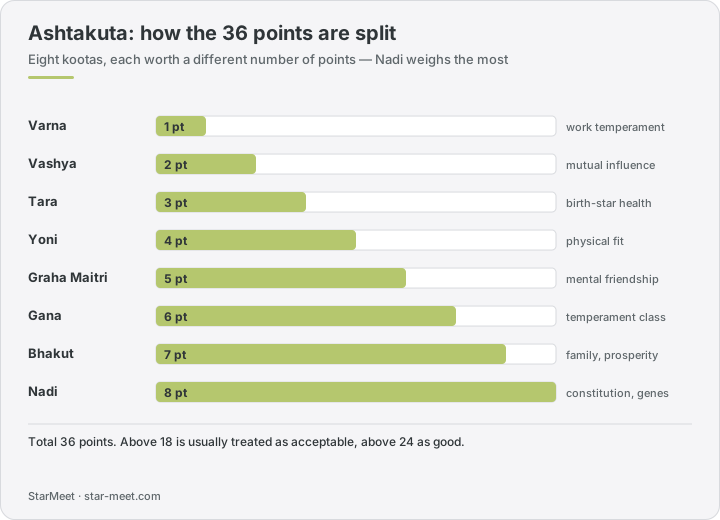
Zodiac compatibility in Eastern astrology (also called Vedic astrology, or Jyotish) is assessed through Ashtakuta — an eight-factor scoring system covering Varna, Vashya, Tara, Yoni, Graha Maitri, Gana, Bhakuta, and Nadi. Total points: 36. A score of 18+ is considered compatible; 24+ is excellent for marriage; below 18 warrants caution.
Perfect zodiac compatibility doesn't exist—and that's actually good news. Astrology reveals that relationships work on seven distinct layers, from physical magnetism to philosophical alignment, and challenging combinations often produce the greatest personal growth. The key isn't finding someone with no friction, but understanding where your friction points lie and how to transform them into development opportunities. Most people spend years—sometimes decades—in relationships that drain them without ever understanding why, cycling through the same painful patterns with different faces. This article gives you the diagnostic map that changes everything: a framework that tells you not just whether two people clash, but where they clash, why it feels impossible to stop, and what that friction is actually trying to build in you.
Key Takeaways
- Seven planetary layers determine compatibility: Ascendant (physical magnetism), Moon (emotional safety), Mars (conflict style), Mercury (communication), Venus (romance), Jupiter (values), and Saturn (commitment)
- The 6-8 house distance creates the most challenging but transformative combinations
- Same-element pairs communicate easily but may lack growth stimulus
- "Perfect" compatibility often leads to stagnation—without friction, there's no motivation to develop
- Your partner is your mirror—they reflect what you need to work on yourself
- One harmonious planet can bridge otherwise difficult combinations
- Conflict is a feature, not a bug—relationships are assignments for mutual evolution
Why This Matters
Sarah and Tom seemed perfect on paper. Both Leos, both ambitious, both loved travel and adventure. Their friends called them "the golden couple." Three years later, they separated—not from conflict, but from boredom. "We agreed on everything," Sarah explained. "There was nothing to push against, nothing to discover. We were the same person twice." She remembered sitting across from him at dinner one night—their favorite restaurant, candles, wine—and feeling a hollow dread settle into her chest because she already knew what he was going to order, how he'd tell the story to the waiter, what he'd say when they got home. There was no mystery left. No edge to grow toward. The relationship had become a mirror with no new reflection.
Meanwhile, Emma and James had a rocky start. She's a Cancer; he's a Sagittarius—a challenging 6-house distance. Their first year included three almost-breakups. There were nights Emma sat on the bathroom floor at 2am, mascara streaked, genuinely convinced she was destroying herself by staying. James would go silent for days after a fight—not out of cruelty, but because he genuinely didn't know how to hold that much emotional weight. She interpreted the silence as abandonment. He interpreted her tears as an attempt to trap him. Neither was right. Neither was wrong. They were simply operating from completely different emotional architectures—and without a map to explain why, they almost lost each other. But ten years later, they credit that friction with transforming them both. "James taught me to take risks," Emma says. "And I taught him that feelings aren't weaknesses. We're completely different people than when we met."
These stories illustrate the central paradox of compatibility: what feels easy isn't always what helps us grow. The relationship that requires nothing of you gives you nothing either. And the relationship that breaks you open—if you have enough of the right foundations in place—can rebuild you into someone you couldn't have become alone.
How to Calculate House Distance: The Basic Technique
House distance is the count of signs from Position A to Position B moving forward through the zodiac — this single number determines which of the 7 compatibility layers applies. Count forward: Aries(1) to Cancer(4) = distance 4. This is the foundation of all compatibility analysis. Think of it as the astrological equivalent of reading a map: you need to know the distance before you can plan the route. Without this calculation, you're navigating by gut feeling alone—and gut feeling, while powerful, doesn't tell you which layer is causing the pain or which planet holds the bridge back to connection.
Step-by-Step Calculation
The zodiac has 12 signs in order: Aries, Taurus, Gemini, Cancer, Leo, Virgo, Libra, Scorpio, Sagittarius, Capricorn, Aquarius, Pisces.
To calculate house distance, count from the first person's sign TO the second person's sign, including the starting sign as "1."
Worked Example: Ascendant Distance
Let's say Sarah has Ascendant in Taurus and Tom has Ascendant in Libra.
Starting from Sarah's Taurus, we count:
- Taurus = 1 (starting point)
- Gemini = 2
- Cancer = 3
- Leo = 4
- Virgo = 5
- Libra = 6
Tom's Ascendant is 6 houses away from Sarah's. This is a "6th house distance"—one of the challenging positions.
Worked Example: Venus Distance
Now let's check their Venus positions. Sarah has Venus in Aries; Tom has Venus in Virgo.
Starting from Sarah's Aries:
- Aries = 1
- Taurus = 2
- Gemini = 3
- Cancer = 4
- Leo = 5
- Virgo = 6
Again, 6 houses apart—challenging for romance.
The Distance Meanings
Once you know the distance, here's what it means:
| Distance | Meaning | Experience |
|---|---|---|
| 1 (same sign) | Intense | Merged energy—you amplify each other |
| 2 or 12 | Supportive | One naturally gives to the other |
| 3 or 11 | Friendly | Easy cooperation |
| 4 or 10 | Tense | Square—friction requiring conscious action |
| 5 or 9 | Harmonious | Trine—natural flow, same element |
| 6 or 8 | Challenging | Conflict or transformation required |
| 7 | Opposition | Mirror dynamic, opposites attract |
Quick Reference: Same Element = Easy Flow
Signs of the same element are always 5 or 9 houses apart:
- Fire signs (Aries, Leo, Sagittarius): Natural understanding
- Earth signs (Taurus, Virgo, Capricorn): Practical harmony
- Air signs (Gemini, Libra, Aquarius): Mental connection
- Water signs (Cancer, Scorpio, Pisces): Emotional depth
If Sarah has Moon in Cancer and Tom has Moon in Scorpio, that's:
- Cancer = 1, Leo = 2, Virgo = 3, Libra = 4, Scorpio = 5
Five houses apart = same element (Water) = emotional compatibility.
You could spend an afternoon doing these calculations manually for every planet in both charts—and many people do, hunched over notebooks, double-checking their counting, unsure if they've made an error. Or you can let StarMeet's AI run the entire seven-layer analysis in under a minute, flagging your exact challenge points and bridge planets with a precision no hand-calculation can match. The technique above is essential for understanding the logic. The tool exists so you can actually use it.
The Seven-Layer Zodiac Signs Compatibility Framework
Calculate your compatibility now → — instant multi-layer analysis.
Now let's apply this calculation technique to each of the seven planetary layers.
Layer 1: Ascendant (Physical Magnetism)
The Ascendant represents your physical presence and how you meet the world. When two Ascendants are compatible, there's natural physical comfort together—the kind where you don't have to manage how you're showing up, where your energy doesn't need to be filtered or translated before it lands. When Ascendants clash, however, something subtler and more exhausting happens: you drain each other just by being in the same room. Not from cruelty or incompatibility of soul—but because your physical rhythms, your nervous system tempos, your sheer metabolic pace operate on frequencies that create static rather than resonance. This is the layer most people never think to check. They wonder why a relationship feels physically exhausting even when nothing is overtly wrong.
Technique Example: Checking Ascendant Compatibility
Jordan has Ascendant in Leo. Casey has Ascendant in Sagittarius.
Let's calculate:
- Leo = 1
- Virgo = 2
- Libra = 3
- Scorpio = 4
- Sagittarius = 5
Five houses apart = same element (Fire) = strong physical compatibility.
How this shows up in real life: "It was like we'd known each other forever," Jordan remembers. "Our energy just matched. Same volume, same intensity, same pace." There was no negotiation required about how loud to laugh, how fast to move through a museum, whether to stay at the party or leave early. They arrived at the same decisions simultaneously, like two instruments tuned to the same pitch. That effortlessness—the sheer relief of not having to translate yourself—is what Ascendant harmony feels like in the body.
Now compare this to Rachel and Marcus:
- Rachel: Ascendant in Virgo
- Marcus: Ascendant in Aries
Calculation:
- Virgo = 1, Libra = 2, Scorpio = 3, Sagittarius = 4, Capricorn = 5, Aquarius = 6, Pisces = 7, Aries = 8
Eight houses apart = challenging distance.
How this shows up: When they first met, Rachel found Marcus "exhausting"—too loud, too fast. Marcus found Rachel "uptight"—too careful, too slow. They had to consciously work to enjoy physical time together. Rachel would leave their dates feeling mysteriously drained, as though she'd been running on a treadmill set two speeds too fast. Marcus would feel vaguely confined, like something in his energy had been muffled all evening. Neither could identify the source. The real culprit wasn't personality—it was Ascendant distance, the fundamental mismatch in how their bodies inhabit space and time. Knowing this didn't eliminate the friction, but it stopped Rachel from concluding she was "too much" and stopped Marcus from assuming Rachel simply didn't like him.
Layer 2: Moon (Emotional Safety)
The Moon governs your emotional nature and security needs. Moon compatibility determines whether you feel emotionally safe with your partner—not just loved in the abstract, but viscerally held, seen in your most unguarded moments without fear of judgment or correction. When Moon compatibility is strong, you can fall apart in front of this person and know they won't flinch, won't fix you too quickly, won't quietly file it away as evidence of your inadequacy. When Moons clash, something far more insidious unfolds: you can love each other completely and still feel profoundly, chronically alone. You can share a bed for years and never feel truly met. That specific ache—the loneliness of being unseen by someone who loves you—is almost always a Moon story.
Technique Example: Checking Moon Compatibility
Chris has Moon in Capricorn. Sam has Moon in Cancer.
Calculation:
- Capricorn = 1, Aquarius = 2, Pisces = 3, Aries = 4, Taurus = 5, Gemini = 6, Cancer = 7
Seven houses apart = opposition = mirror dynamic.
Opposite Moons mean opposite emotional languages:
Sam comes home stressed and says: "I had the worst day. My boss criticized my presentation in front of everyone. I feel so humiliated."
Chris's instinct (Capricorn Moon): Fix the problem. "Okay, what can you do differently next time? Should we practice your presentation skills?"
Sam hears: "Your feelings don't matter. Just solve it and move on."
Sam wanted emotional validation. Chris offered practical solutions. Neither is wrong—but without understanding this Moon dynamic, Sam feels uncared for while Chris feels rejected. Sam eventually stopped sharing the hard things. Not all at once—just a slow withdrawal, like a tide going out so gradually you don't notice until the beach is bare. By the time Chris realized how shut out they'd been, the silence had calcified into a wall. This is what mismatched Moons do when left unnamed: they create emotional loneliness inside a functioning relationship, and that particular loneliness is one of the most disorienting pains a person can carry.
What Compatible Moons Look Like
If Chris had Moon in Taurus instead (same element as Capricorn—Earth):
- Capricorn = 1, Aquarius = 2, Pisces = 3, Aries = 4, Taurus = 5
Five houses = same element = emotional harmony.
Both Earth Moons process emotions through practical action. Both feel comforted by stability. They'd naturally understand each other's emotional language. When Sam came home shattered, a Taurus-Moon Chris would instinctively make tea, sit close, say "that sounds awful"—and mean it without needing Sam to immediately find the lesson. The comfort would land because it was given in the right currency.
Layer 3: Mars (How You Fight)
Mars represents how you take action and handle conflict. Mars compatibility determines whether your fighting styles mesh. This is the layer people feel most urgently—the one that makes them say "we just can't fight without it becoming a war" or "I feel like I'm constantly walking on eggshells." Incompatible Mars placements don't mean you'll fight more than other couples. They mean the mechanics of how you fight are fundamentally misaligned: one person needs to resolve things immediately while the other needs retreat, or one person fights with fire while the other goes ice cold. Neither style is wrong. But without understanding the Mars architecture beneath your conflicts, you'll keep fighting about the fight itself—which is always more painful than the original issue.
Technique Example: Checking Mars Compatibility
Elena has Mars in Aries. Daniel has Mars in Cancer.
Calculation:
- Aries = 1, Taurus = 2, Gemini = 3, Cancer = 4
Four houses apart = square = tense but workable.
How this creates friction:
Elena (Mars in Aries) wants: Address conflict immediately, say what she feels directly, have it out and move on.
Daniel (Mars in Cancer) wants: Withdraw, process internally, approach carefully when emotions settle.
Their typical argument pattern:
- Issue arises
- Elena confronts immediately: "We need to talk about this."
- Daniel feels attacked, withdraws: "I can't do this right now."
- Elena feels abandoned, pursues harder: "Don't walk away from me!"
- Daniel feels cornered, shuts down completely
- Nothing gets resolved
What would help: Elena waits 30 minutes before addressing conflict. Daniel says "I hear you, give me an hour to process, then let's talk." The Mars clash doesn't disappear—but it becomes manageable. What makes this so painful in practice is that both people are acting from love and self-protection simultaneously. Elena pursues because she's terrified that unaddressed conflict means the relationship is crumbling. Daniel withdraws because the emotional intensity feels physically overwhelming—like his nervous system is flooding. The pattern looks like aggression and abandonment from the outside. From the inside, it's two people desperately trying to stay connected through completely opposite strategies. Understanding the Mars square doesn't fix it instantly, but it replaces the narrative of "my partner is cruel" with "my partner and I have different conflict architectures"—and that shift makes repair possible.
Layer 4: Mercury (Communication)
Mercury compatibility — communication style, intellectual rhythm, and how you process information together — is often the deciding factor in long-term harmony. Mercury governs communication and thinking patterns. This is often called the "bridge planet" because good Mercury compatibility helps navigate everything else. When Mercuries harmonize, you can talk about the most charged, difficult things and still feel like you're speaking the same language—like there's a shared translator running silently beneath every conversation. When Mercuries clash, even neutral topics can spiral into misunderstanding, as though your words are being received in a different dialect than the one you spoke them in. The chronic experience of a Mercury mismatch is feeling chronically misunderstood—not occasionally, not when you're tired, but as the baseline texture of every important conversation. Over time, this breeds a kind of communicative despair. You stop trying to explain the complicated things. You edit yourself. You say "never mind" more than you say what you mean.
Technique Example: Checking Mercury Compatibility
Priya has Mercury in Gemini. Wei has Mercury in Libra.
Calculation:
- Gemini = 1, Cancer = 2, Leo = 3, Virgo = 4, Libra = 5
Five houses apart = same element (Air) = excellent communication.
How this helps in real life:
Priya and Wei have challenging aspects in other areas—their Ascendants clash, their Moons are difficult. But their Mercury connection saves the relationship.
"We fight," Priya admits. "But we can always talk about the fight afterward. We can always find words for what went wrong, what we each felt, what would work better." There's something almost miraculous about that post-conflict conversation—the way they can sit across from each other an hour after something ugly and speak without the words turning into weapons. They can say "I felt abandoned when you went quiet" and have it received accurately, not defensively. That capacity to process conflict in language is what their Mercury trine provides.
After a conflict:
- "When you said X, I felt Y. What did you actually mean?"
- "I reacted that way because of Z. Can we try a different approach?"
If Mercuries clash (6 or 8 houses apart), even simple conversations can escalate. If they harmonize, you can talk through almost any problem. This is why Mercury is often the single most important compatibility layer to assess first—it determines whether all the other layers can be worked on consciously, or whether you're trapped in a system where the repair mechanism itself is broken.
Layer 5: Venus (Romance)
Venus represents love, beauty, and romantic expression. This is the layer that answers the question: "Why don't I feel loved, even though I know they love me?" It's the layer beneath the logic. You can know intellectually that your partner is loyal, devoted, committed—and still go to bed feeling somehow starved. That specific hollowness—being in a relationship and still hungry for love—is almost always a Venus mismatch. Two people giving love in dialects the other cannot receive.
Technique Example: Checking Venus Compatibility
Tom has Venus in Capricorn. Sophie has Venus in Leo.
Calculation:
- Capricorn = 1, Aquarius = 2, Pisces = 3, Aries = 4, Taurus = 5, Gemini = 6, Cancer = 7, Leo = 8
Eight houses apart = challenging for romance.
How this creates romantic mismatch:
Tom (Venus in Capricorn) shows love through: Providing, being reliable, practical gestures, long-term planning.
His idea of romance: "I set up automatic transfers to our savings account. We're on track for that house down payment."
Sophie (Venus in Leo) shows love through: Grand gestures, verbal affirmation, celebration, being seen and adored.
Her idea of romance: "You haven't said you love me today. You didn't post about our anniversary. Do you even care?"
Tom IS showing love—through Capricorn Venus's language. Sophie IS showing love—through Leo Venus's language. Neither feels loved by the other.
Sophie would lie awake composing the texts she wanted to send but didn't—"Do you even find me attractive anymore? Do you see me?"—and delete them because they felt too needy. Tom would feel a tightening anxiety every time Sophie brought up the anniversary, because from his vantage point he'd been pouring love into this relationship for months through every practical channel available to him, and apparently none of it counted. That gap—between the love being given and the love being received—is the Venus mismatch made flesh. It breeds resentment on both sides, and the cruelest part is that both people are telling the truth about loving the other.
What Compatible Venus Looks Like
If Sophie had Venus in Sagittarius instead:
- Capricorn = 1, Aquarius = 2, Pisces = 3, Aries = 4, Taurus = 5, Gemini = 6, Cancer = 7, Leo = 8, Virgo = 9, Libra = 10, Scorpio = 11, Sagittarius = 12
Wait—that's 12, which means we should count the other direction. From Capricorn backward to Sagittarius is just 2 houses.
Distance 2 = supportive relationship. Venus in Sagittarius naturally gives to Venus in Capricorn. Different styles, but a flowing dynamic.
Layer 6: Jupiter (Values and Philosophy)
Jupiter compatibility reveals whether you and your partner share a common worldview and life vision. Jupiter represents your belief system and sense of meaning. Jupiter compatibility determines whether you can build a shared life vision. This is the layer that doesn't announce itself at 25 but arrives with devastating clarity at 35—the moment you realize you've been rowing toward entirely different shores, and neither of you noticed because you were too busy rowing. Jupiter incompatibility is one of the loneliest discoveries in a long-term relationship: the realization that the person you love doesn't want the same life you do. Not a different vacation destination—a different architecture of existence.
Technique Example: Checking Jupiter Compatibility
Kate has Jupiter in Sagittarius. Ryan has Jupiter in Cancer.
Calculation:
- Sagittarius = 1, Capricorn = 2, Aquarius = 3, Pisces = 4, Aries = 5, Taurus = 6, Gemini = 7, Cancer = 8
Eight houses apart = challenging for shared values.
How this showed up over time:
When they married at 25, Kate and Ryan seemed aligned. Both wanted careers, travel, eventually kids.
By 35, the Jupiter gap was undeniable:
Kate (Jupiter in Sagittarius): Wanted to keep exploring, travel more, maybe live abroad, maintain adventure and freedom.
Ryan (Jupiter in Cancer): Wanted to settle down, build home, focus on family, create roots and security.
They wanted different futures. Jupiter incompatibility may not surface immediately, but it creates divergence over years. The conversation that broke them open happened over a dinner that started normally—takeout, a Tuesday, nothing significant—and somehow became the moment they both admitted they hadn't been telling the whole truth about what they wanted. Ryan had spent two years quietly assuming Kate would eventually "settle down." Kate had spent two years quietly assuming Ryan would eventually "open up." Neither assumption was ever spoken aloud, because the gap had always felt too large to look at directly. Jupiter incompatibility doesn't just create different visions—it creates the particular grief of discovering that the life you thought you were building together was actually two separate blueprints, laid one on top of the other, hoping they'd eventually align.
Layer 7: Saturn (Commitment)
Saturn represents structure, responsibility, and long-term commitment. This is the layer that only becomes visible under pressure—the one that determines not whether you love each other during the good years, but whether you can function as a unit when the ground drops out. Saturn compatibility is the answer to: "Will we hold each other up, or will we pull each other down, when everything is falling apart?" Couples with compatible Saturns navigate crises with a strange, quiet solidarity. Couples with Saturn squares face a meta-crisis on top of every real crisis: not just the problem, but a fundamental disagreement about how to face the problem.
Technique Example: Checking Saturn Compatibility
Maya has Saturn in Aries. Jake has Saturn in Cancer.
Calculation:
- Aries = 1, Taurus = 2, Gemini = 3, Cancer = 4
Four houses apart = square = tension under pressure.
How this showed up:
Maya and Jake had great chemistry and emotional connection. Then life got hard: Jake lost his job, Maya's father died, they faced financial stress.
Their Saturn square activated:
Jake (Saturn in Cancer): Wanted to process emotionally first, move carefully, protect what they had.
Maya (Saturn in Aries): Wanted to take immediate action, make quick decisions, "just do something."
Every crisis became a meta-crisis: not just dealing with the problem, but fighting about HOW to deal with the problem. During the month after Maya's father died, there was a specific night when Jake sat with her for three hours just holding her hand—which was exactly what he needed and exactly what she found suffocating. She needed motion, momentum, something to do with her hands. She started calling funeral homes and estate lawyers at 9pm. Jake felt she was numbing out with logistics. She felt he was drowning in grief instead of managing it. Both were right. Neither was wrong. The Saturn square doesn't make people cruel—it makes them incompatible in their coping strategies, which is its own particular kind of cruelty when life gets heavy.
The 6-8 Challenge Pairs: Birth Chart Compatibility Analysis
Now that you understand how to calculate distance, let's look at the most challenging combinations. What makes the 6-8 territory different isn't just that it's difficult—it's that the difficulty is mandatory. A 4-house square creates friction you can choose to address or sidestep. A 6 or 8-house distance creates friction that follows you. It shows up in the bedroom, at the dinner table, during vacations, in how you handle money, in how you talk about the future. You cannot organize your life around avoiding it because it exists at the foundational level. That's why these combinations either produce profound transformation or end in exhaustion—there's no comfortable plateau in between.
How to Identify 6-8 Pairs
From any sign, count 6 forward and 8 forward to find its challenging pairs.
Example: Starting from Aries:
- Count 6: Aries(1), Taurus(2), Gemini(3), Cancer(4), Leo(5), Virgo(6)
- Count 8: Aries(1), Taurus(2), Gemini(3), Cancer(4), Leo(5), Virgo(6), Libra(7), Scorpio(8)
So Aries has challenging relationships with Virgo (6) and Scorpio (8).
Complete 6-8 Pair Reference
Here are all the challenging pairs:
| Sign | 6th House Challenge | 8th House Challenge |
|---|---|---|
| Aries | Virgo | Scorpio |
| Taurus | Libra | Sagittarius |
| Gemini | Scorpio | Capricorn |
| Cancer | Sagittarius | Aquarius |
| Leo | Capricorn | Pisces |
| Virgo | Aquarius | Aries |
| Libra | Pisces | Taurus |
| Scorpio | Aries | Gemini |
| Sagittarius | Taurus | Cancer |
| Capricorn | Gemini | Leo |
| Aquarius | Cancer | Virgo |
| Pisces | Leo | Libra |
Real Example: Working With a 6-8 Combination
Mia (Ascendant in Taurus) and Nathan (Ascendant in Sagittarius)
Let's verify this is a challenging distance:
- Taurus = 1, Gemini = 2, Cancer = 3, Leo = 4, Virgo = 5, Libra = 6, Scorpio = 7, Sagittarius = 8
Eight houses apart = maximum challenge.
Year 1: Constant friction. Mia wanted stability and routine; Nathan wanted adventure and change. Every weekend was a negotiation. Mia would suggest the same Saturday farmer's market they both loved, and something in Nathan would physically recoil—not from the market itself, but from the predictability, from the feeling of a life contracting into a pleasant but airless routine. He'd suggest a road trip with no fixed destination, and Mia's stomach would drop at the thought of two days without a plan, sleeping somewhere unbooked, arriving somewhere unknown. The anxiety wasn't irrational—it was her Ascendant's authentic need for groundedness. But to Nathan it looked like a cage.
Mia says: "Can we just stay home and relax?" Nathan responds: "We can relax when we're dead. Let's go somewhere!"
Year 2: They almost broke up three times. She felt he was "irresponsible and restless." He felt she was "boring and stuck." The second near-breakup happened after a vacation where Nathan had booked flights to Lisbon with four hours' notice—which he thought was romantic and spontaneous, which felt to Mia like evidence that he had no regard for her need to prepare. She didn't have time to arrange cat care. She had a deadline the following Monday. She went anyway, and spent the whole trip simultaneously grateful and furious—grateful for the beauty of it, furious that her gratitude was being used as proof that spontaneity was fine after all.
Year 3: Instead of ending it, they asked: "What is this friction trying to teach us?"
What Mia learned from Nathan:
- Life needs adventure, not just security
- Spontaneity can be safe
- She was using "stability" to hide from fear
What Nathan learned from Mia:
- Freedom without foundation is chaos
- Some routines create peace, not prison
- He was using "adventure" to avoid commitment
Year 5: They describe themselves as "completely different people" than when they met. The 8-house friction became their greatest teacher. Mia now plans one genuinely unscripted trip a year—and actually enjoys it, not just tolerates it. Nathan has a standing Sunday ritual that he protects fiercely, a two-hour window of stillness that he once would have found intolerable. They didn't meet in the middle. They each expanded toward the other's territory until their combined map was larger than either could have drawn alone.
Finding Your Bridge Planets
Even challenging combinations contain pathways to harmony. The key is identifying which layers work well. Most people going through relationship difficulty are focused entirely on what's broken—the specific fight, the specific wound, the specific pattern that keeps repeating. The bridge planet approach inverts this: instead of asking "why does this keep breaking?", you ask "what already works that we can build from?" The harmonious layers in your chart aren't just pleasant extras. They're the load-bearing structures that allow the challenging layers to be worked on safely.
How to Find Your Bridges
- Calculate the distance for each planet pair
- Note which are harmonious (1, 3, 5, 9, 11) vs challenging (4, 6, 8, 10)
- Use harmonious planets to navigate challenging ones
Worked Example: Raj and Anika
Let's map their entire compatibility:
| Planet | Raj | Anika | Distance | Assessment |
|---|---|---|---|---|
| Ascendant | Leo | Pisces | 8 | Challenging |
| Moon | Aries | Sagittarius | 9 | Harmonious |
| Mars | Capricorn | Gemini | 6 | Challenging |
| Mercury | Gemini | Libra | 5 | Harmonious |
| Venus | Cancer | Scorpio | 5 | Harmonious |
Summary:
- Challenging: Ascendant, Mars (physical presence, conflict style)
- Harmonious: Moon, Mercury, Venus (emotions, communication, romance)
Their bridge strategy:
After Mars-style conflicts (which escalate due to 6-house distance), they reconnect through:
- Venus compatibility: Romantic gestures, physical affection
- Mercury compatibility: Talking through what happened
- Moon compatibility: Emotional understanding and safety
"We fight badly," Raj admits. "Our arguing styles clash. But we can always make up through romance and conversation. And underneath the fights, we feel emotionally safe with each other." The fights are real—sometimes spectacular, the kind where both people say things they immediately wish they could unsay. But the repair is also real, and it's reliable. Anika knows that if she initiates physical affection after a conflict (Venus), Raj will soften. Raj knows that if he asks Anika to walk him through what she felt (Mercury), she'll feel heard enough to step out of defensive mode. The bridges don't eliminate the conflict architecture. They provide a pathway home after the storm.
Most couples figure this out by accident over years of painful trial and error—or never figure it out at all. The map that StarMeet generates in under a minute shows you your bridges before you've spent three years accidentally avoiding them. Instead of discovering by collision that Venus is your reconnection path, you enter the relationship already knowing: this is how we find our way back to each other.
Zodiac Love Compatibility: Element Quick Reference
Same-element pairs are always 5 or 9 houses apart. Here's how to quickly identify them:
Fire Signs (Aries, Leo, Sagittarius)
Any combination of Fire signs = natural understanding.
Example: Mars in Leo + Mars in Aries
- Leo to Aries: Leo(1), Virgo(2), Libra(3), Scorpio(4), Sagittarius(5), Capricorn(6), Aquarius(7), Pisces(8), Aries(9)
- 9 houses = harmonious trine
Fire-Fire couples: High energy, enthusiasm, adventure. Risk: can burn out from too much heat. Two Fire Mars people fighting is a spectacular, fast-burning blaze—but it also clears quickly, because neither person holds grudges well, and both are allergic to prolonged sulking. The danger comes when both people need to be the one leading at the same moment. Neither Fire sign naturally yields, and so the question for every Fire-Fire pair is: can you take turns at the front?
Earth Signs (Taurus, Virgo, Capricorn)
Any combination of Earth signs = practical harmony.
Example: Venus in Taurus + Venus in Capricorn
- Taurus to Capricorn: 1,2,3,4,5,6,7,8,9 = 9 houses = trine
Earth-Earth couples: Build lasting structures, shared practical values. Risk: can become too routine. Earth-Earth Venus pairs are the couples who don't need elaborate date nights to feel loved—they feel loved when the mortgage is paid on time, when the grocery shopping is done before the fridge empties, when someone refills the coffee before bed so it's ready in the morning. These small practical devotions accumulate into something unshakeable over years. The risk is forgetting to celebrate—forgetting that love also needs to be named, not just demonstrated.
Air Signs (Gemini, Libra, Aquarius)
Any combination of Air signs = mental connection.
Example: Mercury in Gemini + Mercury in Aquarius
- Gemini to Aquarius: 1,2,3,4,5,6,7,8,9 = 9 houses = trine
Air-Air couples: Endless conversation, shared curiosity. Risk: can intellectualize emotions. Air-Air Mercury couples can talk about anything for hours—and that capacity for language-based intimacy is genuinely beautiful. The risk appears when something goes emotionally wrong and both people instinctively reach for analysis instead of feeling. They can construct brilliant theories about why they're in pain without ever actually sitting in the pain. The head leads; the body has to be invited to the conversation separately.
Water Signs (Cancer, Scorpio, Pisces)
Any combination of Water signs = emotional depth.
Example: Moon in Cancer + Moon in Pisces
- Cancer to Pisces: 1,2,3,4,5,6,7,8,9 = 9 houses = trine
Water-Water couples: Profound emotional intimacy. Risk: can drown in emotions together. When two Water Moons attune, the connection is almost psychic—they finish each other's sentences not because they're guessing, but because they genuinely feel into each other's interior states. When things get hard, though, the shared emotional field can amplify pain instead of absorbing it. Both people need support at the same time, and neither has the resources to give what the other needs. Water-Water pairs thrive when they've each developed enough individual groundedness to be each other's harbor rather than each other's flood.
Why Conflict Creates Growth
Here's the paradox: challenging combinations often produce the greatest development. This isn't a consoling myth—it's a structural reality of how humans grow. Friction generates heat, and heat is how metamorphosis happens. A relationship that requires nothing of you is a relationship that changes nothing in you. The friction you're most tempted to flee is often the friction you most need—not because suffering is good, but because the specific type of discomfort a challenging partner creates is almost always pointing directly at the thing you most need to develop.
What "Perfect" Compatibility Creates
| What's Absent | What Doesn't Develop |
|---|---|
| Disagreements | Critical thinking about beliefs |
| Emotional friction | Emotional intelligence |
| Values conflicts | Clarity about what matters |
| Communication struggles | Ability to understand different perspectives |
Lisa and James: Transformation Through Friction
Lisa (Moon in Scorpio, Mars in Aries) and James (Moon in Aquarius, Mars in Libra)
Let's calculate their challenges:
Moon distance:
- Scorpio to Aquarius: 1,2,3,4 = 4 houses = square = challenging
Mars distance:
- Aries to Libra: 1,2,3,4,5,6,7 = 7 houses = opposition = polarizing
Initial experience:
- Lisa felt James was "emotionally unavailable" (Moon square)
- James felt Lisa was "too intense" (Mars opposition)
- They fought constantly, broke up twice
The first breakup happened after James went quiet for four days following a fight Lisa thought had been resolved. She'd apologized. He'd said it was fine. Then nothing—four days of pleasant, surface-level normalcy that felt to Lisa like emotional quarantine. She couldn't sleep. She lay awake cataloguing every conversation of the past week, trying to find the landmine she must have stepped on. By day three, the anxiety had sharpened into anger, which erupted on day four in a way that confirmed every fear James had about her intensity. He'd been processing in his Aquarius Moon way—internally, systematically, at his own pace. She'd experienced it as a rejection so total it felt like grief.
The turning point: Instead of ending it, they asked "What is this friction teaching us?"
Lisa examined:
- Why did she need such intense emotional engagement?
- Was her directness actually aggression sometimes?
- She was using intensity to hide from vulnerability
James examined:
- Why did he withdraw from emotional intensity?
- Was his "calmness" actually avoidance?
- He was using detachment to hide from intimacy
The answers weren't comfortable. Lisa discovered that her Scorpio Moon's need for emotional merger was partly rooted in an old terror of abandonment—that if the emotional temperature dropped, it meant she was being left. James discovered that his Aquarius Moon's detachment had become a sophisticated system for never having to be truly seen, dressed up as self-possession. Neither discovery was made in a single conversation. Both required months of the other person refusing to let them off the hook—gently, stubbornly, out of love.
Five years later:
Lisa learned patience and the ability to feel without overwhelming others. James developed capacity for intimacy and staying present when things got intense.
"We're completely different people," Lisa says. "Not because we changed for each other, but because the relationship forced us to face ourselves." And that distinction matters enormously. Lisa didn't change to become less herself. She became more herself—a version of herself that could carry her Scorpio depth without weaponizing it. James didn't suppress his Aquarian nature. He expanded it to include a room he'd always locked.
Practical Astrological Compatibility Assessment Process
Use this systematic approach for accurate compatibility analysis. The goal here isn't to generate a number or a verdict—"compatible" or "not compatible"—but to build a complete map of where your energy flows easily and where it meets resistance. That map is actionable in a way that a verdict never is. Knowing which layer is difficult tells you exactly what kind of work is needed, and which bridges are already in place to support that work.
Step 1: Gather Birth Data
You need for both people:
- Birth date
- Birth time (as accurate as possible)
- Birth location
The birth time is the variable most people underestimate. The Ascendant—Layer 1 of your compatibility analysis—shifts signs every two hours. A two-hour error in birth time can give you an entirely wrong Ascendant, which means an entirely wrong first layer. If you don't have a reliable birth time, start with Moon, Mars, Mercury, Venus—the planets that move more slowly and are less time-sensitive. But invest in getting that birth time if you can. Hospital records, birth certificates, parents who remember—whatever source is available. The precision is worth it.
Step 2: Calculate Positions
Find the zodiac sign for each person's:
- Ascendant (rising sign)
- Moon
- Mars
- Mercury
- Venus
- Jupiter
- Saturn
Step 3: Calculate Distances
For each planet pair, count houses from Person A to Person B.
Example worksheet:
| Planet | Person A | Person B | Distance | Assessment |
|---|---|---|---|---|
| Ascendant | Taurus | Libra | 6 | Challenging |
| Moon | Cancer | Scorpio | 5 | Harmonious |
| Mars | Aries | Cancer | 4 | Tense |
| Mercury | Gemini | Libra | 5 | Harmonious |
| Venus | Leo | Sagittarius | 5 | Harmonious |
| Jupiter | Virgo | Capricorn | 5 | Harmonious |
Step 4: Identify Patterns
Count harmonious vs. challenging layers:
- Harmonious (1, 3, 5, 9, 11): Moon, Mercury, Venus, Jupiter = 4
- Challenging (4, 6, 8, 10): Ascendant, Mars = 2
This couple has more harmony than challenge. Their bridges (Moon, Mercury, Venus) can help navigate their friction points (Ascendant, Mars).
Step 5: Identify Bridge Strategy
Which harmonious planets can help with challenges?
- After Mars conflicts: Use Mercury (communication) to debrief
- Despite Ascendant friction: Lean on Moon (emotional safety) and Venus (romance)
This five-step process can take anywhere from 30 minutes to two hours depending on how carefully you work through each calculation. Every step is worth doing—but if you want the same analysis in under 90 seconds, StarMeet runs all seven layers simultaneously and delivers a visual bridge map showing exactly where your harmonies and challenges sit. Not to replace your understanding, but to give you something concrete to work with from day one rather than month eighteen.
Frequently Asked Questions
How do you calculate house distance between signs?
Count from the first sign to the second sign, starting with "1" at the first sign. For example, from Aries to Cancer: Aries(1), Taurus(2), Gemini(3), Cancer(4) = 4 houses apart. This is a "square" aspect, indicating tension. Same-element signs are always 5 or 9 houses apart, indicating harmony. Signs 6 or 8 houses apart indicate maximum challenge but also maximum growth potential.
Why do incompatible signs sometimes work well together?
Compatibility operates on multiple layers simultaneously. A couple might have challenging Ascendants (different physical energies) but harmonious Moons (emotional understanding), Mercuries (communication), and Venuses (romance). The harmonious layers provide enough foundation to work through challenging ones. Mia and Nathan's 8-house Ascendant challenge transformed them both because they had other supportive connections.
What makes the 6-8 distance so challenging?
Six houses apart activates "conflict and service" energy—one person often feels criticized or in service to the other. Eight houses apart activates "transformation and crisis" energy—forcing deep change. Both distances create friction that cannot be ignored. This friction either transforms the couple or ends the relationship. There's no comfortable middle ground.
Can you be compatible on one layer and incompatible on another?
Yes, this is normal. Few couples are compatible across all seven layers. The key is having enough harmonious layers to sustain connection while working on challenging ones. Raj and Anika have challenging Ascendant and Mars but harmonious Moon, Mercury, and Venus. Their romantic and emotional connection bridges their physical and conflict-style differences.
Which planet compatibility matters most?
Mercury (communication) is often most important because it determines whether you can talk through other challenges. Couples with compatible Mercuries can discuss any problem productively. Moon compatibility is second—it determines emotional safety. Venus provides romantic reconnection after conflicts. If you have Mercury and Moon compatibility, you can usually navigate other challenges.
How do I find my Ascendant and planet positions?
You need your exact birth time, date, and location. Many free online calculators can generate your birth chart showing all positions. The Ascendant changes signs approximately every two hours, so birth time accuracy matters significantly. If birth time is uncertain, focus on Sun, Moon, Venus, and Mars positions, which change more slowly.
Should I avoid relationships with challenging compatibility?
Not automatically. Challenging compatibility indicates where growth is needed, not that failure is guaranteed. Emma and James's 6-house distance produced a ten-year transformative relationship. The questions to ask: Are you willing to grow in these areas? Do you have enough harmonious layers to sustain connection? Can you communicate about problems?
What's the difference between attraction and compatibility?
Attraction tells you "this person has energy I'm drawn to." Compatibility tells you "this person and I can build sustainable partnership." Often they diverge—the most exciting person may create unsustainable friction. The most compatible person may not initially spark strong attraction. The 6-8 distances often create intense attraction alongside significant compatibility challenges.
Can compatibility change over time?
Birth chart positions don't change, but how people relate to their patterns does. A challenging configuration overwhelming at 25 may become manageable at 35 after personal development. Lisa and James's Moon square and Mars opposition initially caused constant conflict. Five years later, both had grown enough to work with these same patterns productively.
What if we have mostly challenging distances?
Look for compensating factors: Is Mercury compatible? (You can talk through problems) Is Moon compatible? (You feel emotionally safe) Do you have the "wisdom factor"—commitment to growth over comfort? Many challenging-compatibility couples succeed because they take the relationship seriously rather than assuming ease. Raj and Priya's low Kuta score became an advantage because it forced preparation.
Classical Sources
The 7-layer planetary compatibility framework presented here is grounded in classical Jyotish tradition:
Brihat Parashara Hora Shastra (BPHS), the foundational text of Eastern Astrology composed by Sage Parashara, establishes the mathematical basis for Rashi (sign) relationships. BPHS Chapter 80 codifies the Ashtakuta (8-factor) system of Guna Milan, explaining how the Moon sign relationship determines emotional harmony — the basis of Layer 2 in this framework.
B.V. Raman (1912–1998), one of the most respected Jyotish scholars of the 20th century, writes in Hindu Predictive Astrology: "The relation between the radical and the other's natal positions is of primary importance in judging compatibility." His work on planetary distances (house counting from one planet to another) directly informs the house-distance calculation used throughout this guide.
K.N. Rao, Director of the Bharatiya Vidya Bhavan Institute and author of Planets and Education and Yogis, Destiny and the Wheel of Time, emphasizes the multi-layer approach: "No single planet should be taken in isolation for compatibility judgment. The sum of all seven planetary comparisons gives the complete picture." This insight underpins the 7-layer framework — no single layer determines compatibility; all seven must be weighed together.
Key Takeaways: Using Zodiac Compatibility as a Growth Map
Zodiac compatibility isn't about finding a "perfect match." It's about understanding where harmony exists, where friction lives, and how to work with both productively. It's about walking into a relationship with your eyes open to the actual terrain rather than the idealized map. It's about knowing, before the first crisis, which planets are your bridges and which distances will require the most conscious navigation. That knowledge doesn't guarantee anything—but it transforms every difficult moment from a sign that the relationship is broken into evidence that it's working exactly as designed, teaching you exactly what you came here to learn.
The core principles:
- Perfect compatibility is a myth—every combination has challenges
- Analyze all seven layers—Ascendant, Moon, Mars, Mercury, Venus, Jupiter, Saturn
- Learn to calculate house distance—it's the foundation of all compatibility analysis
- 6-8 distances challenge but transform—the hardest combinations often produce the deepest growth
- Mercury is your bridge—communication compatibility helps overcome everything else
- Your partner is your mirror—they show you what you need to develop
- Conflict is development fuel—friction creates the conditions for transformation
The "right" partner isn't someone who never challenges you. It's someone whose challenges push you toward becoming who you're meant to be—and who's willing to grow alongside you. Sarah and Tom had every surface-level compatibility marker and still sat across from each other at dinner feeling the creeping emptiness of a life with no friction to push against. Emma and James nearly ended three times in year one, and are ten years in and still transforming each other. The data point that matters isn't how easy it feels in month two. It's whether you're both still growing in year ten.
Remember: Use the house distance calculation for every layer. Count from Sign A to Sign B. Note whether the distance is harmonious (1, 3, 5, 9, 11) or challenging (4, 6, 8, 10). Identify your bridges. And use your strengths to navigate your growth areas.
Relationships aren't destinations to reach but processes to engage. The question isn't "are we compatible?" but "are we willing to grow together?"
This compatibility framework draws from classical Jyotish texts including Brihat Parashara Hora Shastra and Jaimini Sutras, adapted for modern relationship analysis.
Planetary positions used in compatibility analysis are calculated using Swiss Ephemeris, the astronomical library trusted by professional astrologers worldwide, sourcing ephemeris data from NASA JPL Horizons.
Ready to discover your planetary positions? Calculate your free birth chart now and explore your compatibility patterns.
About the author
Vadim Arkhipov
Founder of StarMeet. Student of Jyotish since 2013, having completed an advanced course under Dr. K.N. Rao; 30+ years in business. Articles here are written to my brief, drafted with AI assistance and edited by me before publishing.
Profile, expertise and all articles →Related Articles
Free Birth Chart Calculator: Your Complete Guide to Natal Charts
Calculate your free birth chart online instantly. Our Eastern Astrology calculator reveals planetary positions, houses, nakshatras, and dasha periods. No signup required.
JyotishMoon Compatibility: The Complete Multi-Layer Analysis
Go beyond sign matching. Learn Moon-to-Moon distance, elemental harmony, and how partner's planets affect your emotional body.
CompatibilitySun Compatibility: Complete Guide to Life Direction Alignment
Discover how Sun-Sun compatibility reveals whether you and your partner share the same life direction. Learn elemental harmony, distance analysis, and planetary conjunctions.
CompatibilityMars Compatibility: The Complete Guide to Passion and Conflict
Go beyond surface attraction. Learn Mars-to-Mars distance, elemental dynamics, and how your partner's planets affect your drive, sexuality, and conflict style.
Compatibility