The Anxious–Avoidant Trap: Why the Push–Pull Cycle Repeats
Contents
The Anxious–Avoidant Trap: Why the Push–Pull Cycle Repeats
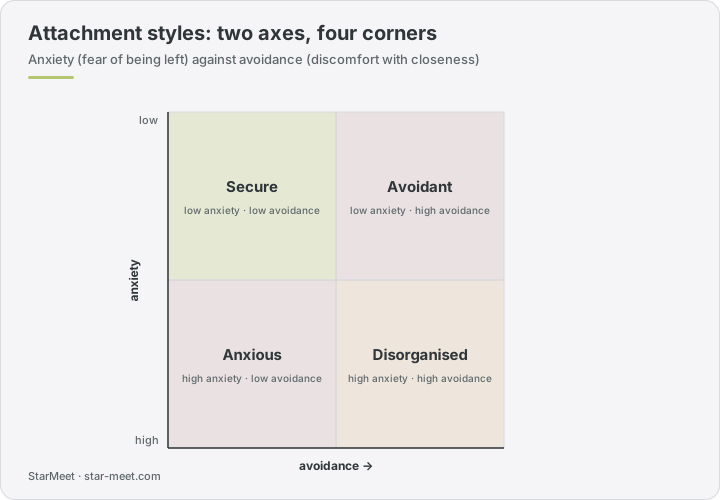
The anxious-avoidant trap—frequently termed the pursuer-distancer or demand-withdraw dynamic—is a self-reinforcing relationship pattern where an anxiously attached partner’s demand for emotional connection triggers an avoidantly attached partner’s urge to withdraw, causing both attachment systems to lock into a continuous cycle of conflict.
What you will learn from this article:
-
🧠 The Magnetic Chemistry: Why anxious and avoidant attachment styles naturally gravitate toward each other.
-
⚡ The Step-by-Step Escalation: The exact neuro-psychological sequence that turns a minor disagreement into a major shutdown.
-
✨ De-escalation & Repair: Proven Emotionally Focused Therapy (EFT) and Gottman protocols to break the trap without breaking up.
You start a conversation trying to feel closer, but within ten minutes, you are either desperately pleading for communication or slamming doors and walking out to escape the suffocating tension.
Both partners end up feeling deeply misunderstood, exhausted, and trapped in a painful relationship loop that repeats the exact same script month after month.
What Is the Anxious–Avoidant Trap?
In adult attachment theory—popularized by Amir Levine and Rachel Heller in Attached, as well as researchers Mario Mikulincer and Phillip Shaver—the anxious-avoidant trap represents a psychological collision between two opposing coping mechanisms.
The pursuer-distancer loop
When relational stress occurs, the anxious partner experiences an activation response (hyper-fixating on restoring closeness), while the avoidant partner experiences a deactivation response (suppressing emotions and pulling back to preserve autonomy).
The more one pursues, the more the other retreats—creating a perpetual feedback loop where neither partner's core emotional safety needs are met.
Why Do Anxious and Avoidant Partners Attract Each Other?
Despite their conflicting needs, anxious and avoidant individuals frequently experience intense initial chemistry due to familiarity bias and confirmation of core beliefs:
-
Confirmation of Core Beliefs: Anxious individuals expect partners to pull away, while avoidants expect partners to be demanding. Entering this dynamic validates each person's unconscious worldview.
-
Mistaking Anxiety for Chemistry: In early dating, the emotional roller coaster of anxiety, anticipation, and intermittent relief is easily mistaken for passionate love.
-
Outsourcing Emotional Regulation: Anxious partners are drawn to the avoidant's apparent self-reliance, while avoidant partners are drawn to the anxious partner's emotional warmth and expressive energy.
What Does the Push–Pull Cycle Look Like Step by Step?
Extensive relationship research by Dr. Sue Johnson (founder of Emotionally Focused Therapy) and Dr. John Gottman reveals that the demand-withdraw pattern follows a predictable escalation sequence:
The cycle escalation sequence
-
The Trigger Event: A minor rupture occurs—a delayed text, an ambiguous comment, or a shift in physical affection.
-
Anxious System Activation: The anxious partner perceives distance, registering a threat of abandonment. Their nervous system enters fight-or-flight.
-
Protest Behavior: To force connection, the anxious partner uses protest behaviors: double-texting, raising their voice, accusing, or demanding immediate answers.
-
Avoidant Deactivation: The avoidant partner registers the anxious pursuit as a threat of enmeshment or criticism. Their nervous system shuts down to protect itself.
-
Withdrawal & Stonewalling: The avoidant partner physically leaves, goes quiet, or becomes cold and dismissive.
-
Panicked Escalation: Seeing the withdrawal, the anxious partner's fear spikes, leading to louder demands until emotional exhaustion forces a temporary pause.
Why Can't Anxious and Avoidant Partners Just Leave Each Other?
Despite constant friction, couples in this dynamic find it remarkably difficult to separate. The primary driver behind this bond is intermittent reinforcement.
Intermittent reinforcement
When an avoidant partner briefly re-engages after a period of cold withdrawal, the anxious partner experiences a powerful surge of relief and dopamine.
This unpredictable cycle mirrors the neurochemical mechanisms of gambling, making the relationship feel intensely addictive and confusing deep trauma bonding with authentic intimacy.
What Triggers the Chase-and-Withdraw Pattern?
Understanding the specific triggers for both attachment styles helps interrupt the cycle before it escalates into crisis:
Triggers for the Anxious Partner
-
Unexplained physical or emotional distance.
-
Unanswered messages or delayed responses.
-
Perceived indifference during discussions.
-
Sudden shifts in a partner's daily routine.
Triggers for the Avoidant Partner
-
Demands for immediate emotional processing.
-
Public displays of intense conflict or emotional distress.
-
Feeling criticized, controlled, or boxed into commitments.
-
Perceptions that their personal autonomy is being violated.
Is the Anxious–Avoidant Relationship Doomed?
An anxious-avoidant relationship is not inherently doomed, but it cannot survive on default autopilot. Without active intervention, the demand-withdraw cycle erodes relationship satisfaction over time.
For the relationship to transform into a secure bond, both partners must shift their focus from trying to change each other to regulating their own nervous system responses and interrupting the cycle itself.
How Do You Break the Cycle Without Breaking Up?
Breaking the pursuer-distancer pattern requires coordinated effort from both individuals using established clinical frameworks:
Interrupting the cycle
| Anxious action | Avoidant action |
|---|---|
| Pause the pursuit | Express the need for time |
| Practice self-soothing | Commit to a specific return |
-
Step 1: Name the Cycle explicitly. Instead of blaming each other, view the push-pull loop as the common enemy. Say: "The cycle is hijacking us right now."
-
Step 2: The Anxious Pause. The anxious partner must practice somatic self-soothing, replacing immediate pursuit with a 20-minute pause to regulate their nervous system.
-
Step 3: The Avoidant Re-Entry. The avoidant partner must replace stonewalling with structured time-outs. Instead of walking away silently, say: "I feel overwhelmed. I need 30 minutes to calm down, and I will come back at 8:00 PM to finish this."
What Each Partner Needs to Hear in the Moment
During active attachment distress, sending the right signal can immediately de-escalate nervous system panic:
What the Anxious Partner Needs to Hear
"I am feeling overwhelmed right now, but I love you and I am not leaving this relationship. I just need 20 minutes to clear my head, and then I want to listen to you."
What the Avoidant Partner Needs to Hear
"I want to resolve this with you, but I don't need us to fix it this very second. Take some time to digest this, and let's talk when you feel ready."
When the Cycle Is Actually Abuse and You Should Leave
It is vital to distinguish between insecure attachment dynamics and domestic toxicity or emotional abuse. Attachment struggles can explain relational pain, but they never justify mistreatment.
Healthy Insecure PatternEmotional Abuse / Red Flags
Pulls away briefly to regulate, then returnsUses the silent treatment for days as intentional punishment
Expresses frustration about boundariesControls who you talk to, your finances, or physical movement
Takes responsibility for reactions after cooling downRefuses all accountability and systematically gaslights you
Shows genuine remorse after conflictsUses threats, intimidation, or physical violence
If your partner relies on coercive control, persistent gaslighting, or physical threats, the dynamic has passed beyond attachment incompatibility into an unsafe environment requiring professional domestic safety resources.
The Astrological Architecture of Synastry Tensions
While clinical psychology explains the behavioral loop of the anxious-avoidant trap, psycho-astrology provides a complementary map of inter-chart dynamics through synastry—the comparison of two natal charts.
Astrological tension between two charts often highlights where attachment triggers are most likely to surface:
Synastry attachment tensions
| Synastry aspect | Clinical attachment expression |
|---|---|
| Moon-Saturn oppositions | Cold emotional distance |
| Venus-Pluto squares | Fear of loss and control |
-
Moon-Saturn Aspects: One partner's emotional expression (Moon) collides with the other partner's defensive boundaries (Saturn), triggering classic demand-withdraw behaviors.
-
Venus-Pluto Tension: Harsh aspects between Venus and Pluto evoke deep fears of loss, leading to anxious hyper-vigilance or avoidant power struggles.
Understanding synastry allows couples to view their dynamic through an objective lens, transforming personal friction into an opportunity for shared growth.
Heal Your Relationship Dynamic with StarMeet
De-escalating the anxious-avoidant trap requires actionable tools, nervous system regulation, and clear emotional insight.
StarMeet combines validated psychological instruments with natal chart and synastry analysis to help couples navigate attachment distress safely.
Instead of navigating the push-pull cycle alone, StarMeet evaluates both partners' attachment patterns using metrics like the Experiences in Close Relationships-Revised (ECR-R) alongside synastry chart analysis. The AI engine identifies your shared triggers, mapping out the precise mechanisms driving your conflict loop.
Through secure, conversational AI-therapy, StarMeet guides both partners through evidence-based protocols, including Emotionally Focused Therapy (EFT) repair scripts, Gottman de-escalation strategies, and Schema Therapy tools—empowering you to step out of the trap and build an earned secure partnership.
Frequently Asked Questions
What is the pursue-withdraw dynamic in marriage?
The pursue-withdraw dynamic is a common pattern identified by Gottman and EFT researchers where one spouse demands communication or change while the other withdraws, leading to chronic marital dissatisfaction if left unaddressed.
Why does an avoidant partner get angry when the anxious partner finally pulls away?
When an anxious partner pulls away, the avoidant partner's perceived threat of enmeshment drops. This allows their underlying attachment feelings to surface, but the sudden shift in control can trigger confusion or anger.
Can an anxious-avoidant couple have a healthy sexual relationship?
Yes, but intimacy often reflects their emotional cycle. Physical closeness may spike after reconciliations due to intermittent reinforcement, but true long-term sexual satisfaction requires establishing baseline emotional safety first.
How does Emotionally Focused Therapy (EFT) help anxious-avoidant couples?
EFT helps couples look past surface arguments and identify the underlying fears driving their behaviors—such as the anxious fear of abandonment or the avoidant fear of inadequacy—allowing them to build secure emotional bonds.
Where can I learn more about individual attachment styles?
To explore individual attachment profiles in depth, review our comprehensive guides on the anxious attachment style and the avoidant attachment style.
🎁 SPECIAL OFFER: Your First Month of Premium for $1.
🔒 100% Safe: Cancel in 1 click, anytime.
👇 Ready to break the push-pull cycle and build secure connection?
About the author
Vadim Arkhipov
Founder of StarMeet. Student of Jyotish since 2013, having completed an advanced course under Dr. K.N. Rao; 30+ years in business. Articles here are written to my brief, drafted with AI assistance and edited by me before publishing.
Profile, expertise and all articles →Related Articles
Anxious Attachment Style: Signs, Causes, and What Actually Helps
Discover the signs and root causes of an anxious attachment style, understand the underlying nervous system activation, and learn proven paths to earned security.
PsychologyAvoidant Attachment: Why They Pull Away and What They Need
Understand avoidant attachment, the difference between dismissive and fearful avoidant patterns, why partners pull away after intimacy, and how to heal.
Psychology