Avoidant Attachment: Why They Pull Away and What They Need
Contents
Avoidant Attachment: Why They Pull Away and What They Need
An avoidant attachment style is an insecure attachment pattern characterized by emotional distance, a strict reliance on self-sufficiency, and an automatic suppression of vulnerability whenever closeness threatens personal autonomy.
What you will learn from this article:
-
🧠 The Neuro-Psychological Trigger: Why emotional intimacy triggers an automatic shutdown response in avoidant individuals.
-
⚡ Dismissive vs. Fearful Avoidant: How to distinguish between self-reliant independence and fear-driven relational withdrawal.
-
✨ Effective Communication Strategies: How to connect with an avoidant partner without causing them to retreat or shut down.
When a relationship feels warm, connected, and deeply intimate, only for your partner to suddenly go distant, become overly critical, or vanish into work and hobbies, you are observing the classic cycle of avoidant attachment.
Their sudden withdrawal feels like a cold wall. It leaves you confused, hurt, and questioning if the intimacy you shared was real or if they ever cared about you at all.
What Is Avoidant Attachment?
In attachment theory—pioneered by John Bowlby and Mary Ainsworth—an avoidant attachment style develops when a child learns that reaching out to caregivers for comfort leads to rejection, emotional neglect, or smothering intrusion.
To adapt and protect their mental health, the child learns to rely entirely on themselves, suppressing their attachment system and avoiding vulnerability.
In adult attachment research, psychologists Mario Mikulincer and Phillip Shaver highlighted that avoidant individuals rely heavily on deactivating strategies.
These strategies are subconscious mental and behavioral defense mechanisms—such as nitpicking a partner's flaws, suppressing emotional needs, or idealizing an unreachable ex—designed to maintain distance and prevent emotional vulnerability.
Dismissive Avoidant vs. Fearful Avoidant: What Is the Difference?
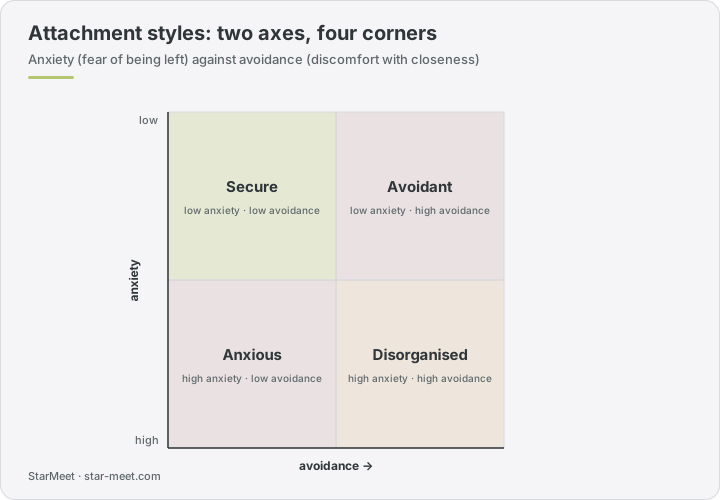
While both subtypes use emotional distance as a shield, their underlying motivations and relationship behaviors differ significantly:
Dismissive vs. fearful avoidant
| Dismissive avoidant | Fearful avoidant |
|---|---|
| Low anxiety / high avoidance | High anxiety / high avoidance |
| Positive view of self | Negative view of self |
| Negative view of others | Negative view of others |
| "I don't need anyone." | "I want love, but it hurts." |
| Cool, self-reliant, aloof | Push-pull, volatile dynamics |
-
Dismissive Avoidant: Highly independent and self-reliant. They view emotional vulnerability as a sign of weakness, rarely experience relational anxiety, and dismiss the need for close emotional bonds.
-
Fearful Avoidant (Disorganized): A complex pattern identified by researchers Mary Main and Judith Solomon. Fearful avoidants intensely crave closeness, yet panic when intimacy develops, constantly cycling between drawing near and pulling away.
Signs of Avoidant Attachment in Adults
Adults with an avoidant attachment pattern frequently rely on specific behaviors to protect their personal autonomy:
-
Extreme Self-Reliance: A rigid insistence on managing every problem alone, treating requests for assistance as a loss of control.
-
Emotional Shutdown under Stress: Stonewalling, going silent, or physically leaving the room when emotional conflicts or intense discussions arise.
-
Phantom Ex Syndrome: Nostalgically idealizing a past partner or chasing an unrealistic standard of "the perfect match" to avoid committing to the person right in front of them.
-
Hyper-Fixation on Minor Flaws: Focusing on small habits or quirks in a partner as an excuse to pull away and create emotional distance.
-
Strict Boundary Control: Guarding personal schedules, physical space, and independence with high vigilance, viewing healthy relationship needs as demanding.
What Causes Avoidant Attachment?
Avoidant patterns stem from childhood environments where emotional expression was discouraged, ignored, or punished.
If primary caregivers were cold, strictly performance-focused, or emotionally overbearing, the child's nervous system adapted to keep distance for survival.
The child learns that vulnerability brings pain or loss of autonomy. Their brain hardwires a protective rule: "It is unsafe to depend on anyone. True safety only comes from total self-reliance."
The Core Wounds Behind Avoidance
Behind the cool, detached persona of an avoidant partner lies a protective shield guarding deep core wounds:
The avoidant defense system
| Core underlying wound | Deactivating response |
|---|---|
| "Intimacy will smother my independence." | Physical distance, work overload, hobbies |
| "If you truly see me, you will reject me." | Nitpicking flaws, quick relationship exits |
-
Fear of Enmeshment: A deep panic that getting close to someone will result in being controlled, overwhelmed, or losing their sense of identity.
-
Fear of Defectiveness: An unconscious belief that showing true vulnerability will expose inner flaws, leading to inevitable rejection.
-
Assumed Abandonment: A protective mindset that assumes everyone eventually leaves, so it is better to leave or pull away first.
Why Do Avoidants Pull Away When Things Get Close?
The primary trigger for an avoidant individual is a sudden increase in emotional intimacy. When a relationship reaches a milestone—such as saying "I love you," moving in, or sharing deep vulnerability—their nervous system registers closeness as a loss of control.
This threat response triggers an automatic shut down. They aren't pulling away because they lack feelings; they are pulling away to soothe an overstimulated nervous system that interprets intimacy as a threat to survival.
Do Avoidants Have Feelings for You?
Yes, avoidant individuals have deep feelings, but their internal alarm system suppresses those emotions when closeness feels overwhelming.
While someone with an anxious attachment pattern expresses distress outwardly through protest behaviors, an avoidant partner buries emotional pain beneath cold detachment or work overload. Their feelings often surface weeks or months later, long after the immediate pressure for intimacy has passed.
The Astrological Architecture of Avoidance
While psychology explains how childhood conditioning shapes relational distance, psycho-astrology reveals the underlying energetic patterns in a natal chart.
In a chart analysis, avoidance often aligns with tensions involving Saturn (boundaries, emotional control, and self-protection) or Uranus (independence, freedom, and detachment) interacting with the Moon or Venus.
-
Saturn-Moon Aspects: Point to early environments where emotional expression was restricted, teaching the individual to maintain strict emotional control.
-
Uranus-Venus Aspects: Indicate a deep need for personal freedom and an automatic reaction to pull away whenever closeness feels constraining.
-
Air Element Predominance: A heavy emphasis on Gemini, Libra, or Aquarius can lead someone to analyze emotions intellectually rather than feeling them somatically.
What an Avoidant Partner Actually Needs
To stay connected without feeling overwhelmed, an avoidant partner requires specific conditions that respect their autonomy:
-
Predictable Space: Uninterrupted personal time to process thoughts and regulate their nervous system without feeling guilty.
-
Low-Pressure Communication: Discussions focused on clear facts and direct solutions rather than high-intensity emotional demands.
-
Autonomy Preservation: Reassurance that being in a loving relationship does not mean sacrificing their freedom or personal identity.
How to Communicate with an Avoidant Partner Without Pushing Them Away
Connecting with an avoidant partner requires shifting from demanding immediate intimacy to building a calm, predictable environment:
-
Avoid Emotional Ambushes: Ask for a good time to talk rather than forcing heavy emotional conversations when they are unprepared.
-
Use Clear, Direct Statements: State your needs without global accusations. Say "I would love to spend an hour together tonight" instead of "You never care about me."
-
Respect Their Shutdown Phase: If they go silent during a conflict, say: "I see you need space. Let's take a break and circle back in two hours." This offers safety while setting a clear timeframe.
Can a Fearful Avoidant Become Secure?
Yes, both fearful avoidant and dismissive avoidant individuals can develop an earned secure attachment.
By learning to recognize deactivating strategies, regulate somatic stress responses, and challenge core beliefs about vulnerability, avoidant individuals can learn that authentic closeness is safe.
The Path to Earned Security with StarMeet
Healing an avoidant pattern requires more than surface-level advice; it demands a structured approach that respects the individual's need for control and privacy.
StarMeet combines validated attachment assessments with personal natal chart analysis to help individuals navigate avoidant patterns at their own pace.
By analyzing psychological frameworks alongside planetary aspects—like Saturn and Uranus placements—StarMeet identifies your specific deactivating triggers and subconscious barriers to closeness.
Through private, conversational AI-therapy, StarMeet guides you through evidence-based protocols, including Schema Therapy modes and CBT reframing. You can explore vulnerability, process suppressed emotions, and build earned security on your own terms.
Frequently Asked Questions
Why does an avoidant partner come back after pulling away?
An avoidant partner often returns once physical or emotional space has lowered their perceived threat levels, allowing their underlying feelings for you to surface without the panic of being overwhelmed.
How do you know if an avoidant is attached to you?
Signs of avoidant attachment include showing up reliably in practical ways, sharing subtle vulnerability, inviting you into their personal space, and staying engaged during difficult conversations instead of shutting down.
What happens when you stop chasing an avoidant?
When you stop pursuing, the pressure on their nervous system drops. This space often allows the avoidant partner to process their emotions, miss your presence, and choose to reach out voluntarily.
Can an anxious and avoidant couple make a relationship work?
Yes, but it requires mutual awareness of the anxious-avoidant dynamic. The anxious partner must practice self-soothing, while the avoidant partner must actively manage deactivating strategies and stay present during conflict.
What is the best therapy for avoidant attachment?
Evidence-based therapies including Schema Therapy, Cognitive Behavioral Therapy (CBT), and somatic nervous system regulation are effective for helping avoidant individuals safely process vulnerability and build secure attachments.
🎁 SPECIAL OFFER: Your First Month of Premium for $1.
🔒 100% Safe: Cancel in 1 click, anytime.
👇 Ready to understand your attachment patterns and heal relational blocks?
About the author
Vadim Arkhipov
Founder of StarMeet. Student of Jyotish since 2013, having completed an advanced course under Dr. K.N. Rao; 30+ years in business. Articles here are written to my brief, drafted with AI assistance and edited by me before publishing.
Profile, expertise and all articles →Related Articles
Anxious Attachment Style: Signs, Causes, and What Actually Helps
Discover the signs and root causes of an anxious attachment style, understand the underlying nervous system activation, and learn proven paths to earned security.
PsychologyThe Anxious–Avoidant Trap: Why the Push–Pull Cycle Repeats
Discover why anxious and avoidant partners magnetically attract, map the step-by-step pursuer-distancer cycle, and learn how to break the trap using EFT and Gottman methods.
Psychology