Disorganized Attachment: Signs, Origins, and How to Heal
Contents
Disorganized Attachment: Signs, Origins and First Steps to Heal
Disorganized attachment is a relational pattern where a person experiences an intense craving for intimacy combined with a profound fear of closeness, leading to simultaneous push-and-pull behavior in romantic partnerships. It develops when early caregivers act as both a source of safety and a source of danger, trapping the nervous system in an unresolved biological paradox.
🧠 What you will learn from this guide:
-
The Biological Trigger: Why you push partners away the exact second an emotional connection becomes deep and real.
-
The Dual Lens Blueprint: How developmental trauma and your natal chart architecture mirror your subconscious relational blocks.
-
The Clinical Protocol: How to stop relying on ineffective coping mechanisms and systematically build earned security.
You find someone who treats you with genuine respect, warmth, and consistency. For the first two weeks, your connection feels extraordinary.
Then, without warning, an overwhelming wave of suffocation hits you. Your chest tightens, your thoughts race, and every instinct screams at you to run away, pick a fight, or disappear.
Two days after cutting contact, an agonizing wave of loneliness takes over, leaving you desperate for their validation. You feel trapped in an exhausting cycle of craving love and immediately sabotaging it when it arrives.
This article explains why this biological paradox occurs and how you can reclaim emotional stability.
What is my attachment style: Secure, anxious, avoidant, or disorganized?
Attachment theory, originally established by British psychologist John Bowlby and expanded by Mary Ainsworth, defines an attachment style as an internal working model that dictates how a human being expects relational safety, handles emotional vulnerability, and regulates fear.
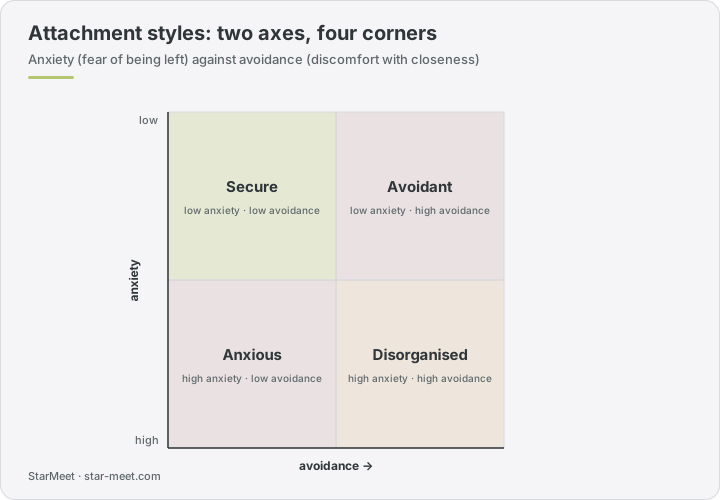
Developmental psychology identifies four core attachment categories:
-
Secure attachment: Characterized by high self-worth, emotional transparency, comfort with vulnerability, and the capacity to establish healthy boundaries without fear of abandonment.
-
Anxious attachment: Defined by hyper-vigilance, a chronic fear of rejection, low baseline self-worth, and a persistent drive to merge with partners to feel safe.
-
Avoidant attachment: Characterized by emotional deactivation, compulsive self-reliance, suppression of vulnerable feelings, and defensive distancing whenever intimacy deepens.
-
Disorganized attachment (Fearful-Avoidant): A volatile combination where an individual oscillates between anxious clinginess and avoidant freezing because closeness feels inherently dangerous.
Attachment StyleView of SelfView of OthersCore Nervous System Response
SecurePositivePositiveRegulated & Collaborative
AnxiousNegativePositiveHyper-arousal (Fight / Cling)
AvoidantPositiveNegativeHypo-arousal (Flight / Numb)
DisorganizedNegativeNegativeBiological Freeze (Approach-Avoidance)
Why do I push people away when they get close?
The impulse to sabotage intimacy stems from a neurobiological conflict known as fright without solution, a concept established by developmental researcher Dr. Mary Main.
When you perceive emotional closeness, your biological attachment system activates, driving you to seek comfort.
Simultaneously, your amygdala scans vulnerability as an existential threat, firing survival signals that trigger an urgent need to flee.
This dynamic leads to profound relational confusion:
-
Intimacy trigger: When a partner says "I love you," your nervous system interprets the commitment as impending trap or betrayal.
-
Emotional dissociation: You shut down emotionally with your partner, feeling completely numb during serious conversations.
-
Relational sabotage: You magnify minor personality flaws to justify ending the relationship before the other person has a chance to hurt you.
Why can't I figure out why my relationships fail?
Relationships with disorganized dynamics often fail because both partners become locked in a trauma bond where emotional volatility is mistaken for passionate love.
When someone who exhibits fearful-avoidant patterns meets a stable, predictable partner, the lack of drama can feel boring or threatening.
Consequently, individuals with this pattern frequently gravitate toward emotionally unavailable partners, unconsciously recreating familiar childhood instability.
This cycle reinforces deep-seated cognitive distortions:
-
"If I let someone see who I really am, they will eventually weaponize it against me."
-
"I am completely alone, yet relying on anyone else is dangerous."
-
"I must maintain complete control over my feelings to prevent total collapse."
How clinical psychology and psycho-astrology reveal the root blueprint
Healing requires understanding both the functional psychological mechanism and the deeper structural blueprint of your core personality.
The Psychological Mechanism: Schema Activation and Dissociation
In Jeffrey Young’s Schema Therapy, disorganized attachment is driven by early maladaptive schemas: Abandonment/Instability, Mistrust/Abuse, and Defectiveness.
When an intimate partner gets close, the "Vulnerable Child" schema triggers sheer terror, causing the "Detached Protector" mode to step in.
You do not choose to disconnect on an intellectual level; your psyche initiates dissociation to protect your emotional core from perceived danger.
The Astrological Architecture: Mapping Internal Tension
Psycho-astrology uses the natal chart as an objective psychological blueprint, revealing where inner architecture experiences fundamental friction:
-
Moon-Pluto Aspects (Squares & Oppositions): Symbolize deep subconscious associations between love and emotional control, crisis, or sudden loss.
-
Saturn in the 4th, 7th, or 12th House: Points to early foundations built on emotional isolation, rigid expectations, or chronic self-reliance.
-
Saturn Transits: Highlight developmental turning points where defensive walls become too heavy to carry, demanding structured self-honesty.
Astrology highlights where and why the structural block exists in your psychological makeup.
Clinical psychology provides the precise tools how to systematically heal it.
Why common self-help workarounds fail to fix attachment trauma
Most people attempt to resolve relational distress using quick fixes that address symptoms rather than the underlying nervous system wiring:
-
Intellectualizing Through Books: Reading dozens of relationship guides gives you intellectual awareness, but your somatic nervous system remains locked in a freeze response when emotional intimacy occurs.
-
Surface Positive Affirmations: Repeating phrases like "I am worthy of safe love" fails to resolve unconscious trauma stored in the body.
-
Superficial Astrological Fatalism: Blaming relationship failures entirely on external planetary alignments eliminates personal agency and prevents active psychological growth.
-
Suppression and Avoidance: Forcing yourself to "stay calm" without processing core fears leads to sudden emotional explosions or total dissociation.
Real transformation requires evidence-based psychological reprocessing paired with an accurate understanding of your psychological blueprint.
Step-by-step roadmap to developing earned security
Developing earned security means building a grounded, resilient attachment system in adulthood, regardless of early childhood instability.
-
Somatic Boundary Recognition: Identify the physical sensations (such as a tightening throat or hollow stomach) that occur right before you disconnect from a partner.
-
Schema Interruption: When the urge to flee or attack arises, pause and label the reaction: "My Detached Protector mode is trying to keep me safe, but I am not in physical danger."
-
Micro-Doses of Vulnerability: Practice expressing small, authentic truths to safe individuals rather than oscillating between silence and emotional outpourings.
-
Integration of the Subconscious Shadow: Use structured clinical exercises to integrate the rejected parts of your psyche, transforming projection into self-awareness.
Taking the Adult Attachment Interview Lite (AAI Lite)
Understanding your exact attachment baseline is the critical first step toward lasting relational stability.
Generic online quizzes often rely on simple multiple-choice questions that only capture surface-level thoughts.
The Adult Attachment Interview Lite (AAI Lite), adapted from foundational clinical protocols, assesses how you organize relational memories, evaluate vulnerability, and handle perceived abandonment.
You do not need to spend hours browsing therapy directories or trying to choose the right intervention on your own.
On the StarMeet platform, you simply describe what you are experiencing in your own words.
The conversational AI engine analyzes your natural language alongside your natal chart blueprint, automatically matches your situation to the right clinical protocol (CBT, Schema Therapy, or Somatic Reprocessing), and guides you through an actionable, staged process across 6 to 8 focused sessions.
Frequently Asked Questions
What is an attachment style quiz?
An attachment style quiz is a self-assessment tool designed to evaluate your emotional, cognitive, and behavioral patterns in close relationships, identifying whether you operate from secure, anxious, avoidant, or disorganized tendencies.
How does a fear of intimacy test help me?
A fear of intimacy test highlights specific emotional barriers, subconscious defense mechanisms, and trust fractures that cause you to push partners away when genuine vulnerability is required.
What does it mean if I shut down emotionally with my partner?
Emotional shutdown is a protective nervous system freeze response known as emotional deactivation. It occurs automatically when relational stress exceeds your current capacity to process vulnerability safely.
Can two partners with insecure attachment build a healthy relationship?
Yes. When both partners develop emotional self-awareness, understand their mutual triggers, and practice structured communication, they can heal reactive cycles and cultivate earned security together.
How is the AAI Lite test different from standard quizzes?
The Adult Attachment Interview Lite analyzes the coherence, defensive structure, and emotional processing of your relationship history, providing a deeper clinical assessment than surface-level personality quizzes.
What role does the Gemini 3.8 Flash engine play in StarMeet therapy?
The Gemini 3.8 Flash engine delivers instant, highly accurate synthesis between complex psychological frameworks and natal chart parameters, powering real-time, personalized therapeutic conversations.
🎁 Transform Your Relational Patterns with StarMeet
Stop losing fulfilling relationships to unconscious panic and self-sabotaging patterns. Take the validated AAI Lite assessment, map your natal chart blueprint, and work through personalized clinical protocols designed to bring stability to your love life.
👉 Start Your Adult Attachment Test on StarMeet
🎁 SPECIAL OFFER: Your First Month of Premium for $1. 🔒 100% Safe: Cancel in 1 click, anytime.
About the author
Vadim Arkhipov
Founder of StarMeet. Student of Jyotish since 2013, having completed an advanced course under Dr. K.N. Rao; 30+ years in business. Articles here are written to my brief, drafted with AI assistance and edited by me before publishing.
Profile, expertise and all articles →Related Articles
Insecure Attachment: The Four Styles and Where Yours Comes From
Understand secure, anxious, avoidant, and disorganized attachment styles. Discover where insecure attachment comes from and how to heal.
PsychologyThe Anxious–Avoidant Trap: Why the Push–Pull Cycle Repeats
Discover why anxious and avoidant partners magnetically attract, map the step-by-step pursuer-distancer cycle, and learn how to break the trap using EFT and Gottman methods.
PsychologyAttachment Style Test: Free, Research-Based, 5 Minutes
Stop guessing why your relationships fail. Take the free 5-minute ECR-R attachment style test to find out if you are secure, anxious, avoidant, or disorganized, and map your emotional blueprint.
Psychology