Insecure Attachment: The Four Styles and Where Yours Comes From
Contents
Insecure Attachment: The Four Styles and Where Yours Comes From
Insecure attachment is a psychological framework describing unstable relationship patterns formed in childhood when emotional needs are unmet. The four main attachment styles are secure, anxious-preoccupied, dismissive-avoidant, and fearful-avoidant (disorganized). Insecure attachment comes from inconsistent or absent caregiver responses, leading to deep-seated fears of intimacy, abandonment, or rejection in adult relationships.
What you will learn from this article:
-
Why your nervous system panics: The exact reasons you repeatedly attract partners who trigger your deepest fears of abandonment or suffocation.
-
Your hidden blueprint: How your Natal Chart and early childhood conditioning created your specific relational architecture.
-
The evidence-based fix: The clinical psychology tools you need to stop sabotaging love and transition toward a secure attachment style.
🧠 The Reality Check: You know the feeling exactly. Your partner takes four hours to text back, and your entire day stops as your nervous system goes into overdrive. Or conversely, they ask for "more closeness," and you physically recoil, feeling trapped and suffocated. You are exhausted by this relentless push-pull dynamic. You wonder why romantic relationships always feel like a battlefield instead of a sanctuary.
It is time to stop guessing and start fixing the root cause. 👇
What is insecure attachment?
Insecure attachment is a subconscious survival mechanism developed when early emotional bonds are unstable, causing ongoing distress in adult relationships. Based on Mary Ainsworth’s Strange Situation research, attachment theory explains how we learn to perceive love, safety, and trust from our earliest days.
When their caregivers are inconsistent, dismissive, or frightening, infants adapt by becoming hyper-vigilant or emotionally shut down. These childhood adaptations do not disappear; they solidify into an insecure attachment style.
As adults, this invisible framework dictates your romantic relationships. You either cling tightly to avoid abandonment or build massive emotional walls to prevent engulfment. These automatic patterns severely impact your mental health, driving a wedge between you and the deep connection you actually crave.
Traditional "cheap" workarounds fail because they treat the symptom, not the root. You cannot simply "communicate better" or buy healing crystals when your nervous system detects intimacy as a lethal threat. You need a structural intervention.
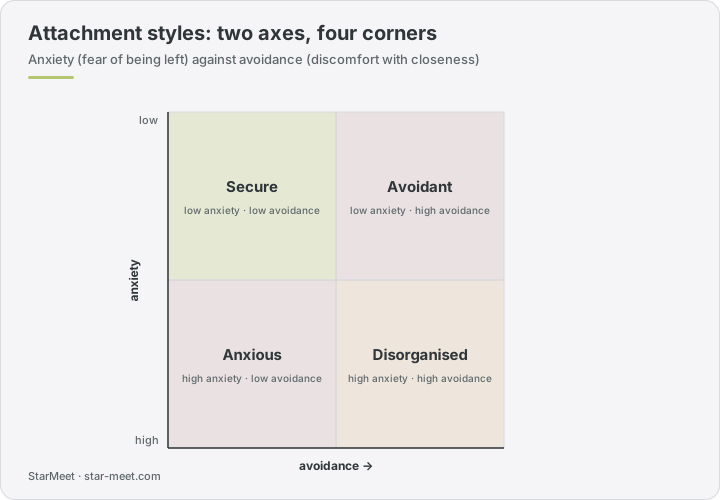
Secure, anxious, avoidant, disorganized: Attachment styles explained
Psychologists Kim Bartholomew and Leonard Horowitz expanded attachment theory into four distinct adult profiles based on an individual's subconscious view of self and others. Understanding your category is the first step toward self awareness.
Attachment StyleView of SelfView of OthersCore Behavior in Relationships
SecurePositivePositiveComfortable with intimacy and independence.
Anxious-PreoccupiedNegativePositiveFears abandonment, highly reactive, clings tightly.
Dismissive-AvoidantPositiveNegativeEquates intimacy with loss of freedom, emotionally distant.
**Fearful-Avoidant (Disorganized)**NegativeNegativeCraves connection but is terrified of it; extreme push-pull.
Secure attachment occurs when you have a positive view of yourself and your partner. You communicate emotional needs clearly without panic. Anxious preoccupied individuals fear abandonment and constantly seek external validation (we cover this deeply in our anxious style guide).
Dismissive avoidant individuals hold a positive view of themselves but distrust others, suppressing their emotions (read our avoidant style guide). Finally, fearful avoidant or disorganized attachment creates a chaotic push-pull dynamic, combining the worst of both fears (explore our anxious-avoidant cycle guide).
Where does insecure attachment come from?
Insecure attachment comes from a combination of childhood conditioning and your innate psychological blueprint. Psychologically, it begins when your emotional needs are repeatedly mishandled by their caregivers. If crying brings punishment instead of comfort, your brain wires itself for defense.
Astrologically, we see this exact architecture in your Natal Chart. The 4th House represents your early home environment and foundational emotional security, while the Moon dictates your instinctive emotional responses.
If you have harsh planetary aspects—like Saturn squaring your Moon—you likely experienced emotional restriction, coldness, or conditional love in childhood. Astrology reveals the blueprint of why the blockage exists, mapping the exact emotional deficits you were born to resolve.
Combining this astrological insight with clinical psychology gives you a complete map. Traditional astrologers who claim "it's just your destiny" leave you powerless. In reality, you are operating on a specific, identifiable script that can be rewritten.
Why do I get anxious and clingy in relationships?
You get anxious and clingy because your nervous system perceives emotional distance as an immediate threat to your survival. Anxious preoccupied attachment develops when caregivers are unpredictable—sometimes intensely warm, sometimes completely absent.
Because you never knew if your needs would be met, you learned to amplify your distress to secure attention. In adult relationships, a delayed text message triggers that exact childhood panic. You pursue, double-text, and hyper-fixate on your partner's shifting moods.
In modern psycho-astrology, we often see heavy afflictions in the 7th House of partnership or difficult aspects to Venus. A prominent Neptune can also create a tendency to over-idealize partners, leading to crushing disappointment when reality sets in.
Your brain currently equates high anxiety with love. You are running on an exhausting loop, convinced that if you just try harder and love louder, you will finally feel safe. This strategy drains your energy to zero.
Why do I shut down emotionally with my partner?
You shut down emotionally because your brain interprets intimacy as a demand, an obligation, or an invasion of your autonomy. Avoidant attachment is forged when caregivers are emotionally unavailable or actively reject a child's attempts at vulnerability.
To survive, you learned to suppress your emotional needs and rely solely on yourself. When a partner asks for deeper connection, your subconscious triggers an emergency override. You deactivate, withdraw, and find reasons to criticize your partner to justify creating distance.
Astrologically, strong Saturn placements or a heavy 12th House of isolation often correlate with this profound need for emotional autonomy. Saturn demands extreme self-sufficiency and builds concrete walls where warmth should exist.
You are not inherently cold; you are highly protected. But this armor prevents you from experiencing the very connection that would make you more secure. Forcing yourself to "just open up" will backfire unless you address the underlying fear of engulfment.
I push people away when they get close: Signs of disorganized attachment
Disorganized attachment is a trauma response where the person who was supposed to be your source of safety was simultaneously your source of fear. This creates an impossible biological paradox: you are driven to seek closeness, but proximity triggers sheer terror.
Also known as fearful avoidant attachment, this style is marked by a severe push-pull dynamic. You desperately want love, but the moment someone actually gets close, you self-sabotage, pick explosive fights, or vanish entirely.
In a Natal Chart, we frequently observe intense Pluto or Uranus transits and aspects. Pluto brings deep subconscious fears of betrayal and control, while Uranus dictates sudden disruptions and an absolute inability to settle into emotional consistency.
Your nervous system is stuck oscillating between the anxiety of abandonment and the claustrophobia of intimacy. Relying on endless TikTok relationship advice reels will only confuse you further. This style demands evidence based clinical intervention to stabilize the nervous system.
How do I know if I have a fear of intimacy?
A fear of intimacy is an underlying resistance to sharing your authentic emotional, physical, or psychological self with another person. It is the core driver behind all forms of insecure attachment.
Signs include chronically choosing emotionally unavailable partners, feeling "trapped" when a relationship becomes peaceful, withholding physical affection, or using relentless work and hobbies to avoid deep conversations. You might also rely on superficial workarounds.
Endless relationship advice, reading generic horoscopes, or trying to logically "force" vulnerability will completely drain your battery. They fail because they try to bypass the nervous system without addressing the architectural wound.
True diagnosis requires clinical precision. Taking an evidence based assessment like the ECR-R (Experiences in Close Relationships-Revised) test is the only reliable way to measure your exact levels of relationship anxiety and avoidance.
Can you change your attachment style?
Yes, you can absolutely change your attachment style. Thanks to neuroplasticity, your brain can unlearn defensive patterns and build a more secure foundation. This ongoing process is clinically known as developing an earned secure attachment.
However, generic talk therapy or standard astrology readings are not enough. You need targeted, integrated intervention. You must identify the structural blockage and apply active, daily psychological reprogramming to change the behavior.
This is where clinical psychology and astrology must synthesize. Astrology maps the tension—identifying a challenging Saturn transit that is currently pushing you to mature. Clinical protocols, like Cognitive Behavioral Therapy (CBT) or Schema Therapy, give you the exact psychological tools to rewire your responses during that transit.
By addressing both the energetic blueprint and the psychological habit, you can permanently stop the cycle of self-sabotage.
The Synthesis: How StarMeet Fixes the Root Cause
You are tired of theoretical advice that doesn't change your daily reality. To actually heal, you need a system that diagnoses your unique blueprint and provides the exact tools to fix it.
StarMeet is the only platform that synthesizes Modern Psycho-Astrology (to find the block in your Natal Chart) with Clinical Psychology (to fix it using proven therapeutic protocols).
Powered by our Gemini 3.8 Flash engine—and offering a deep-dive switch to Gemini 3.1 Pro—StarMeet features over 40 validated scientific tests, including the ECR-R for attachment styles. You get a personalized AI-therapy chat based on CBT and Schema Therapy, directly mapped to your astrological transits.
Stop guessing why your relationships fail. Find your exact attachment style and get the clinical tools to become more secure today.
Take the Free ECR-R Partner Attachment Test Here
🎁 SPECIAL OFFER: Your First Month of Premium for $1. 🔒 100% Safe: Cancel in 1 click, anytime.
About the author
Vadim Arkhipov
Founder of StarMeet. Student of Jyotish since 2013, having completed an advanced course under Dr. K.N. Rao; 30+ years in business. Articles here are written to my brief, drafted with AI assistance and edited by me before publishing.
Profile, expertise and all articles →Related Articles
Anxious Attachment Style: Signs, Causes, and What Actually Helps
Discover the signs and root causes of an anxious attachment style, understand the underlying nervous system activation, and learn proven paths to earned security.
PsychologyAvoidant Attachment: Why They Pull Away and What They Need
Understand avoidant attachment, the difference between dismissive and fearful avoidant patterns, why partners pull away after intimacy, and how to heal.
PsychologyAttachment Style Test: Free, Research-Based, 5 Minutes
Stop guessing why your relationships fail. Take the free 5-minute ECR-R attachment style test to find out if you are secure, anxious, avoidant, or disorganized, and map your emotional blueprint.
Psychology