Does Astrology Actually Work? What the Research Says
Contents
Does Astrology Actually Work? What the Research Says
Astrology does not work as an empirical predictive science, but it functions effectively as a symbolic psychological diagnostic tool. Double-blind scientific studies consistently demonstrate that astrologers cannot predict character traits or life events better than chance. However, when used as a structured framework alongside clinical psychology, a natal chart clarifies deep-seated emotional blueprints, behavioral blind spots, and subconscious defense mechanisms.
What you will learn from this article:
-
🧠 The empirical verdict: What large-scale scientific studies reveal about astrological accuracy.
-
🔍 The psychological mechanism: Why birth charts feel uncannily precise due to cognitive validation and archetypal resonance.
-
🛠️ The synthesis solution: How combining a natal chart architectural blueprint with evidence-based clinical psychology resolves persistent behavioral blocks.
You hit an emotional wall at 2:00 AM, stare at the ceiling, and wonder why the same painful relationship dynamics, self-sabotaging career moves, and chronic burnout cycles keep recurring.
You find yourself reading horoscopes or online interpretations that feel deeply, shockingly personal, yet they leave you with zero practical tools to change your reality.
In this article, we explain why this happens and how to reclaim your energy.
How Accurate Is a Birth Chart According to Science?
A birth chart accuracy test evaluates whether astrological readings match real human personalities better than random guessing under controlled conditions.
Over five decades of empirical research show that traditional astrology fails double-blind scientific testing. In landmark research such as Shawn Carlson's 1985 double-blind study published in Nature, 28 top astrologers were matched against standardized California Psychological Inventory (CPI) personality profiles. The results proved the astrologers were unable to match natal charts to CPI test results better than random chance, scoring an exact 33% success rate across 116 participants.
More recently, in a massive 2020 study evaluating whether astrology works ("Does astrology work? We put 152 astrologers to the test" by Spencer Greenberg and ClearerThinking), 152 professional astrologers attempted to match 12 real person profiles to their correct astrological chart. Astrologers believed they would provide strong, clear matches, predicting they would score over 60% accuracy. Instead, the participants achieved an average score of under 21%, which was no better than random guessing. Furthermore, agreement among astrologers was near zero; they were unable to agree with each other on which chart belonged to which person.
| STUDY | ASTROLOGER PREDICTION | EMPIRICAL OUTCOME |
|---|---|---|
| Nature (Carlson, 1985) ClearerThinking (2020) | > 50% Accuracy > 60% Accuracy | 33.3% (Chance Level) 20.8% (Chance Level) |
When public figures debate the topic—such as when activist Malala Yousafzai engaged in a lighthearted dialogue with skeptics about birth charts—the dividing line remains clear: hard science finds no evidence of physical planetary forces shaping fate.
Yet millions of high-performing individuals continue to find immense resonance in their personal chart readings. The reason lies not in gravitational physics, but in deep psychological mechanics.
What Is a Natal Chart and Why Does It Feel So Accurate?
A natal chart is an astronomical snapshot of the exact positions of the Sun, Moon, and planets relative to Earth's twelve horizon sectors at the precise moment of a person's birth.
When you read a detailed breakdown of your chart, psychological mechanisms immediately engage to create a profound sense of recognition. The primary driver is the Barnum-Forer Effect, identified by psychologist Bertram Forer in 1948, which shows that individuals readily attribute high accuracy to character descriptions that they believe are tailored specifically to them, even when the statements are universally true across human populations.
COGNITIVE RESONANCE LOOP
- ▲
Beyond cognitive bias, Swiss psychiatrist Carl Jung identified the concept of Synchronicity and Archetypes. Jung observed that planetary configurations operate as an ancient, symbolic taxonomy of human psychological drives.
When an astrological chart notes a tension between your Saturn and your Moon, it articulates an authentic, lived psychological conflict: the collision between your instinctual need for emotional safety (Moon) and your internalized, hyper-critical taskmaster (Saturn).
The chart does not cause your neurosis; it provides a mirror that reflects the structural layout of your subconscious mind.
What Does a Natal Chart Tell You: The Structural Blueprint
A natal chart provides a structural framework that outlines an individual's conscious ego, emotional conditioning, defensive adaptations, and core life tensions.
Instead of dictating an unchangeable fate, the chart maps where internal resources and psychological frictions reside within your personality. It serves as a visual diagnostic map of your unconscious operating system.
| CHART COMPONENT | PSYCHOLOGICAL CORRELATION |
|---|---|
| Planetary Drives Zodiac Signs Houses (1-12) Hard Aspects | Innate psychological needs (Agency, Safety, Drive) Behavioral styles and coping mechanisms Specific life arenas (Career, Intimacy, Isolation) Core internal conflicts and neuroses |
Birth Chart Meaning Explained: The Core Trinity
To decode the framework, clinicians and modern psycho-astrologers examine three foundational anchors:
-
☀️ The Sun: Represents conscious will, core identity, and self-actualization goals.
-
🌙 The Moon: Governs emotional regulation, nervous system baselines, and early attachment patterns.
-
🌅 The Ascendant (Rising Sign): Represents your primary social persona, coping mechanisms, and external defense systems.
Understanding this structural blueprint allows you to stop treating symptoms blindly and start identifying the root energetic conflicts running beneath your daily conscious choices.
Natal Chart Houses Meaning: Mapping the Subconscious Arenas
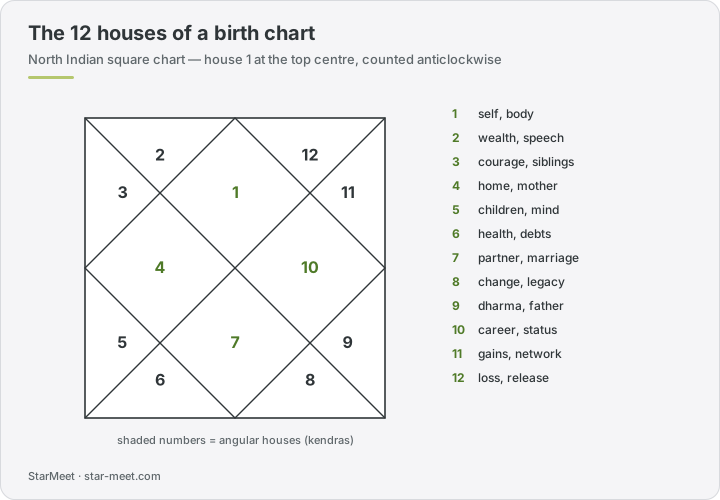
Astrological houses are twelve 30-degree divisions of the natal wheel that map specific spheres of psychological experience, external activity, and relational dynamics.
Each house shifts an abstract emotional impulse into a concrete real-world context, showing exactly where internal conflicts play out:
-
🏠 1st House (Self & Persona): Core self-concept, physical vitality, and instinctual response to new environments.
-
💰 2nd House (Security & Values): Self-worth, relationship to material resources, and financial scarcity scripts.
-
🗣️ 3rd House (Cognition & Communication): Executive functioning, immediate social connections, and daily processing loops.
-
🛡️ 4th House (Roots & Attachment): Early childhood conditioning, domestic sanctuary, and foundational emotional security.
-
🎨 5th House (Expression & Desire): Creative agency, pleasure tolerance, inner-child vitality, and risk-taking.
-
⚙️ 6th House (Somatic Health & Routine): Nervous system capacity, somatic symptoms, daily habits, and stress tolerance.
-
🤝 7th House (Relational Mirror): One-on-one partnerships, projected Shadow traits, and interpersonal contracts.
-
🌑 8th House (Transformation & Shared Power): Deep intimacy, trauma processing, shared finances, and psychological rebirth.
-
🧭 9th House (Expansion & Beliefs): Worldview formation, cognitive restructuring, and existential philosophy.
-
💼 10th House (Vocation & Authority): Public ambition, relationship to parental authority figures, and career execution.
-
🌐 11th House (Belonging & Vision): Community integration, collective goals, and social boundary systems.
-
🔒 12th House (The Unconscious & Shadow): Repressed psychological material, chronic isolation, self-undoing, and deep integration.
THE 12 HOUSES: ARENAS OF EXPERIENCE
- [ 10: Career ] [ 11: Community ] [ 12: Shadow ]
- [ 9: Beliefs ] [ 1: Self ]
- [ 8: Intimacy ] [ 2: Worth ]
- [ 7: Partner ] [ 6: Somatics ] [ 3: Mind ]
- [ 5: Joy ] [ 4: Roots ]
When chronic stress lands in your 6th House of somatic health or your 12th House of unconscious repression, it indicates that unresolved emotional conflicts are manifesting directly as physical exhaustion and psychological burnout.
How to Read Your Birth Chart: Planets and Aspects
Reading your birth chart involves translating planetary placements and geometric aspects into actionable psychological insights.
A planet represents what internal drive is acting; the sign reveals how it seeks expression; the house details where in your life it manifests; and the aspects illustrate how well these drives communicate with one another.
Planetary Aspects Explained
Aspects are the geometric angles formed between planets on the 360-degree chart wheel:
| ASPECT | DEGREES | PSYCHOLOGICAL MEANING |
|---|---|---|
| Conjunction Sextile Square Trine Opposition | 0° 60° 90° 120° 180° | Fusion of drives; intense focal energy Easy behavioral flow; supportive talent Internal friction; actionable tension/crisis Natural harmony; effortless behavioral ease Externalized conflict; projection on others |
When you understand that a natal Mars square Saturn is not a cosmic curse, but an internal behavioral conflict between aggressive forward drive (Mars) and paralyzing fear of failure (Saturn), you stop blaming bad luck.
You can then apply targeted behavioral protocols to resolve the underlying friction.
Why Common Workarounds Keep Failing You
When people feel trapped by chronic anxiety, relationship turmoil, or career paralysis, they typically turn to standard coping mechanisms that fail to address the root problem.
THE TRAP OF GENERIC WORKAROUNDS
- ▲
The 4 Major Dead Ends:
-
❌ Traditional Fatalistic Astrology: Telling someone "Saturn is testing you, endure your karma" provides zero psychological tools. It creates learned helplessness and excuses passive suffering.
-
❌ Superficial Spiritual Workarounds: Burning sage, buying healing crystals, and repeating positive affirmations do not recondition deeply ingrained neural attachment pathways.
-
❌ Generic Self-Help Books: Reading high-level motivational literature offers a temporary dopamine hit, but it ignores your specific neuro-archetypal blueprint.
-
❌ Suppression and Overwork: Attempting to brute-force your way through burnout drains your battery to absolute zero without ever fixing the subconscious core belief driving the exhaustion.
The blueprint shows where the blockage exists. Clinical psychology provides the tools to resolve it. Using one without the other leaves you perpetually stuck.
The StarMeet Solution: Architectural Blueprint Meets Clinical Science
StarMeet is an AI-driven platform for self-discovery and therapy that synthesizes modern western psycho-astrology with clinical psychology protocols.
Instead of generic horoscopes or abstract therapy menus, the platform delivers an integrated system:
-
🗺️ Astrology Shows the "Where & Why": Analyzes your exact natal chart, planetary transits, and house placements to locate structural tensions, Shadow projections, and life-stage trials.
-
🧠 Psychology Delivers the "How to Fix It": Deploys over 40 validated clinical assessments (Jungian Archetypes, Attachment Styles, Burnout inventories) and structured protocols from Cognitive Behavioral Therapy (CBT) and Schema Therapy.
-
⚡ Adaptive AI Engine: Powered by Gemini Flash for rapid diagnostic synthesis, with the option to switch to Gemini Pro for complex psychological analysis.
THE STARMEET INTEGRATED THERAPY FLOW
-
- NATAL BLUEPRINT: Identifies core conflict (e.g., Moon-Saturn Block) │ ▼ 2. CONVERSATIONAL INTAKE: You describe symptoms in your own words │ ▼ 3. AUTOMATED PROTOCOL MATCH: AI assigns evidence-based CBT/Schema path │ ▼ 4. STAGED THERAPY: Guided 6–8 session course going one layer deeper
Our unique asset eliminates decision fatigue entirely: you do not have to pick a therapy program from a menu.
You simply describe what you are experiencing in your own words within a private, conversational chat. The AI therapist automatically matches your situation to the appropriate evidence-based clinical protocol from its library, guiding you through a structured course of 6–8 progressive sessions that dive one layer deeper each week.
Coupled with our proprietary Shadow Trigger Index, you uncover the hidden emotional scripts holding you back and dismantle them systematically.
Frequently Asked Questions
Birth chart vs natal chart: is there any difference?
A birth chart and a natal chart are exact synonyms for the same astronomical map of the sky calculated for the precise minute and geographic location of your birth.
How to interpret natal chart planets?
You interpret natal chart planets by viewing each planet as a core psychological drive (e.g., Mars as assertion, Venus as relational bonding) modified by the zodiac sign it occupies and the life domain (house) where it operates.
What do the planets mean in astrology chart?
In an astrological chart, planets represent primary internal functions: the Sun represents conscious ego, the Moon governs emotional safety, Mercury directs cognitive processing, Venus handles value systems, and Mars drives behavioral execution.
Natal chart aspects explained: what do squares and oppositions mean?
Aspects are geometric angles between planets; hard aspects like squares (90°) and oppositions (180°) represent internal psychological friction and conflicting core drives, whereas trines (120°) and sextiles (60°) indicate natural behavioral flow.
Why do I need my birth time for a natal chart?
You need an exact birth time because the Earth rotates one degree on its axis roughly every four minutes, which changes the Ascendant (Rising sign) and shifts the boundaries of all twelve astrological houses.
What is the difference between Sun, Moon, and Rising?
Your Sun sign reflects your core conscious identity, your Moon sign governs your instinctual emotional needs, and your Rising sign (Ascendant) dictates your external behavioral filter and social persona.
🎁 SPECIAL OFFER: Get your personal natal chart blueprint and clinical assessment with your first month of Premium for $1. Discover your core patterns and begin your structured AI-guided therapy sessions today.
👇 Calculate your chart here — first month of Premium for $1: https://star-meet.com/calculator?utm_source=organic
🔒 100% Safe: Cancel in 1 click, anytime.
About the author
Vadim Arkhipov
Founder of StarMeet. Student of Jyotish since 2013, having completed an advanced course under Dr. K.N. Rao; 30+ years in business. Articles here are written to my brief, drafted with AI assistance and edited by me before publishing.
Profile, expertise and all articles →Related Articles
What Is a Natal Chart — and How to Read Yours Step by Step
Learn what a natal chart tells you, how to interpret houses and planets, and how clinical psychology combined with astrology reveals your exact energetic blueprint.
JyotishFree Birth Chart Calculator: Your Complete Guide to Natal Charts
Calculate your free birth chart online instantly. Our Eastern Astrology calculator reveals planetary positions, houses, nakshatras, and dasha periods. No signup required.
Jyotish