What Is a Natal Chart — and How to Read Yours Step by Step
Contents
What Is a Natal Chart — and How to Read Yours Step by Step
A natal chart is a 360-degree snapshot of the sky at the exact moment and location of your birth. It serves as your psychological and energetic blueprint, mapping your personality traits, subconscious behavioral patterns, and potential life trajectories through the placement of planets within specific zodiac signs and astrological houses.
What you will learn from this article:
-
🧠 The exact mechanism of how your birth chart maps your psychological framework and hidden behavioral loops.
-
✨ Step-by-step methods to decode planets, houses, and aspect patterns without getting overwhelmed by jargon.
-
💼 Why generic horoscopes fail and how combining clinical psychology with your astrological blueprint unlocks immediate behavioral change.
Right now, you likely feel stuck repeating the exact same relationship cycles or hitting an invisible wall in your career. You experience the symptoms of burnout or anxiety, but you cannot locate the root cause. You might be reading daily horoscopes or generic self-help books, desperately hoping for a breakthrough.
These common workarounds waste your emotional energy because they treat the symptom instead of diagnosing the underlying structure. To stop guessing and start fixing, you need to understand the architecture of your subconscious. You need a precise map of where the blockage exists, combined with the psychological tools to dismantle it.
what is a natal chart
A natal chart is a customized cosmic diagram mapping the exact position of the planets, the sun, and the moon from the vantage point of your birthplace at the precise minute you were born. Think of it as the architectural blueprint of your psyche. Dr. Carl Jung famously utilized astrological mapping in his psychoanalytic practice, viewing the planetary placements as symbols of universal human archetypes active within the individual subconscious. When you ask what your chart means, you are actually asking for a visual representation of your internal psychological drives.
Without this map, you wander blindly through life, reacting to triggers you do not understand. You might blame external circumstances for your career stagnation or relationship failures, entirely missing the internal mechanics driving those outcomes. Understanding your chart changes this dynamic completely. It shifts you from a passive victim of circumstance to an active architect of your reality. By analyzing your natal chart, you identify the exact tension points in your personality. You see the energetic framework that dictates your responses, fears, and desires. This is not about passive destiny; it is about gathering diagnostic data. Once you have the data, you can apply targeted psychological interventions, like Cognitive Behavioral Therapy (CBT), to rewire the unhelpful patterns illuminated by the chart.
-
The Blueprint: Shows the underlying structure of your personality.
-
The Diagnostic Tool: Highlights areas of emotional friction and potential burnout.
-
The Roadmap: Guides targeted psychological healing and self-optimization.
birth chart vs natal chart
A birth chart and a natal chart are exactly the same thing; the terms are entirely interchangeable in modern astrology. The term "birth chart" is primarily used in casual, everyday conversation, while "natal chart" is the formal terminology preferred by professional psycho-astrologers. The word "natal" derives from the Latin word natalis, meaning pertaining to birth. When you pull your chart on a free birth chart calculator, you are generating a natal chart.
The distinction only matters in how you approach the data. People seeking a "birth chart" often look for simple entertainment, like reading about their sun sign traits. Those seeking a "natal chart" reading are usually looking for a deeper, systemic analysis of their psychological makeup. They want to understand the intricate connections between their planetary placements and their lived reality. Knowing that these terms represent the same tool allows you to confidently navigate astrological resources. The true value lies not in the terminology, but in the depth of the interpretation applied to the data.
why do i need my birth time for a natal chart
Your exact birth time is the crucial key that locks your natal chart into absolute precision. The Earth rotates completely on its axis every 24 hours, meaning the zodiac sign appearing on the eastern horizon changes roughly every two hours. This specific sign is your rising sign, or Ascendant, and it acts as the anchoring point for your entire chart. Without your exact birth time, your rising sign cannot be calculated accurately.
Because the rising sign determines the starting point of the first house, an unknown birth time throws the entire system of houses out of alignment. You might know your planets, but you will not know which areas of life those planets impact. It is the difference between knowing you have a leak in your house and knowing exactly which pipe in which room is broken. Even a discrepancy of four minutes can shift a planet from one house into another, entirely changing the psychological diagnosis. Furthermore, the precise degrees of the moon, which moves incredibly fast, rely heavily on your birth time. If you do not have an exact time, a chart can still show you the broad planetary aspects, but it loses the laser-focused accuracy required for deep therapeutic synthesis.
how to read your birth chart
Reading your birth chart requires viewing it as a layered psychological diagnostic matrix rather than a fortune-telling device. The first step is identifying your Big Three: your sun sign (core ego), moon sign (emotional baseline), and rising sign (social mask). Once you establish this foundation, you examine the planets and the specific zodiac signs they occupy. The planet tells you what psychological drive is acting, and the sign tells you how that drive expresses itself. Next, you look at the astrological houses to determine where in your life these drives are playing out.
The biggest mistake beginners make is relying on cheap, generic apps or traditional astrologers who offer fatalistic predictions without solutions. These workarounds create anxiety and offer zero actionable relief. A generic daily reading cannot untangle the complex cognitive distortions rooted in your chart's specific tension points. True interpretation requires synthesizing the astrological blueprint with clinical psychology. If your chart indicates a severe fear of abandonment mapped by a difficult Saturn placement, merely knowing it is not enough. You must apply evidence-based protocols, like Schema Therapy developed by Dr. Jeffrey Young, to rewire that underlying abandonment schema. This synthesis turns your chart from a static picture into a dynamic healing tool.
-
Step 1: Calculate your chart using an exact birth time, date, and location.
-
Step 2: Identify the core ego structure via the Sun, Moon, and Ascendant.
-
Step 3: Analyze planetary placements as specific psychological drives.
-
Step 4: Map these drives to specific life areas using the 12 houses.
-
Step 5: Apply targeted therapeutic protocols to resolve the identified tension points.
what do the planets mean in astrology chart
Planets in an astrology chart function as the active psychological agents within your mind. They represent universal human needs and drives, mapping directly to distinct facets of your personality. While the zodiac signs describe the style of energy, the planets are the actual engines generating that energy. Understanding planetary function is crucial because it allows you to pinpoint exactly which part of your psyche is thriving and which part is experiencing severe friction.
When interpreting a chart, you must look at the planets involved to understand the nature of the internal dialogue. For example, if your communication is blocked, you look at Mercury. If your ability to form secure attachments is compromised, you analyze Venus. This targeted approach prevents you from wasting energy on generic self-help solutions. Instead of reading a broad book on "finding love," you analyze the specific planetary mechanics governing your relational patterns, allowing for precise, surgical interventions.
PlanetPsychological DriveClinical Correlation
SunCore ego, identity, vitalitySelf-Concept, Ego Strength
MoonSubconscious, emotional baselineAttachment Style, Affect Regulation
MercuryCommunication, cognitive processingCognitive Distortions, Information Processing
VenusValues, relational needs, aestheticsRelational Schemas, Self-Worth
MarsAggression, assertion, driveConflict Resolution, Libido
SaturnDiscipline, restriction, deep fearsLimiting Beliefs, Super-Ego constraints
natal chart houses meaning
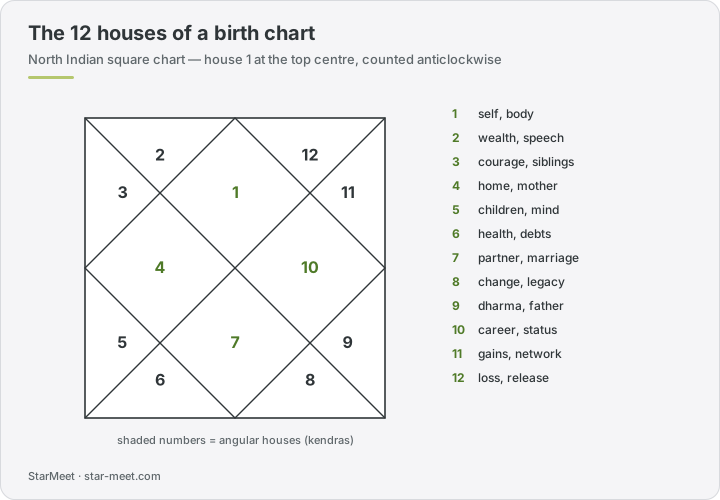
The 12 houses in a natal chart represent the specific, tangible arenas of life where your psychological drives play out. If the planets are the actors and the signs are the costumes, the houses are the actual stages where the drama unfolds. The exact moment of your birth dictates the alignment of these houses, which is why precision is paramount. Each house governs distinct themes, from your finances and daily routines to your deepest subconscious fears and career trajectories.
Understanding the houses allows you to localize your psychological blocks. You might have excellent communication skills (a strong Mercury), but if that planet is trapped in the 12th house of isolation and hidden enemies, you will likely experience intense social anxiety or a feeling of being unheard. This localized diagnosis is critical for effective therapy. Instead of treating a general feeling of career dissatisfaction, analyzing the 10th house reveals the specific structural blockages preventing your advancement. It provides the "where," allowing psychological protocols like CBT to provide the "how to fix it."
-
1st House: Identity, appearance, the social mask.
-
4th House: Psychological roots, family conditioning, the private self.
-
7th House: One-on-one partnerships, marriage, projected shadows.
-
10th House: Career, public reputation, ultimate life goals.
-
12th House: The subconscious, hidden traumas, isolation, self-undoing.
natal chart aspects explained
Aspects are the mathematical angles formed between planets in your chart, representing the complex psychological dialogue occurring within your mind. When two planets interact based on the degrees apart they sit on the 360-degree wheel, they create specific energetic frequencies. The five major aspects dictate whether these psychological drives cooperate smoothly or clash violently. When planets are in the same sign or the same degree, they form a conjunction, intensely blending their energies.
Understanding these angles is the key to mastering your energetic blueprint. When planets occupy the same element, they often form a grand trine, a powerful aspect pattern indicating innate talents and flowing energy. However, it is the challenging aspects—like squares (90 degrees apart) and oppositions (180 degrees apart)—that require the most attention. These challenging aspects create severe internal friction, often manifesting as recurring life crises, burnout, or generalized anxiety. Traditional astrology might label these as "bad luck," but psycho-astrology views them as critical developmental tension. This friction highlights exactly where your cognitive distortions live. By identifying these clashes, you can deploy targeted clinical protocols to resolve the internal conflict, turning a crippling psychological block into your greatest source of resilient power.
how accurate is a birth chart
The accuracy of a birth chart is absolute in terms of mathematical astronomy; it maps the precise location of celestial bodies at your birth. However, the true accuracy of the interpretation depends entirely on the methodology applied. A chart read through the lens of generic, fatalistic fortune-telling is wildly inaccurate and psychologically damaging. It strips you of agency. Conversely, a chart analyzed as a complex diagnostic matrix, mapping your subconscious architecture, is profoundly accurate and clinically actionable.
This is where the synthesis of technology and psycho-astrology changes the game. Human analysts often introduce their own biases, but advanced AI engines process the mathematical data flawlessly, instantly cross-referencing your astrological blueprint with validated clinical psychology frameworks. When you combine the precise mapping of your planetary tension points with the structured interventions of modern therapy, the accuracy translates directly into rapid, tangible behavioral shifts.
FAQ
what does a natal chart tell you? A natal chart tells you the exact structural layout of your personality, highlighting your core motivations, subconscious fears, relationship patterns, and career potential based on the planetary positions at your birth.
how to interpret natal chart planets? You interpret planets by viewing them as psychological drives. For example, Venus represents your attachment style and values, while Mars dictates your aggression and drive. You look at which zodiac sign modifies their expression.
birth chart meaning explained? The meaning of a birth chart lies in its function as a diagnostic tool. It maps the celestial energies present at your birth, serving as a mirror for your internal psychological architecture and life trajectory.
what is the difference between a sun sign and a rising sign? Your sun sign represents your core ego and conscious identity, while your rising sign (Ascendant) dictates the outward mask you wear and how others initially perceive you.
how do challenging aspects affect me? Challenging aspects, such as squares or oppositions between planets, create internal friction. This friction often manifests as psychological blocks or recurring life crises, but it also provides the necessary tension for massive personal growth.
The Ultimate Synthesis: Fix the Root Cause with StarMeet
Generic astrology tells you that you are blocked. Standard therapy takes months to locate the blockage. You do not have the time or energy to waste on fragmented solutions.
StarMeet is the only platform that instantly synthesizes modern psycho-astrology with clinical psychology. Driven by the Gemini 3.8 Flash engine, StarMeet calculates your exact natal chart, pinpoints your structural tension points (like difficult Saturn transits or 12th house blocks), and immediately deploys targeted therapeutic protocols (CBT, Schema Therapy) to fix them. With over 40 validated scientific tests and an integrated private AI-therapy chat, you get the blueprint of your subconscious and the exact tools to rewire it, all in one place.
Stop guessing why you are stuck. Map your psyche. Break the loop.
Reading the basics of your birth chart gives you clarity, but seeing the full scope of your placements changes everything.
The StarMeet AI Astrologer reads your entire chart instead of surface-level summaries. In addition to your primary birth chart, it evaluates 20 divisional layers from Eastern astrology along with special ascendants—analyzing 24 charts and hundreds of planetary combinations in full context.
Get clear timing insights through planetary periods and current Saturn and Jupiter transits. Get concrete answers on relationship compatibility, high-probability dates to act, the year ahead, and core natal strengths. Toggle between Western tropical and Eastern sidereal traditions anytime inside the chat.
Generate your complete chart directly on the page as a guest, entirely free with no account setup.
🎁 SPECIAL OFFER: Your First Month of Premium for $1. 🔒 100% Safe: Cancel in 1 click, anytime.
Want to explore the deeper layers of your natal chart right now? 👇 Explore Your Free Complete Chart Reading
Frequently Asked Questions
what does a natal chart tell you?
A natal chart tells you the exact structural layout of your personality, highlighting your core motivations, subconscious fears, relationship patterns, and career potential based on the planetary positions at your birth.
how to interpret natal chart planets?
You interpret planets by viewing them as psychological drives. For example, Venus represents your attachment style and values, while Mars dictates your aggression and drive. You look at which zodiac sign modifies their expression.
birth chart meaning explained?
The meaning of a birth chart lies in its function as a diagnostic tool. It maps the celestial energies present at your birth, serving as a mirror for your internal psychological architecture and life trajectory.
what is the difference between a sun sign and a rising sign?
Your sun sign represents your core ego and conscious identity, while your rising sign (Ascendant) dictates the outward mask you wear and how others initially perceive you.
how do challenging aspects affect me?
Challenging aspects, such as squares or oppositions between planets, create internal friction. This friction often manifests as psychological blocks or recurring life crises, but it also provides the necessary tension for massive personal growth.
About the author
Vadim Arkhipov
Founder of StarMeet. Student of Jyotish since 2013, having completed an advanced course under Dr. K.N. Rao; 30+ years in business. Articles here are written to my brief, drafted with AI assistance and edited by me before publishing.
Profile, expertise and all articles →Related Articles
Free Birth Chart Calculator: Your Complete Guide to Natal Charts
Calculate your free birth chart online instantly. Our Eastern Astrology calculator reveals planetary positions, houses, nakshatras, and dasha periods. No signup required.
JyotishSun, Moon and Rising: What Your Big Three Really Mean
Discover the psychological and astrological meaning of your Big Three. Learn the difference between Sun, Moon, and Rising signs and how to map your mental architecture.
JyotishRising Sign (Ascendant): What It Means and Why It Matters
Discover what a rising sign is, why exact birth time is essential, how the Ascendant shapes first impressions and sets up your natal chart houses.
Jyotish