Fear of Abandonment: Self-Check and What the Answers Mean
Contents
Fear of Abandonment: Self-Check and What the Answers Mean
A fear of abandonment is an involuntary psychological and neurobiological threat response where a person perceives emotional distance, routine independence, or delayed communication as imminent relational loss. It is rooted in an anxious attachment style, characterized by a hyperactivated nervous system that constantly scans for rejection and demands urgent proximity to restore emotional safety.
What you will learn from this article:
-
🧠 The Diagnostic Self-Check: How to identify your specific attachment style score and interpret reassurance hypersensitivity.
-
💼 The Root Mechanism: How inconsistent childhood attunement and natal chart tension (such as Saturn or 12th House transits) trigger chronic relationship panic.
-
✨ The Clinical Recovery Blueprint: Why surface coping mechanisms fail and how evidence-based AI therapy matches your symptoms to structured 6–8 session protocols.
You send a text message. Thirty minutes pass without a reply. You notice they were active on social media ten minutes ago. Your chest tightens, your heart rate accelerates, and your stomach drops into an icy knot. Your mind immediately crafts catastrophic scenarios: They are losing interest. They are pulling away. I did something wrong.
When they finally reply with a neutral message, the relief is brief. Within hours, the internal surveillance resumes. You are physically exhausted from policing micro-expressions, analyzing tone changes, and managing a constant fear of being left behind. In this article, we explain why this happens and how to reclaim your energy.
What are the Core Signs of Anxious Attachment?
An anxious attachment style is an insecure attachment pattern where an individual experiences chronic anxiety regarding their partner's availability, love, and commitment. Co-developed by John Bowlby and expanded by Mary Ainsworth in their foundational attachment theory, this pattern manifests as an over-reliance on external connection to regulate internal self-worth.
When your attachment system is chronically hyperactivated, relationship dynamics feel like matter-of-life-and-death stakes. You do not just prefer closeness; your nervous system interprets relational space as an immediate survival threat.
-
Reassurance Hypersensitivity: Constantly asking "Are we okay?" or seeking verbal proof of affection because internal certainty fades minutes after reassurance is given.
-
Hyper-Vigilant Micro-Tracking: Monitoring your partner's tone of voice, texting speed, punctuation changes, or physical posture for signs of withdrawal.
-
Protest Behavior: Calling repeatedly, sending walls of text, weaponizing guilt, or giving silent treatment to force an immediate emotional reaction from a partner who is shutting down.
-
Over-Functioning and People-Pleasing: Sacrificing your own boundaries, physical health, and personal goals to keep the peace and remain indispensable.
-
Eradication of Personal Autonomy: Feeling unable to enjoy hobbies, work, or social connections when there is unresolved tension in your relationship.
Fear of Abandonment Test: Quick Self-Assessment
A fear of abandonment test is a structured self assessment diagnostic tool that measures relational anxiety, dependency levels, and rejection sensitivity against validated clinical metrics like the Experiences in Close Relationships-Revised (ECR-R) scale.
Score yourself on each statement using a scale from 1 (Strongly Disagree) to 5 (Strongly Agree):
-
I worry that romantic partners will stop loving me or find someone better.
-
I need a lot of reassurance that I am loved and valued by my partner.
-
When someone I care about seems distant, I immediately assume I did something wrong.
-
I feel immense panic or physical distress when a partner does not respond quickly.
-
I often hide my true feelings or boundaries to prevent people from walking away.
-
My self-worth fluctuates directly based on the emotional temperature of my relationship.
-
I find myself holding back my authentic needs because I fear being labeled "too needy."
Total Score Interpretation: 7 – 15 : Secure Baseline (Low abandonment anxiety; resilient emotional regulation) 16 – 26 : Moderate Anxious Attachment (Situational panic, hyper-fixation during conflict) 27 – 35 : Severe Anxious Preoccupied Attachment (Chronic system dysregulation, relational exhaustion)
If your score falls in the moderate or severe range, this assessment helps illuminate why daily life feels draining. Rather than a personal flaw, this score indicates an overactive threat response wired to defend against sudden separation.
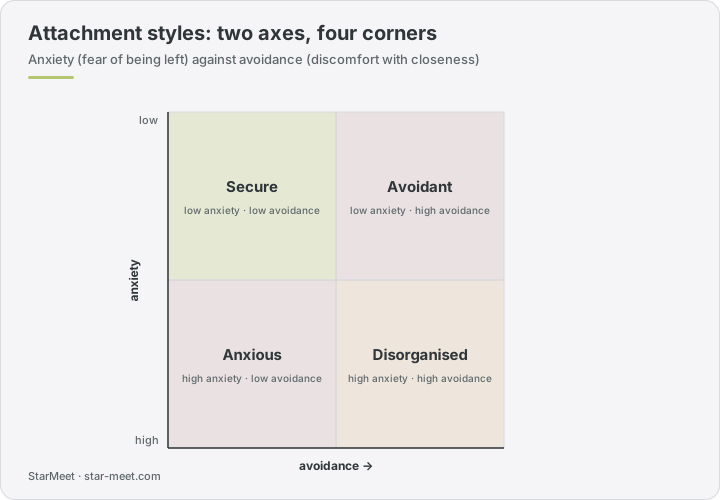
How Does Anxious Preoccupied Attachment Compare to Fearful Avoidant Attachment?
Attachment styles are categorized frameworks that describe the distinct psychological patterns people use to bond, communicate, and manage emotional intimacy in relationships. While all insecure attachment stems from inconsistent early bonding, the behavioral adaptations diverge significantly.
Anxious preoccupied attachment directs all energy toward seeking proximity and reassurance. In contrast, fearful avoidant attachment (also known as disorganized attachment) traps the individual in a push-pull loop: they crave deep emotional intimacy but become terrified and reactive when closeness is achieved.
Diagnostic DimensionSecure AttachmentAnxious Preoccupied AttachmentAvoidant Attachers (Dismissive)Fearful Avoidant Attachment (Disorganized)
Core FearLoss of personal integrityAbandonment, rejection, silenceLoss of autonomy, emotional controlBetrayal, engulfment, and abandonment
Primary Coping StanceOpen communication, self-soothingHyper-activation, protest behaviorDe-activation, shutting downChaotic cycles of clinging and fleeing
View of Self vs. OtherPositive Self / Positive OtherNegative Self / Positive OtherPositive Self / Negative OtherNegative Self / Negative Other
Conflict ResponseCollaborative resolutionDemands immediate answersWithdraws and avoids contactExplosive conflict followed by flight
Reassurance NeedBaseline trust presentConstant external validationRejects emotional validationDesires reassurance, then distrusts it
The Psychological Mechanism: Why Your Nervous System Triggers Panic
The psychological root of abandonment anxiety is an adaptive survival mechanism developed in response to unpredictable emotional attunement during early developmental stages. When primary caregivers provide love intermittently—warm and attentive one day, distant or overwhelmed the next—the infant brain learns that connection is unstable.
To prevent abandonment, the child's psyche develops hyper-activating strategies. In adulthood, this manifests as an overactive amygdala that treats neutral relational cues as life-threatening emergencies.
In adult life, this wiring creates cognitive distortions:
-
Catastrophizing: Converting a delayed text into an absolute conviction that a breakup is imminent.
-
Mind Reading: Assuming you know a partner's unspoken thoughts without asking for clarification.
-
Emotional Reasoning: Believing that because you feel unsafe, the relationship itself must be objectively dangerous.
This dynamic becomes toxic when paired with avoidant attachers. The anxious partner pursues; the avoidant partner feels overwhelmed and retreats; the retreat triggers deeper panic in the anxious partner. This cycle drains emotional reserves and reinforces the belief that abandonment is inevitable.
The Astrological Architecture: Mapping Vulnerability in the Natal Chart
A natal chart is an astronomical map of the sky at the exact moment of birth, serving as a psycho-energetic blueprint that outlines psychological predispositions, core wounds, and structural tensions.
Where clinical psychology diagnoses behavioral symptoms, psychological astrology identifies the underlying architecture of where tension lives and when it activates.
[ 12th House: Unconscious / Repression ]
- ▲
- (Tension / Square)
- (Opposition)
-
Chiron in the 4th or 7th House: Highlights foundational emotional wounds regarding belonging, family safety, or committed partnerships, creating an instinctual expectation of rejection.
-
Hard Moon-Saturn Aspects (Squares or Oppositions): Signifies an internalized feeling of emotional deprivation, where emotional expression was historically met with coldness or duty rather than warmth.
-
Planetary Transits of Saturn: When Saturn transits your 7th House of partnerships or forms hard aspects to your natal Moon or Venus, emotional security is tested. These transits act as developmental trials, forcing you to confront codependency and build internal stability.
-
The 12th House Activations: Planets in the 12th House represent subconscious patterns and repressed grief. Transits here illuminate unacknowledged fears of isolation that drive compensatory clinginess.
Why Common Workarounds Fail to Heal Abandonment Anxiety
When abandonment panic strikes, most people resort to quick-fix survival strategies. These workarounds drain mental energy without repairing the underlying attachment system:
-
Motivational Self-Help Books and Affirmations: Repeating "I am worthy" does not calm an amygdala that is actively firing panic signals down the vagus nerve.
-
Emotional Suppression: Attempting to act "chill" or detached forces anxiety into somatic symptoms—muscle tension, insomnia, digestive distress, and sudden emotional outbursts.
-
Passive Astrological fatalism: Consulting traditional fortune-telling sources that declare "you have a difficult 7th house and are destined for heartbreak" provides zero actionable, therapeutic tools for change.
-
Support Group Overload: Venting endlessly in unmoderated forums without structured cognitive protocols frequently reinforces victim narratives and heightens emotional distress.
How to Heal Anxious Attachment: The Integrated Clinical Pathway
Healing an anxious attachment style requires shifting from an externalized focus on your partner's behavior to an internal foundation of self-regulation and cognitive reframing.
Clinical recovery relies on evidence-based modalities:
-
Cognitive Behavioral Therapy (CBT): Identifies automatic negative thoughts, halts catastrophic cognitive spirals, and tests reality against objective facts.
-
Schema Therapy: Directly addresses the "Abandonment/Instability" schema, teaching you to heal vulnerable inner child states while strengthening your healthy adult mode.
-
Somatic De-escalation: Regulates the vagus nerve through paced respiration and grounding exercises to lower physiological arousal before responding to relational triggers.
Frequently Asked Questions
Why do I get jealous in relationships?
Relationship jealousy is an involuntary threat response triggered by a hyperactive attachment system. When you lack internal emotional security, any external interest your partner has—work, friends, hobbies—is misperceived as a threat to your connection, triggering defensive panic.
Clingy in relationships: how to stop?
To stop clingy behavior, practice the "Pause and Reality Check" protocol: when you feel the urge to send multiple texts or demand reassurance, set a 20-minute timer. Engage in somatic grounding to calm your nervous system, evaluate whether an actual boundary was crossed, and respond from logic rather than emotional panic.
Why do I constantly need reassurance from my partner?
A constant need for reassurance indicates that your internal self-validation mechanisms are offline. Because you struggle to hold an internal sense of being loved when your partner is physically or emotionally occupied, you rely on constant real-time feedback to feel secure.
What is anxious avoidant attachment style?
An anxious avoidant attachment style (often used interchangeably with fearful-avoidant) describes an insecure attachment pattern where an individual experiences high anxiety and high avoidance simultaneously. They crave closeness but sabotage relationships as soon as real vulnerability is required.
Can an anxious relationship pattern become secure?
Yes. Through "earned security," individuals can reprogram attachment patterns by combining cognitive behavioral interventions, somatic nervous system work, and consistent relational boundary practices over a structured 6–8 session therapeutic arc.
Stop Living in Relationship Panic: Meet StarMeet
Reading articles offers insight, but intellectual understanding alone does not rewire an active nervous system panic loop.
StarMeet delivers an integrated self-discovery and AI-therapy platform. By synthesizing over 40 validated psychological diagnostics (including the ECR-R attachment scale, Jungian Archetypes, and Burnout metrics) with precise Western Psycho-Astrology (natal chart dynamics, house activations, and Saturn transits), StarMeet pinpoints both the blueprint of your emotional blocks and the exact clinical tools to resolve them.
Powered by the Gemini 3.8 Flash engine for real-time conversational processing—with the option to switch to Gemini 3.1 Pro for deep, complex psychological reasoning—StarMeet eliminates the guesswork. You never have to guess which therapeutic approach fits your situation.
Describe what you are experiencing in plain language inside the private chat. StarMeet analyzes your symptoms, generates your Shadow Trigger Index, and matches your issue to an evidence-based clinical protocol (CBT, Schema Therapy, or Somatic grounding). It then guides you step-by-step through a structured 6–8 session course, taking you one layer deeper each session.
-
📊 Complete Psychological Profile: Get a multi-dimensional diagnostic assessment evaluating your attachment anxiety, defense mechanisms, and subconscious patterns.
-
🌌 Astrological Root Analysis: Discover which planetary placements and active transits are surfacing your relational fears.
-
🛠 Actionable Therapy Sessions: Receive concrete, daily behavioral exercises designed to build earned secure attachment.
👉 Start Your Free Relational Attachment Self-Assessment on StarMeet
🎁 SPECIAL OFFER: Your First Month of Premium for $1.
🔒 100% Safe: Cancel in 1 click, anytime.
About the author
Vadim Arkhipov
Founder of StarMeet. Student of Jyotish since 2013, having completed an advanced course under Dr. K.N. Rao; 30+ years in business. Articles here are written to my brief, drafted with AI assistance and edited by me before publishing.
Profile, expertise and all articles →Related Articles
Anxious Attachment Style: Signs, Causes, and What Actually Helps
Discover the signs and root causes of an anxious attachment style, understand the underlying nervous system activation, and learn proven paths to earned security.
PsychologyAttachment Style Test: Free, Research-Based, 5 Minutes
Stop guessing why your relationships fail. Take the free 5-minute ECR-R attachment style test to find out if you are secure, anxious, avoidant, or disorganized, and map your emotional blueprint.
PsychologyHow to Heal Anxious Attachment: Self-Soothing That Actually Works
Learn actionable, somatic self-soothing techniques to heal anxious attachment, stop reassurance seeking, and transition to earned secure attachment.
Psychology