Putra Bhava: 5th House in Eastern Astrology — Complete Guide
Contents
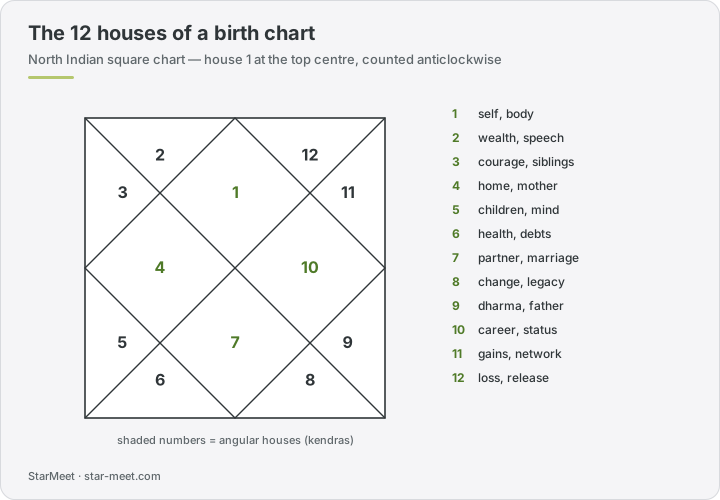
The 5th house in Eastern astrology (also called Vedic astrology, or Jyotish) — Putra Bhava — governs children, intelligence, creative gifts, past-life merit (Purva Punya), speculative investments, and mantra siddhi. It is ruled by Leo in the natural zodiac and co-signified by Jupiter, the karaka of progeny and wisdom.
No other house spans such an arc — from literal children to spiritual merit accumulated across lifetimes. This is why ancient Jyotishis called it by many names, each illuminating a different dimension of the same profound reality.
This complete guide draws from Brihat Parashara Hora Shastra (BPHS), B.V. Raman's How to Judge a Horoscope, P.V.R. Narasimha Rao's lectures (176–181), K.S. Charak, and Jatakalankara. Every dimension of the 5th house — from Purva Punya to the D7 Saptamsha chart, from planet-by-planet analysis to all 12 placements of the 5th lord — is covered completely.
Discover your 5th house placement →
Key Takeaways
- The 5th house is Purva Punya Bhava — your reservoir of merit from previous lives, expressed as innate intelligence and talent
- Jupiter is the natural significator (Putra-Karaka) — but Jupiter in the 5th can delay children via Karako Bhava Nashaya
- The D7 Saptamsha divisional chart is the primary tool for analyzing children, with Narasimha Rao's odd/even Lagna method for accurate reading
- The Dharma trikona (1-5-9) is the most powerful yoga-generating triad; 5th lord connecting to 1st or 9th lord creates Raja Yogas
- The 5-9-11 triad is the classical formula for successful investors and speculators
- The 5th house governs romantic love (Prem) — distinct from marriage (7th house)
- The 5th is Mantra-Sthana: all mantra practice directly strengthens this house and reveals the Ishta-Devata
What Is Putra Bhava? Sanskrit Names, Classification, and Significations
The Sanskrit Names of the 5th House: A Map of Its Meaning
Each Sanskrit name of the 5th house is a doorway into its essential meaning:
| Sanskrit Name | Translation | What It Reveals | Source |
|---|---|---|---|
| Putra Bhava | House of Children/Sons | Physical and creative progeny | BPHS |
| Purva Punya Bhava | House of Merit from Past Lives | Soul-purpose inheritance as talent and luck | BPHS |
| Buddhi Sthana | House of Intelligence | Natural intellect, cognitive quality | Raman |
| Vidya Sthana | House of Knowledge | Classical learning, skill acquisition | Charak |
| Aatmaja Bhava | House of the Soul's Creation | Children as continuation of the soul | Jatakalankara |
| Tanaya Bhava | House of Offspring | All forms of progeny — physical, creative, intellectual | BPHS |
| Mantra Sthana | House of Sacred Mantras | Mantra capacity, Ishta-Devata, ritual potency | Narasimha Rao |
The 5th House in the Dharma Trikona (1-5-9): Why It Generates Raja Yogas
The 5th house is the middle pillar of the Dharma trikona — the triangle of righteousness formed by houses 1, 5, and 9. According to BPHS, connections between the lords of any two Dharma houses automatically create Raja Yogas (combinations for power and success). This makes the 5th lord uniquely powerful: any mutual connection with the Lagna lord (1st) or the Bhagya lord (9th) elevates the entire chart.
The 5th is simultaneously one of the Lakshmi Sthanas (houses 2, 5, 9, 11) — the quarters of Lakshmi, goddess of prosperity. This dual membership in both the Dharma trikona and the Lakshmi sthanas explains why a strong 5th house correlates so consistently with both spiritual merit and material good fortune.
The Complete Karakatva List According to BPHS and B.V. Raman
| Karakatva (Signification) | Sanskrit Term | Connection to Other 5th House Themes |
|---|---|---|
| Children | Putra | Purva Punya manifests as progeny |
| Intelligence | Buddhi | The quality of mind inherited across lifetimes |
| Creativity and Arts | Kala | Purva Punya expressed as talent |
| Romance and Love Affairs | Prem | Joy and emotional play before commitment |
| Speculation and Investments | Purva Punya + Risk | Past-life skill applied to financial risk |
| Mantras and Spiritual Practice | Mantra | Concentration capacity from Purva Punya |
| Stomach and upper digestive system | Udara | Physical seat of the fire of intelligence |
| Past-life Merit | Purva Punya | The root cause of all 5th house blessings |
| Ishta-Devata (Chosen Deity) | Aradhya | The deity who protects your destiny |
| Sports, Games, Play | Krida | Recreational expression of creative energy |
| Disciples and Students | Shishya | Extension of the self through teaching |
Jupiter as Natural Significator (Putra-Karaka): The Karako Bhava Nashaya Principle
Jupiter is the Putra-Karaka — the natural significator of children. This creates the famous Karako Bhava Nashaya paradox: "the significator placed in the house of its signification destroys that signification." When Jupiter occupies the 5th house, it can delay or reduce children, even though (or precisely because) it is the most powerful planet for 5th house matters.
B.V. Raman writes that the Karako Bhava Nashaya principle requires full chart analysis — it is not absolute. A powerful Jupiter in the 5th in its own sign (Sagittarius or Pisces) or exaltation (Cancer) may overcome this tendency. The key is the overall Purva Punya balance in the chart.
Purva Punya: The Destiny of Past Lives Encoded in the 5th House
What Is Purva Punya? Definition in Classical Jyotish
"Purva Punya is the accumulated merit of righteous actions performed in past lives. It is deposited in the 5th house of the current birth chart, where it manifests as innate intelligence, natural talents, creative gifts, and the general grace with which life unfolds for the native." — P.V.R. Narasimha Rao, Lecture 176
Purva Punya distinguishes what you earned (through spiritual effort across lifetimes) from what you merely receive (through external luck). It is the most fundamental explanation in classical Jyotish for why some people seem gifted from birth while others must work laboriously for the same results.
Punya vs Papa: Where Past Merit and Past Sin Show in the Chart
The 5th house shows Punya (merit) — the positive soul-purpose balance. The 6th house immediately following shows Papa (sin) — the debts. A strong, well-aspected 5th house with benefics indicates the native arrives with a full account of Purva Punya. A heavily afflicted 5th (especially by Rahu, Saturn, or malefic 5th lord in Dusthanas) indicates the Punya account is thin, requiring rebuilding through conscious spiritual practice in this lifetime.
How to Read Purva Punya: The 5th House, 5th Lord, and Jupiter
| Planet in 5th or Influencing 5th | Purva Punya Meaning (Past Destiny) | Classical Source |
|---|---|---|
| Sun | Leadership, royal service, government in past lives | BPHS |
| Moon | Nurturing, devotion, service to women and mothers | Raman |
| Mars | Courage, protection, military or warrior destiny | BPHS |
| Mercury | Teaching, writing, trade, intellectual service | Charak |
| Jupiter | Priesthood, Eastern study, teaching, charitable giving | BPHS |
| Venus | Artistic service, beauty, luxury — and sometimes indulgence | Raman |
| Saturn | Hard labor, justice, service to the poor — with soul-purpose delays | BPHS |
| Rahu | Unconventional past, foreign contexts, crossing boundaries | Narasimha Rao |
| Ketu | Deep spiritual practice, renunciation, moksha orientation | Narasimha Rao |
Purva Punya and Natural Intelligence: Why Genius Is a Soul-purpose Achievement
P.V.R. Narasimha Rao makes a counterintuitive observation: exceptional natural intelligence is not a random gift but the direct expression of Purva Punya. The child prodigy, the mathematical genius, the naturally eloquent speaker — all are drawing on accounts of Purva Punya filled through lifetimes of disciplined intellectual or spiritual practice. This is why Jyotish evaluates intelligence not just from Mercury (the processor) but from the 5th house (the accumulated software).
Atmakara and the 5th House: P.V.R. Narasimha Rao's Advanced Method
The Atmakara (the planet with the highest degree in D1) represents the soul's primary evolutionary agenda. When the Atmakara is placed in the 5th house, or when the 5th lord is the Atmakara, the soul has chosen this lifetime to work specifically on the themes of intelligence, creativity, and progeny. According to Narasimha Rao, such natives typically have a deep spiritual purpose connected to teaching, artistic expression, or raising exceptional children.
Children (Putra): Conception, Birth, and the D7 Saptamsha Chart
Classical Rules for Children According to BPHS
According to BPHS, the analysis of children requires examining:
- 5th house — its sign, occupying planets, and aspects received
- 5th lord — its dignity (own sign, exaltation vs debilitation), house placement, and aspects
- Jupiter as Putra-Karaka — its strength, sign, and relationship with the 5th
When the 5th lord is in a Kendra (1st, 4th, 7th, 10th) or Trikona (1st, 5th, 9th) in good dignity, children come with relative ease. When the 5th lord is in a Dusthana (6th, 8th, 12th), children may be delayed, reduced, or come with complications. BPHS specifically notes: "If benefics occupy or aspect the 5th house, the native will have many children; if malefics alone occupy or aspect it without benefic influence, few or no children result."
Jupiter in the 5th House: The Karako Bhava Nashaya Paradox
The classical principle states: "Karako Bhava Nashaya" — the significator harms its own house when placed there. Jupiter (Putra-Karaka) in the 5th can delay children, particularly when aspected by malefics. However, Jupiter in the 5th simultaneously gives:
- Exceptional Purva Punya and philosophical wisdom
- Natural Guru-like intelligence and teaching ability
- Strong capacity for mantra and ritual practice
- Children who, when they do arrive, are often intellectually gifted
Saturn, Rahu, and Ketu in the 5th: What BPHS Says About Delays
BPHS gives specific warnings about malefics in the 5th:
- Saturn in the 5th: Delays children significantly; the native may adopt or have children late in life; causes miscarriages or difficulty conceiving
- Rahu in the 5th: Irregular or troubled pregnancy; possible adoption; children from foreign connections; unconventional parenting experiences
- Ketu in the 5th: Spiritual rather than physical progeny; fewer biological children; children with spiritual or unusual characteristics; strong spiritual Purva Punya
D7 Saptamsha — The Divisional Chart for Children: Full Methodology
The D7 Saptamsha is the principal divisional (Varga) chart for analyzing children in depth. P.V.R. Narasimha Rao's method:
Step 1 — Determine Lagna parity:
- Odd Lagnas (Aries, Gemini, Leo, Libra, Sagittarius, Aquarius): Count Saptamsha divisions forward from the beginning of the sign
- Even Lagnas (Taurus, Cancer, Virgo, Scorpio, Capricorn, Pisces): Count Saptamsha divisions alternately — forward for the 1st subdivision, backward for the 2nd, and so on
Step 2 — Map children to houses:
- 5th house of D7 = 1st child
- 7th house of D7 = 2nd child
- 9th house of D7 = 3rd child (continues by odd houses)
Step 3 — Determine gender:
- Masculine planets (Sun, Mars, Jupiter) dominating the relevant house → male child likely
- Feminine planets (Moon, Venus) or Mercury (neutral) → female child likely
Step 4 — Resolve D1 vs D7 contradictions: When D1 shows good prospects for children but D7 shows affliction (or vice versa), Narasimha Rao's rule is: D7 represents the actual manifestation. D1 may show the native's desire and potential; D7 shows what physically manifests in reality. Both must show agreement for confident predictions.
Timing the Birth of Children: Jupiter Transits and Vimshottari Dasha
Classical timing combines two methods:
- Transit of Jupiter: Jupiter's transit over the 5th house, 5th lord, or natal Jupiter — particularly when Jupiter also aspects the Ascendant — is the most reliable transit indicator for childbirth
- Vimshottari Dasha: The dasha of the 5th lord, or the antardasha of Jupiter within any main period, opens windows for conception and birth
Childlessness (Nirputra): Classical Indicators and Remedies
BPHS describes Nirputra Yoga (childlessness combinations) when:
- The 5th lord is in a Dusthana, debilitated, and without aspect from benefics
- Both Jupiter and the 5th house are severely afflicted
- Saturn and Rahu jointly occupy or aspect the 5th without any benefic relief
Classical remedies: Putra Kameshti yajna; adoption (Dattak-Putra) is specifically endorsed in BPHS as spiritually equivalent to biological children; Jupiter worship (Guru Puja) on Thursdays; chanting of Santana Gopala mantra.
Natural Intelligence: Buddhi, Medha Shakti, and the Types of Mind
The Four Aspects of Mind in Eastern Psychology
Classical Jyotish does not treat "mind" as a single entity. The Antahkarana (inner instrument) has four distinct faculties:
| Sanskrit Term | Faculty | House/Planet in the Chart |
|---|---|---|
| Manas | Reactive mind, emotion, immediate response | Moon, 4th house |
| Buddhi | Discriminative intelligence, judgment | 5th house |
| Chitta | Stored impressions, memory, subconscious | 4th house, Moon |
| Ahamkara | Ego, identity, sense of "I" | Sun, Ascendant |
Why the 5th House Is Intelligence — Not Mercury and Not the 9th House
P.V.R. Narasimha Rao makes the distinction explicit:
- Mercury = the processor — speed of thought, communication, data handling
- 5th house = the software — the quality and depth of intelligence itself (Buddhi)
- 9th house = the university — formal higher education, philosophy, spiritual teaching from Guru
A person can have excellent Mercury (sharp, fast thinking) but weak 5th house (shallow judgment). Conversely, a strong 5th with weak Mercury produces someone whose intelligence is deep but communication is labored. True brilliance requires both.
Planets in the 5th House and the Type of Intellect
| Planet in 5th | Type of Buddhi | Strengths | Weaknesses |
|---|---|---|---|
| Sun | Royal, leadership-oriented | Strategic thinking, natural authority | Ego interference, pride |
| Moon | Intuitive, emotional | Empathic intelligence, creativity | Fluctuating, moody |
| Mars | Sharp, decisive | Technical problem-solving, engineering | Hasty, argumentative |
| Mercury | Analytical, versatile | Multi-domain intelligence, Budhaditya Yoga | Can be shallow |
| Jupiter | Philosophical, expansive | Wisdom, holistic understanding | Can be impractical |
| Venus | Aesthetic, relational | Artistic intelligence, social awareness | Pleasure-seeking |
| Saturn | Systematic, disciplined | Long-term thinking, research | Slow, pessimistic |
| Rahu | Innovative, unconventional | Out-of-box ideas, technology | Confused values |
| Ketu | Mystical, penetrating | Past-life intuition, spiritual depth | Detached, impractical |
Raja Yogas for Exceptional Intelligence Involving the 5th House
- Gaja-Kesari Yoga: Jupiter and Moon in mutual Kendra (1/4/7/10 from each other) — gives elephant-like memory and lion-like confidence; most powerful when the 5th is involved
- Budhaditya Yoga: Sun and Mercury conjunct in the 5th — gives sharp, communicative, government-favored intelligence (particularly powerful for writing and public speaking)
- Saraswati Yoga: Venus, Mercury, and Jupiter all in Kendra, Trikona, or the 2nd house — goddess of learning blesses the native with multi-domain mastery
- Pancha Mahapurusha Yoga: When Mars, Mercury, Jupiter, Venus, or Saturn occupies its own or exaltation sign in a Kendra — creates an exceptional type of intelligence specific to that planet's domain
Creativity, Art, Romance, and Sport: Purva Punya in Action
Creativity as the Direct Expression of Purva Punya
B.V. Raman writes: "The 5th house rules creative intelligence — the ability to bring something new into existence. This creative capacity is itself the flowering of Purva Punya, the merit earned through dedicated creative practice in previous lives." The artist who creates effortlessly, the musician who plays by feel, the writer who channels story — all are drawing on Purva Punya accounts established across multiple incarnations.
Art and Artistic Talent: Which Planet Gives Which Art Form
| Planet in or Influencing the 5th | Art Form | Notes |
|---|---|---|
| Sun | Drama, theatre, performance, royal arts | Natural stage presence |
| Moon | Music (vocal), poetry, dance, storytelling | Emotional resonance |
| Mars | Martial arts, sculpture, percussion, sports | Physical precision |
| Mercury | Writing, comedy, oratory, multi-media | Speed and wit |
| Jupiter | Classical music, philosophy, sacred arts | Depth and wisdom |
| Venus | Fine arts, luxury crafts, cinema, fashion | Beauty and refinement |
| Saturn | Folk art, architecture, discipline-heavy crafts | Longevity and structure |
| Rahu | Digital art, experimental, cross-cultural fusion | Innovation and shock |
| Ketu | Mystical art, abstract, spiritual music | Otherworldly quality |
Romance and Falling in Love (Prem): The 5th House, Not the 7th
"Jyotish makes a strict distinction: the 5th house rules romantic love — the falling-in-love experience, courtship, and the joy of the heart before formal commitment. The 7th house rules legal marriage — the contract, the partnership, and long-term bonding." — P.V.R. Narasimha Rao
Love marriage combination: When the 5th lord is placed in the 7th house, or the 7th lord is placed in the 5th house, or when these lords are conjunct — the romantic feeling (5th) naturally and organically transitions into formal marriage (7th). B.V. Raman identifies this as one of the most reliable classical indicators of love marriage.
The quality of romance is also shaped by the 5th house:
- Sun in 5th: Romantic attraction to authority and confidence
- Venus in 5th: Highly romantic, idealistic, pleasure-loving in courtship
- Mars in 5th: Passionate, direct, sometimes impulsive in love
- Saturn in 5th: Reserved, slow to express, serious about love
Sport, Play, and Recreation: The Inner Child of the Birth Chart
The 5th house governs sport as play and recreation — the domain of enjoyment. For professional sport as a career, the 10th house becomes primary. Classical combinations for athletic ability:
- Mars in 5th: Physical courage, competitive instinct, combat sports
- Sun in 5th: Leadership in team sports, athletics with performance elements
- Mercury in 5th: Speed sports, games of strategy and coordination
- Saturn in 5th: Endurance sports, discipline-heavy training, late bloomer
Investments, Speculation, and Financial Risk: The 5th House Edge
Why the 5th House Rules Speculation: The Purva Punya–Luck Connection
Classical Jyotish places speculation and investment under the 5th house because these activities require a precise combination: analytical intelligence (Buddhi), intuitive risk-reading (Purva Punya), and the willingness to act without certainty. This is exactly the 5th house portfolio. Luck in speculative ventures is, in the Jyotish framework, the direct mobilization of Purva Punya under conditions of risk.
"For successful speculation, a strong connection is required between the 5th lord (risk intelligence), the 11th house (gains), and the 9th house (luck). When all three align, the native naturally makes money through calculated risk." — StarMeet / BPHS
The Four Financial Houses: 2nd, 5th, 8th, 11th — What Each Means
| House | Financial Domain |
|---|---|
| 2nd | Earned wealth, family assets, savings |
| 5th | Speculation, investment, earned by intelligence |
| 8th | Inheritance, windfalls, partner's money, sudden wealth/loss |
| 11th | Gains, income streams, fulfillment of desires |
Planets in the 5th House and Investment Style
| Planet in 5th | Investment Style | Preferred Assets |
|---|---|---|
| Sun | Confident, government-oriented | Blue chips, government bonds |
| Moon | Intuitive, fluctuating | FMCG, real estate, gold |
| Mars | Risk-taking, aggressive | Equities, commodities, real estate |
| Mercury | Analytical, diversified | Tech stocks, multi-asset portfolios |
| Jupiter | Long-term, growth-oriented | Index funds, education sector, gold |
| Venus | Luxury and beauty sectors | Fashion, hospitality, entertainment |
| Saturn | Conservative, disciplined | Value investing, infrastructure, bonds |
| Rahu | Speculative, trend-chasing | Crypto, emerging markets, high-beta |
| Ketu | Detached, intuitive | Minimal assets; sometimes exceptional insight |
Red Flags: When the 5th House Warns Against Speculation
B.V. Raman and BPHS identify combinations that indicate danger in speculation:
- Mars + Rahu in the 5th: Reckless, impulsive speculation — high probability of major losses
- 5th lord in the 6th, 8th, or 12th: Losses through speculation; poor judgment in risk-taking
- Saturn afflicting the 5th without Yoga-karaka status: Delays and chronic losses
- Weak 5th lord + no aspect from Jupiter: Deficient investment intuition
"The 5th lord in the 8th house blocks Purva Punya and may express itself as difficulties with conception or losses in investment — both are manifestations of the same depleted merit." — K.S. Charak / StarMeet
Dhana Yogas for Financial Success Through the 5th House
- Maha-Lakshmi Yoga: 5th lord + 9th lord in mutual Kendra or Trikona — combines Purva Punya with Bhagya for exceptional financial fortune
- 5th lord + 11th lord exchange or conjunction: Speculation leads directly to gains
- Jupiter in the 5th with 9th lord aspecting: Investment intuition supported by cosmic luck
Mantras, All 9 Planets in the 5th House, and the 5th Lord in 12 Houses
The 5th House as Mantra-Sthana: Why It Rules All Mantras
The 5th house is called Mantra-Sthana because mantra practice requires precisely what the 5th provides: Buddhi (discriminating intelligence to understand the mantra), Chitta Shuddhi (purity of mind from Purva Punya), and concentrated devotion to the Ishta-Devata (chosen deity).
"Mantra-Siddhi (perfection in mantra) is determined by the strength of the 5th house — it governs the concentration of consciousness on divine vibrations." — P.V.R. Narasimha Rao / StarMeet
The planet most strongly influencing the 5th house also indicates the Ishta-Devata — the form of the divine most aligned with the native's soul:
- Sun → Vishnu, Rama, or Shiva in solar forms
- Moon → Shiva, Parvati, Durga
- Mars → Hanuman, Subramanya, Durga
- Mercury → Vishnu, Saraswati
- Jupiter → Brahma, Vishnu, Guru tattva
- Venus → Lakshmi, Devi in gentle forms
- Saturn → Shiva, Kali, Shanika
- Rahu → Durga, Kali, or tribal deity
- Ketu → Ganesha, Vishnu, or abstract Brahman
Sun in the 5th House
The Sun in the 5th gives royal confidence and leadership intelligence. Purva Punya indicates past-life service in positions of authority. The native often has strong willpower, creative ambition, and natural authority in group settings. Children may be few but distinguished. Romance has a proud, dramatic quality. Speculation succeeds when guided by strategy rather than ego. Budhaditya Yoga (if Mercury is also present) creates exceptional communicative intelligence.
Moon in the 5th House
The Moon in the 5th gives emotional intelligence and creative fluency. The mind is imaginative, empathic, and highly intuitive. Poetry, music, and storytelling come naturally. Children are often emotionally sensitive. Romance is deeply felt, sometimes idealized. Investments follow intuitive patterns — success when the Moon is waxing and strong. This is one of the classic placements for Gaja-Kesari Yoga when Jupiter is in a Kendra from this Moon.
Mars in the 5th House
Mars in the 5th gives technical intelligence and competitive drive. The native excels in engineering, mathematics, and any domain requiring precision and courage. Children may be assertive or troublesome to manage. Romance is passionate and direct. Risk-taking in investments is natural, sometimes reckless. In classical texts, Mars in the 5th without benefic aspects can indicate pregnancy complications or miscarriages.
Mercury in the 5th House
Mercury in the 5th creates analytical, multi-domain intelligence. The native is quick, versatile, communicative, and naturally drawn to teaching or writing. When the Sun is also in the 5th, Budhaditya Yoga forms — one of the most favorable combinations for intelligence, government favor, and career success through communication. Investment decisions are data-driven and diversified.
Jupiter in the 5th House
Jupiter in the 5th is the Karako Bhava Nashaya placement: exceptional Purva Punya, philosophical wisdom, and natural spiritual intelligence — but potential delay or reduction in biological children. The native is often a natural teacher, philosopher, or spiritual guide. Gaja-Kesari Yoga forms if Moon is in a Kendra from this Jupiter. The soul has deep past-life experience in Eastern study and charitable service.
Venus in the 5th House
Venus in the 5th gives aesthetic intelligence and romantic richness. The native is naturally creative, pleasure-appreciating, and artistically gifted. Romantic life is vibrant and often complex. Children tend to be attractive and culturally refined. Investment favors luxury, beauty, and hospitality sectors. Poetry, fine arts, and cinema are natural domains.
Saturn in the 5th House
Saturn in the 5th is one of the most challenging placements for children (delays, health complications, fewer children) but gives exceptional disciplined, research-oriented intelligence. Purva Punya is present but requires effort to access — like mining for gold. Romance is serious, careful, and late-blooming. Investments succeed through long-term, value-oriented strategies. Mantra practice must be consistent and structured to bear fruit.
Rahu in the 5th House
Rahu in the 5th creates innovative, unconventional intelligence. The native has original ideas that break boundaries but may struggle with conventional learning structures. Purva Punya from past lives involving foreign cultures or taboo-crossing experiences. Children may come from unusual circumstances (adoption, foreign birth, delayed arrival). Speculation is bold and trend-following — can be brilliant or disastrous. Ishta-Devata tends toward fierce goddesses.
Ketu in the 5th House
Ketu in the 5th brings past-life spiritual mastery but creates detachment in current-life 5th house matters. Children may be spiritually inclined or few in number. The native has deep, penetrating intelligence — especially in mystical, philosophical, or technical domains — but may lack continuity of focus. The combination of Mars + Ketu in the 5th is classical for both deep spiritual destiny and potential dangers in pregnancy or childbirth; K.S. Charak notes this as requiring careful remedial attention.
The 5th Lord in All 12 Houses
| 5th Lord In | Intelligence + Children + Creativity + Investments |
|---|---|
| 1st house | Highly intelligent, self-made creative success; children resemble the native; excellent Purva Punya in personal endeavors |
| 2nd house | Wealth through intelligence; teaching family values; children bring financial responsibility; creative talent in writing and speech |
| 3rd house | Intelligence focused on communication, writing, media; children may be separated or siblings-like in bond; creative ventures succeed with effort |
| 4th house | Intelligence applied to home, property, mother; children bring comfort; creativity expressed in domestic arts; real estate speculation |
| 5th house | Strong Purva Punya (in own house); multiple children or great affection for them; exceptional creativity; natural speculator |
| 6th house | Intelligence for service and healing; children may face health challenges; creative work in service domains; losses in speculation |
| 7th house | Intelligence expressed through partnerships; love-marriage combinations; children come through spouse's lineage; joint ventures succeed |
| 8th house | Deep, occult intelligence; children delayed or transformed; creativity in research, hidden arts; speculative losses; Purva Punya blocked |
| 9th house | Exceptional Purva Punya (Dharma trikona connection); philosophically brilliant; children are spiritually gifted; great luck in investments |
| 10th house | Intelligence applied to career; fame through creative work; children support career; speculation linked to professional domain |
| 11th house | Intelligence earns gains; children fulfill dreams; creative work generates income; successful speculator and investor |
| 12th house | Intelligence for moksha and foreign lands; children may live far or be few; creativity in spiritual arts; losses in speculation; liberation-oriented Purva Punya |
The Yogas of the 5th House
| Yoga Name | Formation | Result |
|---|---|---|
| Purva Punya Yoga | Strong 5th house + strong 5th lord + benefic Jupiter | Exceptional past-life merit; blessings in all 5th house areas |
| Putra Yoga | Benefics in 5th + strong 5th lord in Kendra/Trikona | Multiple children, creative success, fine intelligence |
| Nirputra Yoga | Malefics in 5th + 5th lord in Dusthana + afflicted Jupiter | Childlessness or very few children; requires remedial action |
| Saraswati Yoga | Venus + Mercury + Jupiter in Kendra, Trikona, or 2nd house | Goddess of learning blesses with mastery across arts and sciences |
| Budhaditya Yoga | Sun + Mercury in 5th | Sharp intelligence, government favor, communication success |
| Gaja-Kesari Yoga | Moon + Jupiter in mutual Kendra (involving 5th) | Elephant memory, lion-like wisdom, public recognition |
| Maha-Lakshmi Yoga | 5th lord + 9th lord in Kendra/Trikona | Purva Punya combines with Bhagya for extraordinary fortune |
Remedies for an Afflicted 5th House
"Eastern Astrology strictly separates pre-marital romance (5th house) from legal marriage (7th house) — failing to distinguish these two in chart analysis leads to fundamental misreadings of relationship destiny." — StarMeet / BPHS
| Afflicting Planet | Mantra | Upasana / Deity | Practical Action |
|---|---|---|---|
| Saturn | Om Shanicharaya Namah | Shiva, Saturday worship | Donate black sesame; serve the elderly; maintain discipline with children |
| Rahu | Om Rahave Namah | Durga, Kali | Feed crows; donate blue clothing; avoid reckless speculation |
| Ketu | Om Ketave Namah | Ganesha, Vishnu | Practice pranayama; perform Ganesha puja; reduce attachment |
| Mars | Om Mangalaya Namah | Hanuman, Subramanya | Tuesday fasting; donate red lentils; avoid anger |
| Sun (overheating) | Om Suryaya Namah | Vishnu, Rama | Sunday fasting; donate wheat; respect authority figures |
| Weak 5th Lord | Mantra of the 5th lord's planet | Deity of the 5th lord | Strengthen the 5th lord through its natural remedies |
"The D7 Saptamsha is the key divisional chart for unfolding the potential of the 5th house in D1, showing the number, gender, and destiny of progeny." — StarMeet / BPHS
"The Karako Bhava Nashaya principle: Jupiter in the 5th house can delay children but gives colossal Purva Punya and a philosophical mind." — B.V. Raman / StarMeet
Frequently Asked Questions
What is the 5th house in Eastern Astrology? The 5th house is Putra Bhava and Purva Punya Bhava — governing children, intelligence (Buddhi), creativity, romance, speculation, and mantras. Jupiter is its natural significator. It belongs to both the Dharma trikona (1-5-9) and the Lakshmi sthanas (2-5-9-11).
What is Purva Punya Bhava and how does it affect my life? Purva Punya is your reservoir of merit from past lives, encoded in the 5th house. It manifests as innate intelligence, natural talents, creative gifts, and general grace. A strong 5th house means you arrive with an account of merit; a weak 5th requires rebuilding that account through disciplined spiritual practice.
How do I analyze children from the 5th house in Jyotish? Use three factors: (1) the 5th house sign and occupants, (2) the 5th lord's dignity and placement, and (3) Jupiter as Putra-Karaka. Benefics support children; Saturn, Rahu, and Ketu delay them. Always verify with the D7 Saptamsha chart.
What is the D7 Saptamsha chart and how does it show children? The D7 is the primary divisional chart for children. Using Narasimha Rao's odd/even Lagna method, count subdivisions forward (odd Lagna) or alternately (even Lagna). The 5th house of D7 shows the first child, 7th shows second. Masculine planets indicate boys; feminine planets indicate girls.
Why does Jupiter in the 5th house sometimes cause childlessness? This is Karako Bhava Nashaya — the significator in its own house harms those significations. Jupiter (Putra-Karaka) in the 5th can delay children. But it simultaneously gives profound Purva Punya, wisdom, and teaching ability. Remedies include Santana Gopala mantra and Jupiter worship.
Which planets in the 5th house indicate financial talent in speculation? Jupiter gives intuitive risk assessment; Mercury gives analytical precision. The 5-9-11 triad (5th lord linking to 9th and 11th) creates a natural investor. Mars indicates risk-taking; Rahu indicates bold speculation; Saturn indicates conservative value investing.
What is the difference between the 5th house and the 7th house for romance? The 5th rules Prem — romantic love, courtship, falling in love. The 7th rules Vivaha — legal marriage and long-term partnership. When the 5th and 7th lords connect (exchange, conjunction, or mutual aspect), it creates the classical love-marriage combination.
How do I strengthen a weak 5th house — mantras and remedies? Identify the afflicting planet and perform its specific remedies (see table above). Since the 5th is Mantra-Sthana, any sincere mantra practice directly strengthens this house. Identify your Ishta-Devata from the 5th house planet or 5th lord for maximum spiritual alignment.
Key Takeaways: The 5th House (Putra Bhava) in Your Birth Chart
The 5th house in Eastern Astrology is not a simple signification list — it is a window into the soul's accumulated wisdom, creative capacity, and spiritual merit carried across lifetimes. From the joy of children to the precision of investment, from the electricity of falling in love to the silence of mantra practice, every expression of the 5th house is Purva Punya made visible.
Whether you are trying to understand delays with children, evaluate your creative gifts, time your investments, or simply know which deity most resonates with your soul — the 5th house holds the answers. Read it carefully: it is the record of who you have been and the foundation of who you are becoming.
About the author
Vadim Arkhipov
Founder of StarMeet. Student of Jyotish since 2013, having completed an advanced course under Dr. K.N. Rao; 30+ years in business. Articles here are written to my brief, drafted with AI assistance and edited by me before publishing.
Profile, expertise and all articles →Related Articles
Matri Bhava: 4th House in Eastern Astrology — Complete Guide
Master the 4th house in Eastern Astrology — Matri Bhava covers sukha, mother, childhood, real estate, vehicles, planets in 4th house, and the Moksha trikona.
Jyotish2nd House in Eastern Astrology (Dhana Bhava): Wealth, Speech & Family
Complete guide to the 2nd house in Eastern Astrology — Dhana Bhava significations, all 9 planets in 2nd house, Dhana Yoga wealth combinations, Maraka effects, and practical remedies from Brihat Parashara Hora Shastra.
JyotishFree Birth Chart Calculator: Your Complete Guide to Natal Charts
Calculate your free birth chart online instantly. Our Eastern Astrology calculator reveals planetary positions, houses, nakshatras, and dasha periods. No signup required.
Jyotish