Why Do I Push People Away When They Get Close? The Psychology & Fix
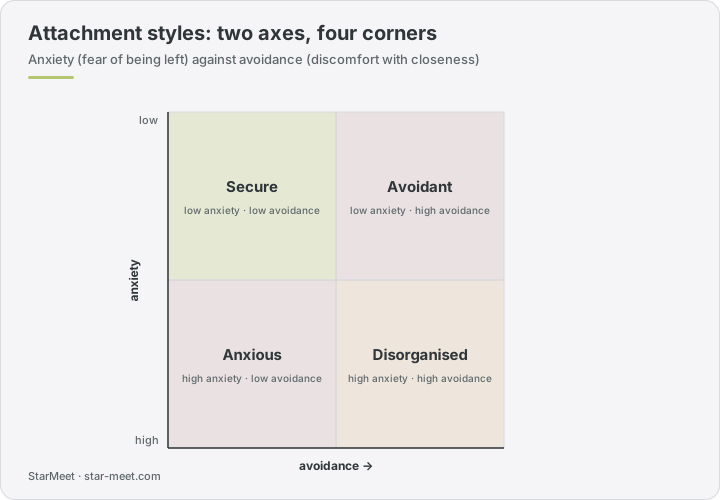
+-------------------------------------------------------------------------------+ | ATTACHMENT STYLES COMPARISON | +-------------------+-----------------------------+-----------------------------+ | Attachment Style | Core Internal Belief | Behavioral Reaction | +-------------------+-----------------------------+-----------------------------+ | Secure | "I am worthy; others can | Communicates needs openly, | | | be trusted." | tolerates vulnerability. | +-------------------+-----------------------------+-----------------------------+ | Avoidant | "I must rely solely on | Pulls away, shuts down, | | (Dismissive) | myself; intimacy traps me." | minimizes emotional needs. | +-------------------+-----------------------------+-----------------------------+ | Anxious | "I will be abandoned unless | Clings, seeks constant | | (Preoccupied) | I maintain total closeness."| reassurance, hypervigilant. | +-------------------+-----------------------------+-----------------------------+ | Disorganized | "I crave love desperately, | Pulls partner close, then | | (Fearful-Avoidant)| but you will hurt me." | panics and pushes away. | +-------------------+-----------------------------+-----------------------------+
An avoidant attachment style is characterized by a compulsive need for self-reliance and an instinctive repulsion toward emotional enmeshment. When an avoidant person senses that someone wants deeper intimacy, their nervous system shuts down affective resonance to maintain emotional safety. A disorganized attachment style (fearful-avoidant) represents a state of biological fright without solution. Individuals with this style crave deep emotional intimacy, but because their early relational experiences tied closeness directly to trauma or betrayal, getting close to someone sets off simultaneous alarms of abandonment and entrapment. They cycle violently between pulling a partner close and pushing them away. --- ## Why Can't I Figure Out Why My Relationships Fail? Persistent relationship failure occurs when unaddressed psychological defense mechanisms collide with unseen behavioral blind spots. When individuals repeat toxic relationship cycles, they frequently believe they simply have bad luck or keep choosing the wrong partner. In reality, the issue is an active, subconscious compulsion to recreate familiar emotional tension. From a clinical perspective, Schema Therapy (developed by Dr. Jeffrey Young) identifies this as an active Defectiveness or Emotional Deprivation schema. When you harbor a core belief that anyone who truly sees the real you will inevitably leave or exploit you, your ego actively sabotages the relationship as a preemptive strike. You reject them first to retain a false sense of control over the inevitable abandonment. Modern Western Psycho-Astrology provides the structural blueprint for where these psychological tensions live within your energetic architecture: - Saturn Transits and Placements: Saturn represents the psychological boundary, structural defense, and core fear. A heavy Saturn influence over your 7th House (the house of partnerships) or squaring personal planets creates an unconscious fortress, manifesting as an intense fear of inadequacy in romantic commitments. - The 12th House Dynamics: The 12th House governs hidden patterns, the unconscious shadow, and self-undoing. Natal planets located in the 12th House represent disowned psychic material—often the deep desire for emotional connection that gets repressed and turned into sudden isolation. - Chiron Placements: Known as the archetype of the foundational wound, Chiron's house and planetary aspects highlight where you expect relational agony, causing you to erect walls precisely where you need connection. When psychological defenses match astrological tension, you remain trapped in the gap between what you consciously want (love) and what your subconscious blueprint allows (isolation). --- ## Why Common Workarounds Fail and Drain Your Energy Attempting to resolve relational sabotage with surface-level fixes fails because basic advice addresses conscious actions rather than subconscious survival programming. Popular culture and casual advice treat avoidant behavior as a simple choice, urging people to "just open up," "communicate better," or use willpower to stay present. These superficial solutions consistently collapse: - Motivational Self-Help Books: Reading about vulnerability does not rewire the somatic freeze response of your nervous system when an actual partner steps closer. - Traditional Predictive Astrologers: Consulting traditionalists who simply declare "it is your destiny to have late or difficult marriage" leaves you completely disempowered, offering zero therapeutic tools for behavioral change. - Suppressing Your Irritation: Forcing yourself to endure closeness without addressing your underlying fear creates massive internal pressure, ultimately leading to explosive breakups or physical somatic burnout. - Esoteric Distractions: Crystals, superficial manifestation rituals, and generic affirmations do not alter developmental attachment injuries or neural trauma loops. These workarounds waste immense psychic energy. You remain stuck in an exhausting loop: craving affection, initiating connection, panicking when it deepens, sabotaging the bond, and retreating into lonely self-justification. --- ## How to Stop Pushing People Away: The Clinical Synthesis Breaking the pattern of emotional withdrawal requires a rigorous synthesis of clinical diagnostic precision and deep psychological self-awareness. Real change does not come from generic advice; it demands identifying your exact defensive schemas and systematically desensitizing your nervous system to relational safety. This transformation requires three concrete phases: 1. Accurate Assessment: Measuring your relational responses against validated psychometric baselines, such as the Adult Attachment Interview framework, Generalized Anxiety Scale (GAD-7), and Young Schema Questionnaires. 2. Root Architecture Mapping: Understanding your individual psychological defense blueprint—locating your unconscious protective boundaries (Saturnian structures) and hidden self-sabotaging patterns (12th House shadow dynamics). 3. Structured Desensitization: Practicing Cognitive Behavioral Therapy (CBT) and Schema Therapy protocols to identify the exact second your threat response activates, challenge automatic cognitive distortions, and widen your window of relational tolerance. On StarMeet, you do not have to guess which protocol fits your needs or pick a therapy programme from a confusing menu. You describe your current struggles, relationship patterns, and emotional fears in your own words directly in the private chat. The platform's advanced AI engine—powered by Gemini 3.8 Flash for instant contextual understanding, with the option to switch to Gemini 3.1 Pro for deep, complex reasoning—analyzes your words alongside your personal chart blueprint and diagnostic data. It automatically matches your situation to the optimal evidence-based clinical protocol from its library of 20+ validated frameworks, guiding you step-by-step through a staged course of roughly 6–8 sessions that goes one layer deeper each session. --- ## Frequently Asked Questions ### What is the Adult Attachment Interview Lite (AAI-Lite)? The Adult Attachment Interview Lite is a structured psychological assessment designed to evaluate how an individual processes past relational experiences and regulates emotions in current adult attachments. It scores your defensive strategies, degree of emotional coherence, and dismissive or preoccupied tendencies. ### How do I know if I have a fear of intimacy? A fear of intimacy manifests as chronic discomfort with vulnerability, an impulse to pull back when a relationship becomes serious, hyper-fixating on minor flaws in a partner, and a persistent belief that total emotional independence is the only way to stay safe. ### Can an avoidant attachment style become secure? Yes. Attachment styles are dynamic behavioral adaptations rather than permanent genetic traits. Through evidence-based psychotherapy, structured schema re-patterning, and somatic awareness, individuals can develop "earned security" and maintain healthy, close relationships. ### What is the difference between anxious and avoidant attachment? An anxious attachment style responds to relational stress by seeking proximity, validation, and hyper-communication, fearing immediate abandonment. An avoidant attachment style responds to the same relational stress by emotional withdrawal, isolation, and suppression of vulnerability, fearing loss of autonomy. ### Why do I feel claustrophobic when a relationship gets serious? Feeling claustrophobic in a relationship is a somatic defense response common in avoidant attachment. When your subconscious perceives intimacy as an invasive demand that will strip away your boundaries and personal freedom, it generates physical anxiety to force you to pull away. --- ### Step Into Relational Freedom with StarMeet Stop losing meaningful connections to automatic, subconscious sabotage. Discover the exact architecture of your relational defenses, uncover your subconscious shadow triggers, and rewire your attachment patterns with clinical precision. - 🧪 40+ Validated Psychological Tests: Screen your attachment style (AAI-Lite), schema triggers, GAD-7 anxiety baselines, and Jungian Shadow indices. - 🌌 In-Depth Psycho-Astrological Blueprint: Discover how your Saturn transits, planetary oppositions, and 12th House placements shape your emotional boundaries. - 💬 Private AI Clinical Guidance: Powered by Gemini 3.8 Flash (and Gemini 3.1 Pro for deep reasoning), matching you directly to personalized 6–8 session CBT and Schema Therapy protocols. 👉 Take the Free Attachment Style Test (AAI-Lite) on StarMeet
🎁 SPECIAL OFFER: Your First Month of Premium for $1. 🔒 100% Safe: Cancel in 1 click, anytime.
About the author
Vadim Arkhipov
Founder of StarMeet. Student of Jyotish since 2013, having completed an advanced course under Dr. K.N. Rao; 30+ years in business. Articles here are written to my brief, drafted with AI assistance and edited by me before publishing.
Profile, expertise and all articles →Related Articles
Avoidant Attachment: Why They Pull Away and What They Need
Understand avoidant attachment, the difference between dismissive and fearful avoidant patterns, why partners pull away after intimacy, and how to heal.
PsychologyInsecure Attachment: The Four Styles and Where Yours Comes From
Understand secure, anxious, avoidant, and disorganized attachment styles. Discover where insecure attachment comes from and how to heal.
PsychologyAttachment Style Test: Free, Research-Based, 5 Minutes
Stop guessing why your relationships fail. Take the free 5-minute ECR-R attachment style test to find out if you are secure, anxious, avoidant, or disorganized, and map your emotional blueprint.
Psychology