The 12 Houses in Astrology: What Each Area of Life Means
Contents
The 12 Houses in Astrology: What Each Area of Life Means
The 12 houses in astrology represent twelve distinct sectors of human experience, dividing the 360-degree natal chart wheel into specific arenas such as identity, finances, relationships, and career. Each house reveals where planetary energies manifest in your everyday life, showing which environmental contexts trigger your personal growth, internal friction, and behavioral patterns.
What You Will Learn From This Article:
-
🧠 The Architectural Blueprint: How natal chart houses map psychological drives directly to real-world environments.
-
⚡ The Root Causes of Friction: Why challenging planetary placements (like Saturn transits or tense squares) create repeated emotional ruts.
-
🛠️ Clinical Resolution: How modern psycho-astrology pairs with cognitive behavioral therapy (CBT) and Schema Therapy to rewire subconscious blocks.
You know that feeling when you work endless hours, optimize your habits, yet hit the exact same wall in your relationships or finances? You feel drained, running on empty, wondering why certain life domains flow effortlessly while others feel like an endless uphill battle.
In this article, we explain why this happens and how to reclaim your energy.
What Does a Natal Chart Tell You?
A natal chart tells you the precise structural blueprint of your psyche, outlining your innate cognitive patterns, emotional defense mechanisms, relational tendencies, and environmental stressors. Rather than predicting fatalistic events, an astrological chart functions as a diagnostic map of human personality, showing how unconscious drives express themselves across practical arenas of life.
When you review your chart, you see a complete psychological ecosystem. Carl Jung observed in his analytical psychology framework that unconscious archetypes project onto external circumstances until brought into conscious awareness.
Astrology formalizes this projection through houses and planets. For instance, an individual with unresolved authority conflicts may consistently experience friction in their professional career or with managers.
| THE 3-TIER SYSTEM | |
|---|---|
| Planet ("The WHAT") Sign ("The HOW") House ("The WHERE") | Core psychological drive (e.g., Mars) Behavioral style (e.g., Capricorn) Real-world arena (e.g., 10th House) |
When you examine the house where a planet sits, you identify the exact stage where that inner actor demands expression.
Natal Chart Houses Meaning: The 12 Arenas of Life
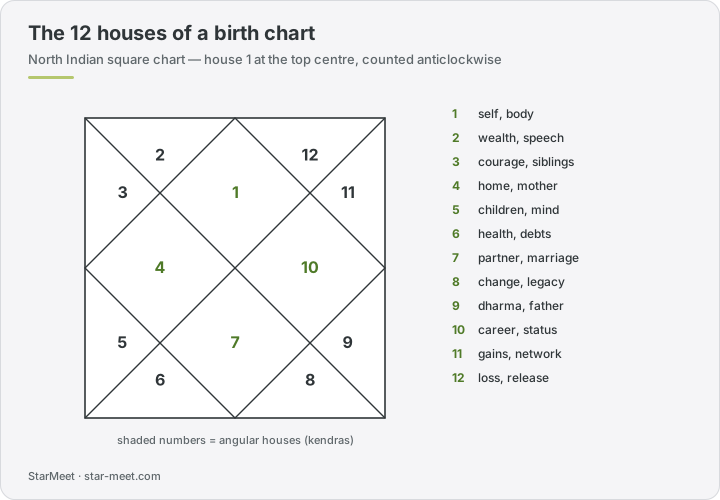
The 12 houses of the zodiac trace the daily rotation of the Earth, mapping every sector of daily living from self-concept to deep subconscious integration. The houses are numbered 1 through 12 counterclockwise around the wheel, beginning at the eastern horizon with the Ascendant.
The Personal Houses (Houses 1–4)
-
1st House (House of Self & Identity): Commences at the eastern horizon with your rising sign. The 1st house governs physical vitality, outward disposition, self-image, and early environmental conditioning.
-
2nd House (House of Value & Resources): Dictates personal finances, self-worth, tangible assets, and your relationship with material security.
-
3rd House (House of Communication & Mind): Governs cognitive framing, early learning, daily communication, siblings, and immediate local surroundings.
-
4th House (House of Home & Roots): Sits at the lowest point of the chart (Imum Coeli). The 4th house reflects childhood foundations, psychological roots, family dynamics, and inner emotional safety.
The Interpersonal Houses (Houses 5–8)
-
5th House (House of Self-Expression & Creation): The 5th house channels creativity pleasure, romance, authentic self-expression, play, and personal risk-taking.
-
6th House (House of Health & Daily Systems): Governs somatic health, nervous system regulation, work routines, daily habits, and practical service.
-
7th House (House of Partnerships): Positioned directly opposite the first house, the 7th house dictates committed one-on-one relationships, business partnerships, marriage, and externalized shadow projections.
-
8th House (House of Transformation & Shared Assets): Governs shared finances, emotional intimacy, psychological regeneration, boundary renegotiation, and letting go of outworn identity structures.
The Collective Houses (Houses 9–12)
-
9th House (House of Higher Learning & Philosophy): Governs belief systems, worldview expansion, higher education, legal matters, and cross-cultural perspective.
-
10th House (House of Career & Public Status): Located at the Midheaven (Medium Coeli), the 10th house governs professional legacy, public reputation, ambitions, and your relationship with societal authority.
-
11th House (House of Community & Vision): The 11th house rules social networks, collective ideals, long-term aspirations, collaborative groups, and friendships.
-
12th House (House of the Unconscious & Release): The 12th house of isolation and hidden patterns represents repressed subconscious material, dreams, spiritual surrender, and self-undoing blind spots.
How to Read Your Birth Chart: Planets, Signs, and House Systems
Reading your birth chart requires synthesizing three separate layers: the planet, the zodiac sign it occupies, and the house it inhabits. An astrological house system is a mathematical calculation that divides the space of the sky into 12 distinct segments, with common frameworks including Placidus (unequal house sizes based on time) and Whole Sign (where each house matches an entire 30-degree zodiac sign).
To interpret any placement correctly, evaluate how the trio interacts:
-
Identify the Planet (Psychological Need): Represents the core drive, such as Saturn representing boundaries, discipline, and fear of inadequacy.
-
Examine the Sign (Behavioral Filter): Shows how that drive operates, such as an analytical, structured Virgo or an intuitive, fluid Pisces.
-
Locate the House (Environmental Stage): Reveals where this dynamic plays out. Saturn in the 7th house, for example, often reflects fear of rejection or hyper-vigilance within committed partnerships.
When planetary energies land in specific sectors, you may experience intense focus or stagnation in those areas. A crowded house can highlight where significant personal growth occurs, while an empty house also carries meaning through the planet that rules its boundary sign.
Natal Chart Aspects Explained: Navigating Internal Tension
Natal chart aspects are the geometric angles formed between planets on the wheel, illustrating how different parts of your psyche communicate, cooperate, or clash. When two planetary drives form harmonious aspects (like 120-degree trines or 60-degree sextiles), their underlying psychological functions integrate smoothly without much conscious friction.
When planets form challenging aspects (like 90-degree squares or 180-degree oppositions), the psyche experiences acute internal conflict:
-
Squares (90°): Create internal tension and behavioral frustration that force active growth and structural problem-solving.
-
Oppositions (180°): Cause polarity, where an individual swings between two competing needs (like personal autonomy versus relational intimacy) until integrated.
-
Planetary Transits: Active planetary movements in the present sky trigger these natal angles. A Saturn transit pressing against your natal Sun frequently brings a season of testing, demanding stronger boundaries and radical maturity.
Why Common Workarounds Fail to Solve Your Cosmic and Psychological Blocks
When you feel stuck in a specific house theme, standard self-help workarounds usually drain your energy without fixing the core issue.
| Strategy | The Mechanism | Why It Drains Energy |
|---|---|---|
| Rationalizing / Suppressing Generic Astrology Superficial Self-Help | Forcing positive thoughts "It's just my destiny" Habit stacking without self-work | Increases somatic tension Fosters learned helplessness Ignores core subconscious scripts |
Trying to "manifest" past a 12th-house subconscious block or relying on fortune-telling horoscopes leaves you stuck. Astrology reveals the energetic blueprint—the exact location of the blockage—while clinical psychology provides the evidence-based tools needed to repair it.
The Solution: Rewiring Your Blueprint With StarMeet
Resolving life-pattern friction requires combining precise astrological diagnostic mapping with structured clinical tools. StarMeet unites these domains through an advanced AI architecture powered by Gemini 3.8 Flash for rapid conversational synthesis (and Gemini 3.1 Pro for comprehensive reasoning).
Instead of forcing you to guess which therapy style matches your chart, StarMeet works intuitively. You do not have to pick a therapy programme from a menu. You simply describe your daily frustration, anxiety, or relationship impasse in your own words directly in the chat.
The AI therapist matches your problem to an evidence-based clinical protocol from its extensive library—drawing from over 40 validated scientific assessments (including Jungian Archetypes, Attachment styles, MBTI, and GAD-7/PHQ-9 scales) alongside Schema Therapy and CBT frameworks.
From there, StarMeet guides you through a structured course of roughly 6–8 targeted sessions, going one layer deeper each time:
-
Pinpoints your planetary triggers and house placements (such as hidden 12th-house defense mechanisms).
-
Calculates your Shadow Trigger Index (Встреча с Тенью) to uncover where unconscious projections damage your relationships or professional pursuits.
-
Delivers concrete, daily cognitive restructuring protocols so you dismantle patterns permanently.
Frequently Asked Questions
What is a natal chart?
A natal chart is a precise astronomical diagram showing the positions of the Sun, Moon, and planets at the exact minute and location of your birth, functioning as an individualized psychological blueprint.
What is the difference between a birth chart vs natal chart?
There is no difference between a birth chart and a natal chart; both terms are used interchangeably in modern western astrology to describe the same diagnostic tool.
Why do I need my birth time for a natal chart?
Your exact birth time is essential because the Earth rotates one degree every four minutes. Without an accurate birth time, the calculator cannot accurately determine your rising sign (Ascendant) or the boundaries of the 12 houses.
What is the difference between Sun, Moon, and Rising signs?
Your Sun sign governs your conscious ego and core identity; your Moon sign governs internal emotional processing and unconscious security needs; your Rising sign represents your outward social persona, bodily presentation, and perspective on life.
How accurate is a birth chart?
A birth chart is mathematically exact in mapping planetary coordinates and astronomical house cusps. Psychologically, it offers an accurate baseline of innate personality drives and developmental growth areas.
What do the planets mean in an astrology chart?
Planets represent fundamental human drives and behavioral functions (such as Mercury for communication, Venus for bonding values, Mars for assertive drive, and Saturn for boundaries and discipline).
🎁 SPECIAL OFFER: Your First Month of Premium for $1. Explore your complete natal chart synthesis, 40+ clinical psychological tests, and private AI therapy sessions today.
👉 Calculate Your Blueprint on StarMeet
🔒 100% Safe: Cancel in 1 click, anytime.
About the author
Vadim Arkhipov
Founder of StarMeet. Student of Jyotish since 2013, having completed an advanced course under Dr. K.N. Rao; 30+ years in business. Articles here are written to my brief, drafted with AI assistance and edited by me before publishing.
Profile, expertise and all articles →Related Articles
What Is a Natal Chart — and How to Read Yours Step by Step
Learn what a natal chart tells you, how to interpret houses and planets, and how clinical psychology combined with astrology reveals your exact energetic blueprint.
JyotishThe Planets in Your Birth Chart and What They Actually Govern
Learn what each planet in your birth chart represents, from personal drivers like Mercury and Mars to outer forces like Saturn and Pluto, mapped to clinical psychology.
JyotishAspects in Astrology: Conjunctions, Trines, Squares, and Oppositions Explained
Learn what astrological aspects mean in your natal chart. Discover how conjunctions, squares, trines, and oppositions shape your subconscious patterns and psychological growth.
Jyotish