The Planets in Your Birth Chart and What They Actually Govern
Contents
The Planets in Your Birth Chart and What They Actually Govern
Planets in your birth chart govern specific psychological functions, internal drives, and behavioral patterns. While your zodiac signs describe how you express energy and the houses show where life events occur, the planets represent the core actors: your conscious ego, emotional processing, communication style, relationship patterns, drive, discipline, and subconscious transformation.
What you will learn from this article:
-
🧠 The 3 Planetary Tiers: How personal, social, and outer planets shape your daily emotional patterns and long-term behavioral blocks.
-
✨ Psychological Architecture: What each celestial body actually governs inside your subconscious mind, stripped of fortune-telling myths.
-
💼 From Tension to Action: Why reading basic horoscopes fails to fix internal friction, and how clinical therapy protocols turn chart tension into emotional regulation.
When you sit at your desk paralyzed by imposter syndrome despite clear achievements, or find yourself repeatedly picking emotionally unavailable partners, you are experiencing misaligned internal drivers. You feel the physical drag of chronic decision fatigue and mental tension. In this article, we explain why this happens and how to reclaim your energy.
What do the planets mean in astrology chart?
A planet in an astrology chart represents a fundamental psychological urge, instinct, or internal sub-personality. In psychological astrology—first formalized through Carl Jung’s work on archetypes and later expanded by Liz Greene—the solar system serves as an architectural blueprint of the human psyche.
Each planet represents a specific need: Mercury represents the need to process information, Mars governs the instinct for self-assertion, and Venus dictates the drive for social connection and self-worth. When a planet sits in a specific astrological sign, that sign colors how the instinct operates. For example, Mars in the sign Aries asserts itself directly and impulsively, while Mars in Capricorn channels assertiveness into systematic, long-term planning.
| Planet Category | Celestial Bodies Included | Primary Psychological Domain |
|---|---|---|
| Personal Planets Social Planets Outer Planets | Sun, Moon, Mercury, Venus, Mars Jupiter, Saturn Uranus, Neptune, Pluto | Day-to-day ego, emotions, and habits Social integration, ethics, limits Transpersonal transformation, trauma |
Rather than predicting external fate, these planetary bodies show where your personality functions smoothly and where internal conflicts create behavioral symptoms like procrastination, people-pleasing, or emotional burnout.
How to interpret natal chart planets: The personal planets
The personal planets consist of the Sun, Moon, Mercury, Venus, and Mars. These inner bodies move rapidly through our solar system and describe your immediate personality, conscious identity, communication style, and primary defense mechanisms.
The Sun: Conscious Ego and Identity
The Sun represents your core identity, conscious will, and primary source of vitality. In clinical terms, it mirrors your self-concept and executive functioning. The Sun shows how you experience personal agency and what conditions you need to feel self-actualized.
The Moon: Emotional Regulation and Attachment
The Moon governs your subconscious mind, emotional safety needs, and instinctive survival responses. Grounded in John Bowlby’s Attachment Theory, your Moon placement reveals your primary attachment style—whether you seek reassurance through proximity or withdraw to self-soothe under acute stress.
Mercury: Cognitive Processing and Communication
Mercury dictates how your brain gathers, processes, analyzes, and transmits information. It governs your cognitive style, internal monologue, and learning pace. In Cognitive Behavioral Therapy (CBT), Mercury represents the cognitive schemas through which you evaluate automatic thoughts.
Venus: Values, Relational Bonding, and Self-Worth
Venus represents your relational values, aesthetic preferences, and underlying sense of self-worth. It dictates what you find pleasurable and how you balance compromise versus personal integrity in romantic and financial partnerships.
Mars: Assertiveness, Drive, and Boundary Defense
Mars governs your physical energy, drive, ambition, and boundary defense mechanisms. It represents your fight-or-flight response and how you express healthy anger. When Mars energy is blocked, it frequently manifests as passive aggression or somatic exhaustion.
How to interpret natal chart planets: Social and outer planets
Social planets (Jupiter and Saturn) bridge your individual personality with societal structures, while outer planets (Uranus, Neptune, and Pluto) govern collective unconscious patterns and deep psychological transformation.
Jupiter: Expansion, Cognition, and Meaning-Making
Jupiter governs cognitive expansion, risk tolerance, optimism, and how you construct meaning from life events. It represents your growth mindset. When ungrounded, Jupiter leads to overextension, grandiosity, and boundary deficits.
Saturn: Structure, Boundaries, and the Inner Critic
Saturn represents structure, discipline, fear, internalized authority, and personal limits. In Schema Therapy, Saturn corresponds directly to the "Demanding Parent" or "Punitive Parent" schema. Saturn transits highlight life areas where avoidance must be replaced with operational competence.
Uranus: Individuation, Disruption, and Autonomy
Uranus governs sudden breakthroughs, psychological individuation, cognitive non-conformity, and rebellion against rigid structures. It points to the life areas where you demand absolute autonomy and break generational cycles.
Neptune: Idealization, Escapism, and Archetypal Imagery
Neptune rules imagination, spirituality, empathy, and boundary dissolution. Psychologically, it governs fantasy defense mechanisms and projection. A poorly integrated Neptune often manifests as codependency, martyrdom, or chronic avoidance through escapism.
Pluto: The Subconscious Shadow and Transformation
Pluto represents deep subconscious drives, control dynamics, primal fears, and radical renewal. Operating as Carl Jung’s archetypal "Shadow," Pluto points to repressed emotional material, unresolved survival fears, and where you must reclaim disowned personal power.
Planets, points, and asteroids in an astrology chart
Beyond the primary planets, an astrological chart contains critical calculated mathematical points and major asteroids that refine your psychological profile. These markers provide granular insight into your karmic blind spots, relationship models, and core emotional vulnerabilities.
-
The Ascendant (Rising Sign) & Descendant: The Ascendant represents your outward interface and behavioral coping style, while the Descendant shows what traits you project onto relationship partners.
-
The Midheaven (MC) & Imum Coeli (IC): The Midheaven marks your public legacy and professional ambition; the IC represents your psychological roots, early domestic conditioning, and private foundation.
-
The Lunar Nodes (North & South Node): Calculated points where the Moon's orbit crosses the ecliptic. The South Node shows habitual, overused comfort-zone behaviors, while the North Node indicates your developmental growth edge.
-
Chiron (The Wounded Healer): A comet-asteroid body representing core attachment injuries and feelings of inadequacy, highlighting where personal healing transforms into therapeutic empathy for others.
-
Major Asteroids (Ceres, Pallas, Juno, Vesta): Asteroids governing specialized psychological functions: Ceres (nurturing), Pallas (strategic pattern recognition), Juno (relational contracts), and Vesta (sacred focus and work dedication).
Why typical workarounds fail to resolve planetary tension
When people feel internal friction—such as the conflict between a spontaneous Mars and a restrictive Saturn placement—they often turn to superficial fixes. They read generic daily horoscopes, buy healing crystals, suppress their anger with toxic positivity, or consult fortune-tellers who declare their chart "cursed."
These workarounds fail because:
-
Horoscopes treat dynamic personality systems as static fortune-telling, offering zero psychological tools to process behavioral loops.
-
Suppression and blind affirmations waste emotional energy, deepening internal fragmentation and worsening anxiety.
-
Traditional astrologers identify tension points without providing clinical solutions, leaving you stuck in deterministic fear.
Astrology maps the blueprint of where your internal drivers conflict. Clinical psychology provides the tools to repair the wiring. Treating one without the other leaves the core problem untouched.
Bridging planetary architecture with evidence-based psychology
StarMeet resolves this disconnect by combining Western psychological astrology with over 40 validated clinical frameworks, including Cognitive Behavioral Therapy (CBT), Schema Therapy, and Attachment Theory. Astrology provides the architectural blueprint of your psyche, identifying precisely where blockages sit; clinical psychology supplies the structured methodology to resolve them.
You do not have to pick a therapy programme from a rigid menu. Instead, you describe your situation in your own words inside the private chat. StarMeet's AI therapist matches your challenge to the fitting evidence-based protocol from its clinical database and guides you through a staged course of roughly 6–8 sessions, going one layer deeper each session.
Powered by the Gemini 3.8 Flash engine (with seamless switching to Gemini 3.1 Pro for advanced reasoning), StarMeet instantly synthesizes your natal placements with clinical assessments like the GAD-7, PHQ-9, and the Shadow Trigger Index. It turns static chart data into daily, actionable self-mastery.
🎁 SPECIAL OFFER: Your First Month of Premium for $1 on StarMeet
🔒 100% Safe: Cancel in 1 click, anytime.
Frequently Asked Questions
what is a natal chart
A natal chart is an astronomical snapshot of the sky at the exact minute and location of your birth, mapping the precise mathematical positions of the Sun, Moon, and planets across 12 zodiac signs and 12 houses.
birth chart vs natal chart
There is no difference between a birth chart and a natal chart; both terms refer to the exact same astronomical and astrological map of the sky at your moment of birth.
how accurate is a birth chart
A birth chart is mathematically exact down to arc-minutes when calculated with an official birth certificate time, though its psychological interpretation depends on synthesizing planetary placements with lived experience.
natal chart houses meaning
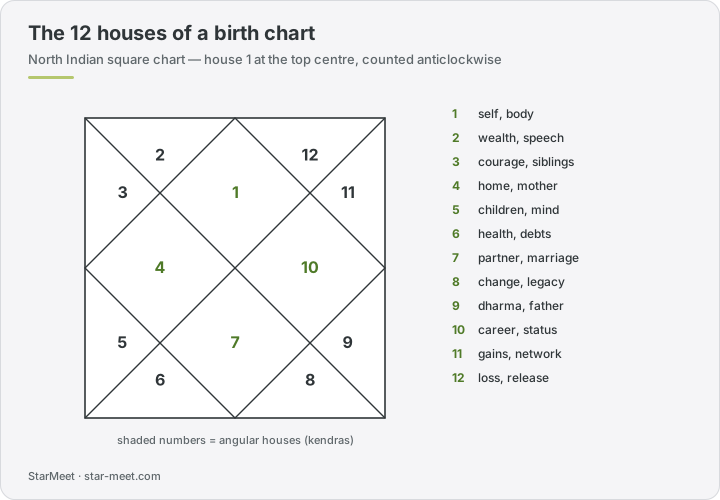
Natal chart houses are twelve distinct 30-degree sectors of your chart that represent specific arenas of life, such as career, relationships, subconscious patterns, and finances.
why do i need my birth time for a natal chart
Your exact birth time is required to calculate your Ascendant (Rising sign) and the precise layout of the twelve houses, which shift by one degree every four minutes.
what is the difference between sun moon and rising
Your Sun sign represents your conscious ego and core identity, your Moon sign governs your subconscious emotional processing, and your Rising sign (Ascendant) dictates your outward social persona and how you interface with the world.
natal chart aspects explained
Natal chart aspects are geometric angles (such as squares, oppositions, trines, and sextiles) formed between two or more planets that dictate whether their archetypal energies cooperate or create psychological tension.
About the author
Vadim Arkhipov
Founder of StarMeet. Student of Jyotish since 2013, having completed an advanced course under Dr. K.N. Rao; 30+ years in business. Articles here are written to my brief, drafted with AI assistance and edited by me before publishing.
Profile, expertise and all articles →Related Articles
What Is a Natal Chart — and How to Read Yours Step by Step
Learn what a natal chart tells you, how to interpret houses and planets, and how clinical psychology combined with astrology reveals your exact energetic blueprint.
JyotishThe 12 Houses in Astrology: What Each Area of Life Means
Discover what the 12 astrological houses mean in your birth chart, how planetary placements shape real-world behaviors, and how psycho-astrology resolves internal blocks.
JyotishAspects in Astrology: Conjunctions, Trines, Squares, and Oppositions Explained
Learn what astrological aspects mean in your natal chart. Discover how conjunctions, squares, trines, and oppositions shape your subconscious patterns and psychological growth.
Jyotish