Aspects in Astrology: Conjunctions, Trines, Squares, and Oppositions Explained
Contents
Aspects in Astrology: Conjunctions, Trines, Squares Explained
Astrological aspects are geometric angles formed between two planets in a 360-degree natal chart that measure how different psychological drives communicate, collaborate, or clash with each other. These angles—such as conjunctions (0°), sextiles (60°), squares (90°), trines (120°), and oppositions (180°)—reveal whether planetary energies interact through seamless flow or internal psychological friction.
What you will learn from this article: - How major aspects reveal the exact root of recurring emotional and behavioral loops - Why "challenging aspects" like squares and oppositions drive personal growth, not bad luck - How to bridge planetary tension with evidence-based Cognitive Behavioral Therapy (CBT) protocols
You know the feeling when one part of you craves intense ambition and career visibility, but another part freezes in fear and demands complete isolation. You might blame yourself for lacking willpower or self-discipline.
In reality, your internal system is caught between competing drives configured by your birth chart geometry. In this article, we explain why this happens and how to reclaim your energy.
What is a Natal Chart and How Do Aspects Work?
A natal chart is a 360-degree mathematical snapshot of the solar system calculated for the precise minute, day, and geographic coordinates of your birth. This astronomical wheel divides into 12 signs and 12 houses, mapping where the Sun, Moon, and planets were positioned across the horizon.
THE GEOMETRY OF A NATAL CHART (360°) Opposition (180°) - Relational Tension ◄─────────────────────────────────────────► Square (90°) Trine (120°) Conjunction (0°) Internal Friction Natural Harmony Fusion/Blend
When two planets occupy specific angular relationships to each other across this circle, they form an aspect. An aspect is an energetic conversation between two distinct parts of your psyche.
Instead of operating in isolation, the planets involved exchange influence based on the nature of the angle. If Mars sits 90 degrees apart from Saturn, your drive to take assertive action constantly collides with your fear of failure or internal authority rules.
Understanding these geometric lines moves astrology out of vague fortune-telling and into precise psychological architecture. You stop seeing your chart as a random collection of zodiac descriptions and begin reading it as a unified, functional system of internal archetypes.
Natal Chart Aspects Explained: The 5 Major Geometric Angles
Major aspects are the primary geometric divisions of the 360-degree circle by whole numbers (1, 2, 3, 4, and 6) that create the strongest energetic connections between planets. Each aspect alters how planetary energies interact, dictating whether an individual experiences innate talent, cognitive dissonance, or dynamic motivation.
| ASPECT | DEGREES APART | PSYCHOLOGICAL DYNAMIC |
|---|---|---|
| Conjunction Sextile Square Trine Opposition | 0° 60° 90° 120° 180° | Fusion, intense focus, blended drives Latent talent, active opportunity Internal friction, crisis, motivation Effortless flow, harmony, blind spots Projection, polarity, externalization |
1. Conjunction (0°): The Fusion of Archetypes
A conjunction occurs when two planets sit at the same degree or within close proximity (orb) in the same sign.
-
The Dynamic: The archetypal functions fuse into a single behavioral response. You cannot easily express one planet without triggering the other.
-
The Psychological Reality: If your Mercury conjuncts Mars, your thinking process and communication style are permanently linked with urgency, assertiveness, and debate. You speak quickly and sharply, rarely separating objective analysis from emotional drive.
2. Sextile (60°): The Bridge of Opportunity
A sextile occurs when planets sit 60 degrees apart, typically linking compatible elements (Fire with Air, or Earth with Water).
-
The Dynamic: This aspect creates supportive communication between planets, but requires conscious effort to activate.
-
The Psychological Reality: A sextile between Venus and Neptune offers deep empathy and creative ability, but it does not run on autopilot; you must deliberately channel it into creative expression or relational repair.
3. Square (90°): Dynamic Tension and Growth
A square happens when planets sit 90 degrees apart, connecting signs of the same modality (Cardinal, Fixed, or Mutable) that share incompatible elements.
-
The Dynamic: Squares represent challenging aspects characterized by sharp internal tension, frustration, and crisis points.
-
The Psychological Reality: A square between the Moon and Pluto triggers deep emotional defense mechanisms. Under stress, your need for safety clashes with an intense compulsion to control the environment. While uncomfortable, squares generate the raw psychological friction that builds resilience and mastery.
4. Trine (120°): Effortless Flow and Potential Blind Spots
A trine occurs when two planets sit 120 degrees apart, almost always connecting signs of the same element (e.g., Taurus-Virgo in Earth, or Gemini-Libra in Air).
-
The Dynamic: Trines provide smooth, harmonious integration where energies support each other without resistance.
-
The Psychological Reality: A Sun-Jupiter trine produces innate optimism and social trust. However, because trines operate with zero resistance, they can create complacency or blind spots where you take natural talents for granted without developing discipline.
5. Opposition (180°): Polarity and Shadow Projection
An opposition occurs when planets sit directly across the zodiac wheel (180 degrees apart) in opposing signs.
-
The Dynamic: Oppositions create an "either/or" tug-of-war where you struggle to honor both planetary needs at the same time.
-
The Psychological Reality: In Jungian analytical psychology, oppositions frequently manifest as Shadow projections. If your Sun opposes Saturn, you may disown your personal authority and project it outward, viewing bosses, institutions, or partners as overly critical and demanding, until you integrate that discipline internally.
How to Interpret Natal Chart Planets and Complex Aspect Patterns
Interpreting planets in a birth chart requires synthesizing three distinct components: the planet (the drive), the sign (how it acts), and the house (where it plays out in life). When three planets or more connect simultaneously, they form geometric configurations called aspect patterns.
An aspect pattern is a closed geometric figure formed by three or more planets that creates a self-reinforcing psychological feedback loop.
[Planet B]─────[Planet C] ◄───────180°───────► 120°
Grand Trine: The Closed Circuit of Talent
A Grand Trine forms when three planets link in a continuous triangle of 120-degree angles across the same element.
-
Earth Grand Trine (Taurus, Virgo, Capricorn): Exceptional practical execution, financial management, and somatic grounding.
-
Air Grand Trine (Gemini, Libra, Aquarius): Fast conceptual intelligence, social networking, and analytical systems thinking.
-
The Risk: Grand Trines can act as comfortable closed circuits. Without external tension, you may stay inside your comfort zone and avoid situations that require struggle.
T-Square: The Engine of Achievement
A T-Square occurs when two planets sit in direct opposition (180°) while both form a 90-degree square to a third planet, known as the "Apex."
-
The Psychological Dynamic: The opposing planets create continuous tension that discharges directly through the house and sign of the Apex planet.
-
The Outcome: While challenging to navigate during early life, T-Squares are found across high-achieving profiles. The apex planet demands mastery, transforming internal anxiety into tangible real-world output.
Birth Chart Meaning Explained: The Diagnostic Blueprint
A birth chart meaning is best understood through the lens of modern psycho-astrology: the chart acts as an architectural blueprint of the unconscious mind. It illustrates your default cognitive wiring, inherited coping mechanisms, and specific developmental challenges.
Astrology identifies where and why internal blockages exist. If you experience chronic creative paralysis, your chart reveals the exact mechanism—such as a Saturn transit forming a square to your natal Mercury in the 5th House of self-expression.
THE PSYCHO-ASTROLOGY REPAIR FRAMEWORK 1. NATAL BLUEPRINT (Astrology) ──► Locates the block (Where & Why) 2. CLINICAL PROTOCOLS (Psychology)──► Reprograms the coping loop (How)
However, traditional astrology often fails because it treats this configuration as a fixed fate. Reading generic horoscopes or buying crystals provides temporary validation without modifying the underlying behavioral schema.
To resolve the tension, you must pair the astrological diagnostic with clinical tools:
-
Astrology diagnoses the structural fault line: (e.g., Saturn-Neptune square producing imposter syndrome and avoidance).
-
Clinical Psychology repairs the behavior: Cognitive Behavioral Therapy (CBT) and Schema Therapy protocols dismantle the cognitive distortions maintaining the avoidance loop.
What Does a Natal Chart Tell You About Your Psychological Blocks?
A natal chart reveals how early environmental conditioning intersected with your natural temperament to form defensive survival strategies. When planetary energies clash, your psyche creates protective schemas to shield you from perceived failure, abandonment, or rejection.
In Schema Therapy (developed by Dr. Jeffrey Young), maladaptive schemas originate when core emotional needs go unmet. In a birth chart, these exact vulnerabilities are mirrored by stressful aspects involving Saturn, Chiron, Pluto, or the 12th House of the unconscious.
CHALLENGING ASPECT TO CLINICAL SCHEMA MAP
- Moon Square Saturn ──► Schema: Emotional Deprivation / Defectiveness Sun Opposite Pluto ──► Schema: Vulnerability to Harm / Subjugation Mars Square Uranus ──► Schema: Insufficient Self-Control Mercury in 12th House ──► Schema: Social Isolation / Inhibited Emotion
When you understand these patterns, you stop fighting your nature. You realize that your chronic procrastination is not laziness; it is a Moon-Saturn hyper-critical schema attempting to protect your ego from judgment.
By identifying the structural aspect, you can apply targeted behavioral adjustments instead of exhausting your willpower on generic productivity hacks.
How to Read Your Birth Chart: A Step-by-Step Diagnostic Method
Reading your birth chart systematically prevents information overload. Follow this structured 4-step framework:
Step 1: Check the Core Triad (Sun, Moon, Rising)
- Sun (Conscious purpose) + Moon (Emotional needs) + Rising (Outer filter)
- Step 2: Identify the House Positions
- Determine which life areas (1st through 12th) host your planetary clusters
- Step 3: Analyze Major Aspects by Tightness of Orb
- Prioritize angles with tight orbs (0° to 3°) as your most active behavioral loops
- Step 4: Map Aspect Patterns and Focal Points
- Look for T-Squares, Grand Trines, or Stelliums that act as core drivers
-
Map Your Core Triad: Identify the signs and house locations of your Sun (conscious ego), Moon (instinctual security), and Ascendant/Rising sign (somatic orientation and interface with the environment).
-
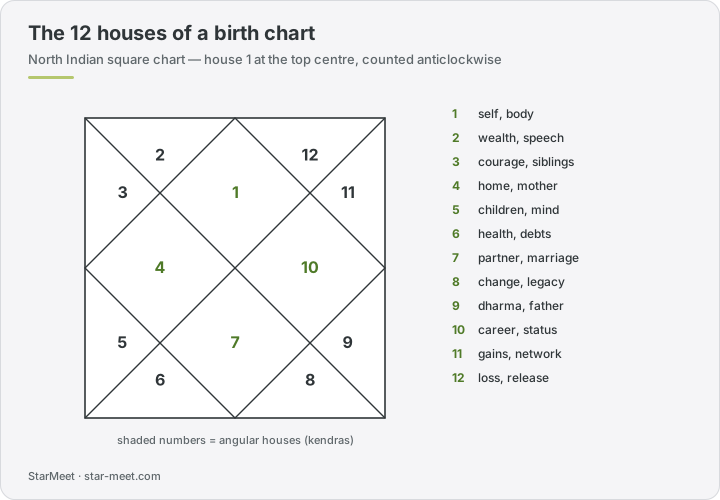
Examine the 12 Houses: Natal chart houses represent life arenas—from the 2nd House of financial resources to the 12th House of unconscious processing. Planets in these houses direct their energy toward specific domains.
-
Isolate Major Aspects by Orb: The "orb" is the mathematical allowance of degrees from an exact aspect. An aspect with a tight orb (0°–2°) exerts a much stronger psychological influence than one with a wide orb (6°–8°).
-
Identify Primary Aspect Patterns: Locate any Grand Trines, T-Squares, or Stelliums (clusters of three or more planets in a single sign or house). These configurations represent your primary talents and core developmental challenges.
The Root Causes: Why Common Self-Help Workarounds Fail
When people experience internal friction from challenging planetary aspects, they typically rely on surface-level coping mechanisms that deplete their energy without fixing the root cause:
❌ Common Workaround: Suppressing reactive anger or anxiety through sheer willpower ⚠️ Why it Fails: Buries the Mars-Pluto aspect in the shadow, leading to sudden emotional burnout ❌ Common Workaround: Consuming generic motivational books and self-discipline hacks ⚠️ Why it Fails: Treats all procrastination identically, ignoring whether it stems from Saturnian perfectionism or a Neptune-Mercury lack of cognitive structure ❌ Common Workaround: Visiting fatalistic astrologers who claim "it is simply your destiny" ⚠️ Why it Fails: Leaves you passive and disempowered, without practical psychological tools to navigate the transit
These workarounds fail because they do not address your unique structural wiring. When you know which planetary drives are locked in opposition, you can stop fighting yourself and apply clinical tools designed for your specific psychological architecture.
The StarMeet Solution: Synthesis of AI Psycho-Astrology and Clinical Therapy
Resolving complex natal chart aspects requires combining diagnostic accuracy with structured therapeutic execution. StarMeet bridges this gap by uniting modern Western psycho-astrology with evidence-based clinical psychology into a single AI platform.
Powered by a specialized high-speed analytical engine running on Gemini 3.8 Flash (with optional switching to Gemini 3.1 Pro for extended reasoning), StarMeet analyzes your exact birth chart geometry and pairs it with over 40 clinically validated psychological assessments (including MBTI, Jungian Archetypes, Attachment Styles, and GAD-7/PHQ-9 scales).
THE STARMEET SYSTEM INTEGRATION [Natal Chart Calculation] [40+ Validated Clinical Tests] NASA Ephemeris Engine Attachment, Archetypes, GAD-7/PHQ-9 │ │ └─────────────────┬──────────────────┘ ▼ [AI Diagnostic Synthesis Chat] Gemini 3.8 Flash / 3.1 Pro │ ▼ [Staged 6-8 Session Therapy Plan] CBT & Schema Therapy Protocols
No Generic Menus: Conversational Protocol Matching
Unlike traditional apps where you must select a therapy program from an overwhelming menu, StarMeet operates differently:
-
You describe your challenge in your own words directly in the secure chat.
-
The AI therapist analyzes your natal chart tensions alongside your psychological inputs to pinpoint the underlying schema.
-
The platform automatically matches you with the appropriate clinical protocol (such as Cognitive Behavioral Therapy or Schema Therapy) and guides you through a staged course of 6–8 structured sessions, diving one layer deeper in each session.
-
You track your progress using the proprietary Shadow Trigger Index (Встреча с Тенью) to monitor how effectively you integrate challenging aspects over time.
Frequently Asked Questions
Birth chart vs natal chart: is there a difference?
No. The terms "birth chart" and "natal chart" are completely interchangeable. Both refer to the precise astronomical map of the sky calculated for the exact moment, date, and geographic location of your birth.
Why do I need my birth time for a natal chart?
An exact birth time is essential because the Earth rotates one degree on its axis every four minutes. Without an accurate birth time, you cannot determine your exact Ascendant (Rising sign) or the precise boundaries of your 12 houses, which rotate through the entire zodiac every 24 hours.
What is the difference between Sun, Moon, and Rising signs?
Your Sun sign represents your conscious ego, core identity, and intentional life purpose. Your Moon sign reflects your instinctual emotional habits, private needs, and unconscious security triggers. Your Rising sign (Ascendant) is the outward behavioral filter through which you view and interact with the physical world.
How accurate is a birth chart?
The astronomical calculation of planetary positions in a birth chart is mathematically exact, using NASA ephemeris data. The psychological accuracy depends on the interpretive system applied; modern psycho-astrology uses these positions as diagnostic models rather than fatalistic predictions.
What do the planets mean in an astrology chart?
Each planet corresponds to a core psychological function:
-
Mercury: Cognitive processing, data analysis, and communication style.
-
Venus: Relational attachment, aesthetic values, and self-worth.
-
Mars: Assertive drive, libido, physical stamina, and anger integration.
-
Jupiter: Cognitive expansion, optimism, and belief frameworks.
-
Saturn: Psychological boundaries, internal discipline, self-criticism, and mastery.
-
Uranus, Neptune, Pluto: Transpersonal drivers of individuation, subconscious dissolution, and deep psychological transformation.
What are natal chart houses and their meaning?
The 12 houses represent the specific arenas of everyday life where planetary energies express themselves. For example, the 1st House represents personal identity and physical vitality, the 4th House governs family roots and emotional foundations, the 7th House dictates one-on-one partnerships, and the 10th House governs career legacy and public reputation.
Take the Next Step
Stop guessing why your internal drives feel in conflict. Calculate your complete planetary aspects and discover how clinical AI therapy can help you resolve lifelong behavioral blocks.
👉 Calculate Your Natal Chart and Begin Your AI Synthesis at StarMeet
🎁 SPECIAL OFFER: Your First Month of Premium for $1.
🔒 100% Safe: Cancel in 1 click, anytime.
About the author
Vadim Arkhipov
Founder of StarMeet. Student of Jyotish since 2013, having completed an advanced course under Dr. K.N. Rao; 30+ years in business. Articles here are written to my brief, drafted with AI assistance and edited by me before publishing.
Profile, expertise and all articles →Related Articles
What Is a Natal Chart — and How to Read Yours Step by Step
Learn what a natal chart tells you, how to interpret houses and planets, and how clinical psychology combined with astrology reveals your exact energetic blueprint.
JyotishThe 12 Houses in Astrology: What Each Area of Life Means
Discover what the 12 astrological houses mean in your birth chart, how planetary placements shape real-world behaviors, and how psycho-astrology resolves internal blocks.
JyotishThe Planets in Your Birth Chart and What They Actually Govern
Learn what each planet in your birth chart represents, from personal drivers like Mercury and Mars to outer forces like Saturn and Pluto, mapped to clinical psychology.
Jyotish