How to Read a Eastern Birth Chart: Step-by-Step Guide
Contents
How to Read a Eastern Birth Chart: Step-by-Step Guide
A Eastern birth chart (Kundali) is the primary tool of Eastern astrology (also called Vedic astrology, or Jyotish) — a precise map of the sky at the moment and place of your birth, showing where each of the 9 planets stood across the 12 zodiac signs.
Unlike Western astrology, the Eastern system uses the sidereal (star-based) zodiac, placing the Sun about 24° earlier in the sky to track actual constellation positions rather than the seasonal calendar. Mastering Eastern birth chart reading begins with six pillars: the chart's visual structure, the Kundali's symbolic meaning, the Lagna (Ascendant), the PAC method of planetary analysis, the classification of the 12 houses, and the Varga divisional chart system.
Use StarMeet's free Eastern calculator to analyze your birth chart instantly:
Calculate your free Eastern birth chart → — instant results with all 9 planets, your Lagna, Navamsha D-9, and your current Dasha period.
Key Takeaways
- The Kundali ("coiled serpent") symbolizes Prarabdha destiny — the destiny already set in motion at the moment of first breath
- The Lagna (Ascendant) changes every ~2 hours — making it more personally unique than the Sun sign, which stays in a sign for a full month
- PAC (Placement, Aspect, Conjunction) is the master framework — no planet should ever be read in isolation
- Three visual chart styles exist (North/South/East Indian) — all show identical data in different formats
- The 12 houses divide into 4 functional types: Kendra (action), Trikona (fortune), Upachaya (growth), Dusthana (challenge)
- Varga charts (16 divisional charts) reveal specialized life areas — Navamsha D-9 changes every 13–14 minutes
- Shadbala measures 6 simultaneous sources of planetary strength — an exalted planet can still score low in Shadbala
- Planetary Avastha states determine whether a planet delivers its full promise — Yuva (prime) gives 100%, Mrita (dead) gives nothing
What Is a Eastern Birth Chart (Kundali)?
A Eastern birth chart, called Kundali (कुंडली) in Sanskrit, is a diagram mapping the positions of 9 planets (Navagrahas) across 12 zodiac signs at the exact moment of birth, calculated using the sidereal zodiac anchored to actual star positions.
The word Kundali means "coiled" — like a coiled serpent. This metaphor carries profound meaning in Jyotish: the chart represents Prarabdha destiny (the portion of destiny already set in motion, coiled at the moment of first breath), which the soul agreed to experience in this lifetime. Every house, planet, and configuration in the Kundali encodes a facet of that soul-purpose blueprint.
Three fundamental distinctions separate Eastern from Western birth chart reading:
-
Sidereal zodiac vs. tropical: Jyotish tracks actual constellation positions (sidereal), placing the Sun ~24° earlier than Western charts (tropical). As of 2025, this creates an ayanamsha difference of approximately 24°.
-
Whole Sign Houses: Brihat Parashara Hora Shastra establishes Whole Sign Houses as the primary system — each zodiac sign constitutes exactly one house, spanning precisely 30° of the ecliptic. There are no intercepted signs and no partial houses.
-
Nine planets (Navagrahas): Jyotish uses 9 planets — Sun, Moon, Mars, Mercury, Jupiter, Venus, Saturn, Rahu, and Ketu. Uranus, Neptune, and Pluto are not used in classical analysis.
Build your complete Eastern birth chart → — all 9 planets calculated using Swiss Ephemeris sidereal data.
Three Eastern Chart Styles: Reading the Visual Map
Before analyzing planetary positions, understand the visual container. Eastern Astrology uses three distinct chart formats — all representing identical astronomical data through different visual lenses.
| Feature | North Indian (Diamond) | South Indian (Square) | East Indian (Orissa) |
|---|---|---|---|
| Shape | Diamond grid | Square grid | Square/rectangular |
| Houses | Fixed positions | Rotate by Lagna | Rotate (counter-clockwise) |
| Signs | Rotate by Lagna | Fixed positions | Fixed positions |
| Count direction | Counter-clockwise | Clockwise | Counter-clockwise |
| Strength | Kendra/Trikona Yogas visible | Best for transit analysis | Bengali/Odisha tradition |
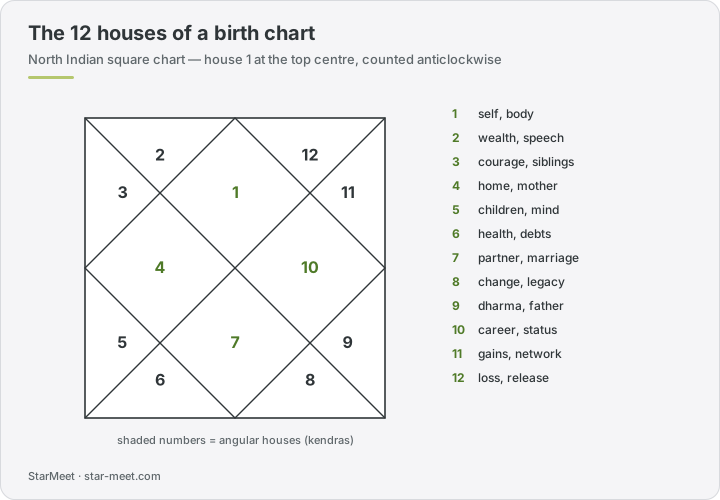
North Indian chart: The topmost diamond is always the 1st house (Lagna). Signs are written as numbers (1 = Aries through 12 = Pisces) and rotate based on the Ascendant. The diamond layout makes Kendra and Trikona positions immediately visible — Kendra houses form the four corners of the cross, Trikona houses form the inner triangle.
South Indian chart: The upper-left block is always Aries (sign 1), proceeding clockwise through all 12 signs. Signs are fixed; houses rotate. Classical astrologers prefer this format for Gochara (transit) analysis because the zodiac remains visually static while transiting planets move through it.
The most common beginner mistake: In the North Indian chart, the numbers written inside diamonds represent zodiac sign numbers — not house numbers. A "5" in the 3rd diamond is Taurus, not the 5th house.
Lagna: The Foundation of Your Eastern Birth Chart
The Lagna (Ascendant) is the zodiac degree rising on the eastern horizon at the exact moment of first breath — the most individually unique point in the entire birth chart, changing every two hours as Earth rotates.
With 12 signs covering the horizon in 24 hours, each sign rises for approximately 2 hours (varying by birth latitude — some signs rise faster at higher latitudes). This creates a stark contrast in individuality:
- Sun sign: changes once per month — shared by roughly 8% of the world
- Moon sign: changes every 2.5 days — shared by roughly 3% of the world
- Lagna: changes every ~2 hours — uniquely yours in a narrow window of ~0.3% of the population
Brihat Parashara Hora Shastra states: "The Ascendant shows you yourself — all other planets show people and circumstances influencing you." The Lagna governs your physical body, intellect, overall vitality, and the personal lens through which all destiny unfolds.
Why Birth Time Accuracy Is Critical
The Navamsha (D-9) divisional chart changes its Ascendant every 13–14 minutes — requiring birth time accurate to within 2 minutes for reliable Navamsha analysis.
Divisional charts (Vargas) amplify birth time sensitivity dramatically. The Navamsha — the most important secondary chart for relationship destiny and the soul's deeper purpose — changes its Ascendant every few minutes. According to P.V.R. Narasimha Rao's Lessons on Eastern Astrology: "In the divisional charts, the Ascendant changes within minutes — making precise birth time the most critical input for any serious Jyotish analysis."
This is why two siblings born just five minutes apart can have identical natal charts yet dramatically different Navamsha charts — and divergent life paths as a result.
Lagnesh: The Lord of Your Ascendant
The sign lord of the Lagna is called the Lagnesh (Ascendant lord). This planet is the single most important planet in the entire birth chart — the focal point through which all destiny is channeled.
K.S. Charak confirms in Elements of Eastern Astrology: "A strong Lagna lord, aspected by benefics and free from malefic influence in angles, destroys all afflictions and ensures increasing prosperity."
The Lagnesh's condition — its sign, house, dignity, aspects, and conjunctions — determines whether any other planetary combination can fully deliver its promise. Three critical rules:
- A Dusthana Lagnesh (placed in houses 6, 8, or 12) faces headwinds in self-expression, though Vipareeta Raja Yoga may compensate
- A combust Lagnesh (within 6° of the Sun) loses its independence and capacity to act on the native's behalf
- A debilitated Lagnesh severely limits the chart's overall vitality, even when other strong planets indicate success
| Lagnesh in House | Core Theme |
|---|---|
| 1st | Strong self-identity; the person embodies their ascendant sign qualities directly |
| 2nd | Life focus on wealth, speech, family heritage |
| 3rd | Courage, siblings, communication as life pillars |
| 4th | Home, mother, emotional security as foundation |
| 5th | Creativity, children, intellect as primary gifts |
| 6th | Service, health battles, enemies as transformative themes |
| 7th | Partnerships, marriage, public visibility |
| 8th | Transformation, research, hidden matters, longevity |
| 9th | Dharma, teachers, philosophy, fortune |
| 10th | Career, authority, public role as primary expression |
| 11th | Gains, social networks, elder sibling connections |
| 12th | Spiritual liberation, foreign lands, introspective path |
The PAC Method: How Planets Shape Your Chart
The PAC method — Placement, Aspect (Drishti), Conjunction — is the master key of Eastern birth chart analysis. No planet can be judged in isolation from these three simultaneous layers of influence.
Placement (Sthana Bala) and Karakatwa
A planet in a house brings two things: its Karakatwa (natural significations) and the agenda of the houses it rules.
- Jupiter in the 4th house brings its Karakatwa of wisdom, expansion, and children to domestic happiness — AND delivers the themes of the houses Jupiter rules in that specific chart (which varies by Ascendant)
- Saturn in the 4th brings discipline, lessons, or delays around home and mother — AND governs whatever houses Saturn rules
The critical hierarchy: the Bhavesha (house lord) outweighs any planets residing within a house. The "landlord" determines whether the house's themes ultimately flourish. If the 5th house lord is strong and well-placed, 5th house topics thrive — even if a malefic occupies it. If the 5th house lord is debilitated, benefics inside cannot fully compensate.
Aspect (Drishti): Graha Drishti and Rashi Drishti
Eastern Astrology has two distinct aspect systems that operate simultaneously:
Graha Drishti (Planetary Gaze): All planets cast a full aspect on the 7th house from their position. Special full aspects:
| Planet | Special Full Aspects | Classical Reason |
|---|---|---|
| Jupiter | 5th and 9th house | Houses of Dharma, wisdom, blessings |
| Mars | 4th and 8th house | Protective wall (4th), hidden destruction (8th) |
| Saturn | 3rd and 10th house | Demand for effort (3rd), soul-purpose duty in career (10th) |
Rashi Drishti (Sign Aspect): Entire zodiac signs cast aspects on other signs based on modality:
- Movable signs (Aries, Cancer, Libra, Capricorn) → aspect all three Fixed signs except the adjacent one
- Fixed signs (Taurus, Leo, Scorpio, Aquarius) → aspect all three Dual signs except the adjacent one
- Dual signs (Gemini, Virgo, Sagittarius, Pisces) → aspect all three Movable signs except the adjacent one
Rashi Drishti aspects apply to all planets within the aspecting sign, regardless of degree. Classical astrologers like Parashara and Jaimini use both systems; integrating both gives a complete picture of how houses and planets interact.
Conjunction (Yuti), Graha Yuddha, and Mercury's Special Rule
When two planets share the same sign, they blend their energies — the closer in degrees, the stronger the fusion.
Graha Yuddha (Planetary War) occurs when two non-luminous planets (Mars, Mercury, Jupiter, Venus, Saturn) come within 1° of each other: the planet with the lower longitude typically wins, while the loser loses capacity to give positive results (per BPHS Chapter 3 and K.S. Charak's analysis).
Mercury's unique rule: Mercury fully adopts the nature of its conjunct planet. Mercury with Jupiter becomes philosophical and wise; Mercury with Saturn becomes methodical and serious; Mercury with Mars becomes sharp-tongued and analytical. This "chameleon" quality makes Mercury's condition heavily dependent on its company.
Panchadha Mitra: Five Levels of Planetary Friendship
Every planet carries both natural (Naisargika) and temporal (Tatkalika) relationships. Combining these creates the Panchadha (fivefold) friendship matrix that shapes how planets cooperate in your specific chart.
Natural friends are fixed across all charts (the Sun is always friends with Moon, Mars, Jupiter). Temporal friends shift based on your birth chart: a planet becomes a temporary friend of planets placed in the 2nd, 3rd, 4th, 10th, 11th, and 12th houses from it — and a temporary enemy of planets in the 1st, 5th, 6th, 7th, 8th, and 9th.
| Level | Formula | Result |
|---|---|---|
| Adhi Mitra (Best Friend) | Natural friend + Temporal friend | Maximum cooperation; abundant results |
| Mitra (Friend) | Natural neutral + Temporal friend | Good cooperation and support |
| Sama (Neutral) | Mixed signals cancel | Balanced, context-dependent results |
| Shatru (Enemy) | Natural neutral + Temporal enemy | Friction and delays |
| Adhi Shatru (Worst Enemy) | Natural enemy + Temporal enemy | Deep stress; blocked energy; mixed destiny |
When a planet transits through the sign of its Adhi Mitra, it delivers outstanding results. When it transits through the sign of its Adhi Shatru, expect obstacles, illness, or losses during that period.
Planetary Dignity and Avastha States
The Six Degrees of Dignity
| State | Sanskrit | Description |
|---|---|---|
| Exaltation | Uccha | Maximum strength; best-case results |
| Moolatrikona | Moolatrikona | Strong "working office"; highly reliable |
| Own sign | Svakshetra | Comfortable; consistent results |
| Friend's sign | Mitra Kshetra | Supported; generally good |
| Neutral sign | Sama Kshetra | Neither aided nor obstructed |
| Enemy's sign | Shatru Kshetra | Weakened; inconsistent results |
| Debilitation | Neecha | Minimum strength; most challenging |
Avastha States: The "Age" of a Planet
According to Brihat Parashara Hora Shastra (Chapter 45), a planet in Yuva (prime) state at 12°–18° of a sign delivers 100% of its promised results — while a planet in Mrita (dead) state produces nothing, regardless of any other strengths.
In odd signs (Aries, Gemini, Leo, Libra, Sagittarius, Aquarius):
- 0°–6°: Bala (infant) — one-quarter results
- 6°–12°: Kumara (youth) — half results
- 12°–18°: Yuva (prime) — full results ✓
- 18°–24°: Vriddha (old) — negligible results
- 24°–30°: Mrita (dead) — no results
In even signs (Taurus, Cancer, Virgo, Scorpio, Capricorn, Pisces): the sequence reverses — 0°–6° is Mrita, 24°–30° is Bala.
This explains a common puzzle: an exalted planet in a natal chart sometimes fails to deliver its apparent promise. Exaltation describes the sign dignity; Avastha describes the planet's active capacity within that sign. Both must be checked.
The 12 Houses: Complete Significations and Functional Types
Four Functional Types
| Type | Houses | Sanskrit Name | Core Function |
|---|---|---|---|
| Kendra (Angular) | 1, 4, 7, 10 | Vishnu Sthana | Action, material foundation — strongest |
| Trikona (Trine) | 1, 5, 9 | Lakshmi Sthana | Fortune, blessings, past-life merit |
| Upachaya (Growing) | 3, 6, 10, 11 | — | Improve with effort and time |
| Dusthana (Challenging) | 6, 8, 12 | — | Obstacles, illness, transformation, loss |
Raja Yoga — the king of all planetary combinations — forms when rulers of Kendra houses connect with rulers of Trikona houses. Note that house 10 belongs to both Kendra and Upachaya, and house 1 belongs to both Kendra and Trikona — making the 1st house the most multidimensional position in the entire chart.
Vipareeta Raja Yoga: when rulers of Dusthana houses (6, 8, 12) occupy other Dusthana houses, evil cancels evil. Negative forces destroy each other, producing unexpected success — often after a period of crisis.
Complete 12-House Significations
| House | Sanskrit | Ruling Body | Key Significations |
|---|---|---|---|
| 1st | Tanu Bhava | Sun/Lagna | Self, body, health, personality, vitality, early life |
| 2nd | Dhana Bhava | Jupiter | Wealth, speech, family, food, face, accumulated resources |
| 3rd | Sahaja Bhava | Mars | Courage, siblings, short travels, communication, hands, efforts |
| 4th | Sukha Bhava | Moon | Home, mother, emotional security, property, vehicles, heart |
| 5th | Putra Bhava | Jupiter | Children, creativity, intelligence, speculation, past-life merit, romance |
| 6th | Ripu Bhava | Mars/Saturn | Enemies, debts, illness, service, litigation, daily work, pets |
| 7th | Kalatra Bhava | Venus | Spouse, partnerships, business, public dealings, desires |
| 8th | Randhra Bhava | Saturn | Longevity, transformation, inheritance, hidden matters, research, occult |
| 9th | Dharma Bhava | Jupiter | Father, dharma, teachers, higher wisdom, long travels, fortune |
| 10th | Karma Bhava | Mercury/Saturn | Career, authority, public role, status, actions, government |
| 11th | Labha Bhava | Jupiter/Saturn | Income, gains, elder siblings, social networks, aspirations |
| 12th | Vyaya Bhava | Saturn | Liberation, losses, foreign lands, sleep, spiritual practice, expenses |
Bhavat Bhavam: The Mirror Principle
The 7th from the 7th equals the 1st house — meaning your partner literally mirrors your own nature back to you.
This "house from house" principle reveals secondary meanings throughout the chart:
- 5th from the 5th = 9th house: creativity's creativity; children's children; accumulated wisdom
- 3rd from the 3rd = 5th house: where personal effort leads — to intellect and creative output
- 8th from the 8th = 3rd house: secondary longevity indicator; courage also preserves life
Varga Charts: The 16 Divisional Charts of Jyotish
The Shodasavarga system contains 16 divisional charts (Varga charts), each derived from the natal chart by dividing each zodiac sign into progressively smaller units. These charts reveal specialized life areas with surgical precision impossible in the natal chart alone.
The natal chart (D-1) shows overall life potential. Each Varga chart illuminates a specific domain — wealth, siblings, marriage, career, spiritual development — by amplifying the sensitivity of the chart far beyond what any single chart can show.
| Chart | Division | Purpose | Ascendant Changes Every |
|---|---|---|---|
| D-1 (Rashi) | 1 part | Overall life, body, personality | ~2 hours |
| D-2 (Hora) | 2 parts | Wealth, financial intelligence | ~1 hour |
| D-3 (Drekkana) | 3 parts | Siblings, courage, communication | ~40 minutes |
| D-9 (Navamsha) | 9 parts | Relationships, soul purpose, inner strengths | 13–14 minutes |
| D-10 (Dashamsha) | 10 parts | Career, public role, professional success | 12 minutes |
| D-12 (Dwadashamsha) | 12 parts | Parents, ancestry, family destiny | 10 minutes |
The Navamsha (D-9) is the most important secondary chart in all of Jyotish — used to validate natal chart promises, assess relationship compatibility, and reveal the soul's deeper purpose beyond surface personality.
A planet that is strong in both D-1 and D-9 is called Vargottama — it occupies the same sign in both charts, dramatically amplifying its power and reliability of results. Vargottama planets are considered among the most powerful in any chart.
Birth Time Rectification
Because Navamsha changes every 13–14 minutes, astrologers use life events to rectify (correct) uncertain birth times:
- Note the birth time range (±15 minutes uncertainty)
- Calculate D-9 for both extremes — observe which Navamsha Ascendant better matches known life events
- Cross-check with D-10 (career) and D-12 (parents) for consistency
- The birth time producing the most consistent Varga chart narrative is the rectified time
Calculate your Navamsha and all 16 Varga charts →
Shadbala: The Six Sources of Planetary Strength
In Eastern Astrology, Shadbala provides 6 simultaneous measurements of planetary strength; a planet can be exalted (maximum dignity) yet score low in Shadbala — explaining why exalted planets sometimes underperform while debilitated planets occasionally exceed expectations.
Dignity (exaltation, own sign, debilitation) describes a planet's quality. Shadbala describes its quantity of active energy. Both must be assessed together for accurate interpretation.
The Six Balas (Strength Sources)
| Bala | Sanskrit Name | What It Measures |
|---|---|---|
| 1. Positional | Sthana Bala | Strength from sign placement (exaltation, own sign, moolatrikona, etc.) |
| 2. Directional | Dig Bala | Angular strength — each planet has a preferred house direction |
| 3. Temporal | Kala Bala | Time-based strength from day/night birth, season, lunar phase, hora |
| 4. Motional | Cheshta Bala | Speed-based strength — retrograde planets gain strength in this category |
| 5. Natural | Naisargika Bala | Fixed natural strength (Sun = maximum; Saturn = minimum) |
| 6. Aspectual | Drik Bala | Net strength gained or lost from aspects received by benefics/malefics |
Dig Bala (directional strength) assigns each planet a "home direction": Jupiter and Mercury gain strength in the 1st house (East); Venus and Moon in the 4th (North); Saturn in the 7th (West); Sun and Mars in the 10th (South). A planet near its Dig Bala house is said to be "at home" and expresses its qualities with maximum clarity.
Retrograde planets score high in Cheshta Bala because their apparent backward motion from Earth's perspective indicates the planet is closest to Earth — amplifying its physical influence. A retrograde debilitated planet may score higher in Shadbala than a direct exalted planet, explaining some puzzling chart outcomes.
A complete Shadbala calculation requires software. The practical shortcut: always verify Avastha state (which captures the degree-based dimension of strength) alongside dignity for a two-layer strength check.
The 12 Houses: Five-Step Reading Algorithm
Classical masters P.V.R. Narasimha Rao and K.S. Charak prescribe a strict analytical hierarchy — not random scanning, but a systematic sequence:
Step 1 — Lagna and Lagnesh (Ascendant lord): Assess the Ascendant sign's qualities and the Lagna lord's complete PAC analysis. A weak Lagnesh undermines the potential of every other combination in the chart.
Step 2 — Moon (mind and perception): The Moon governs how you process reality and respond emotionally. Assess its sign, house, lunar phase at birth (Paksha Bala), aspects received, and the condition of its sign's dispositor. A strong, unafflicted Moon in a waxing phase (Shukla Paksha) is a powerful blessing.
Step 3 — Sun (soul and vitality): The Sun reveals life force, confidence, and the father's influence. Together, the Lagna, Moon, and Sun form the "tripod of life" — the Sudarshana Chakra foundation on which all further analysis rests.
Step 4 — Identify dominant Yogas: Scan for Raja Yogas (Kendra-Trikona lord connections), Dhana Yogas (wealth combinations from houses 2, 5, 9, 11), and Vipareeta Raja Yogas (Dusthana lords in Dusthanas). These define the overall scale and potential of the chart.
Step 5 — Overlay the current Dasha: The chart shows potential; the Dasha (Vimshottari planetary period) shows when that potential activates. Significant events consistently occur when the Dasha theme and transits (Gochara) align on the same house or topic simultaneously.
Ready to begin? Calculate your free Eastern birth chart → — discover your Lagna, all 9 planets, Navamsha D-9, and current Dasha period in seconds.
Frequently Asked Questions
What is a Eastern birth chart (Kundali)?
A Eastern birth chart (Kundali) maps the 9 planets across 12 zodiac signs at the exact moment of birth, using the sidereal zodiac. The word Kundali means "coiled" — representing Prarabdha destiny set in motion at birth. It is the foundation of all Jyotish analysis.
How do I find my Lagna in Eastern Astrology?
Your Lagna is the zodiac sign rising on the eastern horizon at your exact birth time. It changes every ~2 hours. Use a Eastern birth chart calculator with precise birth date, time (accurate to the minute), and place.
What is the PAC method?
PAC — Placement, Aspect (Drishti), Conjunction. Every planet must be evaluated through all three lenses simultaneously. Jupiter aspects the 5th and 9th; Mars the 4th and 8th; Saturn the 3rd and 10th — in addition to the universal 7th-house aspect all planets share.
What are the most powerful houses?
Kendras (1, 4, 7, 10) — Vishnu Sthanas — are the strongest material houses. Trikonas (1, 5, 9) — Lakshmi Sthanas — are the houses of fortune. Their intersection produces Raja Yoga, the king of all favorable combinations.
Why does birth time matter so much?
The Lagna changes every ~2 hours; Navamsha (D-9) changes every 13–14 minutes. Even twins born 5 minutes apart can have different Navamsha charts and divergent destinies. Without accurate birth time, divisional chart analysis becomes unreliable.
What are Avastha states?
Avastha states describe a planet's output capacity by degree. Yuva (prime) at 12°–18° delivers 100%. Mrita (dead) at the opposite end delivers nothing — even if the planet is exalted. Both must be checked alongside dignity for accurate interpretation.
What is Shadbala?
Shadbala measures planetary strength through 6 simultaneous sources: positional, directional, temporal, motional, natural, and aspectual. A planet can be exalted yet score low in Shadbala — explaining why exalted planets sometimes fail to deliver their apparent promise.
What are Varga charts?
Varga charts are 16 divisional charts revealing specialized life areas. Navamsha (D-9) is most important, changing Ascendant every 13–14 minutes. A planet strong in both D-1 and D-9 is Vargottama — among the most powerful planetary conditions in Jyotish.
How do North and South Indian chart styles differ?
North Indian: houses are fixed, signs rotate. South Indian: signs are fixed, houses rotate. Both contain identical data. South Indian simplifies transit tracking; North Indian makes Kendra/Trikona structures immediately visible.
What is Bhavat Bhavam?
"House from the house" — the house equidistant from a given house as that house is from the Ascendant acts as its secondary indicator. The 7th from the 7th = the 1st: your partner mirrors your own nature.
Key Takeaways: Reading Your Eastern Birth Chart
Reading a Eastern Astrology birth chart builds on six interconnected pillars: understanding the Kundali's symbolic meaning (Prarabdha destiny, Whole Sign Houses), recognizing the Lagna as the chart's personal anchor, applying the PAC method to analyze every planet in context, classifying the 12 houses by functional type, extending analysis through the 16 Varga divisional charts, and assessing planetary strength through Avastha states and Shadbala.
This framework is not a collection of isolated rules — it is an integrated system where each element modifies the others. A planet's dignity tells you its quality; Shadbala tells you its quantity of active energy; Avastha tells you whether it can deliver; the Dasha system tells you when. Combining all four layers is the art of Eastern birth chart interpretation.
Ready to apply this? Calculate your free Eastern birth chart → — discover your Lagna, all 9 planets, all 16 Varga charts, and your current Dasha period in seconds. No registration required.
This guide draws on classical principles from Brihat Parashara Hora Shastra (BPHS), K.S. Charak's Elements of Eastern Astrology*, and the teachings of P.V.R. Narasimha Rao. Planetary positions calculated using NASA JPL Horizons ephemeris data.*
Continue reading: What is Eastern Astrology? → | Rahu and Ketu: The Soul-purpose Axis → | Free Birth Chart Calculator →
About the author
Vadim Arkhipov
Founder of StarMeet. Student of Jyotish since 2013, having completed an advanced course under Dr. K.N. Rao; 30+ years in business. Articles here are written to my brief, drafted with AI assistance and edited by me before publishing.
Profile, expertise and all articles →Related Articles
What is Eastern Astrology? Sidereal Zodiac, 9 Planets & Vimshottari Dasha
Eastern Astrology explained: sidereal zodiac, ayanamsha, the 9 Navagraha planets, Whole Sign houses, and Vimshottari Dasha timing. Complete beginner's guide.
JyotishFree Birth Chart Calculator: Your Complete Guide to Natal Charts
Calculate your free birth chart online instantly. Our Eastern Astrology calculator reveals planetary positions, houses, nakshatras, and dasha periods. No signup required.
JyotishZodiac Compatibility Explained: Why "Perfect Match" Is a Myth
Discover why challenging compatibility often leads to growth. Learn the 7-layer planetary analysis and house distance system for accurate relationship assessment.
Compatibility