Jealousy in Relationships: Where It Comes From and How to Calm It
Contents
Jealousy in Relationships: Where It Comes From and How to Calm It
Jealousy is a protective emotional response triggered when your nervous system perceives a threat to a valued bond. It combines fear of abandonment, hyper-vigilance, and biological panic circuits rather than pure malice. Understanding your anxious attachment style and your natal chart architecture allows you to de-escalate this spiral, regulate emotional reactivity, and rebuild relational security.
What you will learn from this article:
-
🧠 The root cause: Why your nervous system triggers panic, hyper-vigilance, and obsessive checking.
-
🌌 The blueprint: How your natal chart (Saturn transits, planetary squares, and the 12th House) maps your vulnerability to insecurity.
-
🛠️ The clinical fix: How to break the anxious-avoidant cycle using Emotion-Focused Therapy (EFT) and structured psychological protocols.
You are lying awake at 2:00 AM, watching the "last seen" status on your partner's phone update without a reply. Your chest tightens, your heart races, and a sudden wave of nausea hits your stomach. You start obsessively scanning their social media, analyzing every like, comment, and subtle tone shift from dinner.
You tell yourself to stop, but the intrusive thoughts take over: Are they losing interest? Am I being replaced?
In this article, we explain why this happens and how to reclaim your energy.
Why do I get jealous in relationships?
Jealousy is a complex emotional state that surfaces when an individual anticipates the loss of a vital connection to a real or perceived rival. According to research by Dr. John Gottman and the Gottman Institute, jealousy functions as an alarm bell signaling underlying emotional vulnerability and unmet attachment needs rather than outright distrust.
When your brain perceives emotional distance, the amygdala fires rapid survival signals, interpreting emotional detachment as an immediate threat to your safety.
THE JEALOUSY SPIRAL CYCLE [Trigger: Perceived Distance] │ ▼ [Amygdala Alarm & Panic Circuits Activate] │ ▼ [Protest Behaviors: Checking, Text Bombing, Demanding Reassurance] │ ▼ [Partner Deactivates & Pulls Away] │ └────────► (Re-triggers Initial Abandonment Panic)
This survival reflex evolved to protect social and romantic bonds. However, when jealousy protects an unhealed core wound, it misreads benign situations as catastrophic rejections.
A partner working late or needing personal space is instantly categorized as a red flag. Your mental health deteriorates as your baseline self-esteem becomes tied to constant external validation.
Instead of an objective reality, your internal state generates a distorted projection where your partner is always on the verge of leaving.
Signs of anxious attachment and the anxious preoccupied attachment style
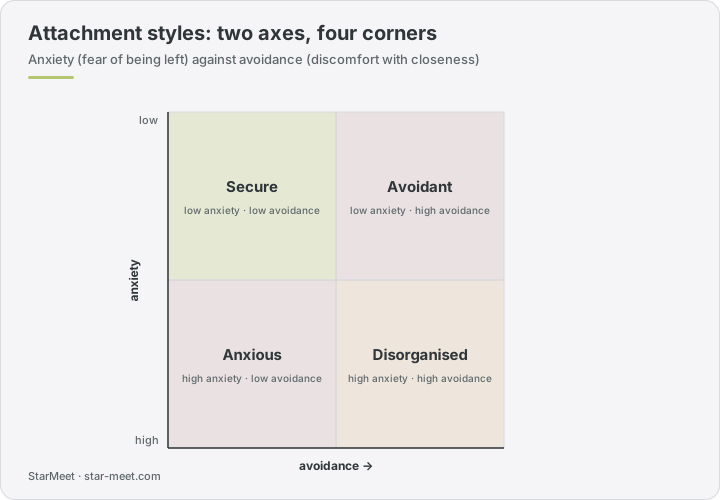
An anxious attachment style is an insecure attachment pattern characterized by an intense fear of rejection, chronic relationship anxiety, and an urgent need for constant closeness. Developed in John Bowlby's Attachment Theory and expanded by Dr. Mary Ainsworth, this pattern forms when early caregivers provide inconsistent affection, leading the developing brain to believe that love is unstable and must be actively monitored.
| ATTACHMENT STYLES COMPARISON | |
|---|---|
| Attachment Pattern | Primary Emotional Mechanism |
| Anxious Preoccupied Fearful Avoidant Dismissive Avoidant Secure | Hyper-activation, proximity-seeking Craving intimacy while fearing hurt Emotional deactivation, hyper-autonomy Self-soothing, collaborative repair |
People with an anxious preoccupied attachment style rely on hyper-activating strategies. They maintain hyper-vigilance over their partner's moods, facial expressions, and texting rhythms.
Common behavioral indicators include:
-
Compulsive reassurance-seeking: Repeatedly asking "Are we okay?" or "Do you still love me?"
-
Protest behavior: Calling repeatedly, sending walls of text, or attempting to induce jealousy to test a partner's devotion.
-
Catastrophic mental loops: Assuming delayed communication equates to abandonment or betrayal.
-
Loss of personal boundaries: Neglecting personal goals, friendships, and hobbies to remain entirely available for a loved one.
When an anxious attacher pairs with an avoidant partner, an escalating cycle forms. The anxious partner pursues reassurance, the avoidant partner feels suffocated and withdraws, and the resulting silence sends the anxious nervous system into a full-scale panic response.
Fearful avoidant attachment and the anxious avoidant trap
Fearful avoidant attachment (also known as disorganized attachment) is an insecure attachment style where a person experiences high anxiety and high avoidance simultaneously. Coined by researchers Mary Main and Judith Solomon, this adaptation occurs when primary attachment figures are a source of comfort and fear.
Individuals with this style crave deep intimacy but perceive close connection as inherently dangerous.
In an anxious relationship, a fearful avoidant oscillates between desperate proximity-seeking and abrupt emotional withdrawal. When they feel vulnerable, their defense mechanisms engage, causing them to push their partner away before they can be rejected.
This dynamic creates unpredictable turmoil:
When two insecure attachment styles collide, each partner's defense mechanisms trigger the other. The anxious partner's demands validate the avoidant partner's belief that intimacy is draining.
Simultaneously, the avoidant partner's emotional shutdown reinforces the anxious partner's core belief that people always leave. Breaking this cycle requires identifying these systemic patterns rather than blaming individual character traits.
Clingy in relationships: how to stop emotional hyper-activation
Being clingy in relationships is a visible manifestation of nervous system hyper-activation seeking to restore a lost sense of safety. When your internal equilibrium depends entirely on your partner's attention, any micro-shift in their presence drops your emotional reserves to zero.
Suppressing these behaviors through sheer willpower rarely works because the underlying attachment panic remains unaddressed.
To calm chronic emotional hyper-activation, implement structured behavioral micro-interventions:
-
The 20-Minute Autonomic Reset: When panic spikes, step away from your phone and engage in bilateral stimulation (such as alternating footsteps or tapping) and physiological sighs (two quick inhales through the nose, one long exhale through the mouth) to lower amygdala arousal.
-
Cognitive Re-framing (CBT Protocol): Write down the catastrophic thought ("They haven't texted, so they are bored of me") and counter it with three objective alternative explanations ("They are in a meeting," "Their battery died," "They need quiet focus").
-
De-escalation of Protest Communication: Establish a mandatory 30-minute cooling-off rule before sending emotionally charged messages or demanding relationship check-ins.
-
Autonomous Identity Rebuilding: Re-invest daily energy into creative, physical, or professional pursuits completely outside of the romantic dynamic.
The Astrological Blueprint: Natal Charts, Saturn Transits, and the 12th House
While psychology outlines your behavioral adaptations, modern Western psycho-astrology provides the architectural blueprint of your core vulnerabilities. Your natal chart highlights the specific energetic configurations where fear, suppression, and hyper-vigilance concentrate.
| ASTROLOGICAL ARCHITECTURE OF INSECURITY | |
|---|---|
| Astrological Placement | Psychological Manifestation |
| 12th House Placements Saturn Transits Moon-Pluto Squares Venus-Saturn Oppositions | Unconscious Shadow projections Core abandonment tests, reality checks Compulsive jealousy, betrayal paranoia Chronic feelings of unworthiness |
1. Planetary Transits of Saturn
In psycho-astrology, Saturn represents structural testing, boundaries, and foundational fears. When transiting Saturn forms hard aspects (squares or oppositions) to your natal Venus (relating style) or natal Moon (emotional security), deep-seated feelings of inadequacy surface. You may feel unloved, neglected, or terrified of being cast aside. These transits do not indicate a doomed connection; they demand that you construct internal emotional self-reliance.
2. The 12th House: The Realm of the Unconscious Shadow
The 12th House governs hidden fears, psychological blind spots, and the Jungian Shadow. Planets residing in or transiting through your 12th house reveal qualities you disown in yourself and project onto your partner. If your natal Moon or Mars sits in the 12th house, unexpressed emotional needs turn inward, manifesting as irrational suspicions, paranoia, and latent resentment.
3. Planetary Squares and Oppositions
Tense aspects between personal planets create perpetual internal friction:
-
Moon square Pluto: Generates an all-or-nothing emotional intensity, driving obsessions with betrayal and emotional control.
-
Venus opposite Saturn: Cultivates a core belief that love is conditional, transactional, or destined to end in rejection.
Viewing these placements as diagnostic blueprints rather than static fatalism shows you where your attachment system is most fragile.
Why Common Workarounds Keep You Stuck
When jealousy strikes, most people resort to low-impact coping mechanisms that fail to address the core problem:
-
❌ Suppressing your emotions: Forcing yourself to "just be chill" bottles up attachment panic until it erupts in explosive accusations.
-
❌ Reading generic self-help books: Gathering intellectual knowledge without somatic regulation leaves your nervous system unprepared when a trigger occurs.
-
❌ Fatalistic astrological consultations: Traditional readings that claim "Your chart says you are destined for turbulent love" strip away your agency and offer no therapeutic resolution.
-
❌ Buying healing crystals or affirmations: Relying on passive rituals without confronting cognitive distortions or attachment styles yields zero long-term change.
These superficial workarounds drain your mental energy while leaving your attachment wounds active. Real transformation demands an integrated approach: identifying your cosmic blueprint and applying targeted psychological protocols to heal it.
How to heal anxious attachment with clinical protocols
Healing an anxious attachment style requires re-wiring the nervous system's response to perceived abandonment using validated clinical protocols. Research in Psychology Today and clinical attachment studies confirms that an insecure attachment style can transition into an "earned secure" attachment through consistent therapeutic work.
THE CLINICAL RE-WIRING FRAMEWORK [Step 1: Somatic De-escalation] ──► Regulate autonomic nervous system [Step 2: Schema Therapy] ──► Identify core abandonment schemas [Step 3: EFT Cycle Disruption] ──► Express primary fears over protest anger [Step 4: Earned Security] ──► Establish internalized self-validation
Key evidence-based frameworks include:
1. Emotion-Focused Therapy (EFT) Cycle De-escalation
Developed by Dr. Sue Johnson, EFT focuses on recognizing the negative interaction loop between partners. Instead of expressing secondary reactive emotions (anger, blame, interrogation), the individual learns to identify and voice primary vulnerable emotions ("I am scared of losing you," "I feel disconnected"). This shifts conversations from hostile standoffs to cooperative repair.
2. Schema Therapy and Abandonment Triggers
Formulated by Dr. Jeffrey Young, Schema Therapy targets early maladaptive schemas. Anxious attachers frequently operate under an Abandonment/Instability Schema—an implicit expectation that significant others are unreliable. Identifying the origins of this schema enables clients to reparent their inner child and separate past trauma from current reality.
3. Cognitive Behavioral Therapy (CBT) for Cognitive Distortions
CBT systematically dismantles the cognitive distortions feeding jealousy:
-
Mind Reading: Assuming you know your partner is bored or deceitful without evidence.
-
Catastrophizing: Treating a missed call as definitive proof of infidelity.
-
Emotional Reasoning: Believing that because you feel insecure, your partner must be acting untrustworthy.
Self-Tests and Next Steps
Evaluating your psychological and energetic patterns is the first step toward lasting security:
-
Attachment Style Self-Tests: Clinically validated assessments (such as the Experiences in Close Relationships-Revised scale) quantify your levels of attachment anxiety and attachment avoidance.
-
The Shadow Trigger Index: Identifies repressed emotional projections in your relational life.
-
Natal Chart Diagnostic Audits: Pinpoint Saturn transits, 12th house activations, and personal planet squares to reveal where your attachment style encounters cosmic friction.
Rather than navigating isolated self-tests, a treatment center, or a fragmented therapist find process on a directory, modern solutions provide integrated guidance tailored to your specific behavioral patterns.
Frequently Asked Questions
What is an anxious attachment style?
An anxious attachment style is an insecure attachment pattern rooted in a profound fear of abandonment and rejection. Individuals with this style often require constant validation, maintain high vigilance regarding their partner's availability, and struggle to regulate their emotions when feeling disconnected.
How do I know if I have an insecure attachment style?
Signs of an insecure attachment style include persistent relationship anxiety, chronic jealousy, difficulty trusting your partner's intentions, alternating between clinginess and emotional withdrawal, and relying on external reassurance to feel secure.
Can an anxious relationship become healthy and secure?
Yes. An anxious relationship can transition to a secure one if both partners learn to identify their attachment triggers, replace protest behaviors with direct emotional communication, and utilize evidence-based protocols like Emotion-Focused Therapy (EFT).
Why do I experience intense jealousy even when my partner gives no reason to worry?
This occurs because jealousy is frequently driven by internal attachment wounds, low self-esteem, or past relational trauma rather than current realities. Your amygdala misinterprets harmless events as urgent threats based on prior experiences of instability.
How does a fear of abandonment test work?
A fear of abandonment test evaluates your reactions to emotional distance, perceived rejection, and boundary-setting. It measures the intensity of your abandonment schemas to help you understand your emotional triggers and relational patterns.
Transform Your Relational Patterns with StarMeet
Traditional astrology tells you what is happening in your chart but leaves you without actionable tools to fix it. Standard therapy provides clinical coping strategies but often overlooks your unique energetic and psychological blueprint.
StarMeet combines both worlds into a unified AI-driven platform for self-discovery and therapy.
Powered by the Gemini 3.8 Flash engine (with the option to switch to Gemini 3.1 Pro for advanced reasoning), StarMeet integrates:
-
Over 40 validated clinical psychological tests (Attachment Styles, Schema Modes, Jungian Archetypes, PHQ-9, GAD-7, and the Shadow Trigger Index).
-
More than 20 evidence-based clinical protocols (including CBT, Schema Therapy, and EFT Cycle De-escalation).
-
Comprehensive Western psycho-astrological analysis covering your Natal Chart, planetary houses, and current Saturn transits.
Our Unique Asset: You never have to guess which psychological program or astrological reading you need. You simply describe your emotional reality in your own words in a private, confidential chat. StarMeet analyzes your psychological state alongside your natal chart blueprint, automatically matches your situation to the appropriate evidence-based protocol, and guides you through a structured, staged course of 6–8 sessions—going one layer deeper each session to resolve the root cause of your jealousy.
Recognizing jealousy as an alarm signal helps, but working through the underlying fear is what keeps it from running your life.
Take 40+ scientifically validated tests immediately, completely free with zero signup required.
You do not have to know which psychological modality you need. Just explain what you are feeling in the chat. The AI guide selects the matching evidence-based protocol from CBT, schema therapy, IFS parts work, Gestalt, ACT, EFT, Jungian analysis, or logotherapy. It walks you through a structured 6–8 session path, moving one layer deeper with every conversation.
Your sessions are entirely confidential and free to start.
🎁 SPECIAL OFFER: Your First Month of Premium for $1. 🔒 100% Safe: Cancel in 1 click, anytime.
Ready to quiet relationship fear and regain your peace of mind? 👇 Start Your Free AI Therapy Session
About the author
Vadim Arkhipov
Founder of StarMeet. Student of Jyotish since 2013, having completed an advanced course under Dr. K.N. Rao; 30+ years in business. Articles here are written to my brief, drafted with AI assistance and edited by me before publishing.
Profile, expertise and all articles →Related Articles
Anxious Attachment Style: Signs, Causes, and What Actually Helps
Discover the signs and root causes of an anxious attachment style, understand the underlying nervous system activation, and learn proven paths to earned security.
PsychologyThe Anxious–Avoidant Trap: Why the Push–Pull Cycle Repeats
Discover why anxious and avoidant partners magnetically attract, map the step-by-step pursuer-distancer cycle, and learn how to break the trap using EFT and Gottman methods.
PsychologyHow to Heal Anxious Attachment: Self-Soothing That Actually Works
Learn actionable, somatic self-soothing techniques to heal anxious attachment, stop reassurance seeking, and transition to earned secure attachment.
Psychology